
Low-friction prevention is the idea that the best health habit isn’t the most optimized one, it’s the one you’ll still be doing in March. Google Trends flagged this shift as a top wellness trend for 2026, and it makes sense. After years of 5 a.m. routines, 14-supplement stacks, and wearable dashboards, many of us are tired. Around 44% of people now say they’re focusing on foundations: quality sleep, regular movement, hydration, and nutrition. The science backs them up. Consistent, simple healthy habits that stick do more for long-term health than a perfect plan you drop after nine days. This guide shows how habits really form, why friction quietly wrecks them, and a “minimum effective dose” for each of the four foundations.
Related: HealthMorph wellness guides
What Is Low-Friction Prevention?
Prevention means acting before something goes wrong: protecting your sleep before burnout, building fitness before a health scare, eating well before blood sugar becomes a problem. Crisis care is what happens after.
Friction is anything that makes a good behavior harder to start: a 25-minute drive to the gym, a recipe with 14 ingredients, a bedtime routine with seven steps. Low-friction prevention means shrinking those barriers until the healthy choice is the easy one.
It’s not about doing less because you’re lazy. It’s about doing the right small things reliably, which is where the results come from. If you want a broader overview of everyday wellness, our Health and Wellness category is a good place to browse.
Why Complicated Health Plans Fail
Most of us have been here. You read about cold plunges, sleep tracking, intermittent fasting, and a new supplement all in one weekend and decide to start everything on Monday. By Thursday you’ve missed two things, felt guilty, and quietly dropped the whole thing.
That’s not a personality flaw. It’s predictable behavior science:
- Willpower is limited and unreliable. It dips when you’re tired, stressed, or hungry, which is exactly when healthy choices are hardest.
- Complexity multiplies failure points. Each added step is another chance to skip.
- All-or-nothing thinking turns one miss into a collapse. “I blew it, so why bother?”
- Optimization culture raises the bar until normal, good-enough habits feel pointless.
The fix isn’t more discipline. It’s a simpler design.
The Science of Habit Formation
A few findings are worth knowing, because they change how you plan.
1. Habits take longer than 21 days. A widely cited study from University College London (Lally and colleagues, 2010) followed people building a new daily behavior. The average time to feel automatic was about 66 days, but the range was huge, from 18 to 254 days. Simple behaviors, like drinking a glass of water, became automatic faster than complex ones, like exercise.
2. Missing a day doesn’t ruin it. In that same research, a single missed day didn’t derail habit formation. What matters is getting back on track, not perfection.
3. Cues beat motivation. Habits attach to cues: a time, a place, or a preceding action. Behavior scientists call a specific plan, “when X happens, I’ll do Y,” an implementation intention, and research on them shows a meaningful boost in follow-through compared with vague goals.
4. Starting small works. Tiny versions of a habit (two push-ups, one glass of water) reduce the effort it takes to begin, and once you’ve started, you often continue. The goal early on is repetition, not results.
5. Your environment shapes your choices. Researchers call this choice architecture: the way options are laid out nudges what people do, usually without them noticing. You don’t need more self-control if you redesign the setting.
Why Friction Kills Consistency
Think of friction as a tax on every action. A small tax is easy to pay once. Paid every day, it adds up until you stop.
Common sources of friction:
| Friction | Low-friction fix |
|---|---|
| Gym is far away | Walk, or use a 10-minute home routine |
| Fruit is in the back of the fridge | Put it on the counter at eye level |
| Phone is on the nightstand | Charge it across the room |
| Water bottle is in a cupboard | Keep one filled at your desk |
| Complex meal prep | Two or three repeatable “default meals” |
| Needing the “perfect” time | Attach the habit to something you already do |
And the reverse is true: add friction to what you want less of. Moving snacks to a high shelf or logging out of an app adds just enough delay to make you pause.

Practical Strategies to Make Healthy Choices Easier
Stack it onto something you already do
Habit stacking links a new habit to an existing one: “After I brew my morning chai, I’ll drink a glass of water.” The old habit becomes the cue.
Make it tiny first
Aim for a version so small you can’t say no: one minute of stretching, a five-minute walk, one extra vegetable at dinner. You can scale up later.
Set defaults
Defaults decide a lot. Pre-fill a bottle of water, keep a go-to healthy snack at work, set an automatic bedtime alarm, lay out walking shoes by the door.
Plan for the bad day
Write a fallback: “If I can’t do 30 minutes, I’ll do 5.” A tiny backup keeps the streak alive and your identity intact.
Track lightly
A calendar tick or a simple note works. Complicated tracking apps can become another source of friction.
Use the “never miss twice” rule
One skipped day is normal. Two in a row is the start of a new pattern, so make the second day the one you protect.
For more routines you can fold into real life, browse our Lifestyle & Habits articles.
The Minimum Effective Dose Framework
“Minimum effective dose” means the smallest amount that still produces a meaningful benefit. It’s a floor, not a ceiling. Once the floor is easy, you can build up.
1. Sleep
Minimum effective dose: a consistent wake-up time, plus about 7 hours in bed for most adults.
Major sleep societies recommend at least 7 hours for adults. But regularity matters nearly as much as duration, and it’s easier to control.
Low-friction moves:
- Pick one wake-up time and keep it within an hour, even on weekends
- Get outdoor light within an hour of waking
- Set a “caffeine curfew” at least 8 hours before bed, since research shows caffeine six hours before bedtime can still cut sleep
- Dim lights and put the phone down 30 minutes before bed
You don’t need a 10-step routine. One or two of these is enough to start.
2. Movement
Minimum effective dose: a daily brisk walk of roughly 10 to 20 minutes, plus some strength work twice a week.
The World Health Organization recommends 150 to 300 minutes of moderate activity a week, but the benefits start well below that. Research on step counts suggests risk of early death drops noticeably as people move from very low activity to around 4,000 steps a day, with benefits continuing to rise up to about 7,000 to 8,000. A 2023 analysis from the University of Cambridge found that even around 11 minutes a day of brisk activity was linked to meaningfully lower risk of early death compared with doing none.
Low-friction moves:
- Walk after meals (it also helps blood sugar)
- Take calls on foot
- Keep a resistance band or two dumbbells at home
- Use stairs when you can
- Do a 5-minute “starter” session on busy days
3. Hydration
Minimum effective dose: a glass of water on waking, one with each meal, and drink to thirst the rest of the day.
Fluid needs vary by body size, weather, activity, and diet, and food provides roughly 20% of intake. U.S. National Academies guidance puts total water at about 2.7 liters for women and 3.7 liters for men, including water from food and other drinks. You don’t have to count every sip. Your urine color, pale yellow, is a decent guide. In hot climates or when exercising, you’ll need more.
Low-friction moves:
- Keep a bottle where you work
- Pair water with existing cues, like meals and meds
- Add lemon, mint, or cucumber if plain water bores you
4. Nutrition
Minimum effective dose: a source of protein at each meal, plus vegetables or fruit with most meals.
You don’t need a perfect diet. The biggest wins for most people come from adding good things, not just cutting bad ones. Protein helps with fullness and muscle maintenance. Fiber from vegetables, fruit, legumes, and whole grains supports gut health and steady energy, and most adults eat too little of it. The WHO suggests at least 400 grams of fruit and vegetables daily.
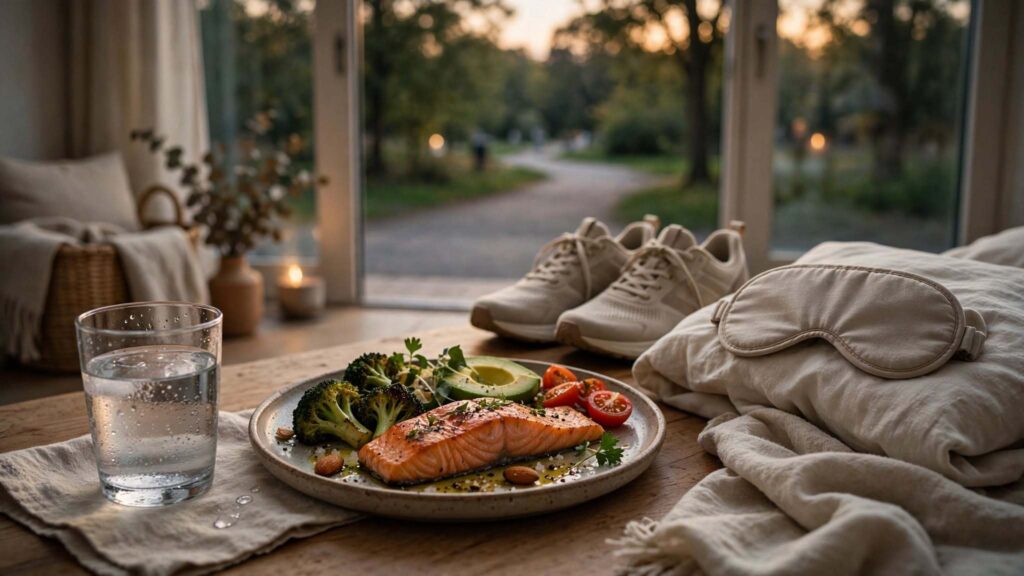
Low-friction moves:
- Build 2 or 3 “default meals” you can make without thinking
- Keep ready-to-eat options at hand: fruit, curd, roasted chana, boiled eggs, nuts
- Add one vegetable to the meal you already eat
- Batch-cook staples like dal or sprouts once a week
- Don’t overlook basics like iron if you often feel tired. See our guide on how to increase hemoglobin naturally, and check your levels before supplementing.
More everyday eating ideas live in our Nutrition & Diet category.
A Sample “Low-Friction Day”
| Time | Habit | Cue | Time cost |
|---|---|---|---|
| Wake up | Glass of water, daylight | Getting out of bed | 2 min |
| Breakfast | Protein plus fruit | Existing breakfast | 0 extra |
| Midday | 10-minute walk | After lunch | 10 min |
| Afternoon | Refill water bottle | Desk routine | 1 min |
| Dinner | Add a vegetable | Existing dinner | 3 min |
| Night | Phone away, lights dim | Brushing teeth | 2 min |
That’s under 20 extra minutes, and it covers all four foundations.
How to Start This Week
- Choose one habit, not four.
- Shrink it until it takes under two minutes.
- Pick a cue, like “after I pour my coffee.”
- Remove one source of friction from your environment.
- Write a fallback for busy days.
- Review in two weeks, then add the next one.
Slow beats perfect. A habit you can do on your worst day is the one that survives.
When Low-Friction Isn’t Enough
Simple habits are a foundation, not a replacement for medical care. See a doctor if you have:
- Persistent fatigue, unexplained weight changes, or poor sleep that doesn’t improve
- Symptoms such as chest pain, breathlessness, or dizziness
- A family history of diabetes, heart disease, or other chronic conditions
- A need for age-appropriate screenings like blood pressure, blood sugar, cholesterol, and cancer checks
Prevention includes the boring stuff, like routine check-ups and screening tests, and those are about as low-friction as health gets once they’re booked.
Frequently Asked Questions
1. What is low-friction prevention?
It’s a approach to health that focuses on making preventive habits so easy to do that you actually keep doing them. It reduces barriers, like time, effort, and complexity, instead of relying on motivation.
2. How long does it take to form a healthy habit?
Research from University College London found an average of about 66 days, with a range of 18 to 254. Simple habits usually form faster than complex ones.
3. What if I miss a day?
Nothing is lost. Studies suggest a single missed day doesn’t derail habit formation. Aim to never miss twice in a row.
4. What is the minimum amount of exercise to stay healthy?
Official guidelines suggest 150 minutes of moderate activity weekly, but research shows meaningful benefits at much lower amounts, such as a daily 10 to 20 minute brisk walk. Something is better than nothing, and more is generally better up to a point.
5. How many hours of sleep do I really need?
Most adults need at least 7 hours. Consistency in bedtime and wake time matters too, so protect your wake-up time first.
6. How much water should I drink a day?
It depends on your size, climate, and activity. Total intake guidelines are around 2.7 liters for women and 3.7 for men, including food. Drinking to thirst and checking for pale-yellow urine works for most healthy people.
7. What is a “minimum effective dose” in health?
It’s the smallest amount of a habit that still gives a real benefit. It lets you build consistency first and increase effort later.
8. How do I stay consistent when I’m busy or stressed?
Shrink the habit, attach it to an existing routine, and prepare a fallback version. A five-minute walk counts.
9. Is low-friction prevention the same as doing the bare minimum?
No. The minimum is a floor, not a limit. Starting small makes it easier to keep going, and many people naturally do more once the habit feels automatic.
10. Can simple habits really prevent chronic disease?
They lower risk, but they don’t guarantee prevention. Sleep, activity, nutrition, and hydration influence heart disease, diabetes, and mental health. Genetics, environment, and medical care matter too, so combine habits with regular check-ups.
The Bottom Line
You don’t need an elaborate protocol to look after your health. You need a few simple habits, set up so well that they hardly feel like effort. Start with one, shrink it, tie it to something you already do, and make the healthy choice the easy one. That’s low-friction prevention, and it’s quietly one of the most powerful ways to protect your health for the long run. Want more practical ideas? Explore the rest of HealthMorph.
Medical disclaimer: This article is for education and isn’t medical advice. Consult a qualified healthcare professional before making major changes to your diet, exercise, or sleep, especially if you have a medical condition.







Leave a Reply