A few years ago, the idea of stirring a mushroom into your morning cup would have gotten a laugh. Now mushroom coffee sits next to the regular beans in half the supermarkets I walk into, and every label promises sharper focus, calmer energy, and a healthier brain. So here’s the question I keep getting: are the mushroom coffee benefits real, or is this just expensive coffee with a good story? The short answer is that lion’s mane has some genuinely interesting research behind it, but most of that research doesn’t match what’s in your cup. In this guide I’ll walk through what the studies found, what a typical serving contains, the side effects worth knowing about, and how to decide if it’s worth your money.
Related: Natural Remedies & Ayurveda on HealthMorph
What Is Mushroom Coffee?
Mushroom coffee is regular coffee blended with powdered extracts of “functional” mushrooms. It doesn’t taste like mushrooms, which surprises most people. The most common additions are:
- Lion’s mane (Hericium erinaceus), for focus and memory
- Chaga, for antioxidants and “immune support”
- Reishi, for calm and sleep
- Cordyceps, for energy and stamina
These mushrooms have a long history in traditional Chinese and Japanese medicine, which is worth respecting. But traditional use isn’t clinical proof, and a mushroom stirred into coffee is a very different thing from a studied extract taken as a capsule or a meal.
Lion’s Mane: What It Is and How It Might Work
Lion’s mane is a shaggy white edible mushroom, sometimes called “monkey head” or yamabushitake. Researchers got interested because it contains two groups of compounds:
- Hericenones, found mostly in the fruiting body (the part you’d cook and eat)
- Erinacines, found mostly in the mycelium (the root-like network)
In lab and animal studies, both groups have been shown to stimulate nerve growth factor (NGF), a protein that helps neurons grow and survive. That’s the exciting part, and it’s where the marketing starts. A compound that boosts NGF in a petri dish or in a mouse is not the same as a supplement that improves memory in a person. Many promising lab findings never translate.
Lion’s mane also contains beta-glucans, a type of fiber, which is the basis for its immune and gut claims.
Does Lion’s Mane Actually Work? The Human Evidence
I want to be fair to both sides here, because the honest picture is “interesting, but early.”
What the better-known studies found
- Older adults with mild cognitive impairment. The study that gets cited most is a small Japanese trial from 2009 (Mori and colleagues). People aged 50 to 80 took 3 grams a day of lion’s mane for 16 weeks, and their cognitive scores improved compared with placebo. When they stopped, the benefit faded within a month. It was a small trial of about 30 people, and it’s still the foundation for a lot of the hype.
- Mood. A small trial in women (Nagano and colleagues, 2010) used lion’s mane cookies for four weeks and reported lower scores for depression and anxiety. Again, small and short.
- Healthy young adults. A more recent randomized trial of 41 adults aged 18 to 45 found that a single dose may have modestly improved how fast people did a stress task about an hour later, but four weeks of daily use did not improve mood or memory over placebo.
What the reviews say
A 2025 systematic review identified five randomized controlled trials alongside laboratory studies, pilot trials, and other designs, which gives you a sense of how thin the human data still is. Another review of three Japanese double-blind trials concluded that lion’s mane appeared useful for cognitive impairment symptoms but not for depression or anxiety, and that studies need to run at least 12 weeks. An independent summary from the Alzheimer’s Drug Discovery Foundation similarly described mixed cognitive effects across a few small, short trials, and called for larger and longer studies. pmc.ncbi.nlm.nih.gov +2
My read: there’s a plausible signal for older adults with mild memory decline, a weak and inconsistent signal for mood, and almost nothing proving a benefit for healthy people looking for sharper focus. Lion’s mane is not a proven treatment for Alzheimer’s, depression, or anxiety, and it shouldn’t replace medical care for any of them.
The Problem Nobody Mentions: The Dose in Your Cup
This is where mushroom coffee often falls short, and it’s the part I’d want any reader to understand before spending money.
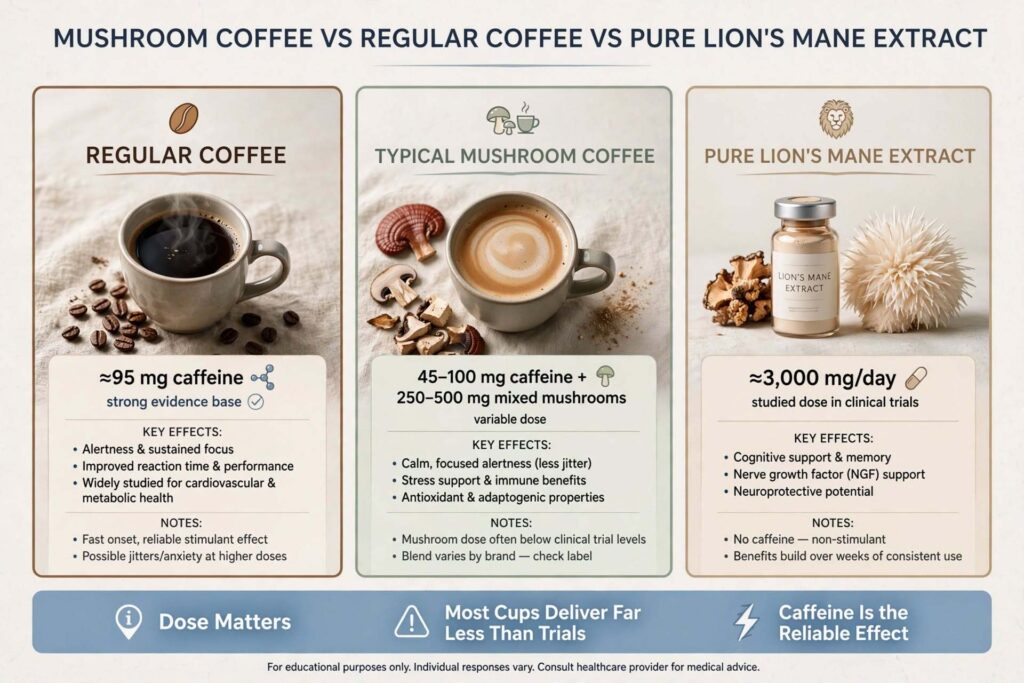
The 2009 trial used 3,000 mg a day. By comparison, most mushroom coffee brands deliver only about 250 to 500 mg of total mushroom content per serving, and that’s often split between two or more mushrooms. One analysis of the category notes that most servings deliver substantially less than the studied dose. yourhealthiersuperpower
So when a label says “500 mg of lion’s mane and chaga,” you may be getting a fraction of what any study tested, with no evidence that the lower dose does anything. That doesn’t mean it’s useless, but it does mean you shouldn’t assume the trial results apply to your morning cup.
Fruiting body vs mycelium on grain
This is a quality issue worth knowing about:
- Fruiting body extracts use the actual mushroom and tend to carry more beta-glucans and hericenones.
- Mycelium-on-grain products are grown on a grain base, and the final powder can contain a large share of leftover starch. Analyses of these products have found lower beta-glucan and higher starch content.
- One honest caveat: erinacines are concentrated in the mycelium, and some of the studies showing neuroprotective effects used mycelium-based extracts. So some brands argue mycelium contains compounds not found in fruiting bodies, and that’s scientifically accurate. It means there’s no simple “fruiting body good, mycelium bad” rule. What matters is knowing which one you’re buying and whether the label tells you. yourhealthier
Caffeine: The Part That Probably Does the Most Work
Here’s the thing most reviews gloss over: much of how you feel after mushroom coffee is plain caffeine. Typical servings contain roughly 50 to 100 mg of caffeine, about half a standard cup of drip coffee, though products vary widely, from around 45 mg to well over 100 mg, and some labels and third-party listings even disagree on the same brand. Check the label rather than trusting a brand reputation. superpower
That can genuinely feel smoother for some people. If you’re someone who gets jittery on a full cup, a half-strength cup may help, and that’s a legitimate benefit. But you can get the same result by drinking half a cup of regular coffee or switching to a half-caf blend, for a lot less money. For more on how your own genes affect caffeine tolerance, see our guide to DNA-based nutrition.
Mushroom Coffee vs Regular Coffee
| Regular coffee | Mushroom coffee | |
|---|---|---|
| Caffeine | Around 95 mg per 8 oz cup (varies a lot) | Often 45 to 100+ mg, depends on the brand |
| Proven benefits | Strong evidence: alertness, linked to lower risk of some diseases | Mostly from the coffee itself; mushroom benefits unproven at typical doses |
| Mushroom dose | None | Usually 250 to 500 mg total, often far below study doses |
| Cost per cup | Low | Often several times higher |
| Side effect profile | Well understood | Less studied |
Regular coffee, to be clear, has a long record of observational research linking moderate intake to a lower risk of several conditions, including type 2 diabetes and some liver diseases. See liver health beyond detox for that angle. Mushroom coffee doesn’t have a comparable body of evidence behind it.
What About the Other Mushrooms?
- Chaga: It’s rich in antioxidants in the lab, but human evidence is minimal. It’s also very high in oxalates, and there are case reports of kidney damage from heavy, long-term use. People with kidney stones or kidney disease should skip it.
- Reishi: Traditionally used for calm and sleep. Human data are limited, and there are rare reports of liver problems with some products.
- Cordyceps: Popular for stamina, but the evidence in humans is small and inconsistent.
- Turkey tail: Studied mostly in people with cancer under medical supervision, which is a very different context from a coffee blend.
Side Effects and Safety
For most healthy adults, lion’s mane appears to be well tolerated. The same systematic reviews describe side effects as rare and generally mild, such as stomach discomfort. One review noted adverse effects were limited and usually mild gastrointestinal discomfort, though in one study a share of participants dropped out because of side effects. Still, there are real caveats. nih
Be careful or talk to a doctor first if you:
- Are pregnant or breastfeeding. There isn’t enough safety data. Caffeine limits also apply (health bodies commonly advise keeping it under about 200 mg a day in pregnancy).
- Have a mushroom allergy or asthma. Allergic reactions, including skin and breathing symptoms, are possible.
- Take blood thinners or have a bleeding disorder. Lion’s mane has shown antiplatelet activity in lab studies, so a theoretical interaction exists.
- Take diabetes medicine. Some mushrooms may lower blood sugar.
- Have kidney problems or a history of kidney stones. Particularly relevant for chaga.
- Are on immunosuppressants or have an autoimmune condition. Beta-glucans may stimulate the immune system.
- Have anxiety, palpitations, reflux, or sleep problems. Caffeine is still caffeine.
- Have surgery coming up. Many doctors suggest pausing supplements for around two weeks beforehand.
Stop and seek help if you notice a rash, swelling, breathing difficulty, yellowing skin or eyes, dark urine, or severe stomach pain.
Remember, too, that supplements aren’t tested for effectiveness before sale in most countries, and quality varies. Independent testing has found products that don’t match the label.
Is Mushroom Coffee Worth It?
It might be worth trying if you:
- Want a gentler caffeine dose
- Enjoy the taste and ritual
- Understand it’s a pleasant beverage with unproven extras
- Can afford it without cutting corners elsewhere
You can probably skip it if you:
- Expect it to treat memory loss, anxiety, or depression
- Are on a tight budget (a standalone lion’s mane supplement with a disclosed dose may give you more mushroom for the money)
- Are pregnant, on blood thinners, or managing kidney disease without medical advice
- Haven’t covered the basics: sleep, movement, nutrition, and stress
If focus or mood is the real issue, start with the foundations. Our piece on low-friction prevention shows how sleep, movement, and food usually matter more than any supplement. And if you’re curious about other herbs in this space, see shatavari and adaptogens beyond ashwagandha.
How to Choose a Mushroom Coffee (If You Decide to Buy One)
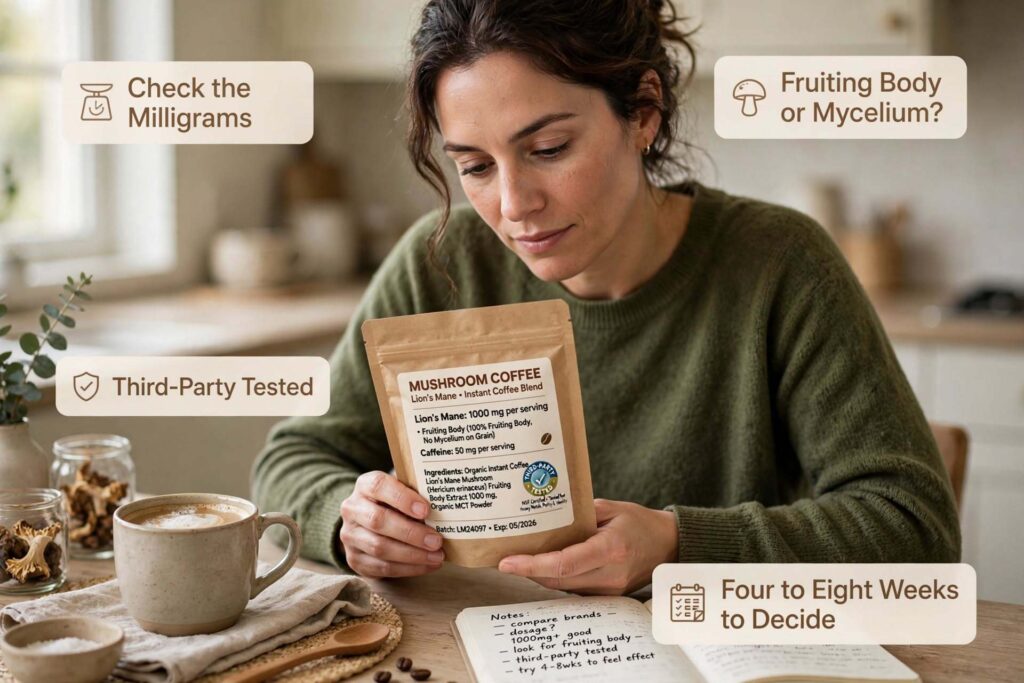
- Look for per-mushroom amounts in milligrams, not a “proprietary blend” with one total number.
- Check whether it’s fruiting body extract, mycelium, or a mix, and be wary of labels that don’t say.
- Read the caffeine content. Don’t assume it’s low.
- Look for third-party testing and a certificate of analysis for contaminants.
- Check for extras, like added sugar, creamers, or other supplements.
- Compare cost per serving against what you’d get from a standalone extract.
- Try it for a fair window, say four to eight weeks, and note any changes in focus, sleep, or digestion. If you can’t tell a difference, stop paying for it.
Frequently Asked Questions
1. What are the benefits of mushroom coffee?
The most reliable effects come from the caffeine. Lion’s mane has early research suggesting possible cognitive benefits, mainly in older adults with mild memory decline, but most mushroom coffees contain far less mushroom than the studies used.
2. Does lion’s mane improve memory?
Possibly, in older adults with mild cognitive impairment, based on a few small trials. Evidence in healthy younger adults is weak. It isn’t a proven treatment for dementia or Alzheimer’s.
3. How much caffeine is in mushroom coffee?
It varies, often from about 45 to 100 mg or more per serving, compared with roughly 95 mg in a standard cup of coffee. Always check the label.
4. Is mushroom coffee better than regular coffee?
Not proven. It may be gentler if it has less caffeine, but regular coffee has a much larger body of research behind it and costs less.
5. Does mushroom coffee help with anxiety or depression?
There’s no solid evidence that it does. Small studies on lion’s mane and mood are mixed. If you have anxiety or low mood, speak to a doctor or mental health professional.
6. What are the side effects of mushroom coffee?
Usually mild: stomach upset, bloating, or the usual effects of caffeine. Allergic reactions are possible, and some mushrooms, like chaga, carry specific risks.
7. Who should avoid mushroom coffee?
People who are pregnant or breastfeeding, have mushroom allergies, take blood thinners or diabetes medicine, have kidney disease or stones, or are on immunosuppressants should check with a doctor first.
8. What is the difference between fruiting body and mycelium?
Fruiting body is the mushroom itself, richer in beta-glucans and hericenones. Mycelium is the root-like network, often grown on grain, which can dilute the product but contains erinacines. Neither is automatically better, but labels should say which one is used.
9. How long does lion’s mane take to work?
Studies suggesting benefits ran for 12 to 16 weeks or longer, and effects faded after stopping. Don’t expect changes in a few days.
10. Can I take lion’s mane every day?
It appears well tolerated in studies lasting weeks to months, but long-term safety data are limited. Check with your doctor if you take medication or have a health condition.
The Bottom Line
Mushroom coffee benefits are real in one sense: a smoother, often lower-caffeine cup can be a nice upgrade for some people. The brain-boosting claims are another matter. Lion’s mane has intriguing early research, but the doses in most coffee blends are well below what studies used, and the human evidence is still small and mixed. If you like it, enjoy it, and buy it with your eyes open. If you want to test lion’s mane properly, a labeled extract with a disclosed dose is a fairer experiment, and a conversation with your doctor comes first if you have health conditions or take medicines. For more practical, evidence-minded guides, explore HealthMorph.
Medical disclaimer: This article is for education and isn’t medical advice. Consult a qualified healthcare professional before starting any supplement, especially if you are pregnant, breastfeeding, have a medical condition, or take prescription medicines.







Leave a Reply