Somewhere around the time “longevity” became a product category, mitochondria stopped being a high-school biology answer and became a sales pitch. You’ve probably seen it: a sleek tub of powder, a promise of “cellular energy,” and a graph that goes up and to the right. The molecules at the center of it are NAD+ precursors, mainly NMN and nicotinamide riboside (NR), and the idea behind them is actually reasonable. The trouble is the distance between a reasonable idea and a result you can feel. This piece walks through what mitochondria and NAD+ really do, what human trials of these supplements have found so far, which everyday habits have far better evidence, and who should think twice before buying anything.
Related: HealthMorph wellness guides
First, what your mitochondria actually do
Most of us learned one fact about mitochondria and it’s true: they make energy. Inside nearly every cell, they burn the fuel from your food with oxygen and turn it into ATP, the molecule your cells spend like cash. Hearts, brains, and muscles are packed with them because those tissues can’t afford to run short.
They also do things the textbook line skips. They help regulate calcium, manage cell death, make heat, and take part in how cells respond to stress. And they carry a small circle of their own DNA, passed down from your mother, which is part of why true mitochondrial diseases run in families and behave so strangely.
So when someone says “support your mitochondria,” it’s not nonsense. It’s just vague enough to sell almost anything.
Where NAD+ comes in
NAD+ is a helper molecule found in every cell. Its best-known job is shuttling electrons during energy metabolism, which is why it sits right in the middle of how mitochondria work. It’s also used up by other enzymes involved in DNA repair, inflammation, and the sirtuin family of proteins that researchers link to aging.
The pitch goes like this. NAD+ levels drop with age in several tissues. Mitochondria get less efficient. Replace the NAD+, the thinking goes, and you restore some of that function.
Parts of that are well supported in animals. In mice, boosting NAD+ has improved muscle, metabolic, and other measures. The catch is that the human picture is much less tidy. Measurements of NAD+ across ages in people have been inconsistent, tissue levels are hard to sample, and a mouse living two years is not much of a model for a person living eighty.
You can’t swallow NAD+ itself and expect it to reach cells intact, so supplements use precursors, building blocks the body converts to NAD+.
The NAD+ precursors people actually take
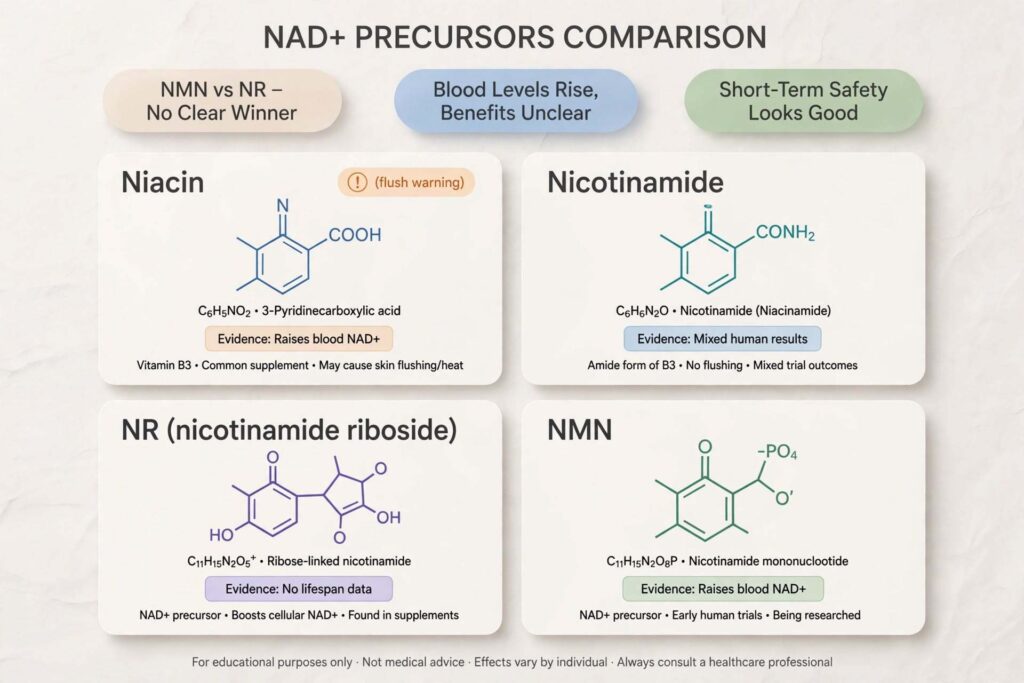
Niacin (vitamin B3) is the oldest. It does raise NAD+, but in the form of nicotinic acid it causes the familiar hot, itchy flush, and high doses can strain the liver. Nicotinamide, another form of B3, avoids the flush. Then come the two stars of the supplement aisle: NR and NMN. NMN sits one step closer to NAD+ in the chain, so people assume it’s stronger, but in practice the two behave a lot alike.
A few things researchers broadly agree on. Both raise NAD+ in the blood, and one analysis noted that NR and NMN each roughly doubled whole-blood NAD+ over 14 days. That part is solid. Raising a number in a blood test, though, is not the same as improving how you feel or function. neuroganhealth
What human trials show (it’s a mixed bag)
I’ll give you the useful ones rather than a wall of citations.
The most encouraging result for NMN is a 10-week trial in postmenopausal women with prediabetes, which reported better insulin sensitivity in muscle. One summary describes that human RCTs confirm dose-dependent increases in blood NAD+, and one trial showed improved muscle insulin sensitivity in prediabetic women. One trial, small and short. superpower
For NR, the story is flatter. Several trials in older adults and in people with obesity found that NR raised NAD+ markers, including inside muscle, but didn’t improve mitochondrial function, insulin sensitivity, or body composition compared with placebo. A few found small blood-pressure or arterial stiffness changes. In Parkinson’s disease, small early studies showed NR could reach the brain and shift some markers, and larger trials are still underway, so it’s too early to call it a treatment.
On safety, the reassuring news is that short trials at hundreds of milligrams a day, and in some NMN studies up to around 1,000 mg a day for several weeks, reported no severe adverse reactions. The less reassuring news is that these studies run weeks to a year, not decades. neuroganhealth
And on the big claim, there’s no wiggle room. No human trial has shown that NMN extends lifespan. Same for NR. neuroganhealth
My read, for what it’s worth: these compounds are interesting and probably safe for most healthy adults in the short term, and the evidence that they make you feel or function better is thin. If a company tells you otherwise, ask to see the trial.
NMN’s legal status: why you’ll see conflicting answers
If you’ve tried to buy NMN, you may have noticed the mess. In 2022 the FDA said NMN couldn’t be sold as a dietary supplement because it had been studied as a drug first. Then, in September 2025, it reportedly reversed course. One account quotes the agency as concluding that NMN is not excluded from the definition of dietary supplement. Many 2026 sources treat it as legal again, subject to standard new-ingredient notification rules. nmnsuperpower
But not every page online has caught up. Some still describe NMN as excluded, and a few say the FDA’s position was never overturned. If you’re in the US, check the FDA’s own site. If you’re in India, as many of our readers are, I’d check what the national regulator allows before ordering anything from overseas, because rules on imported supplements differ and gray-market products are common. NR has had a steadier path as a supplement ingredient.
The other thing nobody warns you about: NAD+ drips and tests
Two offshoots deserve a mention because they cost real money.
IV NAD+ infusions. Clinics sell them for energy, brain fog, and “anti-aging.” I’ve seen no solid human evidence that they do any of that in healthy people, and the infusions themselves can cause nausea, flushing, and chest tightness, especially if run fast. They’re expensive for something unproven.
Consumer NAD+ blood tests. The numbers they return aren’t established as clinically meaningful. A “low” result doesn’t tell you much about your health or whether you’d benefit from a supplement.
Who should be careful
Most healthy adults tolerate these supplements well in studies. Still, a few groups should talk to a doctor first.
If you have, or have had, cancer, or are being screened for it, be cautious. NAD+ is something fast-growing cells use too, and while the concern is mostly theoretical and from lab work, it’s the kind of unknown you shouldn’t take on alone.
If you’re pregnant or breastfeeding, there isn’t enough safety data. If you have liver disease, high-dose niacin forms are a particular worry (see our piece on liver health beyond detox). If you take diabetes medicines or blood pressure medicines, these precursors may nudge both. And if you take multiple supplements already, adding more makes it hard to tell what’s helping or hurting.
Quality is its own problem. Independent testing of supplements often finds products with less active ingredient than the label claims, and powders can degrade with heat and humidity. Look for third-party testing and a brand that publishes it.
What actually supports mitochondrial health
Here’s the part that’s less fun to sell and better supported by the evidence.
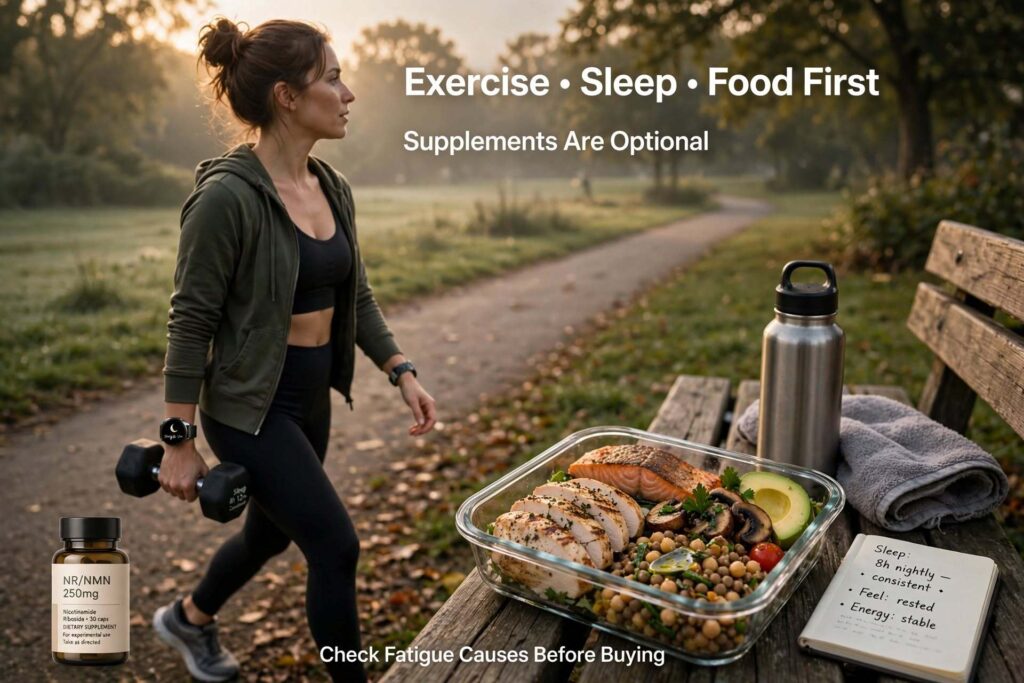
Exercise is the clearest one. Regular endurance and interval training make muscle cells build more and better mitochondria. It’s one of the most reliable findings in the field, and it works at any age. Strength training helps too, mostly by preserving the muscle mass those mitochondria live in.
Sleep matters more than people expect. Poor sleep is linked with worse metabolic health and energy regulation, and no supplement undoes a chronic shortfall. Eating enough also counts. Long-term crash dieting and very low protein intake can leave you drained, while a diet built on whole foods supplies the B vitamins, iron, magnesium, and other nutrients your energy chemistry runs on. If you’re often exhausted, it’s worth checking your iron before reaching for anything exotic; our guide on how to increase hemoglobin naturally is a decent place to start.
Cutting back on smoking and heavy drinking helps your mitochondria in the most boring way possible: you stop damaging them. And managing stress and building routines you can actually sustain matters more than any single biohack, which is the whole argument of our post on low-friction prevention.
When fatigue isn’t a mitochondria problem
This is where I’d slow down. “Mitochondrial dysfunction” is the fashionable explanation for every kind of tiredness, and it’s rarely the real one. Far more common culprits are anemia, an underactive thyroid, low vitamin B12 or vitamin D, sleep apnea, depression, diabetes, and plain overwork.
True primary mitochondrial disease exists, but it’s rare and usually shows up with a recognizable pattern: muscle weakness, exercise intolerance, problems affecting several organ systems, often starting early in life or running in families. If that sounds like you or your child, you need a specialist, not a supplement.
See a doctor if fatigue lasts more than a few weeks, comes with weight changes, shortness of breath, palpitations, or low mood, or doesn’t improve with sleep.
So, should you buy one?
Honestly, it depends on what you’re hoping for and how much the money matters.
If you’re a healthy adult, you’re already sleeping, moving, and eating reasonably well, and you’re curious, a reputable NR or NMN product is a low-risk experiment for most people. Give it a couple of months, track something specific like energy, workout recovery, or sleep, and decide whether it earned its place. Don’t expect a miracle.
If you’re hoping it will fix chronic exhaustion, reverse aging, or treat a disease, I’d spend the money on a doctor’s visit, blood tests, and a gym membership first. They’re less glamorous and far more likely to help.
Browsing other supplement-and-longevity topics? Our takes on shatavari and adaptogens beyond ashwagandha and mushroom coffee and lion’s mane follow the same approach. For caffeine and genetics, see DNA-based nutrition.
Frequently Asked Questions
1. What are NAD+ precursors?
They’re compounds your body converts into NAD+, a molecule involved in energy metabolism. The best known are niacin, nicotinamide, nicotinamide riboside (NR), and nicotinamide mononucleotide (NMN).
2. Do NAD+ supplements really work?
They reliably raise NAD+ levels in the blood. Whether that translates into better energy, fitness, or health is still unclear. Results from human trials are mixed and mostly small and short.
3. NMN or NR: which is better?
There’s no clear winner. Both raise NAD+ in human studies and appear safe in the short term. Choose based on quality, third-party testing, price, and what’s legal where you live.
4. How do I boost NAD+ naturally?
Regular exercise, enough sleep, a balanced diet that includes B3-containing foods like poultry, fish, mushrooms, and legumes, limited alcohol, and a healthy weight all support NAD+ metabolism. These have better evidence than supplements.
5. Is NMN safe to take?
Short-term trials at several hundred milligrams a day reported no serious adverse effects, but long-term safety isn’t established. People with cancer, those who are pregnant or breastfeeding, and anyone on medication should speak with a doctor first.
6. What are the side effects of nicotinamide riboside?
Usually mild, if any: nausea, stomach upset, fatigue, or headache in some people. Niacin, a different form of B3, is the one that commonly causes flushing.
7. Do NAD+ levels really decline with age?
They fall in several tissues in animals, and some human data point the same way, but results are inconsistent, and levels vary a lot between people and tissues.
8. Are NAD+ IV drips worth it?
There’s no strong evidence of benefit in healthy people. They’re costly, and side effects like nausea and chest tightness can occur. Ask for the evidence before paying.
9. What are the symptoms of mitochondrial dysfunction?
True mitochondrial disease can cause muscle weakness, exercise intolerance, and problems in organs with high energy needs. Ordinary tiredness is usually caused by something more common, like anemia, thyroid problems, poor sleep, or depression, so get it checked.
10. How do I improve mitochondrial function naturally?
Exercise regularly (including some interval and strength work), sleep consistently, eat enough whole foods, avoid smoking, and keep alcohol low. These are the habits with the strongest evidence.
Where this leaves us
NAD+ precursors are a decent idea with a strong story and modest proof. They’re probably safe for most healthy adults in the short run, and they may help certain people in specific situations, but nobody has shown they slow aging or fix fatigue. If you try them, treat it as a cheap experiment, not a strategy. The things that look after your mitochondria most reliably haven’t changed in years: move more, sleep properly, eat real food, and get unexplained tiredness checked. For more on building those habits, explore HealthMorph.
Medical disclaimer: This article is for education and isn’t medical advice. Talk to a qualified doctor before starting any supplement, especially if you are pregnant, breastfeeding, have a medical condition, or take prescription medicines.





Leave a Reply