
Kalonji for weight loss is one of the few kitchen remedies with a decent pile of trials behind it, and also one of the most oversold. Pooled results from randomized trials put the extra loss at roughly 1 to 2 kg over placebo, usually over 8 to 12 weeks, alongside diet and activity. That’s a nudge, not a transformation. This guide covers why that nudge can matter if your weight is stuck, the way of taking kalonji that actually makes sense, the dose, who should stay away, and what to pair it with so the effort isn’t wasted.
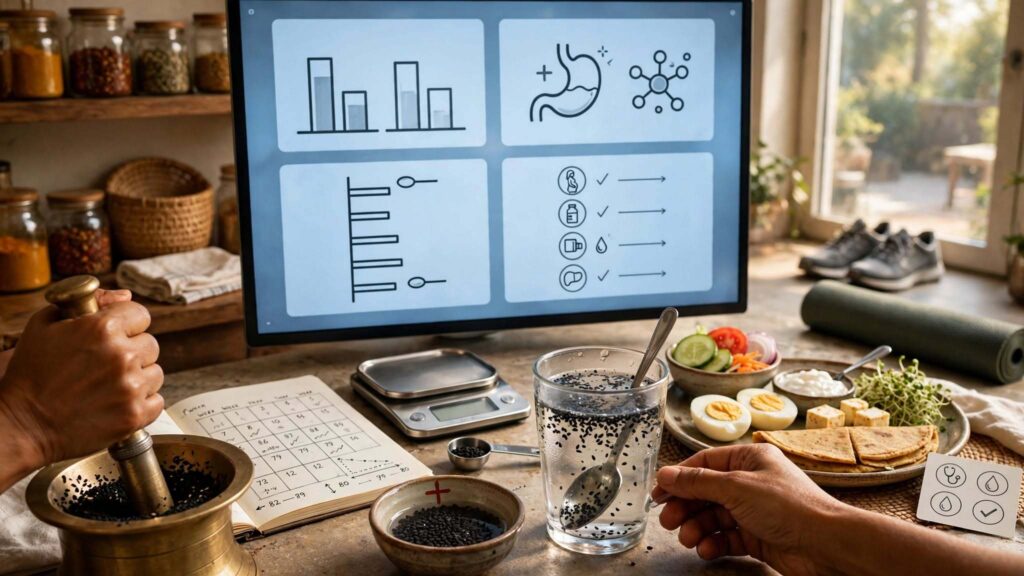
Quick answer: Lightly crush 1/2 teaspoon of kalonji (nigella seeds), stir it into a glass of lukewarm water, and drink it with the seeds 20 to 30 minutes before breakfast. If it suits your stomach after a week, go up to 1 teaspoon (about 3 grams) a day. Most trials ran 8 to 12 weeks. Skip it, or ask your doctor first, if you’re pregnant, take blood thinners, diabetes or blood pressure medicines, or have liver or kidney disease.
Why you regain the weight: it isn’t a willpower problem
You start a diet, lose 2 or 3 kilos, and then the hunger arrives. A few months later the scale is back where it began. People blame themselves for this, but the body is doing what it is built to do.
The best-known evidence comes from an Australian study published in the New England Journal of Medicine in 2011. Fifty overweight and obese adults followed a very low-calorie diet for 10 weeks and lost about 13.5 kg on average. Their hunger hormone ghrelin rose, their fullness hormones fell, and a year later they were hungrier than before the diet. The body defends its old weight. If you want to keep weight off, you have to work with appetite, not against it.
Slow-moving weight also has medical causes that no seed can fix. An underactive thyroid, PCOS, and medicines such as steroids, some antidepressants, antipsychotics, insulin and sulfonylureas can all raise weight or block loss. Poor sleep matters too: short sleep has been shown to raise ghrelin and lower leptin. If you’ve done everything right for 8 to 12 weeks and the scale hasn’t moved, get your TSH, fasting sugar or HbA1c, and lipid profile checked before adding another remedy.
What kalonji is, and what tradition says about it
Kalonji is the black seed of Nigella sativa. Unani medicine calls it shoneez and discusses it in Ibn Sina’s Al-Qanun. In Unani thinking, obesity (simane mufrit) is a cold, moist, phlegmatic state, treated with warming, drying foods and eating less. Kalonji’s warm, dry temperament fits that picture. Ayurveda lists the seed as upakunchika and uses it for digestion and sluggish metabolism. These are traditional frameworks, and they explain why people reached for it. Whether it works is a question for trials, which is where we go next.
What the research says about kalonji and body weight
Several meta-analyses have now pooled the trials, and they agree on direction while disagreeing on size:
- 2018, Complementary Therapies in Medicine: 13 trials, 875 adults. Nigella reduced body weight by about 1.76 kg and BMI by about 0.85 compared with placebo. Waist circumference did not change significantly.
- 2018, Journal of Ethnopharmacology: 11 studies. Weight down about 2.1 kg, BMI down about 1.2, and waist down about 3.5 cm. The authors warned that the weight results varied a lot between trials.
- 2023, Journal of Functional Foods (32 studies): weight down about 1.2 kg, BMI down about 0.4, waist down about 1.1 cm.
- 2023, Journal of Functional Foods (dose-response review): weight down about 1.5 kg and BMI down about 0.6, with no clear change in waist or hip measurements. The authors suggested black seed as an add-on to obesity management, not a stand-alone treatment.
So the honest summary is this: on average, people taking kalonji lost about one to two kilos more than people taking a placebo. The trials differed in form (powder, oil, capsules), dose, duration and who took part, and many were short. The effect looks larger in people who already have raised blood sugar, blood pressure or cholesterol, and smaller in otherwise healthy people. A small trial in women with obesity also found reduced appetite and longer-lasting fullness, which could explain part of the effect, but that needs bigger studies.
The video’s “fast weight loss” headline overreaches. Kalonji users lose a bit faster than non-users, not overnight. Think of it as helping with the last stubborn kilos, not as a replacement for the diet.
The right way to take it, and the mistake to avoid
The common mistake: Soaking kalonji overnight, drinking the water and throwing away the seeds. The compound most studied in kalonji, thymoquinone, is oil-soluble. It dissolves poorly in water, and most of it stays inside the seed. Drinking only the soak water gives you very little of what the research is about.
A better method:
- Take 1/2 teaspoon of kalonji seeds.
- Crush them coarsely with a mortar and pestle. Don’t grind to a fine powder, which goes stale faster.
- Stir into a glass of lukewarm water, not hot.
- Drink it immediately along with the seeds.
- Do this 20 to 30 minutes before breakfast.
Dose: Start with 1/2 teaspoon for the first week. If your stomach is comfortable, move to 1 teaspoon (about 3 grams) a day, and don’t go above that. The trials used a range of doses, commonly 1 to 3 grams a day of seed powder, or about 2 to 3 grams in other forms, for 8 to 12 weeks. If you feel burning or nausea on an empty stomach, take it after food, ideally with a meal that contains some fat.
Duration: Give it 8 to 12 weeks, then take a 2 to 4 week break. Track your waist measurement along with your weight, because the scale hides muscle and water changes.
Buying and storing: Buy whole seeds that smell sharp and peppery, keep them in a dark airtight jar, and crush only what you need. Oil capsules are an option, but a trial result on one product doesn’t transfer to another, and supplements aren’t tightly regulated.
Who should avoid kalonji or ask a doctor first
- Pregnancy: Don’t use it in medicinal amounts. Some animal data suggest it can affect the uterus.
- Diabetes medicines or insulin: Kalonji can lower blood sugar, so the combination can push you too low. Check your readings more often and tell your doctor.
- Blood pressure medicines: It may lower blood pressure further. Watch for dizziness.
- Blood thinners (warfarin and similar), or surgery within two weeks: It may affect clotting.
- Many long-term medicines: Thymoquinone may change how the liver processes some drugs. Ask your doctor or pharmacist before combining.
- Liver or kidney disease: Only with your doctor’s approval.
- On a prescription weight-loss injection: Ask your doctor, because both lower appetite and blood sugar.
- Allergy or stomach sensitivity: Rashes and burning are rare but possible. Stop if they occur.
What to pair it with so it actually helps
Kalonji works at the edges. These things work at the center.
| Addition | How to use | Why it helps | Caution |
|---|---|---|---|
| Protein at breakfast | Eggs, besan chilla, paneer, curd, sprouts | Protein is the most filling nutrient and protects muscle during weight loss | Check with a doctor if you have kidney disease |
| Fiber before meals | 1 tsp psyllium husk in a full glass of water, or a bowl of salad first | Slows eating and stretches the stomach, which dulls appetite | Needs plenty of water; keep a gap from medicines |
| Ground flaxseed or soaked chia | 1 tbsp daily in curd or dal | Fiber plus omega-3 fats keep you full longer | Introduce slowly to avoid gas |
| Methi seeds | 1 tsp soaked overnight | Soluble fiber slows sugar absorption | Avoid in pregnancy; may lower blood sugar |
| Jeera water | 1 tsp roasted cumin in water after meals | Small trials of cumin with a diet showed modest extra loss | Evidence is limited |
| Green tea | 1 to 2 cups, not late in the day | Mild effect on appetite and fat burning | Caffeine can affect sleep and acidity |
| Strength training | 2 to 3 sessions a week | Keeps muscle, so the metabolism doesn’t drop as the weight does | Build up gradually |
| Sleep | 7 hours at fixed times | Short sleep raises ghrelin and cravings | None |
Apple cider vinegar is popular, but the evidence is thin and it can irritate the throat and teeth, so we leave it out.
A simple day that fits the routine
On waking: Crushed kalonji in lukewarm water, with the seeds.
30 minutes later: A protein-first breakfast, such as two eggs with a roti, or besan chilla with curd.
Mid-morning: A fruit and a handful of nuts instead of biscuits. That 11 a.m. hunger is often the moment the day’s calories drift.
Lunch: Start with salad or dal, then roti and sabzi. Take a 10-minute walk afterward.
Evening: Roasted chana or sprouts, not namkeen.
Dinner: Early and light, at least three hours before bed.
The point isn’t a perfect plan. It’s removing the unplanned snacks that appear when protein and fiber run out.
When to see a doctor
- Your weight hasn’t moved after 8 to 12 weeks of honest effort
- You’ve gained weight quickly with tiredness, hair fall, constipation or irregular periods (thyroid, PCOS)
- You have diabetes, high blood pressure or heart disease and want to add kalonji
- You feel dizzy, shaky or faint after starting it
- You’ve lost more than 5% of your body weight without trying
Frequently asked questions
Does kalonji really help with weight loss? On average, trials show about 1 to 2 kg more loss than placebo over 8 to 12 weeks, mostly alongside diet changes. It’s a small aid, not a fat burner.
How much kalonji should I take a day for weight loss? Start with 1/2 teaspoon, then up to 1 teaspoon (about 3 grams) daily if you tolerate it. Don’t exceed that without medical advice.
Should I soak kalonji overnight? Soaking and drinking only the water is not the best approach, since thymoquinone is oil-soluble and stays in the seeds. Crush the seeds and swallow them with lukewarm water.
When is the best time to take kalonji? Most people take it 20 to 30 minutes before breakfast. If it irritates the stomach, take it after food.
Can I take kalonji with honey or lemon? You can, and plenty of people do, but there’s no trial evidence that either improves the effect. Honey adds sugar, so keep it small.
Can kalonji reduce belly fat? The results on waist size are mixed. Some meta-analyses found small reductions and others found none, so don’t count on spot reduction.
Is kalonji safe for diabetics and people with high BP? It can lower both, so it can be risky alongside medicines. Monitor closely and talk to your doctor first.
How long before I see a difference? Appetite may feel different within two to four weeks. Measurable changes usually need 8 to 12 weeks.
Sources
- Mousavi SM, et al. Effect of Nigella sativa supplementation on obesity indices: a systematic review and meta-analysis of randomized controlled trials. Complement Ther Med. 2018;38:48-57. https://www.pubmed.ncbi.nlm.nih.gov/29857879/
- Namazi N, et al. The effects of Nigella sativa L. on obesity: a systematic review and meta-analysis. J Ethnopharmacol. 2018;219:173-181. https://pubmed.ncbi.nlm.nih.gov/29559374/
- Naghsh N, et al. The effect of Nigella sativa (black seed) supplementation on body weight and body composition: a GRADE-assessed systematic review and dose-response meta-analysis of randomized controlled trials. J Funct Foods. 2023;105:105565.
- Effects of Nigella sativa supplementation on anthropometric indices in adults: a systematic review and meta-analysis. J Funct Foods. 2023;103:105472.
- Sumithran P, et al. Long-term persistence of hormonal adaptations to weight loss. N Engl J Med. 2011;365:1597-1604.
- Spiegel K, et al. Brief communication: sleep curtailment in healthy young men is associated with decreased leptin levels, elevated ghrelin levels, and increased hunger and appetite. Ann Intern Med. 2004;141:846-850.
This article is for general information and does not replace medical advice. If you take regular medicines, are pregnant, or have a long-term condition, check with your doctor before starting kalonji or any supplement.







Leave a Reply