
A herbal massage oil for joint pain can make stiff knees, shoulders and hands feel looser for a few hours, mostly because warmth and massage do that work, with the herbs adding comfort rather than proven treatment. The same goes for a turmeric-ginger-amla spice blend taken by mouth: it is a food, useful as part of a pattern, not a medicine. This guide breaks down both preparations ingredient by ingredient, gives realistic ratios you can make at home, explains the dose math that most articles skip, and shows where the research ends and the marketing begins.
Quick answer: For the oil, mix sesame, sunflower, jojoba, fractionated coconut and a little black seed oil, then add lavender, ginger and rosemary essential oils at 1% in total. Patch-test, warm it gently, and massage for 5 to 10 minutes. For the powder, blend amla, turmeric, dry ginger, coriander, cumin, cinnamon and cardamom, add a little black pepper, and take half to one teaspoon daily with food. Neither replaces diagnosis or medical treatment for arthritis. Check with your doctor first if you take blood thinners or diabetes medicines, are pregnant, or have gallstones, liver disease or a sesame allergy.
What this two-part approach is, and what it isn’t
The idea is simple: one product you rub on the joint, and one you eat. The oil works on the skin and muscles around the joint through warmth, massage and aroma. The powder tries to bring anti-inflammatory kitchen spices into your daily meals.
Both are best described as joint comfort products. Nobody has shown that either one treats osteoarthritis or inflammatory arthritis, and the honest claim is limited to comfort and general wellbeing. If a seller promises to cure or reverse arthritis, treat that as a warning sign.
🔗 Related on HealthMorph: Home remedies for joint pain: what works and what doesn’t
Part 1: the herbal massage oil
What each ingredient does
| Ingredient | Role | What we know | Caution |
|---|---|---|---|
| Sesame oil | Base carrier, warming in Ayurvedic tradition | Stable, widely used for abhyanga; absorbs well | Sesame allergy; keep away from broken skin |
| Sunflower oil | Light carrier, adds vitamin E | Oxidizes faster than other oils, so use fresh or high-oleic type | Goes rancid; check the smell |
| Jojoba oil | Skin-friendly carrier (technically a wax ester) | Very stable, long shelf life, rarely irritates | Expensive; a little goes far |
| Fractionated coconut oil | Keeps the blend light and non-greasy | Stays liquid, long shelf life | None significant |
| Black seed (kalonji) oil | Active botanical | Thymoquinone has anti-inflammatory activity in the lab; topical human evidence for joints is thin | Can cause contact dermatitis, so patch-test |
| Lavender essential oil | Aroma, relaxation | Studied in aromatherapy massage for relaxation and pain perception | Avoid on children; rare allergy |
| Ginger essential oil | Warming sensation | Traditional circulatory stimulant; limited topical joint data | Can irritate at high concentration |
| Rosemary essential oil | Stimulating aroma | Used in massage research; the camphor-rich types are the strong ones | Avoid in pregnancy, epilepsy and young children |
| Vitamin E | Slows rancidity of the oil | Acts as an antioxidant in the oil, not as a joint treatment | Rarely a skin sensitizer |
One note on the source formulation: it lists fractionated coconut oil in the body text but not in the abstract. We’ve included it because it improves feel and stability.
A 100 ml batch you can make at home
- Sesame oil: 45 ml
- Sunflower oil (fresh, or high-oleic): 20 ml
- Jojoba oil: 15 ml
- Fractionated coconut oil: 15 ml
- Black seed oil: 5 ml
- Vitamin E oil: about 0.5 ml
- Essential oils: 1 ml in total, about 20 drops (8 lavender, 6 ginger, 6 rosemary)
That gives roughly a 1% essential oil dilution, which is conservative and suits most adults. If your skin is sensitive, halve the essential oils. A dilution of 2 to 3% is common in professional massage, but there’s no reason to go there at home.
Method: Mix the carrier oils in a clean glass bottle. Stand the bottle in a bowl of warm water for a few minutes. Don’t heat it on a flame. Let it cool slightly, then add the vitamin E and essential oils and shake. Store it in a dark glass bottle away from heat and light.
Shelf life: About 3 to 6 months. Discard it if it smells sharp, stale or like old paint.
How to use it
- Patch-test first. Dab a small amount on the inner forearm, leave it for 24 hours, and watch for redness, itching or a rash.
- Warm a spoonful in your palms or stand the bottle in warm water.
- Massage the joint with slow, firm strokes for 5 to 10 minutes. Work toward the heart on the limbs.
- Cover the area with a warm cloth or a heating pad on low for 10 to 15 minutes.
- Repeat once a day, ideally in the evening.
Don’t use it on broken, burnt or inflamed skin, on a hot swollen joint (that needs a doctor), near the eyes, or under a heating pad set to high. Heat plus essential oils can burn.
Who should be careful: Pregnant or breastfeeding women (skip rosemary and ask your doctor), people with epilepsy (skip rosemary), people with sesame, nut or fragrance allergies, and anyone applying it to a child.
Part 2: the oral spice blend
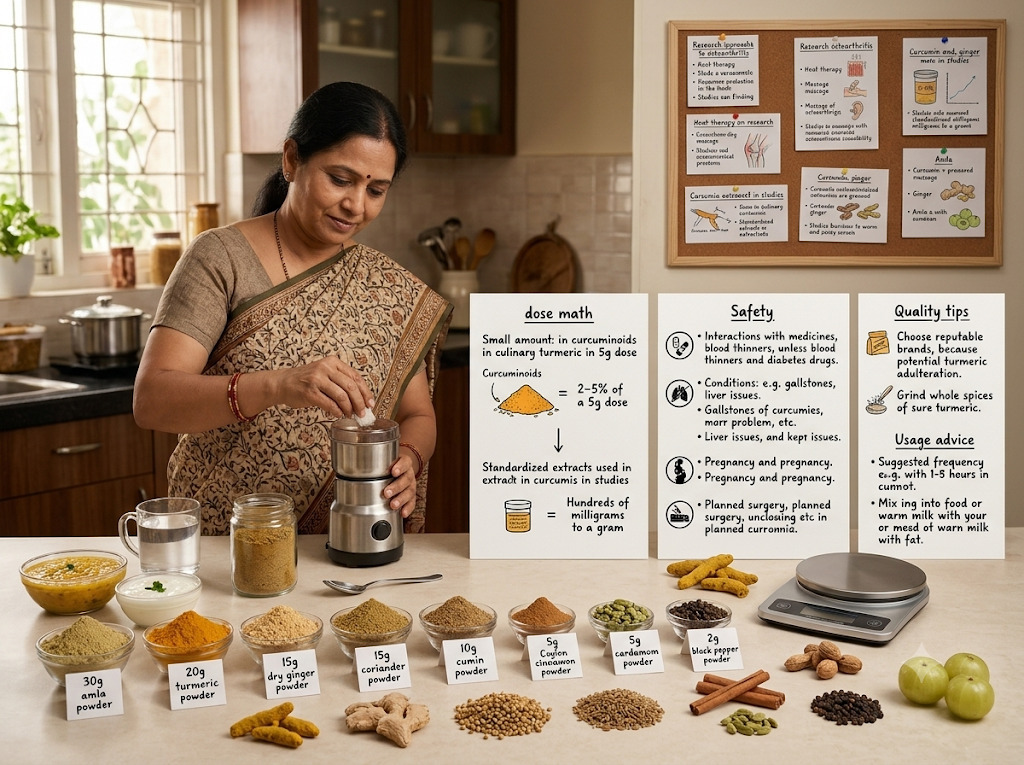
The 100 g blend and what each part brings
| Ingredient | Amount per 100 g | Why it’s there | Caution |
|---|---|---|---|
| Amla powder | 30 g | Vitamin C and polyphenols; drying and storage reduce vitamin C | Can aggravate acidity |
| Turmeric powder | 20 g | Curcuminoids, the most studied joint spice | Gallbladder stones; blood thinners; binds iron |
| Dry ginger (sonth) powder | 15 g | Gingerols and shogaols; mild warming effect | Heartburn; blood thinners |
| Coriander powder | 15 g | Culinary base, mild flavor | Very safe in food amounts |
| Cumin powder | 10 g | Digestive comfort | Very safe in food amounts |
| Cinnamon powder | 5 g | Flavor, mild blood sugar effect | Use Ceylon cinnamon; cassia has more coumarin |
| Cardamom powder | 5 g | Flavor, digestive comfort | Very safe in food amounts |
Our two upgrades: Add 2 g of black pepper powder to each 100 g. The piperine in pepper can raise how much curcumin the body absorbs, in some studies by a very large factor, which is why turmeric is traditionally cooked with pepper and fat. Also choose Ceylon (true) cinnamon over cassia, since cassia carries much more coumarin, which can stress the liver in high or long-term intake.
The dose math that most articles skip
Here is the honest part. Turmeric powder is typically only about 2 to 5% curcuminoids. In this blend, a teaspoon (about 5 g) contains roughly 1 g of turmeric, which works out to roughly 20 to 50 mg of curcuminoids. The joint trials that showed modest pain relief used standardized extracts providing several hundred milligrams to over a gram of curcuminoids a day. So a culinary spice blend delivers a tiny fraction of what the trials tested.
Ginger is closer. The same teaspoon gives roughly 0.75 g of dry ginger, which is within the range used in some studies.
That doesn’t make the blend pointless. Spices in food are safe, pleasant and part of healthy eating patterns. It means you shouldn’t expect it to behave like a curcumin supplement, and you shouldn’t take more to chase an effect. More is not safer.
How to take it
- Half to one teaspoon (about 2.5 to 5 g) once or twice a day.
- Stir it into warm water, dal, curd, khichdi or warm milk, with a little fat, since curcumin dissolves in fat.
- Take it with or after food, not on an empty stomach, to avoid heartburn.
- Try it for 8 to 12 weeks, then take stock.
Quality matters more than the recipe
- Buy whole spices and grind them yourself when you can. Powdered turmeric has been found adulterated with lead-based colorants in some markets, which is a serious risk with daily use. Reputable brands with lab testing reduce the risk.
- Store in airtight, dark jars away from moisture.
- Make small batches of 100 g, since amla and ground spices lose potency and flavor.
Who should check with a doctor first
- Blood thinners or antiplatelet drugs: turmeric and ginger may add to the effect.
- Diabetes medicines: cinnamon, amla and ginger can lower blood sugar further.
- Gallstones or bile duct problems: turmeric can trigger gallbladder contractions.
- Iron deficiency anemia: turmeric may reduce iron absorption.
- Pregnancy and breastfeeding: keep to normal food amounts.
- Liver disease: concentrated turmeric products have been linked to rare liver injury, and a blend with pepper increases absorption.
- Medicines affected by piperine: it can raise blood levels of some drugs, including certain epilepsy and heart medicines.
- Planned surgery: stop two weeks before.
What the research really says
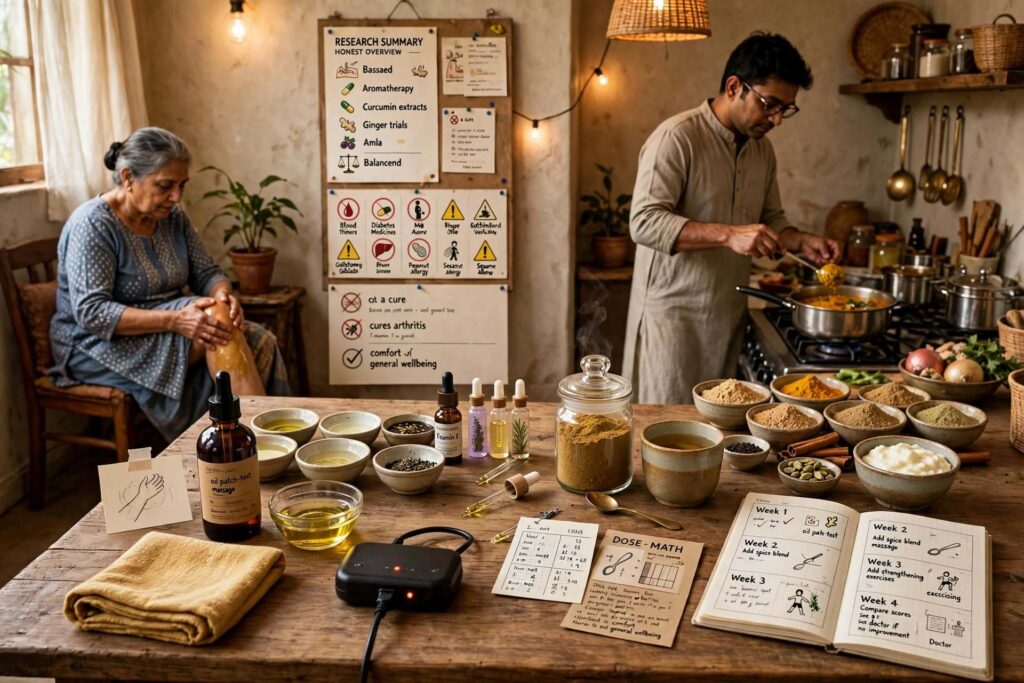
- Massage and heat reduce stiffness and pain for many people with osteoarthritis, so a warm oil massage has a sound basis. Whether the herbs add beyond the massage itself isn’t established.
- Aromatherapy massage with lavender, rosemary or ginger has produced short-term pain relief in some small trials. They are small and hard to blind, because people can smell what they’re getting.
- Curcumin and turmeric extracts show modest pain improvement in knee osteoarthritis across several meta-analyses, sometimes similar to NSAIDs over a few weeks. The studies vary in quality, and they used concentrated extracts, not culinary powder.
- Ginger has some trials showing modest pain reduction in osteoarthritis.
- Amla has laboratory and small human studies, but little joint-specific evidence.
- Boswellia (shallaki) has small trials in osteoarthritis. The source formulation correctly says it should be studied as a standardized extract and not tossed into a home blend.
The bottom line matches the source document’s own caution: ingredient popularity and traditional use don’t equal clinical effectiveness.
🔗 Related on HealthMorph: Natural remedies and Ayurveda and anti-aging morning routine with kalonji and methi
A four-week routine to try both
Week 1: Patch-test the oil. Begin the evening oil massage and warmth on the sore joint. Note your baseline pain score out of 10, morning stiffness minutes and how far you can walk.
Week 2: Add the spice blend, half a teaspoon with lunch or dinner.
Week 3: Add daily strengthening exercises for the joint, since exercise is the best-supported joint treatment. See our guide on leg weakness after 45 for protein and strength training basics.
Week 4: Compare your scores. If pain and stiffness are no better, or the joint is swollen, hot or getting worse, see a doctor. Low vitamin D or B12 can cause aching, and a quick test is worth it: vitamin B12 and D deficiency symptoms.
For makers: if you plan to sell these
The source document is a formulation proposal, and it is right that efficacy claims must wait for evidence. If you intend to sell either product, a few practical points apply.
- Regulatory category: In India, a body oil sold as a cosmetic and a traditional medicine sold under an Ayurvedic licence fall under different rules, and a food-grade powder falls under food regulations. Which one you choose limits what you can say on the label.
- Claims: Avoid words like “treats”, “cures” and “reverses” arthritis. Stick to comfort, stiffness and massage language.
- Testing: Run identity, microbial, heavy metal and pesticide tests on the powder, and stability and rancidity tests on the oil, before launch.
- Safety file: Keep documentation of ingredient sources, allergen warnings and patch-test advice on the label.
- Evidence: Plan a small, controlled study with validated pain and function scores (for example WOMAC or KOOS) before any stronger claims.
When to see a doctor
- A hot, red, swollen joint, especially with fever
- Pain after an injury, or a joint that locks or gives way
- Numbness, weakness or loss of bladder or bowel control with back pain
- Morning stiffness lasting over an hour, or swelling in several small joints
- Pain that wakes you at night, or comes with weight loss
- No improvement after 4 to 6 weeks of consistent effort
Frequently asked questions
What is the best herbal massage oil for joint pain? There’s no single proven best. A blend of sesame oil with other stable carrier oils and a low concentration of essential oils is a reasonable comfort option. Warmth and massage technique matter as much as the herbs.
How do I make herbal joint oil at home? Mix carrier oils (sesame, sunflower, jojoba, fractionated coconut), add a little black seed oil, then add essential oils at 1% in total once the blend has cooled. Store in dark glass.
Is it safe to use essential oils on arthritis? Diluted to about 1% and patch-tested, they are safe for most adults. Avoid them on broken skin and in children, pregnancy and epilepsy where noted.
Can black seed oil be applied to joints? Many people do. Patch-test first, since contact dermatitis is reported. Evidence for joint relief from topical use is limited.
Is turmeric powder good for joint pain? Turmeric extracts show modest benefit in trials, but culinary turmeric powder has far less curcumin. It’s a sensible food, not a substitute for treatment.
How should I take turmeric, ginger and amla powder? Half to one teaspoon with a meal that contains some fat, with a pinch of black pepper. Don’t take more to speed things up.
Can I take the powder every day? For most healthy adults in food amounts, yes. People with gallstones, on blood thinners, or with liver disease should ask a doctor first.
How long before I notice anything? Warmth and massage can feel better the same day. Any effect from the spice blend would take weeks, and may be small.
Is Mahanarayan oil better than a homemade blend? Mahanarayan taila is a classical formula, but trials usually test it as part of a package. A well-made homemade oil gives you control of freshness and ingredients. Neither is proven better.
Sources
- Kolasinski SL, et al. 2019 American College of Rheumatology/Arthritis Foundation guideline for the management of osteoarthritis of the hand, hip, and knee. Arthritis Rheumatol. 2020;72(2):220-233.
- Daily JW, et al. Efficacy of turmeric extracts and curcumin for alleviating the symptoms of joint arthritis: a systematic review and meta-analysis of randomized clinical trials. J Med Food. 2016;19(8):717-729.
- Shoba G, et al. Influence of piperine on the pharmacokinetics of curcumin in animals and human volunteers. Planta Med. 1998;64(4):353-356.
- Forsyth JE, et al. Turmeric means “yellow” in Bengali: lead chromate pigments added to turmeric threaten public health across Bangladesh. Environ Res. 2019;179:108722.
- European Food Safety Authority. Coumarin in flavourings and other food ingredients with flavouring properties. EFSA Journal. 2004;104.
- Multimodal Ayurvedic management for Sandhigatavata (osteoarthritis of knee joints). Ayu. 2013;34(1):49-55. https://pmc.ncbi.nlm.nih.gov/articles/PMC3764880
This article is for general information and does not replace medical advice. See a doctor for persistent or severe joint pain, and check with one before using herbal products if you take regular medicines, are pregnant, or have a long-term condition.





Leave a Reply