
Pashanbhed literally means “stone-breaker”, and that name has sold a lot of capsules. It’s also the reason Ayurvedic remedies for kidney stones deserve a careful read before you spend a month on a herbal course for a stone that really needed a urologist. A stone that’s stuck, infected or blocking a kidney doesn’t care how traditional your decoction is.
Here’s the more useful version of the story on Ayurvedic remedies for kidney stones. A few of these herbs have small human trials. The best-evidenced thing in this whole article isn’t a herb at all: it’s how much urine you make in a day. And the Ayurvedic idea that a herb will “dissolve” a stone mostly doesn’t survive the lab, particularly for the calcium oxalate stones that make up most cases. I went through the Ayurvedic remedies for kidney stones studies, the urology guidelines and the large hydration trials. Below you’ll find what each herb really has behind it, a hydration plan built for Indian summers, a diet that’s different from what you’ve probably been told (don’t cut calcium), the extra ingredients with a case for them, and the signs that mean you need a hospital tonight.
General information only. Fever with flank pain, vomiting that won’t stop, or being unable to pass urine are emergencies. See the red flags near the end.
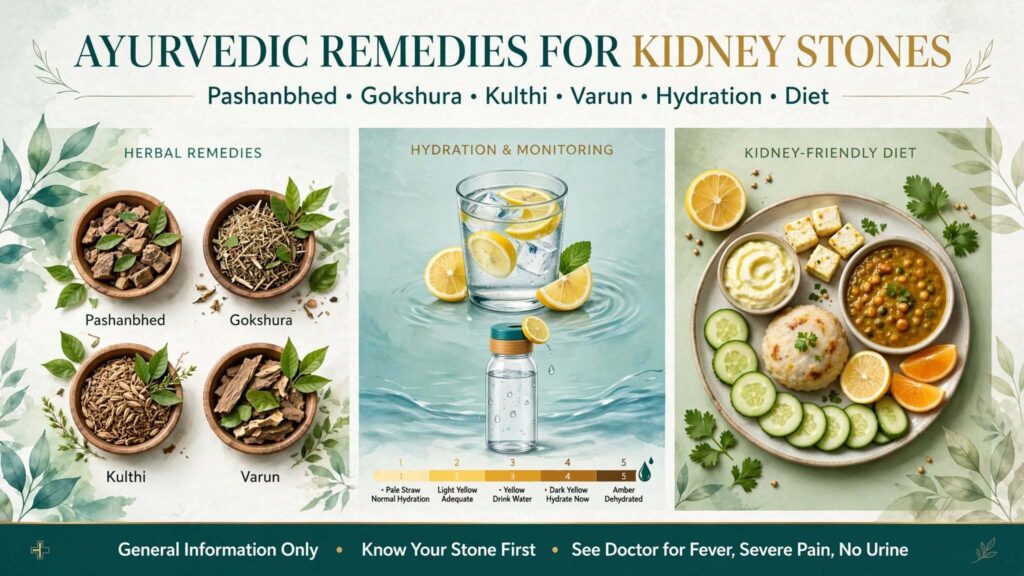
Know your stone first, before any Ayurvedic remedies for kidney stones
Kidney stones are hard crystals that form when urine gets too concentrated with minerals. About 70 to 80% of stones contain calcium, usually calcium oxalate. Roughly 10% are uric acid, about 10% are struvite (linked to infection), and a few are cystine or drug-related. Which type you have changes what works.
The lifetime risk of a symptomatic stone is around 12 to 13% in men and 7% in women in Western data, and stones are common across the “stone belt” of north and north-west India. They come back often: about 35 to 50% of people have another within five years without prevention. That recurrence number is the reason prevention matters more than any one of the Ayurvedic remedies for kidney stones.
Common risk factors include low fluid intake, hot climates and sweating, a high-salt diet, lots of animal protein, obesity, gout (which doubles the risk in men), family history, bariatric surgery and certain medicines. Vitamin C supplements can raise urinary oxalate. Our guide to amla benefits mentions that caution for concentrated products.
The single most useful first step is to catch the stone and have it analysed. Strain your urine through a fine cloth or tea strainer when a stone is passing, keep any fragments, and take them to your doctor. After that, a 24-hour urine collection can show whether your urine is low in volume, low in citrate or high in calcium, oxalate or uric acid, which tells you what to fix.
The scorecard for Ayurvedic remedies for kidney stones
| Remedy | What’s behind it | Verdict |
|---|---|---|
| Hydration to about 2.5 L of urine a day | One 5-year RCT (12% vs 27% recurrence); recommended by AUA, EAU and ACP | Best-supported by far |
| Normal calcium, less salt, less animal protein | Small trials and guidelines; a combined diet halved recurrence in one trial | Strong rationale |
| Citrate (lemon, orange juice, or potassium citrate) | Medicine has solid trials; juices have weaker data | Medicine yes; juice helpful extra |
| Kulthi (horse gram) | Small human trial; animal and lab work | Plausible, unproven |
| Varun bark | One placebo-controlled trial reported changes in urine chemistry | Plausible, unproven |
| Gokshura | Small randomised trial plus lab work | Plausible, unproven |
| Pashanbhed | Lab and animal work; part of mixed formulas | Unproven in humans |
| “Stone-dissolving” claims | Test-tube dissolving of oxalate stones is poor | Mostly marketing |
What the herb research really looks like
Let me start with the honest overview of Ayurvedic remedies for kidney stones, because it frames everything else. A urologist writing for the European Association of Urology congress went looking for evidence on herbal remedies for stones and found that almost every report is an in-vitro (test-tube) or animal study, mostly on calcium oxalate. He could find four published randomised clinical trials, only one of them double-blind. He also noted that a well-known polyherbal product (Cystone) reduced calcium oxalate crystallisation in the lab but that didn’t translate into clinical efficacy in the people studied.
That’s a sober starting point for Ayurvedic remedies for kidney stones. Some narrative reviews take a friendlier view and rate Dolichos biflorus (horse gram), Crataeva nurvala (varun), Tribulus terrestris (gokshura) and the black-cumin seed Nigella sativa as the herbs with the best clinical and preclinical support. They’re worth taking seriously, but they’re reviews drawing on small trials of mixed quality, many from the same research circles.
One more reality check on Ayurvedic remedies for kidney stones from the test tube. In a lab model of stone dissolution, varun and kulthi extracts did not dissolve oxalate, uric acid or cystine stones, and gokshura dissolved uric acid and cystine stones only to some extent. In a different test-tube study, an extract from a close relative of pashanbhed (Bergenia ciliata) dissolved calcium phosphate stones far better (about 68%) than calcium oxalate (about 37%). A test tube isn’t a kidney, and it shows why “dissolves stones” is the wrong expectation.
Pashanbhed (Bergenia ligulata) among Ayurvedic remedies for kidney stones
Pashanbhed is the headline herb, and its human evidence is thin. Most of what exists is lab and animal work showing anti-crystallisation effects. It appears as one ingredient in many mixed formulas, which makes it impossible to say what it contributes. I couldn’t find a good trial of pashanbhed on its own. It’s a traditional herb with a plausible mechanism, and no more.
Gokshura (Tribulus terrestris) among Ayurvedic remedies for kidney stones
A review notes a randomised trial in which gokshura fruit or root reduced the number and size of stones over 90 days. I couldn’t read the original, and it’s a small study, so I’d call it suggestive. Practical cautions: gokshura may lower blood pressure and blood sugar, so tell your doctor if you take medicines for either. Avoid it in pregnancy, and treat the “testosterone booster” marketing with scepticism.
Kulthi (horse gram) among Ayurvedic remedies for kidney stones
Kulthi (Dolichos biflorus, kulattha) has the best “food” case on the list. The traditional kulthi ka pani or kulthi dal is deeply rooted, and there’s some research: animal studies reported fewer calcium oxalate stones, and a review cites a trial of 47 patients in which a kulthi preparation was compared with potassium citrate. It’s a small study. It’s also a nutritious pulse, rich in protein and iron, so eating it as dal is harmless for most people. I couldn’t find a reliable oxalate value for horse gram, so if you have calcium oxalate stones, mention it to your urologist before making it a daily staple. And remember the lab finding above: it didn’t dissolve oxalate stones in the test tube.
Varun bark (Crateva nurvala) among Ayurvedic remedies for kidney stones
Varun has the most interesting human data. A reviewed placebo-controlled, double-blind study reported that stem bark and root bark powder altered urinary electrolytes in ways that reduce crystallisation, and animal studies of the bark decoction showed less stone formation. That’s a plausible mechanism, from a small study. It doesn’t make a stone vanish, and I wouldn’t expect it to shrink an existing stone of any size.
An Ayurvedic trial of Ayurvedic remedies for kidney stones worth knowing
In a small randomised trial of 39 people with kidney or ureteric stones up to 10 mm, researchers compared two Ayurvedic treatments (Palasha kshara and an Ashmarihara kwatha made of pashanbhed, gokshura, varun, shatavari and other herbs) with a pathya-apathya diet chart for both groups. The study was registered retrospectively, which is a flag on design. It shows Ayurvedic practitioners are running trials, and it’s too small to change anyone’s treatment.
Extra ingredients to add to Ayurvedic remedies for kidney stones
You asked for more ingredients that make this more useful. Here are the ones for Ayurvedic remedies for kidney stones with some real rationale, graded honestly.
Lemon, mosambi and orange juice (citrate). Citrate binds calcium in urine and stops crystals forming, and low urinary citrate is a common problem in stone formers. Doctors often prescribe potassium citrate, which has good trial support and is recommended in guidelines for recurrent calcium stones. A review of fluids and stones lists orange juice among suitable beverages. Lemon juice and lemonade raise urinary citrate modestly in smaller studies. Use unsweetened lemon water, or fresh citrus with its natural sugar, and skip the sugar-sweetened versions.
Water with high bicarbonate. In one analysis, drinking 2 L a day of mineral water high in bicarbonate raised urine pH and citrate and lowered oxalate. It’s an option if you can find and afford it, though plain water works for most people.
Kalonji (Nigella sativa). A review describes an 80-person randomised trial in which 1 g of black cumin seed every 12 hours for two weeks was compared with tamsulosin (0.4 mg) in people with 4 to 10 mm stones, with stone sizes decreasing. I couldn’t verify the original, so I’d treat it as a lead, not a result. Black cumin is a common kitchen spice with a long history of use.
Bhumi amla (Phyllanthus niruri, “stone breaker”). This is an Indian plant with a long reputation for stones. The urologist’s review lists a trial of a bhumi amla product that had no blinding. Human evidence is limited and mixed, so I’d consider it an unproven option, and it needs the same caution as other herbal products.
Coconut water and barley water (jau ka pani). Both are popular, and harmless in reasonable amounts, as a way to drink more. Coconut water contains potassium, so be careful if you have kidney disease or take potassium-raising medicines. Neither has solid stone-prevention trials. Treat them as pleasant ways to increase fluid intake.
Banana stem juice (kele ka tana). A traditional remedy for stones with little human evidence. Avoid if it upsets your stomach or you have diabetes and it’s mixed with sugar.
What I’d skip among Ayurvedic remedies for kidney stones: apple cider vinegar (no evidence), “olive oil and lemon” flushes (that’s a gallstone myth, not a kidney stone treatment), and any herbal powder promising to dissolve a stone in days.
The hydration plan: the part of Ayurvedic remedies for kidney stones that actually has evidence
This is the section of Ayurvedic remedies for kidney stones to follow most closely, with one twist.
The best evidence is a 5-year trial by Borghi and colleagues, published in 1996. After a first calcium stone, 199 people were randomised to drink enough to produce about 2 litres of urine a day, or to no intervention. After five years, stones came back in 12% of the water group versus 27% of controls. The people who stayed stone-free averaged about 2.6 litres of urine a day, against about 1 litre in the controls. That trial is the reason the American Urological Association and European guidelines recommend producing at least 2.5 litres of urine a day. A review for the AHRQ rated the overall evidence as low quality (it rests on two small trials), and calculated that you’d need to treat about seven people to prevent one recurrence. That’s still a strong result for a free treatment.
The twist: telling people to drink more isn’t enough
In March 2026, the PUSH trial reported on 1,658 people with previous stones across six US centres. A two-year programme with a target of more than 2.5 litres of urine, a smart water bottle and financial incentives didn’t reduce symptomatic stone recurrence compared with usual care. The reason is instructive: average urine volume in the intervention group peaked at 1.8 litres at six months and sank to under 1.6 litres by 24 months. Almost nobody reached the target, and the effect of what they did drink was too small. A few more participants in the intervention group had mild, symptom-free low sodium (12 versus 2), a reminder that more isn’t always better.
The lesson I take from both trials for Ayurvedic remedies for kidney stones: the benefit depends on actually achieving a large urine volume, and most people don’t. The hydration plan is only as good as your urine output, so measure it.
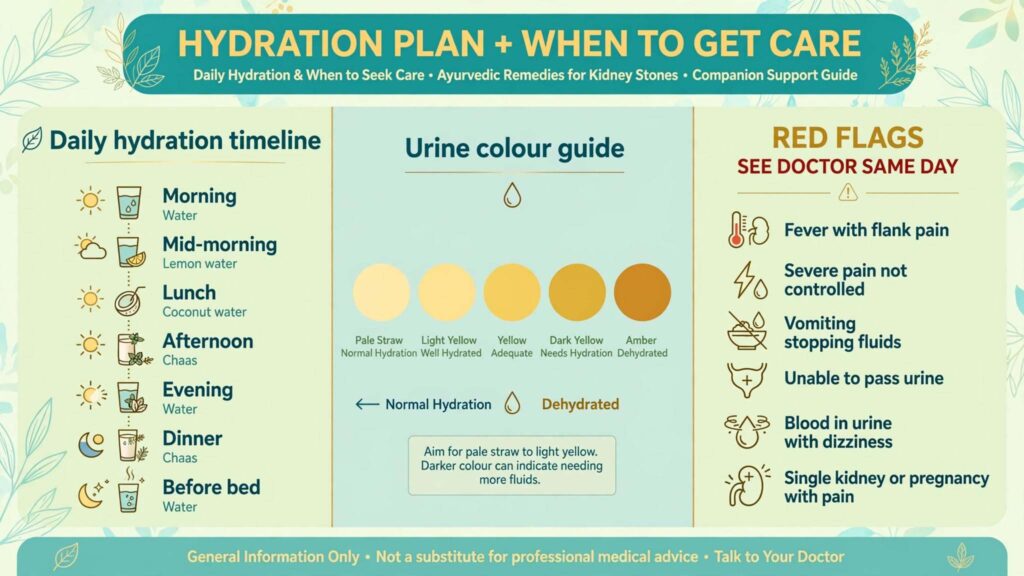
How to do the hydration plan for Ayurvedic remedies for kidney stones in an Indian summer
The AUA guideline notes that fluid intake has to exceed the urine target, because not all of it comes out. As a rough example, about 3 litres of fluid may yield about 2.5 litres of urine, and in hot weather or if you sweat a lot, you’ll need more.
| Time | What to drink |
|---|---|
| On waking | 400 to 500 ml water |
| Mid-morning | 250 to 300 ml (water, nimbu pani, coconut water) |
| With lunch | 300 ml, plus a glass of chaas if you like it |
| Afternoon | 300 ml |
| Evening | 250 to 300 ml (unsweetened citrus drink is fine) |
| With dinner | 250 to 300 ml |
| 1 to 2 hours before bed | 250 ml |
Adjust it to your climate, sweat and activity. Ways to check it’s working:
- Urine colour: pale straw all day. Dark yellow means drink more.
- Frequency: you should pass urine every two to three hours.
- Measure it for a day: collect your urine in a jug for 24 hours and see whether you reach about 2 to 2.5 litres. It sounds unpleasant and takes a day, and it tells you more than guessing.
- Spread it out. Chugging two litres in the evening doesn’t prevent crystals overnight.
Limits and cautions: guidelines advise limiting tea and caffeinated coffee to about half a litre a day in total, and avoiding sugar-sweetened soft drinks, including colas. If you have heart failure, kidney failure or any condition where your doctor has restricted fluids, don’t push your intake without checking. Don’t overdo it either: very large volumes of plain water can lower blood sodium. Our guide to low-friction prevention explains how to tie a water habit to routines you already have, which is what PUSH shows most people struggle with.
The diet for Ayurvedic remedies for kidney stones: what to do (and the calcium surprise)
Here’s the part of Ayurvedic remedies for kidney stones that surprises people most. Don’t cut calcium. For decades, people were told to avoid milk and curd to prevent calcium stones. The evidence says the opposite. Dietary calcium binds oxalate in the gut, so less oxalate is absorbed, and low-calcium diets increase urinary oxalate and may cause bone loss. In an AHRQ-reviewed trial, a diet with normal calcium (about 1,200 mg a day), low sodium, low animal protein, low oxalate and plenty of water was linked with about half the recurrence risk of a low-calcium diet. The evidence on each individual element is weaker, and the AHRQ rated it low certainty, but the combination makes sense.
Note the word food. Calcium from curd, milk and paneer lowers risk, while calcium supplements may increase it.
An Indian plate for Ayurvedic remedies for kidney stones
- Calcium from food, at meals. Curd, milk, paneer and ragi, about 1,000 to 1,200 mg a day in total. Eat calcium-rich food at the same meal as oxalate-rich food so they bind in the gut.
- Less salt. A high-sodium diet raises urinary calcium. Aim for under 5 g a day. Pickles, papad, namkeen and instant noodles are the usual culprits. Our guide to habits to quit for better health shows where the hidden salt is.
- Moderate animal protein. Large portions of meat, fish and eggs raise urinary calcium and uric acid and lower citrate. Dal, pulses and dairy in sensible amounts are fine. For protein supplements, our guide to protein powder for women covers how much is enough.
- Oxalate: be sensible, not extreme. High-oxalate foods include spinach (palak), beetroot, rhubarb, nuts like almonds, tea, wheat bran, strawberries and soy. Guidelines suggest limiting them if your urinary oxalate is high, though one review concluded the benefit of oxalate restriction is unproven except after bariatric surgery. A practical compromise: don’t live on spinach and almonds, boil leafy vegetables and discard the water (which lowers soluble oxalate), and eat them with calcium-rich foods.
- Skip vitamin C megadoses. High-dose vitamin C supplements are metabolised to oxalate and raise stone risk. Food sources of vitamin C are fine. This matters if you use concentrated amla capsules.
- Cut sugary drinks. High fructose intake and sugar-sweetened soft drinks are linked to stones.
- Watch purines if you have uric acid stones or gout: organ meats, some seafood and heavy alcohol.
- Weight and blood sugar. Obesity raises stone risk. See our pages on blood sugar and insulin resistance.
What actually treats a stone when Ayurvedic remedies for kidney stones aren’t enough
Most small stones pass on their own. Roughly two-thirds of stones up to 5 mm pass without intervention, and about half of those between 5 and 10 mm, with size and position being the key predictors. Pain relief (usually an anti-inflammatory, taken as your doctor advises), fluids and time are the basics.
Alpha-blockers like tamsulosin. The evidence is split. The large UK SUSPEND trial (1,136 people) found no benefit. A 2025 meta-analysis of randomised trials found that alpha-blockers improved expulsion, especially for distal ureteral stones (about 1.5 times as likely to pass) and for stones 5 to 10 mm, with a number needed to treat of about four to six. Ask your urologist whether it makes sense for your stone.
Procedures are for stones that are too big, don’t pass, cause infection or obstruct the kidney: shock wave lithotripsy (ESWL), ureteroscopy with laser, or percutaneous nephrolithotomy for large kidney stones.
Preventive medicines. Potassium citrate, thiazide diuretics (for high urinary calcium) and allopurinol (for high uric acid) each reduce recurrence of calcium stones when added to fluids, according to a review of controlled trials. These need prescriptions, based on your urine tests.
Uric acid stones can sometimes be dissolved by making the urine less acidic with medicine. That’s the one type where “dissolving” is realistic, and it needs a doctor’s guidance.
Hazards in Ayurvedic remedies for kidney stones
- Herbs that harm the kidney. Some traditional preparations made with Aristolochia species contain aristolochic acid, a proven cause of kidney damage and cancer. Avoid any product containing it, and stay away from unknown herbal powders.
- Heavy metals. A widely cited 2008 JAMA survey of Ayurvedic medicines sold online found that about one in five contained detectable lead, mercury or arsenic. Be extra careful with bhasma and rasa preparations.
- Diuretic overload. Herbs sold as “diuretics” can leave you dehydrated if you don’t drink enough, which can worsen stones.
- Interactions. Gokshura may lower blood pressure and blood sugar. Herbs with diuretic effects may add to water tablets.
- Pregnancy. Avoid concentrated herbal extracts unless your doctor approves.
- Delay. The biggest risk with Ayurvedic remedies for kidney stones is time. A blocked, infected kidney can be damaged within days, so don’t “try the course first” if you have red flag symptoms.
Our supplement safety articles are a good general guide, and our guide to Ayurvedic remedies for high blood pressure covers hidden hazards that apply here too.
Red flags: when Ayurvedic remedies for kidney stones should wait and you go to the hospital
Go to an emergency department the same day if you have:
- Flank or back pain with fever, chills or shivering. An infected, blocked kidney is an emergency.
- Severe pain that painkillers don’t control, or vomiting that stops you keeping fluids down
- Being unable to pass urine
- Blood in the urine with dizziness, or very little urine
- A single kidney, kidney transplant or known kidney disease
- Pregnancy with flank pain
See a doctor promptly if the stone hasn’t passed after a few weeks, it’s larger than about 10 mm, you have repeated stones, or you have diabetes or are on blood thinners. If you’ve been searching your symptoms online, our article on AI self-diagnosis and digital health explains how to use that research without letting it make the decision.
A 12-week prevention plan around Ayurvedic remedies for kidney stones
Weeks 0 to 2: find out what you’re dealing with. Get imaging and blood tests. Catch and analyse any stone. Ask your doctor about a 24-hour urine test. Start measuring your fluid and urine output. Cut obvious salt and sugary drinks.
Weeks 3 to 8: build the habits. Reach about 2.5 litres of urine on most days. Eat calcium-rich foods at meals. Reduce animal protein and salt. Add unsweetened lemon or orange juice if your doctor agrees. Add herbs only one at a time, and tell your doctor.
Weeks 9 to 12: review. Repeat the urine test or imaging if advised. Decide on preventive medicine if you have recurrent stones. If you’re doing everything right and stones keep forming, that points to a metabolic cause, not a lack of effort.
A finance footnote on Ayurvedic remedies for kidney stones: a stone episode can mean imaging, procedures, lost workdays and sometimes a hospital stay. A 24-hour urine test and stone analysis cost a fraction of that and tell you what to prevent. They also tell you whether the monthly herbal capsule is worth continuing. If the herbal spend is higher than the cost of the test, get the test first.
Where to go next
- Diet and habits: Habits to quit for better health, Low-friction prevention, Protein powder for women
- Herbs and safety: Supplement safety, Amla benefits, Ayurvedic remedies for high blood pressure
- Metabolic health: Blood sugar, Insulin resistance
- Using online health tools wisely: AI self-diagnosis and digital health
- More guides: Health & Wellness, Nutrition & Diet
Questions people ask about Ayurvedic remedies for kidney stones
Can Ayurvedic remedies for kidney stones dissolve stones?
Mostly not. Test-tube studies show weak dissolving of calcium oxalate stones, and there are few good human trials. Only uric acid stones can realistically be dissolved, and that needs medical guidance. Don’t delay seeing a doctor for a stone that causes pain, fever or blockage.
Does pashanbhed work among Ayurvedic remedies for kidney stones?
There’s no good human evidence. The research is mostly lab and animal work, and pashanbhed is usually one ingredient in mixed formulas. It’s a traditional herb with a plausible mechanism, not a proven stone-breaker.
Is kulthi one of the good Ayurvedic remedies for kidney stones?
It’s a nutritious pulse, and a small trial compared a kulthi preparation with potassium citrate, but the evidence is limited, and lab studies found it didn’t dissolve oxalate stones. Eating it as dal is generally fine. If you have calcium oxalate stones, mention it to your urologist.
How much water should I drink alongside Ayurvedic remedies for kidney stones?
Enough to produce about 2.5 litres of urine a day, which usually means about 3 litres of fluid, more in hot weather. In the key trial, people who stayed stone-free averaged about 2.6 litres of urine. Check your urine colour and measure a day’s output.
Should I avoid calcium while using Ayurvedic remedies for kidney stones?
No. Calcium from food binds oxalate in the gut and lowers stone risk, while low-calcium diets can increase it. Calcium supplements may raise risk, so get calcium from curd, milk, paneer and ragi, at meals.
Is lemon water one of the good Ayurvedic remedies for kidney stones?
It can help by adding citrate, which blocks crystal formation, and by contributing to your fluid intake. Evidence for lemon juice is weaker than for prescription potassium citrate. Use it unsweetened.
Which foods should I avoid with Ayurvedic remedies for kidney stones?
Cut excess salt, sugary drinks and large portions of animal protein. If you form calcium oxalate stones, limit very high-oxalate foods like spinach, beetroot, nuts, strong tea and soy, and avoid vitamin C megadoses.
Does tamsulosin beat Ayurvedic remedies for kidney stones?
Evidence is mixed. The UK SUSPEND trial found no benefit, while a 2025 meta-analysis found it helped with distal ureteral stones and stones of 5 to 10 mm. Ask your urologist whether it’s appropriate.
Are Ayurvedic remedies for kidney stones safe?
Many are, but quality varies. Some traditional preparations contain aristolochic acid, which can damage the kidneys, and some products contain heavy metals. Buy from reputable sources, tell your doctor everything you take, and avoid anything promising a quick cure.
When should I go to the hospital instead of using Ayurvedic remedies for kidney stones?
For flank pain with fever or chills, severe pain that painkillers don’t control, persistent vomiting, being unable to pass urine, or if you have a single kidney or known kidney disease.
The short version
The most reliable Ayurvedic remedies for kidney stones are the least exotic: drink enough to pass about 2.5 litres of urine, keep calcium in your diet from food, cut salt and animal protein, and add citrate in the form of unsweetened citrus. Pashanbhed, gokshura, kulthi and varun are traditional herbs with small studies and plausible mechanisms, and none has been shown to dissolve a calcium oxalate stone. The biggest danger isn’t a herb. It’s waiting too long with a blocked or infected kidney.
If you do one thing for Ayurvedic remedies for kidney stones this week, measure your urine for 24 hours and see whether you reach 2 to 2.5 litres. If you’ve had a stone, catch the next one and have it analysed. Both cost almost nothing, and they tell you what to prevent.
Disclaimer: this article is general education, not medical advice. Always consult a qualified healthcare professional about kidney stones, particularly if you have pain, fever, blood in the urine, kidney disease or are pregnant. See our full disclaimer.
Research referenced: Borghi et al., 1996, Journal of Urology, urinary volume, water and recurrences in idiopathic calcium nephrolithiasis; the American Urological Association guideline statement on fluid intake; the 2026 PUSH trial as discussed in American Family Physician; the AHRQ review of dietary and pharmacologic interventions in American Family Physician; Zisman, 2017, on the effectiveness of treatment modalities for kidney stone recurrence; the 2021 review of diet and kidney stone prevention; the European Association of Urology congress overview of herbal remedies for renal stones; the 2022 review of medicinal plants for kidney stones; the Ayurvedic randomised trial of Palasha kshara and Ashmarihara kwatha; experimental studies of varuna and the review of herbal drugs in urolithiasis; the 2025 meta-analysis of alpha-blockers for ureteral stones and the SUSPEND trial; and Saper et al., JAMA, 2008, on heavy metals in Ayurvedic products.






Leave a Reply