
AI self-diagnosis is already part of how people deal with symptoms. A strange rash, a headache that won’t quit, a lab report you can’t read at 11 p.m.: the first stop for many of us is now a chatbot, a symptom checker app or the data on a smartwatch. Some of that AI self-diagnosis is genuinely useful. Some of it is risky in ways that aren’t obvious until something goes wrong. This guide to AI self-diagnosis and digital health pulls together the strongest studies from the past few years, explains why a tool that scores brilliantly on exams can still steer real people wrong, and gives you a practical way to use these tools without handing over your judgment.
Educational content only. It doesn’t replace a consultation with a doctor, and it can’t assess an emergency. If you think you are having one, call your local emergency number now.
What AI Self-Diagnosis Actually Means
People use the phrase for three quite different things, and mixing them up is where most of the confusion starts.
Information. You ask what a symptom or test result usually means. This is the lowest-risk use and often the most helpful.
AI self-diagnosis. You describe symptoms and ask what you have. The tool gives you a name, or a ranked list of possibilities.
Self-triage. You ask what to do next: wait, see a GP, go to urgent care, call an ambulance. This one matters far more than people realise, because a wrong answer here is what causes harm.
The tools involved fall into a few groups: rule-based symptom checkers, general AI chatbots built on large language models, wearables with health features, lab-result explainers, and mental health apps. Each fails in a different way. The rest of this guide takes them one at a time, starting with the research.
How Common AI Self-Diagnosis Has Become
Surveys cited in recent reviews suggest roughly two-thirds of US adults look up health information online, and about a third use it to work out what’s wrong with them. Younger adults lean on symptom checkers even more heavily, and a large majority of users in one survey said they found them helpful and would use them again.
That last number is worth sitting with. Satisfaction and accuracy are not the same thing. A confident, well-written answer feels helpful whether or not it’s right, which is exactly why AI self-diagnosis deserves a closer look at the evidence than a quick “it worked for me.”
What the Studies Say About AI Self-Diagnosis
Older symptom checkers: right about half the time
Before chatbots, the main tools were symptom checker apps. A widely cited comparison found they listed the correct diagnosis within their top three suggestions about half the time (51%) and told users to seek care roughly two-thirds of the time. A separate review of the literature reported accuracy ranging from the high teens to the high thirties, with results that changed between tools even when the symptoms entered stayed the same. Physicians did better than the apps but still missed plenty.
Chatbots on written case vignettes: much better
When researchers gave a general chatbot the same 45 case vignettes, it put the right diagnosis in its top three in 39 of them (87%), well ahead of the symptom checkers. Its triage advice was appropriate in 30 of 45 (67%). Those numbers explain the excitement. They also hide a catch: vignettes are tidy, complete and written by clinicians. Real symptoms aren’t.
Real people using chatbots for AI self-diagnosis: the result that should change your habits
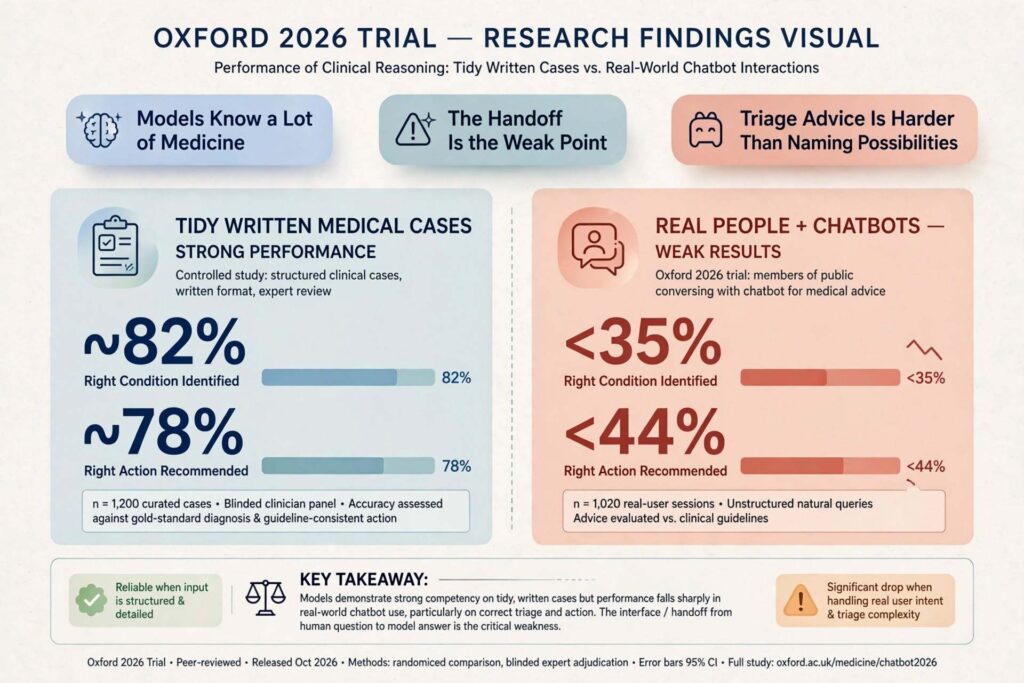
The most important study I’ve read on this is the large randomized trial from the University of Oxford, published in Nature Medicine in 2026. Researchers gave 1,298 people in the UK ten medical scenarios, ranging from a common cold to a life-threatening brain bleed. Some participants used one of three chatbots; others used whatever they normally would, like a web search.
Tested alone, the chatbots identified the right condition in about 95% of cases and picked the right course of action in about 56%. But when real people used them, relevant conditions were identified in fewer than 35% of cases and the right action in fewer than 44%. That was no better than the group using ordinary search.
Why the collapse? The researchers pointed to a communication breakdown. People often didn’t know what details the chatbot needed, so they left out key information. And the answers frequently mixed good advice with bad, leaving users unsure which part to follow. The tool wasn’t the only weak link. The conversation was.
Large language models across many health questions
A Penn State team had nine board-certified physicians grade AI responses to more than 200 health questions and symptom descriptions. The average accuracy was around 76%, which beat traditional search engines. Performance was strongest on routine questions about common illnesses and weaker in dermatology, mental health and internal medicine. The authors’ message to the public was caution, not panic.
Research prototypes and company studies
Google’s research team has described a conversational symptom assessment prototype called SymptomAI and reported that its top-five differential list more often contained the diagnosis later given by a person’s own clinician than the clinicians’ own lists did. Interesting, but it’s a research benchmark, not a product you can rely on, and the comparison used self-reported diagnoses. Similarly, some symptom checker developers publish studies showing their tool beating competitors, often funded by the company itself. Treat sponsor-funded accuracy claims the way you’d treat a restaurant reviewing itself.
Consistency problems
One small study asked a popular chatbot the same orthopedic questions over five days and found inconsistent accuracy. If a tool gives different answers to identical symptoms, a single reassuring reply isn’t evidence of anything.
The Takeaway From All This Research
Put these AI self-diagnosis findings side by side and a pattern emerges:
- Modern AI knows a lot of medicine. Its knowledge is rarely the problem.
- The weak point is the handoff between a person and the tool: what you say, what it asks, and how you read what comes back.
- Diagnosis lists are better than triage advice. Naming possibilities is easier than deciding how urgent your situation is.
- Performance drops on exactly the areas where symptoms are vague or emotional: skin, mood, tiredness, pain without a clear cause.
So the way to use AI self-diagnosis well is to treat it as a thinking aid, a way to organise questions, and never as the judge of whether something is serious.
Why AI Self-Diagnosis Gets It Wrong With Real Patients
You leave out what matters
A doctor asks follow-up questions because patients rarely volunteer the one detail that changes everything: the pain started after a long flight, the cough has blood in it, the headache is the worst of your life. Chatbots are inconsistent about asking, and people are inconsistent about answering.
Confidence without calibration
AI answers read as fluent and certain. They rarely convey “I’m only moderately sure,” and they can state a wrong claim in the same tone as a right one. Humans over-trust confident text, and that tendency has a name: automation bias.
No examination, no tests, no history
A clinician looks at you, feels the abdomen, checks your pulse and has your records. A chatbot has a paragraph you typed. Many conditions can’t be separated without a test, and “viral infection” is a polite way of saying “I can’t tell from this.”
Bias in training data
Models learn from the data they’re given. Skin conditions photographed mostly on light skin are harder to recognise on dark skin, and heart attack symptoms in women have long been under-described in medical literature. Tools can inherit those gaps. If you have a darker skin tone or atypical symptoms, be extra careful about reassurance.
Anchoring
If the first answer sounds right, we stop looking. People also anchor on the scariest possibility. Both are bad for decisions.
Where AI Self-Diagnosis Genuinely Helps
I don’t want this to read as a lecture against the technology. Used well, it helps in specific ways:
- Translating jargon. Lab reports, discharge summaries and radiology reports are written for clinicians. Asking what a term means is a good use.
- Preparing for an appointment. Turning a messy symptom story into a clean timeline and a list of questions makes a 10-minute consultation far more productive.
- Understanding a diagnosis you already have. Explaining how a condition works, what a medicine does, what side effects to watch for.
- Generating possibilities to raise with a doctor. Not to settle on one.
- Finding the right type of care. Knowing whether a problem belongs with a GP, a specialist or a physiotherapist.
- Support between visits. Medication reminders, symptom diaries, exercise plans from your clinician.
For routine, low-stakes queries such as a mild cold, AI self-diagnosis can save time. Our guides on natural remedies for cold, flu and sore throat and walking pneumonia are the kind of reading that pairs well with an AI summary, because they tell you what’s normal, how long it lasts and when a cough crosses the line.

When AI Self-Diagnosis Is the Wrong Tool
Don’t rely on AI self-diagnosis to decide what to do if you have any of the following. Get urgent in-person care or call your emergency number (112 in India, 911 in the US, 999 in the UK, 112 in much of Europe).
- Chest pain, pressure or tightness, especially with sweating, breathlessness or pain spreading to the arm or jaw
- Signs of a stroke: face drooping, arm weakness, slurred speech, sudden vision loss
- A sudden, severe headache unlike any you’ve had
- Difficulty breathing, blue lips, or a severe allergic reaction
- Heavy bleeding, vomiting blood, or black tarry stools
- Confusion, fainting, seizures or a sudden change in alertness
- Fever in a newborn or a very sick-looking child
- Pregnancy with bleeding, severe pain or reduced baby movement
- Thoughts of harming yourself, which need immediate human help, not a chatbot
In these situations the cost of a wrong answer is enormous and the time to double-check is gone.
A Simple Way to Think About the Risk of AI Self-Diagnosis
Here’s the lens I’d borrow from personal finance. When you make a decision under uncertainty, don’t just ask “how likely is it that I’m right?” Ask “what does it cost if I’m wrong, in each direction?”
If a chatbot wrongly tells you a skin tag is harmless, the cost is usually small. If it wrongly tells you chest tightness is anxiety, the cost can be your life. A false alarm costs you a few hours and a clinic fee. False reassurance can cost far more. That asymmetry is why self-triage deserves the most caution, and why you should always lean toward over-checking rather than under-checking when the stakes are high.
A Traffic-Light Guide to AI Self-Diagnosis
| Light | Situation | What to do |
|---|---|---|
| Green | Understanding a known diagnosis, a medicine, a lab term, or general wellness | AI is a reasonable first stop. Verify anything important. |
| Amber | New symptoms lasting more than a few days, unexplained fatigue, skin changes, mood changes, recurring pain | Use AI to organise your story, then book a doctor. Don’t treat its answer as a conclusion. |
| Red | Anything in the emergency list above, symptoms getting rapidly worse, symptoms in infants, pregnancy or older frail adults | Skip the app. Get care now. |
How to Use AI Self-Diagnosis More Safely
The Oxford study found the failure point in AI self-diagnosis was the conversation, so improve the conversation. This is the routine I’d follow.
- Give the basics. Age, sex, pregnancy status, existing conditions, medicines and allergies.
- Describe the timeline. When it started, whether it’s getting better or worse, what makes it change.
- Include the details people forget: fever readings, recent travel, new foods or medicines, injuries, family history, recent stress or sleep changes.
- Ask for a list, not a verdict. “What are the possible causes, from most to least likely, and what would make each more or less likely?”
- Ask what would make it urgent. “What warning signs would mean I should seek care today?”
- Ask what information it still needs. Let it question you.
- Run it twice. Rephrase and compare. If the answers disagree on urgency, assume the more cautious one.
- Cross-check with a trusted source, such as a national health service site, a hospital patient guide or a clinician.
- Write down your questions and take them to your doctor.
- Set a deadline. If symptoms haven’t clearly improved in a few days, or they worsen, book care regardless of what any tool said.
Wearables and Digital Health Tools: What They Can and Can’t Do
Smartwatches and rings are the other half of digital health, and they come with their own set of misunderstandings.
Fairly reliable: resting heart rate, step counts, and irregular rhythm alerts for atrial fibrillation on some clinically validated devices. Those alerts are worth taking to a doctor, though they can produce false positives.
Useful trends, shaky absolutes: sleep duration and heart rate variability. The pattern over weeks tells you more than any single night.
Unreliable: calorie burn estimates, “stress scores” and many “readiness” numbers. They are proprietary calculations, not clinical measurements. Blood oxygen readings can be less accurate across skin tones and in poor contact.
Wearables extend AI self-diagnosis into daily life, and the risk is anxiety, not just error. A number that dips for one night can trigger a spiral. If the data makes you more worried without changing what you do, it’s costing you more than it gives. Our piece on low-friction prevention is a good reminder that consistent habits beat constant monitoring, and light hygiene shows how much sleep quality depends on things a tracker can’t fix.
Privacy in AI Self-Diagnosis: What You Hand Over When You Describe Symptoms
Health data is among the most sensitive information you have, yet many people paste symptoms, scan results and lab reports into consumer chatbots without a second thought.
- In many countries, general consumer chatbots aren’t covered by the medical privacy rules that bind your doctor. Data protection law varies by country, so read the app’s privacy policy.
- Check whether your conversations are stored, used for training, or shared with partners, and whether you can turn that off.
- Remove names, dates of birth, ID numbers and addresses before uploading a report.
- Be cautious with apps that connect to your wearable, pharmacy or insurance data.
- If a service is free, ask how it makes money.
AI Self-Diagnosis, Health Anxiety and Mental Health
Researchers have linked heavy use of AI self-diagnosis and online symptom tools with greater health anxiety in some users, a pattern sometimes called cyberchondria. Searching “could this be cancer?” at 2 a.m. rarely ends in calm. If you notice you’re checking repeatedly, getting more worried, or avoiding a doctor because you’ve already “diagnosed” yourself, that’s a signal to stop and talk to a real person.
AI is also being used as a stand-in for therapy. A chatbot can be a place to put thoughts down, but it isn’t a clinician and shouldn’t be your only support, particularly for depression, trauma or self-harm. Our Mental Health section covers practical, evidence-based options. If you’re in crisis, contact local emergency services or a crisis line in your country right away.
Real-Life AI Self-Diagnosis Scenarios (Illustrative Examples)
These are composite examples to show how the guidance plays out, not individual patient cases.
Tired, hair shedding, periods heavier than usual. A chatbot suggests thyroid problems, anemia or hormonal changes. That’s reasonable, and it’s a useful list to take to a doctor, who can order ferritin, TSH and a full blood count. You can read more in our guides to iron deficiency and anemia in women and women’s hormonal health. The AI helps you ask better questions. The blood test gives the answer.
Cough for three weeks, mild fever, no breathlessness. A chatbot suggests a lingering viral infection, allergies or a mild chest infection. Reading about walking pneumonia helps you recognise the pattern, but persistent cough warrants a clinical check, and any blood or breathing trouble moves this to red.
Chest tightness after climbing stairs, age 52. This is red territory. A chatbot suggesting acid reflux or stress is exactly the sort of plausible, wrong answer that causes harm. Don’t ask a tool. Get assessed the same day.
How to Talk to Your Doctor About AI Self-Diagnosis Results
Many people hide their AI self-diagnosis from their doctor because they expect to be dismissed. In my experience, clinicians respond far better when you’re open and specific.
- Say it plainly: “I used an AI tool and it suggested a few possibilities I’d like to ask about.”
- Bring your timeline and a short list of questions, not a printed diagnosis.
- Ask “what would make you more or less worried about this?” and “what should I do if it gets worse?”
- Ask which tests would separate the possibilities.
A good doctor will use your research as a starting point, not a threat.
How to Judge an AI Self-Diagnosis Tool Before You Trust It
If you’re choosing a tool for AI self-diagnosis or general health use, check for:
- Clear limits. Does it say what it can’t do and push you toward care when needed?
- Evidence. Has it been tested in published studies with real users, not just exam-style questions?
- Independent validation. Not just company-sponsored results.
- Regulatory status. Some tools are cleared as medical devices in certain countries. Most general chatbots aren’t.
- Transparent sourcing. Does it cite where its information comes from?
- Sensible privacy terms.
- Human backup. A route to a clinician when the tool is out of its depth.
If it never says “I don’t know” or “see a doctor,” be suspicious.
Where to Go Next
- Everyday illness and recovery: Walking pneumonia, Natural remedies for cold, flu and sore throat
- Building habits that actually hold: Low-friction prevention, Light hygiene and sleep
- Women’s health and lab results: Women’s hormonal health, Iron deficiency in women
- Hype versus evidence in wellness tech: NAD+ and mitochondrial health, Mushroom coffee, Functional protein and next-gen collagen
- Personalized health claims: DNA-based nutrition
- More guides: Health & Wellness and Mental Health
Frequently Asked Questions About AI Self-Diagnosis
1. Is AI self-diagnosis accurate?
It depends on the tool and the task. On tidy written cases, modern chatbots can name the right condition most of the time. But in a large 2026 Oxford trial, real people using chatbots identified the right condition in fewer than one in three cases and chose the right action in fewer than half, no better than using search. Accuracy on paper doesn’t guarantee safety in practice.
2. Can I trust ChatGPT for AI self-diagnosis or medical advice?
Trust them for explanations, preparation and questions to ask, not for deciding whether something is serious. They can sound confident while being wrong, answers can vary from one attempt to the next, and they don’t examine you or order tests.
3. Are symptom checkers better than chatbots for AI self-diagnosis?
Older rule-based symptom checkers were right within their top three suggestions about half the time in one well-known comparison, and newer chatbots scored higher on written cases. Neither has been shown to make everyday decisions safer for real users. Treat both as starting points.
4. Which symptoms should never go through AI self-diagnosis?
Chest pain, stroke signs, severe breathing difficulty, heavy bleeding, sudden severe headache, confusion or fainting, seizures, serious allergic reactions, fever in newborns, pregnancy complications and thoughts of self-harm. Call your emergency number or go to the nearest emergency department.
5. How do I describe symptoms to an AI for better answers?
Include age, sex, pregnancy status, medical history, medicines, allergies, timeline, severity, what makes it better or worse, and any red flags. Ask for a ranked list of possibilities and the warning signs that mean you should seek care today. Then ask what information it’s missing.
6. Is it safe to upload lab reports for AI self-diagnosis?
It can be useful for explanations, but check the privacy policy first. Remove names, ID numbers and dates of birth, and avoid uploading anything you wouldn’t want stored. Consumer chatbots aren’t always bound by the same privacy rules as your doctor.
7. Can AI self-diagnosis replace my doctor?
No. AI can help you understand and prepare, but it can’t examine you, order and interpret tests in context, or take responsibility for your care. The research so far points to AI working best alongside clinicians.
8. Do smartwatches and digital health devices diagnose problems?
Mostly no. Some devices have validated features, such as irregular heart rhythm alerts, which are meant to prompt a medical check. Many other metrics, like stress scores and calorie burn, are estimates. Use them for trends and take concerning alerts to a clinician.
9. Can AI self-diagnosis cause health anxiety?
Yes, for some people. Repeatedly searching symptoms or checking trackers can raise worry without improving decisions. If you’re spiralling or avoiding care because of what a tool said, step back and speak to a doctor or counsellor.
10. How should I tell my doctor I used AI?
Be direct and calm: “I used an AI tool and it suggested a few possibilities. Can we go through them?” Bring your symptom timeline and your questions. Most doctors appreciate the preparation, as long as you stay open to their examination and judgment.
Final Thoughts
AI self-diagnosis isn’t going away, and for plenty of everyday questions it’s a real help. But the best evidence we have says the risk lives in the gap between what a model knows and what a worried person can get out of it. Use these tools to understand, to prepare and to ask better questions. Keep them away from emergencies and from the decision of how urgent your symptoms are. And when your gut tells you something is wrong, let a human check.
If you want more evidence-led guides on health and technology, browse our Health & Wellness section.
Disclaimer: this article is general education and not medical advice. It can’t diagnose or treat any condition. Always consult a qualified healthcare professional about symptoms, and seek emergency care if you suspect a serious problem. See our full disclaimer.
Research referenced: the University of Oxford’s randomized study on public use of large language models for medical decisions, published in Nature Medicine and summarised by Oxford; the Penn State physician evaluation of AI health answers (2026 ACM FAccT conference); the comparison of ChatGPT with symptom checkers reported in STAT; and Google Research’s SymptomAI prototype.







Leave a Reply