
Functional protein is the label that’s quietly taking over supplement shelves, and it usually means a protein product that promises something extra: better skin, stronger joints, a calmer gut, steadier blood sugar. The poster child is next-gen collagen, the powders, tablets and “beauty waters” that now sit next to whey in every store. Some functional protein claims are backed by decent trials. Others are a pretty tub and a price tag. This guide to functional protein sorts one from the other, shows you what the latest research says about collagen peptides, and gives you a way to decide whether any of it belongs in your routine, and your budget.
Educational content only. It doesn’t replace advice from your doctor or a registered dietitian.
What “Functional Protein” Actually Means
There’s no legal or scientific definition. Functional protein is a marketing term for protein plus a bioactive claim. In practice that covers a few families:
- Collagen peptides for skin, joints, hair and nails
- Whey or plant protein with added fibre, probiotics or prebiotics for gut health and fullness
- Protein with creatine, leucine or vitamin D for muscle and strength
- Casein or slow-release blends for overnight recovery
- Protein with adaptogens or mushrooms, which is where marketing tends to run furthest ahead of evidence (we looked at the same pattern in mushroom coffee and lion’s mane)
The useful question about any functional protein isn’t “is it functional?” It’s “what does the functional part do, at what dose, and was that dose in the studies?” Keep that question in your pocket. It will save you money every time you stand in a supplement aisle.
Why This Category Exploded
Three things pushed functional protein from gym bags to kitchen counters. First, protein became a mainstream health goal, not just a bodybuilding one. Second, people on weight-loss medications were told to protect muscle, which sent them looking for easy protein sources. Third, women’s nutrition finally got attention; for decades the research base was built mostly on men, a gap we discuss in our piece on sex-specific nutrition for women.
Collagen became the flagship of the functional protein trend because it has a believable story. It’s the most abundant protein in your body, making up roughly 30% of your total protein, and it gives skin, tendons, cartilage and bone their structure. Levels fall with age. Replace it, the logic goes, and you slow the decline. The trouble is that eating collagen isn’t the same as building it, and that gap is where the real science (and the real marketing) lives.
Collagen 101: Types, Peptides and the Tryptophan Problem
Your body makes at least 28 types of collagen. The three you’ll meet on a label are:
- Type I: skin, bone, tendon, ligament. The most common in supplements.
- Type II: cartilage. Used in joint products.
- Type III: skin, blood vessels, gut lining, often paired with type I.
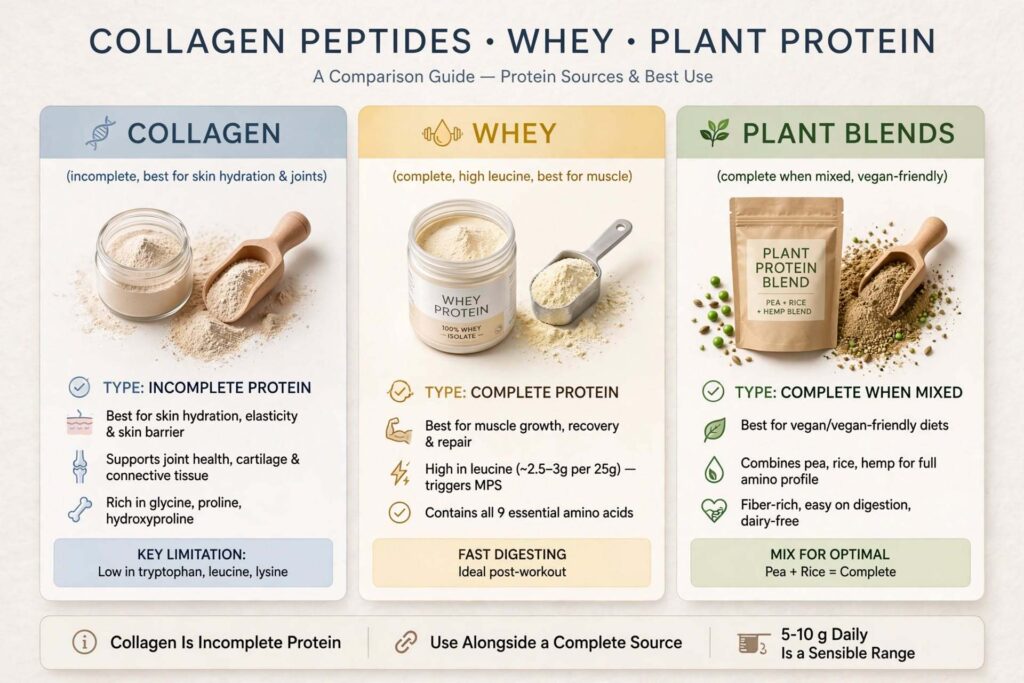
Collagen is rich in glycine, proline and hydroxyproline. What it lacks is tryptophan, an essential amino acid, which means collagen is an incomplete protein. It counts toward your total grams on the label but does not do the same job as whey, eggs, soy or fish for building muscle. That one fact is missing from a surprising number of product pages.
Whole collagen is too big to absorb, so supplements use hydrolyzed collagen (collagen peptides): protein that’s been chopped into small fragments. Some of those fragments, including short di- and tri-peptides, reach the bloodstream and appear to signal skin and connective tissue cells. That’s the plausible mechanism behind the benefit. Plausible isn’t proven, which brings us to the evidence.
What Next-Gen Collagen Really Means
The phrase has no official definition, just like functional protein itself, but next-gen collagen generally points to one of these upgrades:
- Multi-collagen blends combining bovine, marine, chicken or eggshell sources to cover types I, II, III, V and X
- Targeted peptides and tripeptides, such as products built around the glycine-proline-hydroxyproline sequence
- Undenatured type II collagen (UC-II), taken at a tiny dose for joint comfort, working through an entirely different (immune-mediated) mechanism than regular peptides
- Collagen with co-factors: vitamin C, hyaluronic acid, silica, biotin, zinc
- Precision-fermentation or recombinant collagen, made by microbes rather than animals, aimed at vegetarians and brands that want to avoid animal sourcing
- “Vegan collagen” boosters, which don’t contain collagen at all, just amino acids and vitamin C meant to support your own production
Numbers 5 and 6 of next-gen collagen are worth separating. Recombinant collagen is an actual collagen-like protein; “vegan collagen” is a blend of building blocks. They are not interchangeable, and the second has far thinner human evidence. Compare them to the first four as separate categories, not as upgrades of each other.
What the Research Shows About Next-Gen Collagen and Collagen Peptides
Here’s where honest writing on functional protein beats hype.
Skin: the strongest evidence
A 2023 meta-analysis pooling 26 randomized trials and 1,721 participants found that oral collagen peptides improved skin hydration and elasticity compared with placebo. An updated 2026 analysis reported a moderate effect on elasticity, a smaller one on hydration, and better skin barrier function through reduced water loss. So far, good.
Now the part most competitors skip. The same updated analysis did not find robust evidence that oral collagen reduces wrinkles or increases dermal density once study differences and outliers were accounted for. It also found no clear relationship between higher daily doses and bigger results. In plain terms: collagen peptides seem to make skin a bit more hydrated and bouncy. They haven’t been shown to erase lines, and taking more doesn’t reliably do more.
Joints and tendons: small to moderate
Trials in people with knee osteoarthritis and in active adults report modest pain and function improvements. These effects are real enough to try for a few months, not big enough to replace physiotherapy, strength work or weight management. Some of the more interesting data pairs collagen with vitamin C before loading tendons, but those studies are small.
Muscle: helpful only with training, and not instead of other protein
A few small trials, mostly in older men doing resistance training, found collagen peptides produced similar or slightly better gains in fat-free mass than placebo. That’s encouraging for older adults, but it doesn’t make collagen equal to whey. Leucine, the amino acid that switches on muscle building, is low in collagen. If muscle is your goal, a complete protein is the base layer and collagen is an optional add-on.
Bone
Early trials show small improvements in bone density markers in postmenopausal women, but the evidence is thinner than for skin. Calcium, vitamin D, protein overall, and resistance training have a much stronger case.
Hair and nails
Mostly small studies, often funded by the manufacturer. If your hair shedding is heavy, check iron, thyroid and ferritin first; our guides to iron deficiency and anemia in women and hair fall solutions explain why.
The Gaps Nobody Mentions About Functional Protein
If you’ve read other functional protein or collagen guides, you’ve probably seen the benefits list but not the caveats. These are the ones that matter.
Almost every skin trial compares collagen to placebo, not to an equal amount of other protein. So we can’t be sure whether the benefit comes from something special about collagen peptides or simply from adding protein to the diet. Few trials have tested that directly.
A lot of the research is industry-funded. That doesn’t invalidate it, but it’s a reason to read effect sizes with a cool head.
More isn’t better. Studies use anywhere from a few grams to around 15 g a day, and the 2026 analysis found no clear dose-response. Spending more on a bigger scoop is rarely the right move.
Timing is patient. Most skin trials run eight to twelve weeks before measuring. If someone promises results in two weeks, close the tab.
Age might matter. One 2026 review suggested benefits may be larger when people start in their 30s to late 40s, but that’s a single analysis, so treat it as interesting rather than settled.
Sunscreen, not smoking, sleep and retinoids still outrank any oral supplement for skin ageing. Collagen is a small tailwind, not a replacement for those basics.
Collagen vs Whey vs Plant Protein: Functional Protein Compared
| Collagen peptides | Whey protein | Plant blends (pea, rice, soy) | |
|---|---|---|---|
| Complete amino acid profile | No (lacks tryptophan) | Yes | Yes when blended well |
| Leucine content | Low | High | Moderate to high |
| Best evidence for | Skin hydration and elasticity, joint comfort | Muscle building, satiety | Muscle building, vegan diets |
| Typical dose in studies | About 2.5 to 15 g/day | 20 to 40 g/serving | 25 to 40 g/serving |
| Works as your only protein | No | Mostly | Often |
| Mixes easily | Very | Moderately | Varies |
The most sensible functional protein strategy for most people: get your main protein from whole foods and a complete protein powder, then add collagen as a separate, small scoop if you want to test it. If you’re still working out your overall target, our guide to protein powder for women breaks down how much you need and which type fits.
How Much Protein Do You Actually Need Before Adding Functional Protein?
The recommended dietary allowance is 0.8 g per kilogram of body weight, which many dietitians consider a minimum rather than a goal. Active adults, older adults and people losing weight often do better at roughly 1.2 to 1.6 g per kilogram, spread across meals with about 25 to 40 g of complete protein at each. Kidney disease changes this, so check with your doctor if that applies to you.
A functional protein like collagen can help you hit the total, but only count it as part of your protein if the rest of your intake already provides enough essential amino acids. Think of it as a supporting actor.
How to Choose a Collagen or Functional Protein Product
Here’s the checklist I’d use to judge any functional protein product if I were buying for myself.
- Read the grams per serving. Many “collagen” products contain 1 to 2 g of collagen and a lot of marketing. Trial-level doses start around 2.5 g and usually sit between 5 and 15 g.
- Check the form. Hydrolyzed collagen or collagen peptides are what the studies used. UC-II is a separate joint-focused product with a much smaller dose.
- Look at the source and your diet. Bovine collagen won’t suit many Hindu or Muslim consumers and some vegetarians; marine collagen is a problem if you have a fish allergy. Look for halal or kosher certification if that matters to you.
- Ask for third-party testing. Collagen comes from animal tissue, so heavy metals and contaminants are a legitimate concern. Seals like NSF Certified for Sport or Informed Sport are a good sign.
- Beware proprietary blends. If a label hides the grams of each ingredient, you can’t compare it with trial doses.
- Skip the sweetener and additive pile-up. Flavoured powders with long ingredient lists may not suit your gut. Plain or lightly flavoured is easier to tolerate.
- Be skeptical of miracle language. “Boosts your body’s collagen production by X%” almost always refers to a lab or small study, not a visible outcome.
The cost-per-dose test
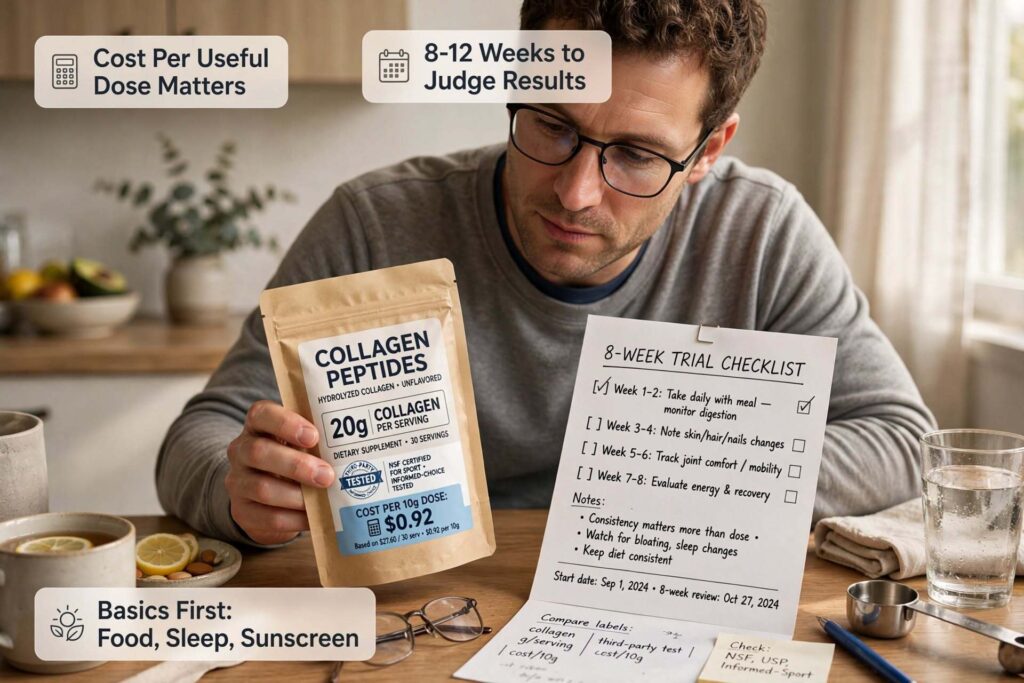
This is the habit I’d steal from personal finance: compare products by cost per useful unit, not sticker price. Divide the price by the number of servings, then divide by the grams of collagen per serving, and multiply by ten. That gives you the cost of a 10 g dose. A cheap tub with 2 g per scoop can cost more per effective dose than a pricier one with 10 g. Do this before you subscribe to any functional protein product, and recheck it after three months to see whether the product earned its place in your budget.
Food First: Supporting Collagen Without a Powder
You don’t need a supplement to give your body what it needs to make collagen.
- Enough total protein from fish, eggs, dairy, meat, lentils, tofu and nuts
- Vitamin C from citrus, amla, guava, peppers and berries, which your body needs to build collagen
- Zinc and copper from seeds, legumes, nuts and shellfish
- Bone broth if you enjoy it, though collagen content varies widely and it isn’t a reliable dose
- Fish with skin, chicken with skin, and slow-cooked cuts for gelatin-rich meals
Lifestyle factors matter as much as food. UV exposure, smoking, high sugar intake and poor sleep all accelerate collagen breakdown. Better light and sleep habits (see our guide to light hygiene and circadian health) support skin repair in ways no powder can replicate.
Who May Benefit From Functional Protein, and Who Can Skip It
A functional protein like collagen may be worth trying if you’re in your 30s to 50s and want a modest improvement in skin hydration, have mild joint discomfort and already exercise, or are an older adult doing resistance training and struggling to eat enough protein.
You can probably skip functional protein products if your diet already covers protein and vitamin C well and you’re not bothered by skin dryness or joint pain, if your budget is tight (spend on food, sleep and sunscreen first), or if you expect wrinkle removal.
Talk to a clinician first if you’re pregnant or breastfeeding, have kidney disease, have a history of kidney stones, take blood thinners or other prescription medication, or have food allergies to fish, shellfish or eggs. For general guidance on using supplements wisely, browse our supplement safety articles.
Collagen, Perimenopause and Women Over 40
Estrogen helps maintain skin thickness and bone density, so skin dryness, joint aches and muscle loss often show up together around perimenopause. Collagen peptides may help a little with skin hydration and joint comfort, but the heavy lifting still comes from strength training, adequate protein, calcium, vitamin D and, for some women, hormone therapy. Our guide to perimenopause symptoms and how to manage them covers the full picture, and our perimenopause and menopause natural remedies article goes through what is and isn’t worth trying.
Functional Protein for Gut, Blood Sugar and Weight Goals
Collagen gets the headlines, but other functional protein formats may suit your goals better:
- Protein plus fibre can improve fullness and support steadier blood sugar after meals. See our notes on blood sugar and insulin resistance.
- Protein-forward meals while using weight-loss medications help preserve muscle. Our GLP-1 foods articles cover practical choices.
- Probiotic or prebiotic protein blends may help some people, though strain, dose and your own gut matter more than the tub’s label. Our gut health tag has the basics.
- Creatine with protein has strong evidence for strength and muscle in both men and women, more than most “beauty” blends.
If you like the idea of personalizing your approach, read our honest take on DNA-based nutrition before paying for a genetic test.
Functional Protein Safety and Side Effects
Collagen peptides are generally well tolerated. The most common complaints are mild digestive upset, a heavy feeling in the stomach, or an unpleasant aftertaste. Other things to keep in mind:
- Collagen can contain trace contaminants, so third-party testing matters.
- People with kidney problems should be careful about overall protein intake.
- Allergic reactions are possible with fish, shellfish or egg-derived products.
- Supplements are not regulated like medicines in most countries, so quality varies widely.
- Very high doses haven’t been shown to give extra benefit, so there’s no reason to push them.
A reasonable rule for any functional protein: start with one product at a time, give it eight to twelve weeks, and stop if you notice digestive trouble, rash or any unusual symptoms.
A Simple Eight-Week Test for Any Functional Protein
If you’re curious but skeptical, run your own test.
- Take a clear baseline: photo in daylight, a note on skin dryness, and a rating of joint pain from 1 to 10.
- Pick one product with 5 to 10 g of hydrolyzed collagen per serving and a third-party test seal.
- Take it daily with a vitamin C-containing food or drink.
- Change nothing else in your skincare or training for eight weeks.
- Re-rate your skin and joints at week eight. If you can’t tell the difference, don’t re-order.
Testing a functional protein this way follows the same principle as our article on low-friction prevention: keep changes simple enough that you can actually judge them.
Where to Go Next
- Functional protein basics: Protein powder for women
- Why women’s needs differ: Sex-specific nutrition
- Hair and nutrient gaps: Iron deficiency in women, Hair fall solutions
- Hype versus evidence: Mushroom coffee, NAD+ precursors
- Liver and clean-up claims: Liver health beyond detox
- More guides: Nutrition & Diet and Skin & Beauty
Frequently Asked Questions About Functional Protein and Collagen
1. What is functional protein?
Functional protein is protein that comes with an added benefit claim, such as collagen for skin, probiotics for gut health, or creatine for strength. It isn’t a regulated term, so the benefit depends entirely on the added ingredient, its dose and the quality of the evidence behind it.
2. Does collagen powder really work for skin?
Reasonably well for hydration and elasticity. Several meta-analyses of randomized trials show moderate improvements over placebo after about eight to twelve weeks. Evidence that it reduces wrinkles or thickens deeper skin layers is much weaker.
3. Is collagen a complete protein?
No. Collagen lacks tryptophan and is low in several other essential amino acids, so it can’t be your only protein source. Use it alongside whey, eggs, fish, dairy, soy or well-combined plant proteins.
4. What does next-gen collagen mean?
It’s a marketing phrase for upgraded formats: multi-collagen blends, targeted tripeptides, undenatured type II collagen for joints, collagen with vitamin C or hyaluronic acid, and recombinant collagen made by fermentation. Check which type is inside before you pay extra.
5. How much collagen should I take per day?
Trials generally use somewhere between 2.5 and 15 g a day. The newest analysis found no clear advantage for higher doses, so 5 to 10 g is a sensible range for most adults. Always follow the label and your clinician’s advice.
6. How long does collagen take to work?
Most studies measure results after eight to twelve weeks of daily use. Skin hydration tends to change earlier than elasticity, and joint comfort can take longer. If nothing changes after three months, it probably isn’t helping you.
7. Is collagen better than whey protein?
They do different jobs. Whey is a complete, leucine-rich protein that’s better for building muscle. Collagen has better evidence for skin hydration and connective tissue. Many people use whey as their main powder and collagen as an occasional add-on.
8. Is vegan collagen real?
Not exactly. Plants don’t contain collagen. “Vegan collagen” products are usually blends of amino acids, vitamin C and minerals meant to support your own production. Recombinant collagen made by microbes is a different, newer technology with limited human data.
9. Are there side effects or risks?
Most people tolerate collagen well. Mild bloating and taste complaints are the main issues. Watch for allergies to fish, shellfish or egg, choose third-party tested products, and speak with a doctor if you have kidney disease, are pregnant or take regular medication.
10. Can I get enough collagen support from food?
You can support your body’s collagen production with enough protein, vitamin C, zinc, copper and good sleep. Bone broth and gelatin-rich dishes contain collagen but in variable amounts. Powders offer a more predictable dose, but they aren’t essential.
Final Thoughts
Functional protein isn’t a scam, and it isn’t a miracle. Collagen peptides have a modest, credible case for skin hydration and some joint comfort, and nothing yet shows they erase wrinkles or replace complete protein. The smart move with next-gen collagen is to get your basics right, pick a tested product at a sensible dose, run a fair eight-week trial, and judge it by cost per useful dose. If it earns its place, keep it. If not, put that money into better food and better sleep.
For more practical, evidence-led guides, browse our Nutrition & Diet section.
Disclaimer: this article is general education and not medical advice. Speak to a qualified healthcare provider before starting any supplement. See our full disclaimer.
Research referenced: the 2023 meta-analysis of 26 randomized trials on hydrolyzed collagen and skin (Nutrients), summarized in a 2026 Springer review, and the 2026 updated meta-analysis reported by Dermatology Times.






Leave a Reply