
Microplastics in skincare and cosmetics stopped being a niche environmental concern the moment researchers confirmed these particles can cross the skin barrier and carry harmful chemical additives with them. This isn’t speculative anymore — a 2026 peer-reviewed review found that microplastics in cosmetics can penetrate the skin barrier, trigger oxidative stress, promote inflammation, and contribute to premature skin aging, while a separate 2026 study specifically quantified how many of these particles are sitting in the treatment creams already in most people’s bathroom cabinets. This guide covers what the actual research shows about skin absorption, exactly which ingredient names to watch for, what the EU and US are (and aren’t) doing about it, and how to make lower-risk choices without needing a chemistry degree to read a label.
What Microplastics Are Doing in Your Skincare in the First Place
Microplastics aren’t accidental contamination in most personal care products — they’re intentionally added ingredients. Manufacturers use tiny plastic particles for exfoliation, to modify texture, to stabilize emulsions so oil and water phases don’t separate, and to create the shimmering or matte finish in makeup. A 2025 study specifically analyzing skin-cleansing products found microplastics added deliberately across scrubs, cleansers, and micellar waters for exactly these functional reasons — this is a manufacturing choice, not an unintended byproduct.
What the Research Actually Shows About Skin Absorption
For years, the assumption in dermatology was that intact skin was a fairly effective barrier against particle penetration. More recent research complicates that picture considerably.
A 2026 comprehensive review, published in a peer-reviewed toxicology journal, concluded that microplastics can penetrate the skin barrier and are linked to oxidative stress, inflammation, and premature aging of skin tissue — though the review’s authors were also careful to note that global regulatory inconsistencies remain a barrier to fully understanding and controlling the problem, and that long-term human health effects still need more research to characterize completely.
Separately, and arguably more concerning, a study using 3D human skin-equivalent models found that flame-retardant chemical additives commonly bound to microplastics — including polybrominated diphenyl ethers (PBDEs) — passed through the skin barrier and into simulated bloodstream models, with sweaty skin absorbing more than dry skin. The researchers’ broader point was that the particles themselves may matter less than the toxic additives they carry: these chemicals have documented associations with endocrine disruption, reproductive toxicity, neurotoxicity, liver toxicity, and cancer risk in existing toxicology research, independent of the microplastics debate specifically.
A 2026 review published by the American Journal of Managed Care went further, linking nanosized microplastics and related plastic-associated chemicals to a specific list of dermatologic conditions: cutaneous inflammation, accelerated skin aging, acne, atopic dermatitis, skin cancer, and urticaria (hives). Skin inflammation rarely has just one cause, either — our guide to gut health signs, causes, and what helps covers how internal inflammation often shows up on skin, too. The same review flagged that this goes beyond plastics in the traditional sense — ingredients like dimethicone and carbomer, found respectively in roughly 20% and 11% of personal care products surveyed, are polymers with genuinely limited human safety data despite widespread, longstanding use.
The honest caveat across all of this research: most of the strongest mechanistic evidence — oxidative stress, inflammation, barrier disruption — comes from cell and skin-model studies rather than long-term human trials, which is a real evidence gap the reviews themselves acknowledge. What’s not in dispute is that the exposure is real and measurable; what’s still being worked out is the precise scale of the long-term health impact in humans.
Which Ingredients to Actually Look For
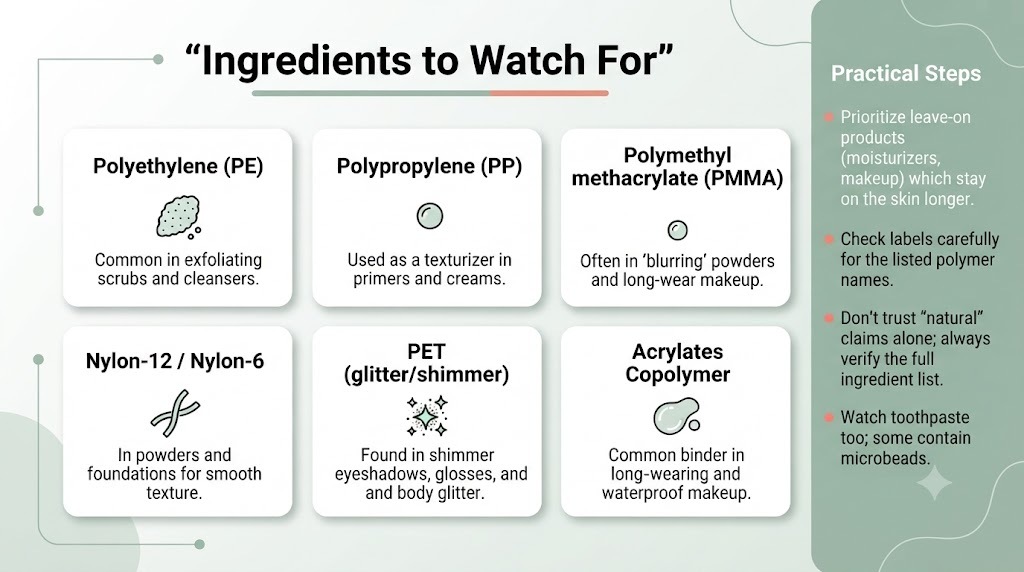
This is the practical part most coverage skips. Not everything with “poly-” in the name is a plastic, and not every plastic-adjacent ingredient is currently regulated, so it helps to know specifically what to check for:
Common microplastic ingredients to watch for on a label:
- Polyethylene (PE) — most common in older exfoliating scrubs
- Polypropylene (PP)
- Polymethyl methacrylate (PMMA) — used for a pore-blurring, soft-focus effect
- Nylon-12, Nylon-6, or “Polyamide” — used in powders, primers, and mascara for texture
- Polyethylene terephthalate (PET) — used for shimmer and glitter in makeup
- Acrylates copolymer / acrylates crosspolymer — used as a film-former in long-wear and waterproof formulas
- Polyurethane
Worth knowing, but genuinely NOT microplastics — these get flagged incorrectly often enough that it’s worth naming them specifically: cetearyl alcohol (a fatty alcohol from coconut or palm, not a drying alcohol or a plastic), and xanthan gum (a natural polysaccharide thickener, not a synthetic acrylate). Reading ingredient panels carefully in both directions — not just flagging plastics, but correctly clearing safe ingredients — is part of doing this well, the same way we approach dosing nuance in our vitamin E capsule benefits and risks guide.
The Regulatory Gap Most People Don’t Realize Exists
The Microbead-Free Waters Act of 2015 banned plastic microbeads in rinse-off products in the United States — the exfoliating beads you’d see in a face scrub. What it did not do is cover leave-on products: moisturizers, foundation, sunscreen, and most of what actually sits on skin for hours rather than being rinsed off within a minute. Liquid polymers, film-forming agents, and plastic powders in leave-on products remain completely legal and unregulated in the US as of 2026.
The EU has gone considerably further, though on a slower timeline than most consumers realize. Under REACH Regulation 2023/2055, the EU has phased restrictions on intentionally added microplastics: rinse-off products like scrubs and cleansers must be microplastic-free by 2027, leave-on products follow by 2029, and color cosmetics — makeup, nail polish, products where plastic particles create shimmer or long-wear finish — aren’t required to comply until 2035. In other words, even in the more aggressively regulated EU market, a significant share of cosmetics will legally contain microplastics for close to another decade.
Practical Steps: Lowering Your Exposure Without Overhauling Your Routine
- Prioritize checking leave-on products first, since they sit on skin far longer than rinse-off items and face the least regulation
- Scan for the ingredient names above, particularly in exfoliants, long-wear foundation, waterproof mascara, and shimmer products, where plastic particles are most functionally useful to manufacturers
- Don’t assume “natural” or “clean” labeling means plastic-free — some products marketed as natural exfoliants still contain synthetic polymers elsewhere in the formula for texture or stability, so the marketing claim and the ingredient list don’t always match
- Toothpaste is a commonly overlooked source worth checking too, since it’s used daily and partially swallowed — polyethylene, PEG compounds, and acrylates copolymer show up in many mainstream formulas despite not being covered by the 2015 microbead ban
- Use ingredient-scanning apps or databases like Beat the Microbead or EWG Skin Deep if manually parsing ingredient lists feels tedious — they’re built specifically for this and update as ingredient databases expand
Who Should Be More Cautious
- People with compromised or already-inflamed skin barriers — conditions like eczema or atopic dermatitis may make skin more permeable to particle penetration, which is relevant given the documented association between plastic-associated chemicals and these same conditions
- Anyone using leave-on products daily over years — cumulative exposure from repeated, long-duration contact is a more relevant concern than occasional use
- Parents choosing products for children — children’s skin barriers are still developing, and the 2026 skincare cream study specifically flagged children as a population worth separate exposure analysis
Frequently Asked Questions
Are microplastics in skincare actually dangerous, or is this overblown? The concern is genuinely evidence-based rather than overblown — multiple 2025-2026 peer-reviewed studies have documented skin barrier penetration and links to inflammation and skin conditions. That said, the strongest evidence so far comes from lab and skin-model studies rather than long-term human trials, so the precise scale of real-world health risk is still being established rather than fully settled.
What’s the single easiest change to reduce microplastic exposure from skincare? Start with leave-on products (moisturizer, sunscreen, foundation) rather than rinse-off items, since they’re both less regulated and stay on skin far longer. Checking for polyethylene, nylon, acrylates copolymer, and PMMA on labels catches most common offenders.
Does the US ban microplastics in cosmetics? Only partially. The 2015 Microbead-Free Waters Act covers rinse-off products like face scrubs, but leave-on products — moisturizer, makeup, sunscreen — remain unregulated for microplastic content in the US as of 2026.
Are all polymers in skincare microplastics? No. Some widely used polymers like xanthan gum are naturally derived and not classified as microplastics. Others, like dimethicone and carbomer, aren’t classified as traditional plastics either, but do have genuinely limited human safety data despite common use — worth distinguishing from the clearly plastic ingredients above.
Is glitter makeup a bigger concern than regular makeup? Generally yes — glitter and shimmer particles in eyeshadow, highlighter, and nail polish commonly rely on PET or similar plastic particles specifically for their shine, and under EU rules, this category has the longest compliance runway (2035), meaning it’s likely to remain a higher-microplastic category longer than other cosmetics.
The Bottom Line
Microplastics in skincare and cosmetics isn’t a fringe environmental talking point anymore — it’s a documented exposure pathway with real, if still-developing, evidence linking it to skin inflammation, oxidative stress, and specific dermatologic conditions. The regulatory gap is wider than most people assume: the US ban only covers rinse-off products, and even the EU’s more thorough restrictions won’t fully apply to color cosmetics until 2035. You don’t need to overhaul your entire routine overnight, but knowing which ingredient names to check for — and which ones are commonly, incorrectly flagged — puts a genuinely evidence-backed decision in your hands rather than a marketing claim.
This article is for informational purposes only and is not a substitute for personalized medical or dermatological advice. Consult a dermatologist if you have a diagnosed skin condition or concerns about a specific product or ingredient.






Leave a Reply