Protein powder for women used to be marketed with pastel packaging, the word “slim” on the front, and a not-so-subtle promise that you’d get “toned” without ever getting bigger. That era is finally ending, and good riddance — because the research that’s accumulated over the last decade makes something very clear: most women aren’t eating too much protein, they’re eating far too little, and the consequences show up as lost muscle, weaker bones, stalled strength progress, constant hunger, and a metabolism that quietly slows with every passing decade. This guide covers what the science actually says about how much protein women need at different life stages, whether whey or plant-based protein is the better choice for your body, when to take it, what to look for on a label (including the contamination issue nobody talks about), and how your requirements shift across your menstrual cycle, pregnancy, and menopause. No pastel marketing, no “toning” myths — just the numbers and the reasoning behind them.
Why the “Toning” Myth Held Women Back for So Long
Let’s address this first, because it shapes everything else.
For decades, women were sold the idea that they should lift light weights for high reps to “tone” muscle, and that protein supplements were something men took to “bulk up.” Both ideas are physiologically wrong.
There is no such thing as “toning” as a separate process. What people call a toned look is simply more muscle plus less fat over it. Building that muscle requires two things: resistance training that actually challenges you, and enough protein to repair and build the tissue afterward. Women who avoid protein while doing endless light-weight circuits are, functionally, asking their bodies to build without materials.
And the fear of “getting bulky”? Women produce roughly 10–20 times less testosterone than men, which makes accidental bulk essentially impossible. Female physique athletes who look very muscular spend years training specifically and deliberately for that outcome. It does not happen by accident from drinking a protein shake.
How Much Protein Do Women Actually Need?
This is the question most women get wrong, largely because the official RDA is genuinely misleading.
The RDA Is a Floor, Not a Target
The standard RDA of 0.8 g of protein per kg of body weight is the amount required to prevent deficiency in a sedentary adult — it’s the minimum to avoid a problem, not the amount to thrive, build muscle, or preserve bone. Researchers increasingly argue this figure is insufficient for aging women in particular.
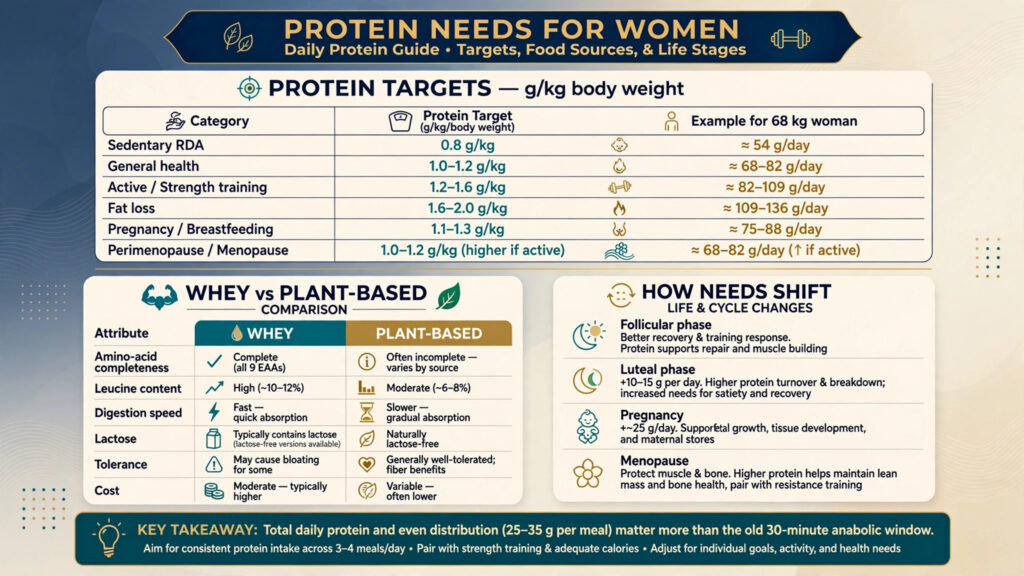
Realistic Targets by Situation
| Situation | Protein Target (per kg body weight) | Example (150 lb / 68 kg woman) |
|---|---|---|
| Sedentary minimum (RDA) | 0.8 g/kg | ~54 g/day |
| General health, lightly active | 1.0–1.2 g/kg | 68–82 g/day |
| Active / strength training | 1.2–1.6 g/kg | 82–109 g/day |
| Fat loss (preserving muscle) | 1.6–2.0 g/kg | 109–136 g/day |
| Pregnancy | 1.1–1.3 g/kg (~+25 g/day) | 75–88 g/day |
| Breastfeeding | 1.1–1.3 g/kg | 75–88 g/day |
| Perimenopause / menopause | 1.0–1.2 g/kg minimum | 68–82 g/day |
| Postmenopausal + active or dieting | 1.2–1.6 g/kg | 82–109 g/day |
Mayo Clinic guidance for postmenopausal women recommends 1.0 to 1.2 g per kg daily, with the higher end for those who exercise regularly, are older, or are attempting weight loss. Clinicians specializing in midlife women’s health often recommend around 1.2–1.3 g/kg, which works out to roughly 95 g daily for a 170-pound woman. Some researchers argue for an even higher 1.5–1.8 g per kg of lean body mass for aging women.
The ranges differ because the research is still evolving, but notice what they have in common: every single one is above the RDA. That’s the real takeaway.
How to Calculate Yours in 10 Seconds
- Divide your weight in pounds by 2.2 to get kilograms
- Multiply by your target number from the table above
A 150-pound woman who strength trains twice a week: 150 ÷ 2.2 = 68 kg × 1.4 = 95 g of protein per day.
Why Most Women Fall Short Without Realizing It
Here’s what a protein-light day quietly looks like: coffee and toast (5 g), a salad with a small amount of chicken at lunch (20 g), some fruit and crackers in the afternoon (3 g), and a pasta dinner with a modest protein portion (25 g). That’s about 53 grams — a day that feels perfectly healthy and lands 40 grams short of the target.
The biggest gap is almost always breakfast. Most conventional Western breakfasts are refined carbohydrate with almost no protein, which sets off blood sugar swings and cravings that follow you all day. This breakdown of the 6 worst foods for breakfast you should avoid is worth reading if your mornings currently revolve around cereal, toast, pastries, or bakery muffins — it explains exactly why a 400–600 calorie muffin with 30–40 g of sugar leaves you hungry by 10 a.m.
Signs You’re Not Eating Enough Protein
- Constant hunger and snacking despite adequate calories
- Strength plateauing or declining despite consistent training
- Hair thinning, brittle nails, slow-healing cuts
- Poor recovery — soreness lasting three or four days
- Losing weight but looking “softer” rather than leaner (a sign you’re losing muscle, not fat)
- Frequent illness or slow recovery from it
Where Protein Powder for Women Actually Fits In
Important framing: protein powder is a supplement, not a foundation. Whole foods should supply the majority of your intake, because they bring iron, zinc, B12, calcium, and fiber along with the protein.
Powder earns its place when:
- You’re consistently falling short of your target through food alone
- Mornings are rushed and breakfast keeps getting skipped
- You train and want convenient post-workout protein
- Your appetite is low (common in perimenopause, illness, or high stress)
- You’re traveling or working long shifts with poor food access
- You’re plant-based and struggling to hit targets from whole foods alone
Most powders deliver 18–25 g of protein per scoop, which fills the gap efficiently. Think of it as a tool for the days that don’t go to plan — which, realistically, is most days.
Does It Actually Work? What the Meta-Analysis Shows
A 2025 systematic review and multilevel meta-analysis examined randomized controlled trials on protein supplementation combined with exercise in women specifically — not men, not mixed populations. Across nine RCTs involving 408 healthy women aged 18 to 73, combining protein supplementation with exercise training produced significant increases in fat-free mass.
This matters because so much supplement research is done exclusively on young men and then assumed to apply to everyone. The female-specific data supports the same conclusion: protein plus resistance training builds and preserves lean tissue in women across a very wide age range.
Whey vs. Plant-Based Protein Powder for Women
This is the most common decision point, so let’s compare properly.
| Factor | Whey Protein | Plant-Based Protein |
|---|---|---|
| Amino acid profile | Complete; highest leucine content | Complete when blended (pea + rice); single sources often limited |
| Leucine per serving | ~2.5–3 g | ~1.8–2.3 g (may need slightly larger serving) |
| Digestion speed | Fast (whey isolate fastest) | Moderate to slow |
| Lactose | Present in concentrate; minimal in isolate | None |
| Digestive tolerance | Can cause bloating in lactose-sensitive women | Often better tolerated; some find pea protein gassy |
| Fiber content | None | Often some, which aids fullness |
| Environmental impact | Higher | Lower |
| Cost | Usually lower | Usually higher |
Types of Whey, Decoded
- Whey concentrate — 70–80% protein, contains some lactose and fat, cheapest, fine if you tolerate dairy
- Whey isolate — 90%+ protein, minimal lactose, better for sensitive stomachs
- Whey hydrolysate — pre-digested for fastest absorption, most expensive, rarely necessary for non-athletes
- Casein — slow-digesting dairy protein, often used before bed for overnight amino acid release
Plant-Based Options, Decoded
- Pea protein — highest-quality single plant source, good leucine content, slightly low in methionine
- Rice protein — low in lysine, best combined with pea (which is why pea-rice blends are so common)
- Soy protein — genuinely complete, and notable for menopause: a clinical trial in peri- and early menopausal women used 25 g of soy protein daily alongside isoflavones specifically to study abdominal obesity and body composition. Soy’s phytoestrogen content may offer added benefit during the menopause transition
- Hemp protein — contains omega-3s and fiber, but lower protein per scoop
- Pumpkin seed protein — good mineral content including magnesium and zinc
The Honest Verdict
Whey has a slight edge for pure muscle protein synthesis due to higher leucine density. But a well-formulated pea-rice blend closes most of that gap, and the powder you tolerate and actually drink daily will always outperform the theoretically superior one sitting unopened because it bloats you.
If you experience bloating with whey, don’t assume the protein itself is the problem — poor digestion can prevent proper protein absorption regardless of source. Gut health and nutrient absorption are tightly linked, and this research-backed look at the gut-brain axis and how gut health affects the rest of the body explains why digestion deserves attention before you blame the supplement.
How Protein Needs Change Across a Woman’s Life
This is where most generic protein articles stop being useful, because they treat women as one static category. Hormones change how your body handles protein — here’s how.
During Your Menstrual Cycle
Estrogen and progesterone directly influence protein synthesis and muscle breakdown, which means your needs aren’t identical across the month.
Follicular phase (roughly days 1–14, period through ovulation): Estrogen rises, which supports muscle protein synthesis and improves recovery. Many women find they can train harder, recover faster, and make their best strength progress here.
Luteal phase (roughly days 15–28, ovulation to period): Progesterone rises, and it has a catabolic effect — it increases protein breakdown. Core body temperature rises slightly, and many women notice worse recovery, more fatigue, and higher hunger. Research suggests protein needs are modestly higher in this phase, not lower. Practical translation: add roughly 10–15 g of protein per day in the second half of your cycle, and don’t be alarmed if your usual training feels harder.
During your period: Iron loss through menstruation is significant and frequently overlooked. Low iron causes fatigue that gets misattributed to poor sleep or stress, and it directly limits exercise performance. If you’re perpetually tired despite training and eating well, this guide on how to increase hemoglobin naturally with summer and winter remedies is genuinely relevant — a plant-based protein powder won’t supply the heme iron that animal foods do, so plant-based menstruating women need to pay closer attention here.
Pregnancy
Protein requirements rise substantially — roughly an additional 25 g per day, totaling around 70–100 g depending on weight and activity, or approximately 1.1–1.3 g/kg. Protein supports fetal tissue development including the brain, plus increased maternal blood volume and tissue growth.
Important safety note: protein powder is not automatically pregnancy-safe. Many products contain herbal blends, high caffeine, digestive enzymes, or “fat burning” additives that are not appropriate during pregnancy. If you use a powder while pregnant, choose a plain, single-ingredient, third-party-tested product with no proprietary blends — and clear it with your OB or midwife first.
Breastfeeding
Requirements stay elevated at roughly 1.1–1.3 g/kg to support milk production and maternal tissue recovery. Hydration and adequate total calories matter just as much here; under-eating while breastfeeding affects supply.
Perimenopause and Menopause
This is where protein moves from helpful to genuinely protective.
Declining estrogen accelerates two processes simultaneously: sarcopenia (age-related muscle loss) and bone density loss. Women can lose a meaningful percentage of bone density in the years surrounding menopause, and muscle mass declines roughly 3–8% per decade after 30, accelerating afterward.
Protein counters both. Research consistently shows that higher protein intake helps minimize muscle loss, maintain mobility, and reduce fracture risk in older adults — yet during menopause, women often consume less protein precisely when their need for it increases. Studies also indicate that women who increase protein intake during midlife maintain better strength, mobility, and independence as they age.
There’s a metabolic angle too: menopause often brings increased insulin resistance, and protein helps blunt glucose responses and support stable blood sugar.
Protein alone isn’t enough here. It works best paired with resistance training, adequate calcium, vitamin D, and sufficient total calories. Vitamin D deficiency is remarkably common and directly impairs both calcium absorption and muscle function — this guide on vitamin D deficiency symptoms, causes, and how much you actually need is worth reading as a companion, because protein without vitamin D leaves bone benefits on the table.
Protein Timing: Does It Actually Matter?
The old “anabolic window” panic — that you had 30 minutes post-workout or wasted the session — has been largely overturned. Total daily protein matters far more than precise timing.
What does matter is distribution.
Muscle protein synthesis is optimized when protein is spread evenly across the day rather than concentrated in one large dinner. The practical target:
- 25–35 g of protein at each main meal
- 10–20 g at snacks
- Don’t leave breakfast and lunch protein-light and expect dinner to carry the entire day
This single change — moving protein earlier into the day — is often more impactful than adding a supplement at all.
Post-Workout
Within a couple of hours of training is fine. A shake is convenient, not magical.
Before Bed
Casein (or Greek yogurt or cottage cheese) 30–60 minutes before sleep provides slow-release amino acids overnight, which has modest research support for recovery and overnight muscle protein synthesis, particularly in older adults.
Training Fasted
Some women prefer fasted training. If you do, getting protein in shortly afterward becomes more important. If you’re interested in how longer fasting periods affect metabolism and muscle, this detailed guide on what a 72-hour fast actually does covers both the benefits and the realistic muscle-related risks.
The Contamination Issue Nobody Mentions
Here’s a content gap most protein articles skip entirely, and it matters.
Protein powders are regulated as dietary supplements, which means they are not tested for safety and purity before hitting shelves. Independent testing organizations have repeatedly found detectable levels of heavy metals — lead, cadmium, arsenic, and mercury — in a meaningful share of tested products. Plant-based powders tend to test higher, because plants absorb metals from soil and the protein is concentrated from large volumes of plant matter.
This is not a reason to avoid protein powder. It is a reason to buy carefully.
What to Look for on the Label
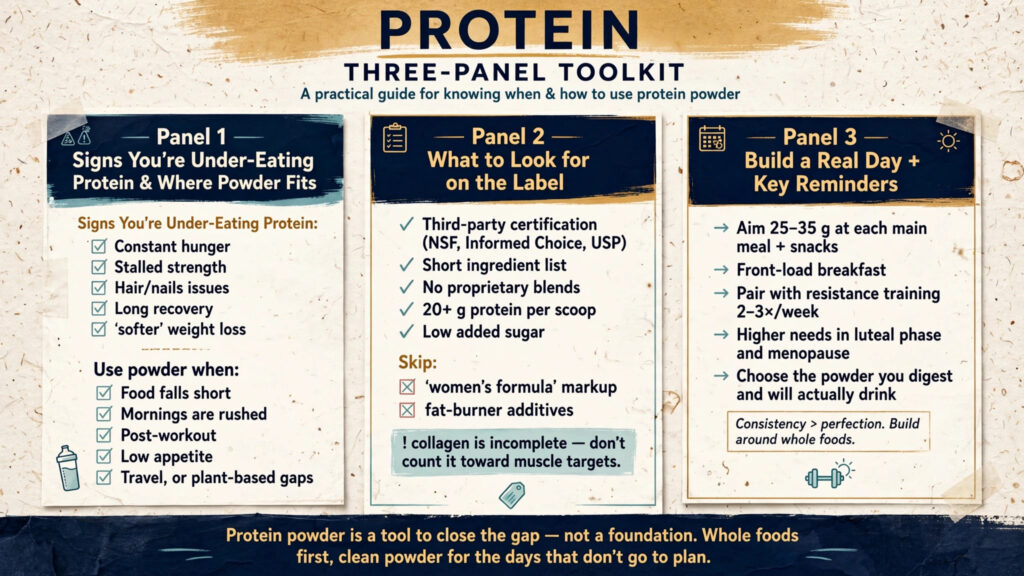
- Third-party certification — NSF Certified for Sport, Informed Choice, or USP verification. This is the single most important marker.
- Short ingredient list — protein source, natural flavor, maybe a sweetener. That’s it.
- No proprietary blends — if a company won’t disclose amounts, you don’t know what you’re taking.
- 20+ g protein per scoop — some “women’s” powders dilute the protein with fillers.
- Check added sugar — some products carry 15+ g per serving.
- Skip the “women’s formula” markup — a pink label with added biotin and collagen is usually the same protein at a higher price. Buy a clean protein and take any vitamins separately.
- Watch the “fat burner” additives — green tea extract, caffeine, CLA, and similar inclusions belong nowhere near a daily protein powder.
What About Added Collagen?
Collagen is popular in women’s protein products for skin, hair, and joints. It’s worth knowing that collagen is an incomplete protein — it’s very low in tryptophan and not optimal for muscle protein synthesis. It has its own uses, but it should not be counted toward your muscle-building protein target, and it shouldn’t be your primary powder.
Common Concerns, Answered Honestly
“Will protein powder damage my kidneys?”
In women with healthy kidneys, higher protein intake has not been shown to cause kidney damage. This concern originates from guidance given to people with existing kidney disease, where protein restriction is genuinely appropriate. If you have diagnosed kidney disease, follow your doctor’s guidance. If you don’t, the evidence doesn’t support the fear.
“Will it make me gain weight?”
Protein powder is calories, and excess calories from any source cause weight gain. But protein is the most satiating macronutrient and has the highest thermic effect — your body burns roughly 20–30% of protein calories just digesting it, compared to 5–10% for carbs and 0–3% for fat. Used to replace lower-quality calories rather than added on top, it typically supports fat loss rather than gain.
“Does whey cause acne?”
Some women do report acne with whey, possibly due to its effect on IGF-1 and insulin. If you notice a clear pattern, switching to a plant-based option is a reasonable experiment.
“Is soy protein bad for hormones?”
The phytoestrogen concern around soy has been largely overstated in popular media. Soy isoflavones are far weaker than human estrogen, and research in menopausal women has explored soy protein for its potential benefits rather than harms. Women with a history of hormone-sensitive cancer should discuss it with their oncologist.
“Do I need BCAAs or EAAs too?”
If you’re hitting your daily protein target from complete sources, BCAA supplements are largely redundant — you’re already consuming those amino acids in greater quantity. Save the money.
Building It Into a Real Day
| Meal | Example | Protein |
|---|---|---|
| Breakfast | Greek yogurt with berries and chia seeds, or eggs with spinach | 25–30 g |
| Mid-morning | Protein shake (or cottage cheese) | 20–25 g |
| Lunch | Chicken, lentil, or tofu bowl with quinoa | 30 g |
| Snack | Handful of nuts + boiled egg | 10 g |
| Dinner | Salmon or paneer with vegetables | 30 g |
| Total | ~120 g |
Chia seeds, incidentally, provide complete protein alongside heart-healthy fats — one of several swaps covered in this guide to the 5 worst foods for heart health Americans eat daily, which is useful if you’re rebuilding your diet around better protein choices.
For a plant-forward day, nutrient-dense options help close micronutrient gaps that come with cutting animal foods — this deep dive into moringa leaves benefits covers a plant source with a notable amino acid and mineral profile.
Protein Without Training Is Half a Strategy
Protein supplies the building materials. Resistance training supplies the signal telling your body to use them. Without the signal, extra protein is largely just extra calories.
For women, especially from the mid-thirties onward, resistance training two to three times a week is the single highest-return investment for body composition, bone density, insulin sensitivity, and long-term independence. Cardio supports cardiovascular and metabolic health alongside it — lower-intensity, sustainable training is particularly effective here, and this guide on Zone 2 cardio and why everyone’s doing it explains how to structure it without excessive fatigue.
Recovery is the third piece. Muscle repair happens during sleep, and chronic sleep deprivation measurably blunts muscle protein synthesis and raises cortisol. If sleep is your weak link, this practical guide on using nutmeg for sleep naturally offers a low-cost starting point.
And if you’re wrestling with the low-energy, foggy-headed feeling that often accompanies under-eating protein and chronic stress, this guide on brain fog causes, natural remedies, and when to see a doctor covers overlapping territory worth understanding.
Frequently Asked Questions
1. How much protein powder should a woman take per day? Most women need one to two scoops daily, providing roughly 20–50 g, but the right amount depends entirely on how much protein you’re already getting from food. Calculate your total target first (typically 1.0–1.6 g per kg of body weight), track your food intake for a few days, and use powder to fill whatever gap remains rather than adding it arbitrarily.
2. Is whey or plant-based protein powder better for women? Whey has a slight advantage for muscle protein synthesis due to higher leucine content, but a quality pea-rice blend closes most of that gap. Plant-based is often better tolerated by women with lactose sensitivity or dairy-related bloating. The best choice is the one you digest comfortably and will actually take consistently.
3. Will protein powder make women bulky or muscular? No. Women produce roughly 10 to 20 times less testosterone than men, making significant muscle bulk extremely difficult to achieve accidentally. Protein powder supports lean muscle maintenance and the firmer appearance most women are actually after, which requires deliberate, prolonged training to develop further.
4. Can I drink protein powder without working out? Yes, and it can still help you meet daily protein needs, support satiety, and preserve muscle during weight loss or aging. However, protein without resistance training mainly prevents muscle loss rather than building new muscle, since training provides the stimulus that directs protein toward tissue growth.
5. Is protein powder safe during pregnancy? Plain, third-party-tested protein powder with no herbal blends, added caffeine, or “fat burning” ingredients is generally considered acceptable, but protein powder is not automatically pregnancy-safe. Protein needs rise by roughly 25 g daily during pregnancy, so clear any supplement with your OB or midwife before using it.
6. How much protein do women need during menopause? Mayo Clinic guidance suggests 1.0 to 1.2 g per kg of body weight daily for postmenopausal women, with the higher end for those who are active, older, or losing weight. Some midlife specialists recommend 1.2 to 1.3 g/kg, and protein works best paired with resistance training, calcium, and vitamin D.
7. Does protein powder cause weight gain in women? Only if it pushes you into a calorie surplus. Protein is the most satiating macronutrient and has the highest thermic effect of food, meaning your body burns 20–30% of its calories during digestion, so replacing lower-quality calories with protein typically supports fat loss rather than gain.
8. When is the best time for women to take protein powder? Total daily protein matters more than exact timing, but distribution matters significantly — aim for 25–35 g at each main meal rather than concentrating protein at dinner. Many women benefit most from adding protein at breakfast, which is where intake is typically lowest.
9. Do protein needs change during the menstrual cycle? Yes. Progesterone rises during the luteal phase (the second half of your cycle) and has a catabolic effect that increases protein breakdown, so needs are modestly higher then. Adding roughly 10–15 g daily in that phase, and expecting slightly harder training sessions, is a reasonable adjustment.
10. Are there heavy metals in protein powder? Independent testing has repeatedly found detectable heavy metals including lead, cadmium, and arsenic in a share of protein powders, with plant-based products often testing higher because plants absorb metals from soil. Choosing products with NSF Certified for Sport, Informed Choice, or USP third-party certification substantially reduces this risk.
11. Is collagen protein good for building muscle in women? Not particularly. Collagen is an incomplete protein that is very low in tryptophan and not optimal for muscle protein synthesis, so while it may support skin and joint health, it shouldn’t count toward your muscle-building protein target or serve as your primary powder.
12. Can protein powder damage women’s kidneys? In women with healthy kidney function, higher protein intake has not been shown to cause kidney damage. This concern stems from guidance for people with pre-existing kidney disease, where protein restriction is genuinely warranted. Anyone with diagnosed kidney problems should follow their doctor’s specific recommendations.
13. Do women need special “women’s” protein powder? Generally no. Protein is the same molecule regardless of who consumes it, and “women’s formulas” typically add small amounts of vitamins or collagen while charging a premium and sometimes reducing protein per scoop. A clean, third-party-tested protein plus separate vitamins is usually better value.
Final Thoughts
Protein powder for women isn’t a shortcut, a bulking risk, or a niche product for athletes — it’s a practical tool for closing the gap between the protein you need and the protein a real, busy, imperfect day actually delivers. The bigger shift is mental: moving away from the “eat less, tone up” framing that shortchanged a generation of women, and toward eating enough to build and keep the muscle that protects your strength, your bones, your metabolism, and your independence for decades. Calculate your target, check what you’re actually eating for a few days, front-load more protein into breakfast, pick a clean third-party-tested powder for the gaps, and pair it with resistance training. That’s the whole strategy — and it works at 25, at 45, and at 70.
This article is for informational purposes only and is not a substitute for professional medical advice. Consult your healthcare provider or a registered dietitian before making significant dietary changes, particularly if you are pregnant, breastfeeding, or have kidney disease or other existing health conditions.





Leave a Reply