
Zone 2 cardio has quietly become the most talked-about form of exercise in longevity and fitness circles over the past few years, and the pitch is genuinely appealing: a low-intensity, conversational-pace workout that builds your mitochondria, torches fat as fuel, and lays the metabolic foundation for a longer, healthier life. What’s gotten far less attention is a real, current scientific fight happening inside exercise physiology itself — a 2025-2026 body of research directly challenges whether Zone 2 actually deserves the almost mythical status it’s been given, arguing that higher-intensity exercise produces equal or greater benefits for the same time invested. This guide explains what Zone 2 cardio actually is, walks through both sides of the genuine scientific debate, and gives you a practical, evidence-informed way to think about where it fits in your training.

What Zone 2 Cardio Actually Is
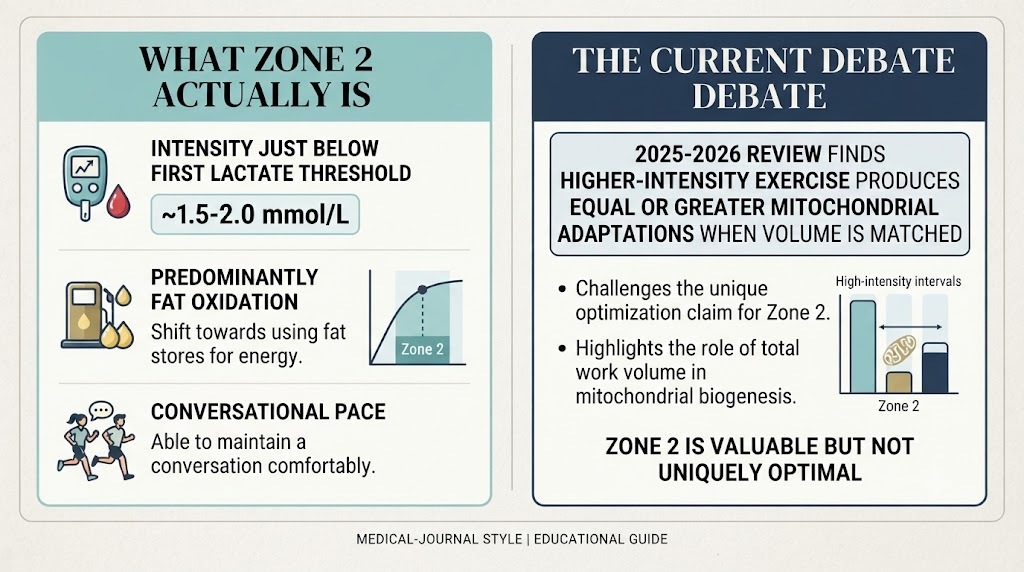
Zone 2 refers to a specific, physiologically defined intensity of aerobic exercise — not just “easy cardio” in a loose, casual sense. It sits just below your first lactate threshold, the point where blood lactate begins accumulating faster than your body can clear it, corresponding to blood lactate levels of roughly 1.5 to 2.0 mmol/L. At this intensity, your body relies predominantly on fat oxidation for fuel, your mitochondria meet your muscles’ energy demands without lactate piling up, and you can typically hold a full conversation while exercising without gasping for breath. For most people, this translates to roughly 60-70% of maximum heart rate, though genuine precision requires either lab-based lactate testing or a validated field method like the talk test, since age-based heart rate formulas frequently misclassify a person’s actual physiological zone.
Why Zone 2 Became So Popular
Much of Zone 2’s current popularity traces back to the work of Dr. Iñigo San Millán, a physiologist at the University of Colorado School of Medicine who has trained elite endurance athletes, including Tour de France cyclists, and applied similar principles to metabolic disease patients. His research and public advocacy — amplified significantly by longevity-focused physicians and podcasts — built the case that this specific intensity uniquely and optimally stimulates mitochondrial biogenesis, the process by which cells build new mitochondria, along with improved fat oxidation capacity. Both of these are genuine, real physiological adaptations with legitimate health implications — the disagreement in the field isn’t about whether they matter, but about whether Zone 2 is actually the best, most efficient way to get them.
The Real Scientific Controversy Most Content Skips
This is the part of the Zone 2 conversation that deserves far more visibility than it currently gets, and it’s genuinely current — not old, settled debate.
A 2025-2026 narrative review published in Sports Medicine, authored by researchers including Brad Schoenfeld — a widely respected exercise scientist — directly challenged the broad endorsement of Zone 2 training for the general public. Their central argument, based on reviewing the available mechanistic and training-study evidence: when total training volume is matched, higher-intensity exercise (above the lactate threshold) produces equal or greater mitochondrial adaptations compared to Zone 2, not fewer. The review points to the underlying signaling biology — Zone 2 exercise induces modest changes in AMP/ADP ratios and AMPK activation, the molecular signals that trigger mitochondrial biogenesis, but higher-intensity work activates these same pathways more strongly, plus additional signals (greater calcium flux, more mechanical stress) that Zone 2 doesn’t sufficiently trigger at all. Their broader point is pointed and specific: much of the evidence underpinning Zone 2’s reputation comes from observational data on elite endurance athletes who train enormous total volumes, not controlled comparisons showing Zone 2 is uniquely superior at a matched time investment for the general public.
This connects to a pattern we’ve now seen across several trending wellness claims — a plausible, well-marketed mechanism getting ahead of what controlled evidence actually shows, similar to what we found examining the gut-brain axis serotonin claim and the polyvagal theory controversy — a real underlying mechanism exists, but the popular claim built on top of it outpaces the actual comparative evidence.
What the VO2 Max and Mortality Data Actually Shows
Regardless of which side of the Zone 2 debate you land on, the data connecting overall cardiorespiratory fitness to longevity is genuinely some of the strongest, most consistently replicated evidence in exercise science, and it’s worth separating from the narrower Zone 2-specific argument.
A meta-analysis published in Mayo Clinic Proceedings, pooling data from over 2.2 million participants, found people in the top third of cardiorespiratory fitness had a 45% lower risk of all-cause mortality compared to those in the bottom third, with each 1-MET increase in fitness associated with an 11-15% reduction in mortality risk — a dose-response relationship confirmed consistently across multiple independent studies and populations. Separate large cohort data, including the Copenhagen Male Study following over 5,000 men for 46 years, found the highest-fitness group lived roughly five years longer than the lowest-fitness group, even after adjusting for other health factors.
Where this gets genuinely interesting for the Zone 2 debate specifically: studies comparing VO2 max improvements directly show high-intensity interval training (HIIT) producing slightly larger gains than steady-state aerobic training for the same time invested — one comparison found HIIT improved VO2 max by an average of 5.5 mL/kg/min versus 4.9 for continuous moderate exercise. This doesn’t mean Zone 2 is worthless; it means the “Zone 2 is uniquely optimal” framing oversells what the comparative data actually supports, while both approaches genuinely improve the fitness metric most strongly linked to longevity.
So Is Zone 2 Cardio Actually Worth Doing?
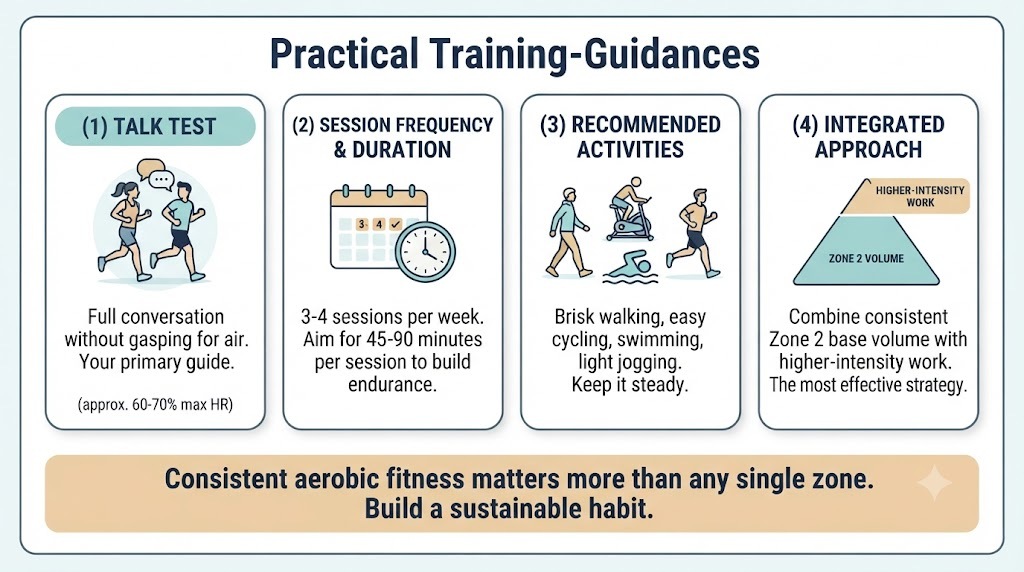
Based on the full picture, yes — just not necessarily for the specific “uniquely optimal mitochondrial hack” reason it’s usually marketed for. Zone 2 remains a genuinely valuable training intensity for several well-supported reasons independent of the mitochondrial biogenesis debate: it builds a large volume of low-fatigue aerobic work that’s sustainable several times a week without the recovery cost of high-intensity sessions, it’s accessible to beginners and older adults who may not tolerate frequent high-intensity work, and it improves fat oxidation capacity and aerobic base — both genuinely useful adaptations, even if they’re not exclusively unlocked at this one intensity. The most defensible, current expert position is a combination approach: most fitness and longevity researchers, even those skeptical of Zone 2’s uniquely optimal status, recommend pairing Zone 2 volume with some higher-intensity work rather than choosing one exclusively.
How to Actually Do Zone 2 Training
- Use the talk test as a practical, accessible gauge: you should be able to hold a full conversation, speaking in complete sentences, without gasping — if you can only manage a few words at a time, you’ve drifted above Zone 2
- Heart rate estimate: roughly 60-70% of your maximum heart rate, though this is a rough guide, not a precise physiological marker — individual variation is significant, and age-based formulas frequently misclassify people
- Duration and frequency: 3-4 sessions per week of 45-90 minutes each is the volume most commonly cited as sufficient for meaningful adaptation, though beginners should start shorter and build up gradually rather than jumping straight to longer durations
- Activity options: brisk walking, easy cycling, swimming, or light jogging all work, as long as the intensity stays in the conversational range rather than the activity type itself
- Consistency matters more than any single session — mitochondrial and aerobic adaptations respond to repeated, sustained stimulus over months, not a single long ride or run
Fueling and Recovery Considerations
Since Zone 2 relies heavily on fat oxidation, some people experiment with training in a fasted state to further emphasize this fuel pathway, though the evidence for meaningfully better long-term adaptations from fasted training specifically remains limited compared to just training consistently. What genuinely matters more is making sure your overall nutrition supports the training load — adequate protein intake supports the muscle tissue doing this aerobic work, covered in detail in our protein intake guide, and proper recovery between sessions benefits from the same sleep fundamentals we cover in our guide to how to fall asleep faster, since poor sleep blunts training adaptations regardless of which heart rate zone you trained in. Consistent aerobic exercise also has real, separate benefits for mood and stress regulation, connecting to the same gut-brain axis pathways we’ve covered from a different angle.
Who Should Be Cautious
- Anyone with a diagnosed cardiovascular condition should get medical clearance before starting a new structured cardio program, regardless of intended intensity
- Beginners returning from a long period of inactivity should start with shorter durations and build volume gradually rather than jumping to the 45-90 minute range immediately
- Anyone relying purely on a fitness tracker’s heart rate zones should treat the numbers as a rough estimate rather than precise physiological fact — consumer wearables can meaningfully misjudge individual thresholds, similar to the accuracy limitations we found examining continuous glucose monitors, where consumer-grade devices carry real, underappreciated margins of error
Frequently Asked Questions
What heart rate is considered Zone 2 cardio? Roughly 60-70% of maximum heart rate for most people, though this is an estimate — genuine precision requires lactate testing or a validated field method like the talk test, since standard age-based heart rate formulas frequently misclassify a person’s actual physiological zone.
Is Zone 2 cardio actually better than high-intensity exercise for mitochondrial health? This is genuinely contested in current research. A 2025-2026 narrative review found that when training volume is matched, higher-intensity exercise produces equal or greater mitochondrial adaptations than Zone 2, challenging the popular claim that Zone 2 is uniquely optimal for this purpose.
How many days a week should I do Zone 2 cardio? Most commonly cited guidance suggests 3-4 sessions per week of 45-90 minutes each for meaningful adaptation, though beginners should start with shorter sessions and build volume gradually.
Can I do Zone 2 cardio every day? Generally yes, since it’s a low-fatigue intensity that most people can recover from between sessions, unlike high-intensity training which requires more recovery time. That said, some rest and variety in training still benefits overall recovery and long-term consistency.
Is Zone 2 training the same as the talk test? The talk test is a practical way to estimate whether you’re in Zone 2 — if you can hold a full conversation without gasping, you’re likely in the right range. It’s not a precise substitute for lab-based lactate testing, but it’s a genuinely useful, accessible tool for most people.
Does Zone 2 cardio actually burn more fat than other exercise intensities? Zone 2 does rely predominantly on fat oxidation as a fuel source during the exercise itself, but total fat loss over time depends more on overall calorie balance and consistency than which specific heart rate zone you trained in for any given session.
Is HIIT better than Zone 2 for improving VO2 max? Comparative studies suggest HIIT produces slightly larger VO2 max improvements per unit of time than steady-state aerobic training, though both genuinely improve this fitness metric, which is strongly linked to lower mortality risk regardless of which training method got you there.
Do I need a heart rate monitor to do Zone 2 cardio correctly? It helps for precision, but it’s not strictly necessary — the talk test is a reasonably reliable, free alternative for most healthy people starting out, and heart rate monitors themselves carry some inherent estimation error regardless of the device.
Can beginners start with Zone 2 cardio, or is it only for endurance athletes? Zone 2 is genuinely one of the more beginner-friendly and accessible training intensities, since it’s low-fatigue and doesn’t require the recovery demands of high-intensity work — it’s a reasonable starting point for most people building an aerobic base.
What’s the most realistic way to think about Zone 2 cardio given the ongoing scientific debate? Treat it as one genuinely valuable tool among several, not a uniquely magical intensity — combining consistent Zone 2 volume with some higher-intensity training sessions is the position most current exercise scientists, even skeptics of the strongest Zone 2 marketing claims, actually recommend.
The Bottom Line
Zone 2 cardio is a real, physiologically well-defined training intensity with genuine benefits — but the popular claim that it’s uniquely, exclusively optimal for mitochondrial health and longevity outpaces what current comparative research actually supports. This same pattern — a real mechanism stretched into an oversold, marketable claim — is one we keep running into, including in our fact-check on what actually lowers cortisol. A 2025-2026 scientific review found higher-intensity exercise matches or exceeds Zone 2’s mitochondrial benefits when training volume is equal, which doesn’t make Zone 2 worthless — it remains an accessible, sustainable, low-fatigue way to build aerobic fitness, especially valuable for beginners and anyone needing a lower-recovery-cost training option. The strongest, most defensible approach based on the full evidence: build a foundation of Zone 2 volume, add some higher-intensity work alongside it, and focus on the fitness metric with the most robust mortality data behind it — overall cardiorespiratory fitness — rather than treating any single heart rate zone as a magic bullet.
This article is for informational purposes only and is not a substitute for personalized medical or fitness advice. Consult a physician before starting a new exercise program, particularly if you have a cardiovascular condition or have been inactive for an extended period.







Leave a Reply