
Grounding sheets went from a niche wellness gadget to a bestseller in a few years, and the pitch is hard to ignore: plug a conductive sheet into the wall, sleep on it, and let “the earth’s electrons” calm inflammation, deepen sleep and speed up recovery. Walking barefoot on grass promises the same thing for free. So is any of it real? The honest answer is more interesting than either “it’s a miracle” or “it’s nonsense.” This guide walks through the proposed mechanism, the clinical studies on sleep, pain, inflammation and recovery, the serious limits of that research, and what to do if you want to try grounding sheets, mats or barefoot walking safely and without wasting money.
Educational content only. Grounding isn’t a treatment for any medical condition. Persistent sleep problems, pain or inflammation deserve a proper medical assessment.
What Grounding (Earthing) Actually Means
Grounding, also called earthing, is the practice of making direct electrical contact between your body and the surface of the earth. You can do it in three ways:
- Outdoors: walking or standing barefoot on grass, soil, sand or wet ground
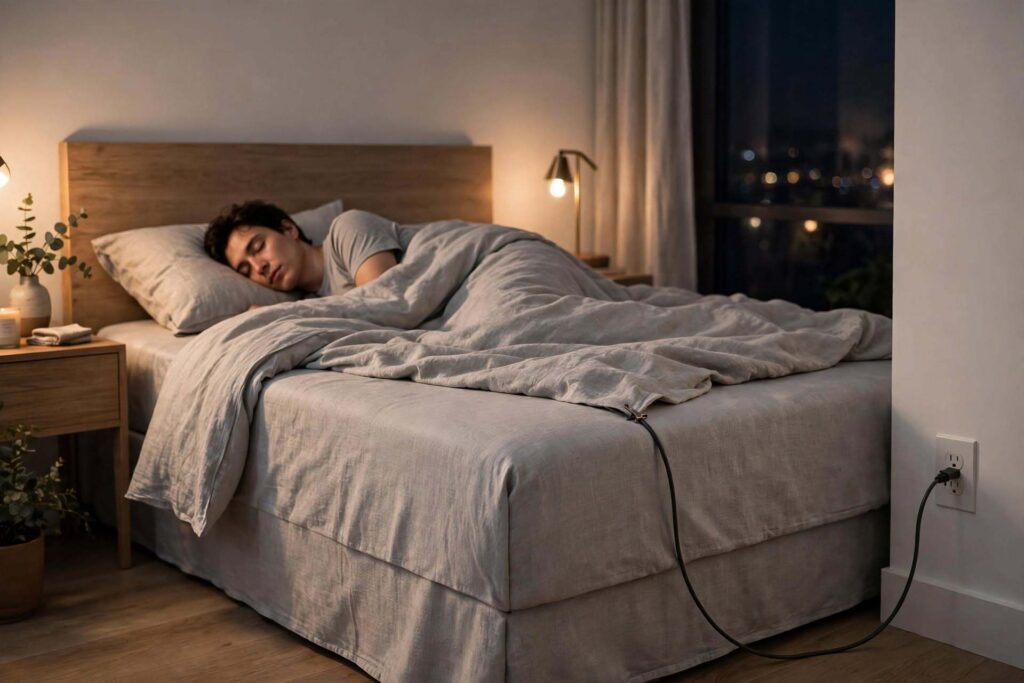
- Indoors with a product: sleeping on or sitting at grounding sheets, mats or patches connected by a cord to a wall outlet’s earth terminal or an outdoor ground rod
- Direct contact: lying on the ground, sitting on a beach, or gardening with bare hands in soil
One quick note on terminology: this isn’t the same as the “grounding techniques” therapists teach for anxiety, like noticing five things you can see or feeling your feet on the floor. Those are mindfulness tools with a separate evidence base. If that’s what you were looking for, our Mental Health section is a better starting point. This article is about the electrical kind.
How Grounding Sheets Are Supposed to Work: Electrons From the Earth
The central idea, often called the earthing hypothesis, goes like this. The earth’s surface carries a mildly negative electrical charge and is rich in free electrons. Modern life, with rubber-soled shoes, raised beds and buildings, cuts us off from that contact. Proponents argue that reconnecting lets electrons flow into the body, where they act like antioxidants, neutralising the free radicals involved in inflammation.
It’s a tidy story. Here’s the problem: nobody has directly shown it happens in humans. No study has demonstrated that meaningful numbers of electrons move from soil into tissue and neutralise reactive oxygen species at the site of inflammation. The leap from “your skin is conductive” to “your inflammation falls” is an assumption, not a result.
A more plausible, narrower mechanism
There is a second, more modest mechanism with some measurable support. Your body is a conductor, and mains wiring and appliances around a bedroom induce a small alternating voltage on your skin. This is known as body voltage. Connecting yourself to earth, through a properly working grounding sheet, for example, measurably lowers that induced voltage. Some researchers have linked higher body voltage with lower parasympathetic (calming) nervous system tone. Whether that tiny voltage actually affects sleep or inflammation is an open question, and critics point out that the induced currents are extremely small. So the physics of “grounding changes something” is real. The biology of “that something matters” is unproven.
What the Clinical Evidence Shows About Grounding Sheets
Here’s where I want to be careful, because the internet is full of confident claims in both directions.
The size and quality of the research
Most grounding studies are small, often under 30 participants. Many were run or funded by people connected to the companies that sell grounding products, and a small circle of researchers wrote a large share of the early papers. Blinding is also tricky, because participants may notice a difference between a real and sham setup, or simply expect to feel better. Prominent review papers that support grounding sheets and earthing were written by authors with ties to the field, and there is no large, independent systematic review or meta-analysis confirming the benefits. Mainstream sleep guidelines don’t list grounding sheets or other grounding products among their recommendations.
That doesn’t mean everything is worthless. It means you should hold the evidence loosely.
Grounding Sheets and Sleep
This is the area with the most interest, and the most mixed picture.
- Early studies reported improvements in self-rated sleep, shifts in the daily cortisol rhythm and reductions in pain in small groups of people sleeping grounded. Many lacked a proper sham control.
- A 2022 pilot in older adults with Alzheimer’s disease used a sham-controlled design. Of 22 enrolled, 15 completed the 12 weeks. Sleep quality scores improved with real grounding compared with sham, but anxiety and depression scores didn’t change significantly.
- A 2025 randomized, double-blind, placebo-controlled study in Korea gave 60 participants a grounded or non-grounded mat to use over 31 days. The authors concluded earthing mats reduced stress, insomnia severity and daytime sleepiness compared with baseline. Different summaries disagree on how many outcomes beat the sham group, which is why the details matter more than the headline.
- A registered sham-controlled trial in hospitalised cancer patients with insomnia is measuring body voltage alongside sleep, which would help show whether the sheet actually did something physical. It’s a step in the right direction, but results aren’t something to bank on yet.
So the honest summary on sleep: there are promising signals from small trials, including a couple with sham controls, but nothing large, independent and replicated. Reviewers writing for the general public reach a similar view: limited conclusive evidence, no sign of harm to sleep, and a reasonable “try it if you’re curious” attitude.
Grounding Sheets, Pain, Soreness and Recovery
A small randomized trial in massage therapists reported self-rated improvements in physical function and pain after six weeks of using grounding mats at work and at home. A 2019 study of people sleeping grounded after intense exercise reported less soreness and lower inflammation markers in blood compared with ungrounded participants, although summaries of that work differ on whether the soreness ratings beat the sham. Again: small numbers, short timeframes, outcomes that depend heavily on how people feel.
Inflammation and blood markers
Several small studies have reported changes in inflammation markers such as C-reactive protein, and one tiny unblinded study of ten people reported changes in blood viscosity. These are interesting hypotheses, not established effects. A lab number moving in 16 people doesn’t tell you anything about heart disease or autoimmune conditions.
Stress, mood and cortisol
Small studies have reported shifts in cortisol patterns and improvements in mood and stress scores. Because these outcomes are subjective and highly responsive to expectation, they’re exactly the type of result most vulnerable to placebo effects.
What has no evidence at all
Claims that grounding cures arthritis, regulates blood pressure, protects against EMFs, treats cancer or replaces medication aren’t supported by any credible trial. If a seller promises these, close the tab.
The evidence at a glance
| Claim | Evidence quality | Straight answer |
|---|---|---|
| Better sleep | Small trials, a few sham-controlled | Possible benefit, unproven |
| Less pain and soreness | Small trials, mixed | Possible, unproven |
| Lower inflammation markers | Tiny studies | Hypothesis, not established |
| Lower cortisol | Very small studies | Hypothesis |
| Better mood and stress | Pilot studies, subjective | Possible, placebo likely a factor |
| Thinner blood | Tiny, unblinded, industry-linked | Don’t act on this |
| Treats chronic disease | None | No |
| Harms sleep or recovery | None found | Appears safe when used properly |
Why Many People Feel Better on Grounding Sheets: Other Explanations
Being transparent matters here. Even if the electron story is wrong, people can still feel better, and not only because of placebo.
- Expectation. When a sleep or pain outcome is self-rated, belief matters.
- A new bedtime routine. Buying grounding sheets often comes with a better bedroom, a cleaner schedule and more attention to sleep.
- Being outside. Barefoot walking usually means daylight, fresh air, movement and a break from screens. Outdoor light alone can improve sleep timing and mood, which we explain in our guide to light hygiene and circadian health.
- Slower pace. A few quiet minutes on grass lowers stress for many people regardless of electrons.
- Natural fluctuation. Pain, mood and sleep rise and fall. People often start a new remedy when they feel at their worst.
None of this makes the benefit fake. It just means we can’t credit the electrons.
Barefoot Walking: What It Does and Doesn’t Do
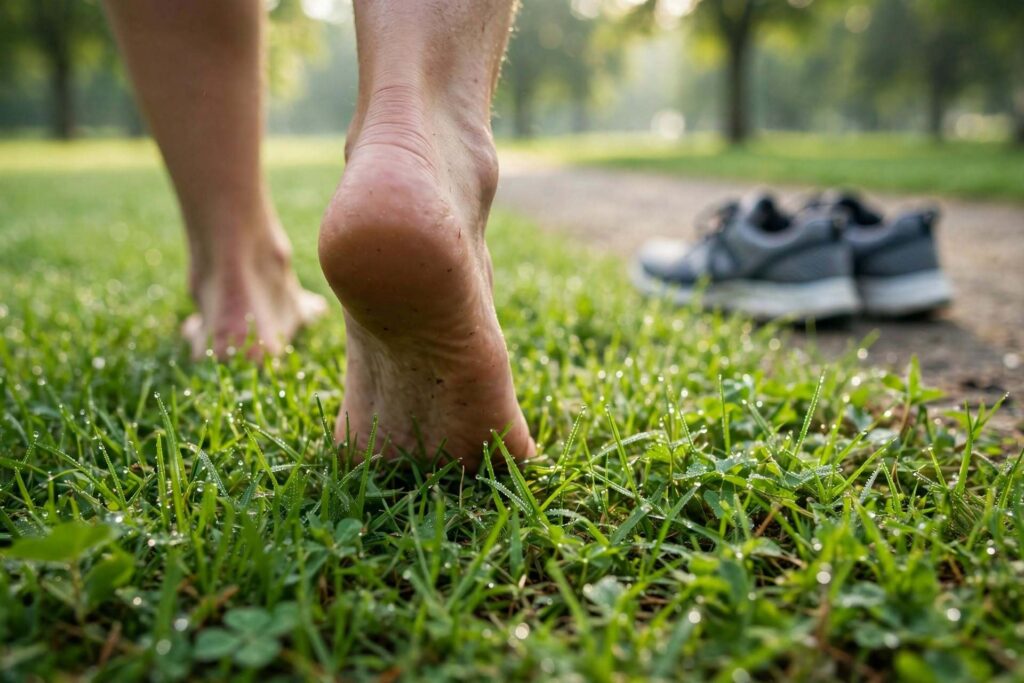
Walking barefoot outdoors is the free version, and it has benefits that don’t rely on any electrical theory.
What’s reasonable to expect: stronger small muscles in the feet, better balance and proprioception when you build up gradually, time in nature, and a lower stress feeling for many people.
What isn’t established: that the electrical contact itself reduces inflammation or improves sleep. There isn’t a clean trial comparing outdoor barefoot time with a sham.
Surfaces matter if you care about conduction. Damp grass, bare soil, wet sand and concrete tend to conduct. Dry rubber, plastic, asphalt, wood and painted surfaces don’t. If grounding is the goal, shoes with rubber soles defeat it.
Safety checklist:
- Check the ground for glass, thorns, nails and debris.
- In tropical and rural areas, soil can carry hookworm and other parasites that enter through the skin. Stay on clean, well-kept grass or sand, and avoid areas with animal waste.
- Keep your tetanus vaccination up to date.
- Watch for snakes and insects where relevant.
- Avoid hot pavement and cold, icy ground.
- People with diabetes, neuropathy or poor circulation should check with their doctor first, because small cuts can become serious infections.
- Skip it during thunderstorms.
Start with ten minutes a day and build up. If you have a lifestyle that doesn’t allow regular park time, our guide to low-friction prevention shows how to attach new habits to routines you already have.
Grounding Sheets, Mats and Patches: How They Work
Grounding products use conductive threads, usually carbon or silver, woven into fabric. A cord connects the product to a ground source, most often the earth terminal of a wall socket, or sometimes a ground rod pushed into soil outside. The idea is to complete the electrical connection between you and the earth while you sleep or sit.
| Product | How it’s used | Pros | Cons |
|---|---|---|---|
| Grounding sheets | Fitted over your mattress, skin contact needed | Full-night use, closest to what most trials tested | Washing wears conductivity, you must touch it directly, and price varies widely |
| Grounding mats | Under feet at a desk, on the bed or under a pillow | Cheaper, portable, easy to test | Only grounds the contact area; needs skin contact |
| Grounding patches | Adhesive electrodes on skin | Used in a few small studies | Skin irritation possible, limited practicality |
| Ground rod kits | Cord to a rod in soil | Avoids dependence on a wall socket | Awkward, weather-dependent, safety considerations |
| “Grounding” shoes and socks | Conductive soles | Usable while walking | Evidence even thinner, conduction depends on surface |
Do grounding sheets work?
Based on the research above, the fair answer is: maybe, a little, for some people, and not with the certainty marketing implies. The best trials used mats and sheets connected to earth, so if the effect is real, grounding sheets are a reasonable way to test it. But the evidence doesn’t justify claims of treating disease, and it doesn’t justify paying a premium for exaggerated promises.
Are Grounding Sheets Safe? Read This Before You Plug One In
In the studies done so far, researchers haven’t reported harm. But grounding sheets are electrical products, and safety depends on your home’s wiring, which is where many people get this wrong.
- Only use the earth terminal of a properly wired socket. A three-pin socket with a working earth pin is essential. Don’t plug a grounding cord into a socket where the earth connection is missing or faulty.
- Test your sockets. A simple plug-in socket tester costs very little and tells you whether the earth connection exists and is correctly wired. In many older buildings, including in India, the earth pin may not be connected to anything. If the tester shows a fault, get an electrician to fix it, or don’t use the product.
- Use a product with a built-in current-limiting resistor. Reputable grounding cords include one as a safety measure. Don’t modify the cord.
- Don’t use extension leads of unknown quality, or two-pin adaptors that bypass the earth pin.
- Never use a ground rod or outdoor connection during a thunderstorm.
- Pacemakers and implanted devices: ask your cardiologist before using any grounding product.
- Blood thinners: some grounding advocates claim grounding changes blood viscosity. That claim is unproven, and you should never change medication based on it. If you take anticoagulants, mention the product to your doctor.
- Children and pregnancy: there’s little research. Use caution and ask your clinician.
- Skin and washing: wash according to the maker’s instructions. Fabric softener and harsh detergents can damage conductive threads. Stop using a product that irritates your skin.
How to Buy Grounding Sheets Without Wasting Money
Here’s the finance writer in me: treat this as a purchase with uncertain return and test it before committing.
Check these before buying:
- A clear refund window of at least 30 days, ideally 60 or more, so you can run a fair test.
- A built-in safety resistor and a plug designed for your country’s sockets.
- Conductivity testing information. Reputable sellers explain how to test continuity with a multimeter.
- Washing instructions and how conductivity holds up after washes.
- Honest claims. Avoid sellers that promise to treat disease or block EMFs.
- Independent reviews rather than pages written by the seller.
- Total cost of ownership. Add the price of a socket tester and replacements.
The cost-per-night check. Divide the price by the number of nights you expect to use your grounding sheets. A set of grounding sheets used 700 nights over two years costs far less per night than one you abandon in March. If a free walk in the park does the same job for you, grounding sheets have to beat that.
Free alternatives with better evidence. Morning daylight, a consistent sleep and wake time, a cool dark room, less caffeine late in the day and less evening screen time all have far stronger support for sleep. If you haven’t done those, start there. Our sleep hygiene articles walk through the basics.
A Fair Four-Week Test of Grounding Sheets You Can Run at Home
The big weakness of grounding research is placebo. You can reduce it yourself.
- Keep a simple sleep diary for one week before starting. Note bedtime, wake time, how long it took to fall asleep, night wakings and morning energy on a 1 to 10 scale.
- Run a blind swap. Ask a partner or friend to set up the grounding sheets for two weeks with the cord connected to a tested earth terminal, and for two weeks with the cord disconnected (which is the safe state), without telling you which week is which. Randomise the order.
- Keep everything else constant: caffeine, bedtime, room temperature, exercise.
- Compare your diary scores between the two blocks before you learn which was which.
- Decide using your own data. If there’s no difference, you’ve saved yourself money. If there’s a consistent one, you’ve got your own evidence.
It isn’t perfect science, but it’s more honest than a testimonial.
Who Might Reasonably Try Grounding Sheets, and Who Should Be Careful
Reasonable to try grounding sheets if you’re a healthy adult, curious, comfortable with a low-risk experiment, and willing to set a trial period and budget.
Talk to a clinician first if you have a pacemaker or implanted electrical device, take blood thinners, have diabetes with foot problems or neuropathy, are pregnant, or have an ongoing medical condition you were hoping grounding might treat.
Don’t use it as a substitute for assessment of chronic pain, insomnia lasting weeks, unexplained fatigue or low mood. If your sleep is poor, our guides to cortisol and stress and adaptogens explain what the evidence supports, and a doctor can check for sleep apnea, thyroid problems and iron deficiency.
Grounding Sheets Hype vs Evidence: How to Spot Overselling
Grounding isn’t unique. Plenty of wellness trends follow the same arc: a plausible idea, a few small positive studies, marketing that races ahead. We see it with mushroom coffee, with NAD+ precursors, and even with functional protein and next-gen collagen, where modest evidence for a narrow benefit gets stretched into universal promises.
Warning signs in any claim about grounding sheets:
- “Clinically proven” with no link to a study
- Studies funded by the seller, with no independent replication
- Claims about curing diseases
- Dramatic percentages from tiny samples
- Anything about “blocking EMFs” or “detoxing”
- Urgency tactics and fake scarcity
The same critical eye helps when you research health topics with online tools. Our guide to AI self-diagnosis and digital health shows how to stress-test answers before acting on them.
Where to Go Next
- Better sleep fundamentals: Light hygiene and circadian health, Sleep hygiene
- Stress and cortisol: Cortisol and stress, Adaptogens
- Habits that stick: Low-friction prevention
- More hype vs evidence: Mushroom coffee, NAD+ precursors, Functional protein and collagen
- Reading health claims critically: AI self-diagnosis and digital health
- Browse more: Health & Wellness and Mental Health
Frequently Asked Questions About Grounding Sheets and Earthing
1. What are grounding sheets and how do they work?
Grounding sheets are fitted bed sheets woven with conductive threads, connected by a cord to the earth terminal of a wall socket or an outdoor ground rod. The idea is to link your body electrically to the earth while you sleep. They reliably lower the small alternating voltage your body picks up from household wiring. Whether that translates into better sleep or less inflammation is still unproven.
2. Do grounding sheets really work for sleep?
Possibly, for some people. A few small trials, including some with sham controls, report better sleep quality, but most are small and many have ties to the industry. No large independent trial has confirmed it, so treat it as a low-risk experiment, not a guarantee.
3. Is earthing scientifically proven?
No. There is some interesting early research, but it’s limited by small samples, short durations, possible conflicts of interest and imperfect blinding. The proposed mechanism, electrons from the earth neutralising free radicals in your body, hasn’t been demonstrated directly in humans.
4. Are grounding sheets safe to use?
In studies so far, researchers haven’t reported harm, but safety depends on correct use. Only connect to a properly earthed socket, test it with a socket tester, use a cord with a built-in resistor, and avoid ground rods in storms. People with pacemakers or on blood thinners should check with their doctor first.
5. Does walking barefoot count as grounding, the way grounding sheets do?
Yes, if the surface conducts, such as damp grass, soil or wet sand. Whether the electrical contact adds anything beyond the movement, fresh air and daylight isn’t proven. Check the ground for hazards, and ask your doctor first if you have diabetes or poor foot sensation.
6. Do grounding mats work as well as grounding sheets?
Mats and sheets use the same principle. Mats are cheaper and portable but only ground the area you touch. Several of the better-known trials used mats, so a mat is a sensible low-cost way to test whether you notice anything.
7. Can grounding sheets reduce inflammation?
Small studies have reported changes in some inflammation markers, but they involved few people and haven’t been reliably replicated. There’s no evidence that grounding treats any inflammatory disease, so it shouldn’t replace medical care.
8. How long should I try grounding sheets before deciding?
Four weeks with a sleep diary is a fair minimum. For a stronger test, use the blind swap method described above: two weeks connected and two weeks disconnected, without knowing which is which. Pick a seller with a refund window of at least 30 days.
9. Can I use grounding sheets if my home wiring has no earth connection?
Don’t plug it in until you’ve tested the socket. If the tester shows no earth or faulty wiring, have an electrician correct it. Using a grounding cord with a faulty earth connection can be dangerous. When in doubt, skip the product and try barefoot walking outdoors instead.
10. What should I do first if I sleep badly?
Start with proven basics: consistent sleep and wake times, morning daylight, less caffeine and screens in the evening, and a cool, dark bedroom. If problems last more than a few weeks, see a doctor to check for sleep apnea, thyroid problems, anaemia, depression or medication effects, before adding any gadget.
Final Thoughts
Grounding sheets sit in an awkward middle ground. They’re not a scam in the sense that nothing happens, because body voltage really does drop, and a few small, careful trials hint at better sleep. But the leap to treating inflammation or chronic disease is unsupported, much of the research has commercial ties, and no one has shown the electron story is true. If you’re curious, treat grounding as a cheap, time-limited experiment: test your wiring, set a budget and a refund window, track your sleep honestly, and keep the proven habits going alongside. If it works for you, fine. If not, you’ve lost very little and learned something.
For more evidence-led takes on wellness trends, browse our Health & Wellness section.
Disclaimer: this article is general education, not medical advice, and grounding products are not approved to treat or cure any disease. Consult a qualified healthcare professional about ongoing symptoms, implanted devices or medication. See our full disclaimer.
Research referenced: the 2022 sham-controlled grounding pilot in older adults with Alzheimer’s disease; the 2025 randomized, double-blind, placebo-controlled Earthing mat sleep study; the registered sham-controlled trial of electrical grounding in hospitalised cancer patients; the Chevalier et al. 2012 review in the Journal of Environmental and Public Health; Menigoz et al. 2020 in Explore (abstract); and public-facing summaries from Healthline and the CQUniversity researchers writing in The Conversation.





Leave a Reply