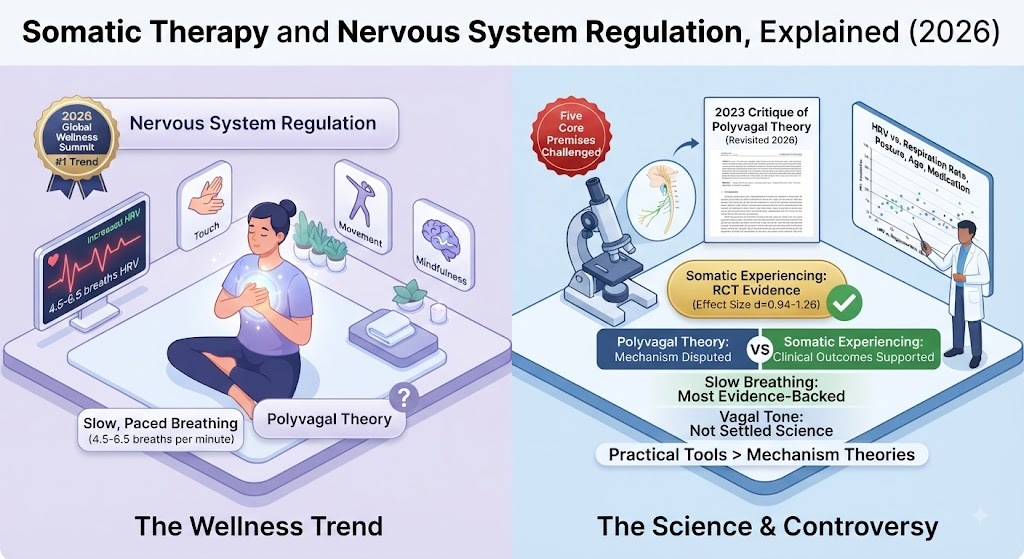
Somatic therapy and nervous system regulation were named the single biggest wellness trend of 2026 by the Global Wellness Summit’s annual report, and if your feed has been full of “vagal tone,” “nervous system resets,” and body-based trauma healing lately, this is why. The appeal is real: after years of biohacking and data-obsessed wellness, people want practices that actually calm them down rather than just optimize another metric. What’s genuinely surprising, though, is that the scientific story underneath this trend is more complicated than almost anyone talking about it online is letting on — the specific theory most of this language comes from has been directly and publicly challenged by researchers in the past two years, while some of the actual therapy techniques built loosely on top of it have real, separate clinical trial support. Those are two different claims, and untangling them is the entire point of this guide.
What “Nervous System Regulation” Actually Means
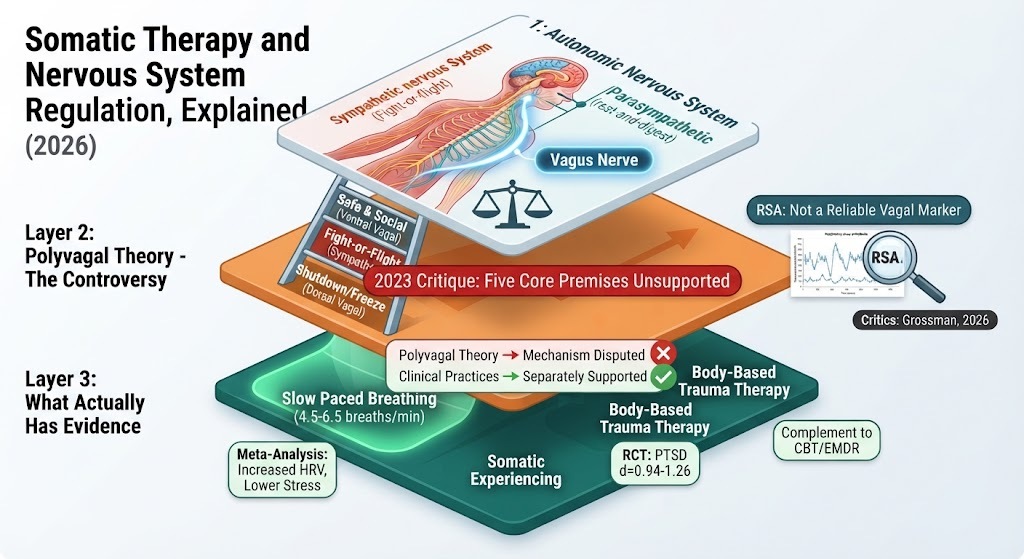
Your autonomic nervous system runs largely outside conscious control, managing things like heart rate, digestion, and your stress response through two broad branches: the sympathetic system (associated with alertness and the “fight or flight” response) and the parasympathetic system (associated with rest, digestion, and recovery). “Nervous system regulation,” as the term is used in 2026 wellness content, generally refers to practices meant to shift you out of a stressed, sympathetic-dominant state and into a calmer, parasympathetic one — through breathing, movement, touch, or body-focused therapy rather than talk therapy or medication alone.
That basic framework — sympathetic versus parasympathetic activation — is genuinely well-established physiology, not controversial at all, and it’s worth noting this system doesn’t run in isolation from the rest of your body either; stable blood sugar and adequate protein intake measurably affect how reactive your stress response feels day to day. The controversy starts one layer deeper, in the specific theory most somatic wellness content leans on to explain how this regulation supposedly works.
Polyvagal Theory: Where the Popular Explanation Runs Into Real Trouble
If you’ve heard someone explain nervous system states using a three-tier “ladder” — safe and social, fight-or-flight, and shutdown or freeze — that framework comes from polyvagal theory, developed by researcher Stephen Porges in the 1990s. It’s become the dominant explanatory language across trauma therapy, somatic coaching, and wellness content, and it’s worth being direct about where things currently stand: a rigorous 2023 peer-reviewed critique, revisited and expanded in 2026, examined polyvagal theory’s five core premises and concluded that each is either untenable or highly implausible given current evidence.
The specific problems researchers have raised are worth naming rather than glossing over. The theory relies heavily on respiratory sinus arrhythmia — a measure of how your heart rate shifts with breathing — as a stand-in for “vagal tone,” but critics point out this measure is strongly influenced by respiration rate, posture, medication, and age, making it an unreliable proxy for the specific brain-body pathway the theory claims to be measuring. The evolutionary story polyvagal theory tells — that a uniquely mammalian, “newer” branch of the vagus nerve evolved specifically to support social engagement — also doesn’t hold up well against comparative neuroanatomy research in other species. And prominent critics, including physiological psychologist Paul Grossman, have argued the theory is too vague and broad to be properly tested in the first place.
Here’s the part that matters most for anyone using these tools day to day, though: as Psychology Today put it plainly in an April 2026 piece responding to this exact controversy, polyvagal theory has not been “debunked” in the sense that its clinical tools stopped working — the mechanism explanation is what’s under fire, not necessarily the practices themselves. Somatic trauma therapies, paced breathing, and body-based co-regulation techniques have documented effects that don’t actually rise or fall based on whether Porges’s specific vagal-pathway story turns out to be biologically accurate. In other words: the map may be wrong in places, but that doesn’t automatically mean the territory it was pointing toward doesn’t exist.
Somatic Experiencing: The Therapy Technique With Real Trial Data
Separate from the polyvagal mechanism debate, Somatic Experiencing (SE) — a body-focused trauma therapy developed by Peter Levine, which involves tracking physical sensations to help “complete” incomplete stress responses — has its own, independently testable evidence base, and it’s more substantial than most somatic wellness content acknowledges when it just gestures vaguely at “the science.”
The first randomized controlled trial of SE for PTSD, published in the Journal of Traumatic Stress, found large effect sizes for reducing both PTSD symptom severity (Cohen’s d = 0.94–1.26) and depression (d = 0.7–1.08) compared to a waitlist control group, with improvements holding up at follow-up. A separate randomized trial specifically testing SE for chronic low back pain with comorbid PTSD symptoms found the addition of SE significantly reduced PTSD symptoms with a large effect size, alongside a moderate reduction in fear of movement — genuinely useful for understanding why body-based approaches sometimes help with pain that talk therapy alone doesn’t touch, a connection also worth reading about in our guide to natural approaches for joint pain, where the mind-body pain connection shows up from a different angle.
A 2021 scoping review of SE research was honest about the field’s limitations: only a small number of studies meet rigorous RCT standards, and researchers specifically called for more high-quality replication with larger sample sizes. But the review also noted something important — in the methodologically strongest trials that do exist, SE was statistically most effective, not least. That’s a meaningfully different, more encouraging position than dismissing the whole approach as unproven.
Slow, Paced Breathing: The Most Accessible, Best-Studied Piece of This Whole Trend
If there’s one “nervous system regulation” technique that clears the evidence bar most cleanly, it’s slow, paced breathing — typically 4.5 to 6.5 breaths per minute, sometimes called resonance or coherent breathing.
A systematic review and meta-analysis found paced breathing produced significantly greater heart rate variability than normal, spontaneous breathing, along with measurably lower subjective stress and anxiety scores across the pooled studies. A randomized controlled trial in professional musicians found that a single 30-minute session of slow breathing, with or without biofeedback equipment, significantly improved physiological measures of calm before a high-stress performance, with the biggest self-reported anxiety reductions specifically among musicians who started with the highest baseline anxiety.
The honest caveat here matters too: while paced breathing reliably shifts HRV during the practice itself, meta-analytic evidence for lasting changes to your resting HRV — meaning benefits that persist once you stop actively breathing slowly — remains limited and inconsistent across studies. The practical takeaway isn’t “breathing training permanently rewires your baseline calm,” which is a common oversell in wellness content; it’s closer to “slow breathing is a genuinely effective, low-risk tool you can use in the moment,” which is still a legitimately useful thing to have, just a more modest claim than the marketing usually makes.
So What Should You Actually Do With This Information?
Given everything above, here’s a realistic way to engage with the somatic therapy and nervous system regulation trend without either dismissing it entirely or buying into the more overstated claims:
- Use slow, paced breathing (4.5–6.5 breaths per minute) as an in-the-moment tool for acute stress or anxiety — this has the cleanest, most consistent evidence of anything in this category
- Consider Somatic Experiencing or another body-focused trauma therapy from a licensed practitioner if you’re dealing with trauma symptoms that haven’t fully responded to talk therapy — the trial data, while still limited in volume, is genuinely encouraging
- Be appropriately skeptical of anyone confidently explaining “vagal tone” or “neuroception” as settled biological fact — these terms come from a theory currently facing serious, unresolved scientific challenges, and a practitioner who presents contested science as established fact is a reason to ask more questions, not fewer
- Don’t let “nervous system work” replace evidence-based treatment for significant anxiety or trauma symptoms — it’s a reasonable complement to established approaches like CBT or EMDR, not a replacement, particularly for anything more severe than everyday stress
It’s also worth noting this trend didn’t appear in isolation — it’s part of the same 2026 cultural shift toward practices people can feel working, in real time, without needing a wearable to confirm it, which is the same instinct behind the renewed interest in things like an evidence-checked Ayurvedic morning routine and honestly examining what actually lowers cortisol rather than what’s just marketed as if it does.
When to See a Professional Instead of Self-Directing This
Somatic practices are reasonable self-directed tools for everyday stress, but certain situations call for professional support rather than a solo breathing routine:
- Trauma symptoms that significantly interfere with daily functioning, relationships, or work
- Flashbacks, dissociation, or emotional flooding during self-directed body-based practices — this can happen and is a sign to work with a trained practitioner rather than continuing alone
- Persistent anxiety or hypervigilance that hasn’t responded to basic stress-management tools
- Any trauma history involving significant medical, sexual, or physical harm, where professional-led somatic work has real trial support behind it that self-guided practice doesn’t replicate
Sleep disruption is also worth flagging here, since chronic nervous system activation and poor sleep tend to reinforce each other — if wind-down practices alone aren’t helping you actually fall asleep, our guide on how to fall asleep faster covers the evidence-backed techniques worth trying alongside this.
Frequently Asked Questions
Is polyvagal theory scientifically proven? No — a rigorous 2023 peer-reviewed critique, expanded on in 2026, found the theory’s core premises are either untenable or highly implausible based on current evidence, particularly its reliance on respiratory sinus arrhythmia as a marker of “vagal tone” and its evolutionary claims about the vagus nerve. This is a genuine, ongoing scientific debate, not settled fact in either direction.
Does that mean somatic therapy doesn’t work? Not necessarily. Somatic Experiencing specifically has its own independent randomized controlled trial evidence showing large effect sizes for PTSD symptom reduction, separate from whether polyvagal theory’s explanation for why it works turns out to be accurate. The technique and its underlying theoretical explanation are two separate claims worth evaluating separately.
What’s the single most evidence-backed nervous system regulation technique? Slow, paced breathing at roughly 4.5–6.5 breaths per minute has the most consistent research support of any technique in this category, with meta-analyses showing real reductions in subjective stress and anxiety, though the evidence for lasting changes beyond the practice session itself is more limited.
Can I do somatic work on my own, or do I need a therapist? Simple techniques like paced breathing are reasonable to try independently. Somatic Experiencing and other body-focused trauma therapies, however, are typically delivered by trained practitioners for good reason — body-based trauma work can occasionally bring up intense reactions that are safer to navigate with professional support.
Is “vagal tone” a real, measurable thing? The vagus nerve and its role in the parasympathetic nervous system are real and well-established. What’s contested is whether respiratory sinus arrhythmia — the specific measure “vagal tone” claims typically rely on — accurately reflects it, given how many other factors (breathing rate, posture, age) influence that same measurement.
The Bottom Line
Somatic therapy and nervous system regulation sit at a genuinely interesting scientific crossroads right now: the specific theory (polyvagal theory) that popularized most of the language behind this 2026 trend is facing serious, well-documented scientific challenges, while at least one of the actual therapy techniques built loosely on top of it (Somatic Experiencing) has its own separate, genuinely encouraging clinical trial data. The most broadly evidence-backed piece of the whole trend — slow, paced breathing — doesn’t need the contested theory to justify using it; it works on its own well-documented terms. Approach the trend with that nuance: skeptical of confident claims about “vagal tone” as settled biology, open to the actual therapy techniques that have their own independent research support, and realistic that any of this complements rather than replaces care for significant trauma or anxiety symptoms.
This article is for informational purposes only and is not a substitute for personalized mental health treatment. If you’re experiencing trauma symptoms, persistent anxiety, or emotional distress that affects your daily life, consult a licensed mental health professional rather than relying on self-directed techniques alone.







Leave a Reply