
“Vagus nerve reset” sounds like something you could do with a screwdriver and a spare ten minutes, which is probably why it’s spread so fast. Every other video promises that one weird trick, a cold splash or a hum or a neck rub, will “flip your body out of fight-or-flight”. I like the instinct behind the vagus nerve reset. I just don’t like what it leaves out.
So here’s my attempt at an honest guide to the vagus nerve reset. A vagus nerve reset isn’t a reset at all, and the nerve isn’t being zapped. What the best evidence for a vagus nerve reset supports is something much plainer and much cheaper: slow breathing with a long exhale. I’ll take you through the five exercises that appear on nearly every hospital and wellness page, show you what the research says about each, and end with a 12-minute daily routine you can start tonight. You’ll also find the safety bits that the viral clips skip, especially the one about pressing on your neck.
General information only. If you faint, have chest pain or have heart palpitations that worry you, see a doctor instead of trying a breathing exercise.
What the vagus nerve is, and why a “vagus nerve reset” is the wrong idea
The vagus is the tenth cranial nerve, and it’s less a nerve than a long, branching cable. It runs from the brainstem down through the neck and chest to the heart, lungs and gut. “Vagus” means wanderer in Latin, which fits. Roughly four-fifths of its fibres carry information up to the brain from the organs, not commands down. It slows the heart, helps regulate digestion, and takes part in the body’s calming reflexes.
Two things make “reset” a misleading word in vagus nerve reset claims. First, nothing is broken. Your vagus nerve works all day, and your heart rate rising and falling with each breath is it doing its job. Second, you can’t switch it on and off like a light. The calm you feel after a good slow-breathing vagus nerve reset is real, but it comes from changing how fast and how deeply you breathe, which then shifts your heart rate, blood pressure and brain’s stress signals.
A word on polyvagal theory, because it’s behind a lot of viral language (“dorsal vagal shutdown”, “ventral vagal safety”). It’s a popular framework in trauma therapy circles, and some people find it a useful way to describe their experience. As physiology, though, it’s heavily disputed. Several researchers, Paul Grossman among them, have published detailed critiques arguing its core claims about how the vagus works in humans don’t hold up. You don’t need the theory for any of the exercises below to work. I’d treat it as a metaphor, not a map.
And “vagal tone”, the thing everyone tries to raise, is usually measured by heart rate variability (HRV): the small beat-to-beat variation in your pulse. Higher HRV tends to go with better health and resilience. But HRV is an indirect proxy for the vagus, not a direct readout, and it also reflects fitness, age, sleep and what you ate last night. Nobody has shown that deliberately pushing your HRV up makes you healthier. Keep that in mind when a smartwatch scores your vagus nerve reset with a number.
The five vagus nerve reset exercises every hospital page repeats
Read enough “how to stimulate your vagus nerve” articles and you meet the same five: deep breathing, humming or gargling, cold exposure, massage, and meditation or yoga. Here’s how I’d rate them.
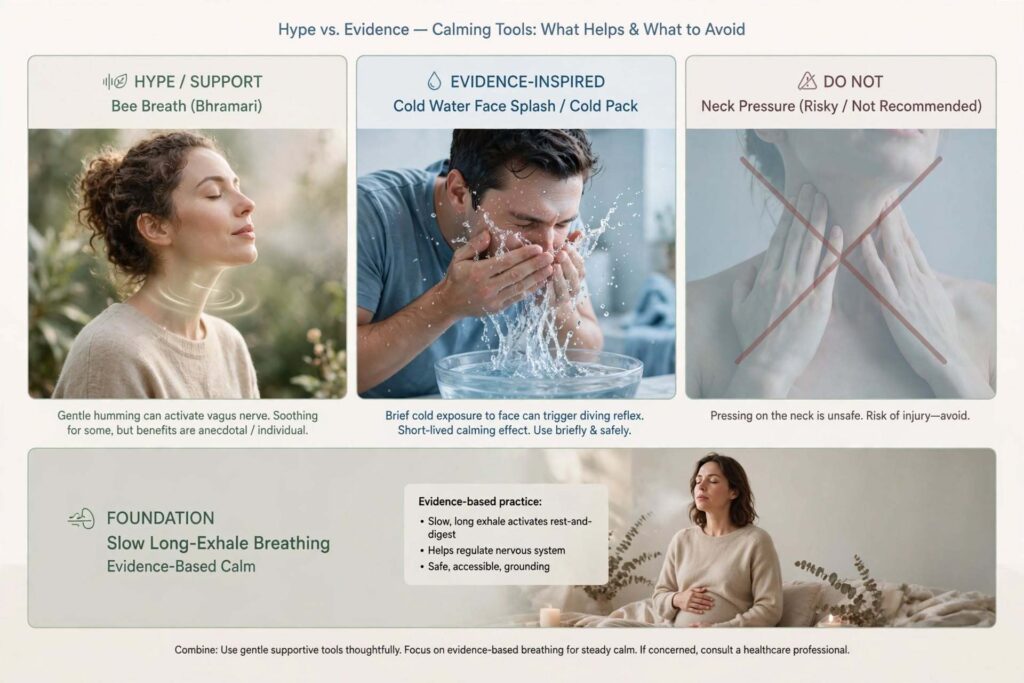
| Practice | The claim | What the evidence says | My verdict |
|---|---|---|---|
| Slow, long-exhale breathing | Raises vagal activity, calms stress | Strongest: hundreds of studies; benefits within minutes | Do this one |
| Humming, bee breath, gargling, singing | Vibrates the throat and stimulates the nerve | Small trials; likely works because it’s slow exhaling | Fine, optional |
| Cold face immersion or cold pack | Triggers the diving reflex, slows the heart | Real reflex, short-lived; thin for lasting effects | Situational, with cautions |
| Neck, ear or “vagal” massage | Directly stimulates the nerve | Neck pressing is risky; ear stimulation preliminary | Skip the neck, ignore the rest |
| Meditation, yoga, tai chi | Improves vagal tone over time | Positive for stress, mixed for HRV specifically | Good for other reasons |
The surprising part: most of the benefit across all five vagus nerve reset methods probably traces back to the same thing, slower and more deliberate breathing. Which is why I’ll spend most of the next section there.
Long-exhale breathing: the vagus nerve reset with real evidence
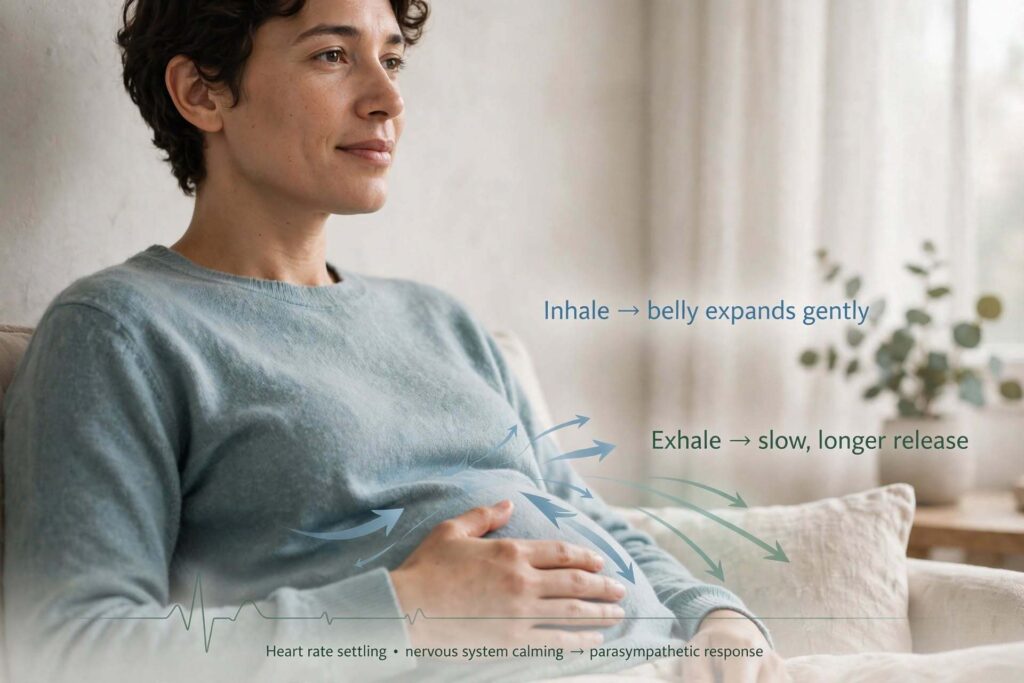
When you breathe in, your heart rate rises a little. When you breathe out, it falls. That swing is called respiratory sinus arrhythmia, and it’s largely run by the vagus. Slow your breathing to about six breaths a minute, around ten seconds a breath, and the swing gets bigger. That’s the basic mechanism behind nearly all the studies.
How good is the evidence for a vagus nerve reset? A large systematic review and meta-analysis on voluntary slow breathing pulled together 223 studies, 172 of which measured heart rate variability during the breathing itself. It’s the most comprehensive picture we have, and it supports the idea that slow breathing increases vagally mediated heart rate variability while you’re doing it. The effects after a longer training programme are smaller and more varied between studies, so I wouldn’t promise a permanent upgrade.
There’s also experimental work on the details, mostly from Sylvain Laborde’s group. When people breathed at six cycles a minute, vagal activity (measured by RMSSD, one HRV marker) was higher when the exhale was longer than the inhale. Adding tiny pauses between breaths made no extra difference. And in a study comparing sessions of 5, 10, 15 and 20 minutes, all increased RMSSD compared with a control, with no difference between the durations. In other words, for a vagus nerve reset, five minutes did as well as twenty. That’s the single most useful fact in this article for anyone short on time.
Then there’s the mood side. A 2023 randomised study in Cell Reports Medicine from Stanford compared three daily five-minute breathing exercises with five minutes of mindfulness meditation over a month. The exhale-focused one, cyclic sighing, gave a bigger improvement in mood and a bigger reduction in breathing rate than meditation. The differences were modest and the study was remote, with people tracking their own results using a wearable, so I wouldn’t oversell it. It does, though, point the same way as the physiology.
How to do it without turning it into homework:
- Sit or lie down comfortably. Relax your jaw and your shoulders.
- Breathe in gently through your nose for about four seconds.
- Breathe out slowly through your nose or pursed lips for about six seconds.
- Keep the breath soft, belly and lower ribs moving, with no big gulps.
- Aim for roughly six breaths a minute, and don’t chase the numbers if they feel forced.
Cyclic sighing, if you want to try the version from the study: a full breath in through the nose, a second small sip of air on top to fill the lungs completely, then a long, slow exhale through the mouth. Repeat for a few minutes.
The mistakes I’d watch for are breathing too hard, because over-breathing makes you dizzy and tingly, and forcing the exhale so long that you feel air-hungry. The goal is slow and comfortable, not heroic. If you’re after the same movement used in another context, our guides on pelvic floor health and acid reflux and GERD both use diaphragmatic breathing for different reasons, and it’s worth noticing how much overlap there is.
Humming, bee breath and gargling: a vagus nerve reset in costume
Humming gets a lot of attention, because the vagus sends branches to the larynx and throat, and the vibration is said to stimulate it. It’s a neat story. The evidence is small studies. One often-cited randomised trial of bee-humming breath (the yogic bhramari) in people with high blood pressure found a drop in blood pressure and a change in heart rate variability within minutes, and several other small studies point the same way.
What I can’t tell you is whether humming does anything that slow breathing alone doesn’t. When you hum, you exhale slowly and for longer than you’d normally breathe out, so you’re doing a long-exhale breath whether you meant to or not. That’s a perfectly good reason to like it. It’s also a reason not to believe the claim that the vibration is “zapping” the nerve. And gargling to “activate the vagus”? The proposal is that it engages throat muscles linked to the nerve, but I couldn’t find solid human trials showing it does anything beyond what other brief exercises do. If you enjoy singing, humming in the shower or chanting, carry on. Singing in a group has its own benefits, as we cover in our piece on the loneliness epidemic.
Cold water on the face: a vagus nerve reset with a real reflex
This is the one exercise that does something unambiguously vagal. When cold water hits your face, especially around the forehead, eyes and cheeks, nerves in the trigeminal system fire to the brainstem, which triggers the diving reflex. Your heart rate drops, sometimes noticeably, and the slowing is carried out by the vagus nerve. It’s the same reflex that slows a seal’s heart rate when it dives, and it’s been used in physiology labs for decades.
So splashing very cold water on your face can calm a racing heart rate for a minute or two. Therapists use it as a quick “pause” skill for intense anxiety or panic, and I think it’s genuinely handy for that.
The overclaim in the cold-water vagus nerve reset is the next step: that regular cold exposure “tones” the vagus nerve over time. Cold showers and ice baths are a different stimulus (a full-body cold shock, with a surge in adrenaline), and the evidence that they improve resting vagal activity in the long run is thin. Studies on cold stimulation and heart rate variability are small and mixed.
If you want to try the face version:
- Fill a bowl with cold water (colder is stronger; cold-face studies generally use water well below 15 °C) or hold a cold pack or ice-filled bag against your forehead, eyes and cheeks.
- Hold your breath briefly and keep the cold on for about 15 to 30 seconds, then breathe normally.
- Stop if you feel dizzy, chest discomfort or palpitations.
Cautions: cold on the face can slow the heart sharply. Don’t do it if you have a heart rhythm problem, heart disease, uncontrolled high blood pressure or a history of fainting, or if you’re pregnant, without checking with your doctor first. Never put your face in cold water while alone in a bath or pool.
“Vagal massage” as a vagus nerve reset: the one I’d skip
“Vagal massage” isn’t a defined technique, and the versions floating around fall into three buckets.
Pressing on the neck. Doctors do perform something called carotid sinus massage to slow certain fast heart rhythms, but it’s done in a monitored setting, only after checking the arteries, because pressing there can dislodge plaque and cause a stroke or trigger dangerous slowing of the heart. It’s not a home technique. Please don’t massage the front or sides of your neck to “stimulate the vagus”.
Pressing on the eyes. Pressure on the eyeballs triggers a reflex that slows the heart. It’s old, risky and can injure the eye. Don’t.
Ear massage and auricular stimulation. Part of the outer ear is supplied by a small branch of the vagus nerve, and researchers have tested devices that pass tiny electrical currents through the ear (transcutaneous auricular vagus nerve stimulation). Those studies are early, mostly small, and use specific settings. Rubbing your ear with a fingertip is harmless and may feel nice, but there’s no good evidence it does anything to your vagal activity.
There is one real “vagal manoeuvre” worth knowing about, and it’s the modified Valsalva. It’s used for supraventricular tachycardia (SVT), a sudden bout of very fast heartbeat. In a large UK trial (REVERT), a modified version, where you strain against a closed airway and then lie back with your legs raised, worked in about 43% of cases compared with 17% for the standard technique. If you’ve been diagnosed with SVT, ask your doctor to teach it to you. If you haven’t, a racing heart needs checking, not self-treating.
What real vagus nerve stimulation looks like (it isn’t a vagus nerve reset)
There’s an important distinction that gets lost in vagus nerve reset content online. Medical vagus nerve stimulation (VNS) means an implanted device that delivers carefully programmed pulses to the nerve in the neck. It’s approved for some drug-resistant epilepsy and treatment-resistant depression, and a version has been approved to help arm recovery after stroke. A non-implanted device that stimulates the nerve through the skin has been cleared for headache disorders such as cluster headache. These are real treatments, prescribed for specific conditions, with specific settings.
Breathing, humming and a splash of cold water are not the same thing. They’re all ways of nudging your autonomic nervous system, mostly through breath and reflexes. That’s useful, but it’s a different level of intervention. And it’s why I get irritated by ads for consumer “vagus nerve stimulators”, ear clips and wearables priced in the hundreds of dollars (or thousands of rupees). Some have small trials behind them, many don’t, and none have been shown to beat free slow breathing for general stress.
How honest can we be about the vagus nerve reset?
A few limits of the vagus nerve reset worth saying out loud.
- HRV isn’t the vagus. It’s a signal that depends on the vagus, plus other things. Watching it go up after breathing is encouraging, but it isn’t proof of a healthier nerve.
- Most studies are short and small. Many measure the effect during or right after a session. Long-term benefits for stress, blood pressure or mood are less certain.
- Placebo and expectation matter. Calm is subjective, and believing in a technique helps.
- We can’t separate the parts. When people hum, splash cold water and meditate in one routine, it’s impossible to say which bit helped.
- More isn’t better. The vagus can also overreact. Vasovagal fainting, where a sudden surge of vagal activity drops your heart rate and blood pressure, is the most common type of faint. Vagal tone isn’t a score to maximise.
The 12-minute daily vagus nerve reset
Here’s the vagus nerve reset routine I’d give a friend. It’s built around the strongest evidence, so most of the time goes to slow breathing, and the extras are optional. You can do it sitting in a chair, in the morning or evening. Set a gentle timer.
Minute 0 to 1: settle. Sit with your back supported, feet on the floor. Let your shoulders drop and unclench your jaw. Breathe normally and notice where your breath goes. No fixing yet.
Minutes 1 to 6: long-exhale breathing (5 minutes). In through the nose for four seconds, out for six, belly and lower ribs moving, about six breaths a minute. If four-six feels easy, try five-seven. If you feel air-hungry or dizzy, shorten both. This is the core. If you only have five minutes in a day, do just this.
Minutes 6 to 9: humming (3 minutes). Breathe in through the nose, then hum on the exhale with your lips closed, like a low “mmm”. Aim for a slow, even hum for as long as is comfortable, then repeat. Feel the buzz in your lips and face. This keeps the long exhale going and adds a gentle focus.
Minute 9 to 10: cool face (optional). Splash cold water on your face, or press a cold pack to your forehead and cheeks for 15 to 30 seconds. Skip this if you have any heart condition, if it makes you uneasy, or if you’re doing the evening version.
Minutes 10 to 12: quiet check-in (2 minutes). Breathe naturally. Notice your heart rate, your shoulders, your thoughts. Rate how calm you feel from 0 to 10, and jot it down.
An evening vagus nerve reset variation. Skip the cold step, extend the long-exhale part to 7 minutes, and finish lying down. Pair it with good sleep habits. Our guides to sleep hygiene and light hygiene and circadian health show what else helps at night.
A three-minute desk vagus nerve reset. Six slow breaths with a long exhale, a short hum, and one minute of quiet. Good before a difficult email, a meeting or an exam.
What to expect from a vagus nerve reset, and how to judge it
In the first session you may feel your heart slow a little, your shoulders loosen and your thoughts quieten. That’s normal and the effect is quick. Over two to four weeks, many people find they recover faster after stressful moments and sleep a bit more easily. If you track HRV with a watch, treat the number as a rough trend, not a score. Nightly swings are large and often driven by alcohol, late meals and poor sleep.
Give it a fair test: do it daily for four weeks, rate your calm and your sleep, and stop if you can’t tell the difference. Pairing it with something you already do, like making tea or sitting on the train, helps it stick, and our article on low-friction prevention is about exactly that.
Vagus nerve reset safety: who should be careful
- Heart conditions, arrhythmias, fainting: talk to your doctor before cold exposure, and don’t use any technique that involves pressing on the neck or eyes.
- Pregnancy: gentle breathing is fine. Check before cold-water or breath-holding techniques.
- Asthma, COPD or panic disorder: slow breathing is usually helpful, but focusing on breath can trigger symptoms in some people. Go gently, and stop if it increases anxiety.
- Low blood pressure: slow breathing and cold can make you light-headed. Sit down and don’t stand up fast.
- Raynaud’s, severe cold sensitivity: avoid cold face exposure.
- Epilepsy or an implanted device: ask your specialist before using any stimulation gadget.
- Trauma: some people find breath focus or closing their eyes uncomfortable. Keep your eyes open, shorten the session, and consider guidance from a therapist.
What I wouldn’t spend money on for a vagus nerve reset
Vagus nerve “courses”, ear clips, “toning” apps and devices come at a wide range of prices. If you’re curious about one, ask three questions: where’s the human trial, who funded it, and does it beat slow breathing for the same time? Often the answers are “a small study”, “the manufacturer” and “nobody tested that”. Spend the money on a good night’s sleep and a physical therapist if you need one. Our article on grounding sheets and earthing and the one on nootropics show the same pattern: a plausible idea, a few small studies, marketing way ahead of the evidence.
When it isn’t a vagus nerve problem
Breathing exercises are a tool for ordinary stress, not a treatment for everything. See a doctor if you have:
- Chest pain, fainting, or palpitations that are frequent, prolonged or frightening
- Panic attacks that are becoming more frequent
- Persistent low mood, loss of interest, or thoughts of self-harm (our Mental Health section has resources)
- Constant fatigue, weight change, or heat or cold intolerance (thyroid and other conditions can mimic “stress”)
- Anxiety that interferes with work, relationships or sleep
If your symptoms feel like “my nervous system is stuck”, it’s reasonable to want answers, but self-diagnosing from videos can go wrong. Our guide to AI self-diagnosis and digital health explains how to prepare for an appointment instead. And if stress is a big part of your picture, our pages on cortisol and stress and women’s hormonal health go into the hormone side.
Where to go next
- Stress and sleep: Cortisol and stress, Sleep hygiene, Light hygiene and circadian health
- Breathing in other contexts: Pelvic floor health, Acid reflux and GERD
- Mind and connection: The loneliness epidemic, Mental Health
- Habits that last: Low-friction prevention
- More hype vs evidence: Grounding sheets, Nootropics, AI self-diagnosis
- More guides: Health & Wellness
Questions people ask about the vagus nerve reset
What is a vagus nerve reset?
It’s a popular phrase for exercises said to calm your nervous system by stimulating the vagus nerve, such as slow breathing, humming and cold water on the face. Nothing is actually being reset. The best-supported technique is slow breathing with a longer exhale, which raises vagally mediated heart rate variability within minutes.
Does a vagus nerve reset actually work?
Partly. Slow, long-exhale breathing has strong evidence for increasing vagal activity measures and reducing stress in the short term. Humming and cold face immersion have smaller or shorter-lived evidence. Claims about “zapping” the nerve or permanently raising vagal tone are overstated.
What is the best vagus nerve reset exercise?
Slow breathing at about six breaths a minute with a longer exhale than inhale, such as four seconds in and six out. It has the most research, takes no equipment, and in one study five minutes worked as well as twenty.
How long should a vagus nerve reset take?
Five minutes of slow breathing is enough to see an effect in studies. The 12-minute routine in this article adds humming, an optional cold-face step and a short check-in, but you can do just the breathing part.
Does humming work as a vagus nerve reset?
It might, since the vagus supplies parts of the throat, and small trials show bee-breath humming can change heart rate variability and blood pressure briefly. Humming also forces a long, slow exhale, so it’s hard to say it does more than slow breathing alone.
Is cold water on the face a good vagus nerve reset?
Cold on the face triggers the diving reflex, which slows the heart through the vagus nerve, so the short-term effect is real. Evidence that regular cold exposure raises vagal tone in the long run is thin, and it isn’t safe for everyone, particularly people with heart conditions.
Is vagus nerve massage a safe vagus nerve reset?
Massaging or pressing on the neck is not safe because it can affect the carotid artery and heart rhythm. Pressing on the eyes is also dangerous. Gentle ear massage is harmless but unproven. The real “vagal manoeuvre” for fast heart rhythms should be taught by a doctor.
Can I measure the effect of a vagus nerve reset at home?
Not directly. Smartwatches and chest straps estimate heart rate variability, a proxy for vagal activity. Readings are noisy and affected by sleep, alcohol, illness and fitness, so use the trend over weeks, not a single number.
Can you have too much vagal activity?
Yes. Strong vagal reactions cause vasovagal fainting, a sudden drop in heart rate and blood pressure. More isn’t always better, and the goal is flexible, not maximal, vagal activity.
When should I see a doctor instead of trying a vagus nerve reset?
If you have chest pain, fainting, palpitations that are frequent or alarming, frequent panic attacks, persistent low mood, or thoughts of self-harm. Breathing exercises are for everyday stress, not for diagnosing or treating medical conditions.
The short version
A vagus nerve reset is mostly a slow-breathing routine with better branding. Long, gentle exhales are the part with serious evidence behind them. Humming is a pleasant way to extend an exhale. A cold splash can briefly slow the heart. Pressing on your neck is a bad idea. And nobody can promise you a permanent upgrade to your “vagal tone”.
If you do one vagus nerve reset today, breathe in for four and out for six, for five minutes, and see how you feel. It’s free, it’s safe for most people, and it’s the closest thing in this whole trend to a real, tested tool.
Disclaimer: this article is general education, not medical advice. Consult a qualified healthcare professional about heart, breathing or mental health symptoms before trying new techniques, particularly cold exposure. See our full disclaimer.
Research referenced: the Laborde et al. systematic review and meta-analysis of voluntary slow breathing and heart rate variability (Neuroscience & Biobehavioral Reviews, 2022); the slow-paced breathing inhalation/exhalation ratio study; the single-session slow-paced breathing dose-response study; the Balban et al. 2023 randomised study of brief breathing practices in Cell Reports Medicine; the Laborde 2022 study of slow-paced breathing with and without HRV biofeedback; the REVERT trial of the modified Valsalva manoeuvre (Appelboam et al., The Lancet, 2015); and critical work on polyvagal theory by Paul Grossman and colleagues.





Leave a Reply