
The word “nootropic” was coined in 1972 by a Romanian chemist, Corneliu Giurgea, and he was strict about it. A real one, he said, should help learning and memory, protect the brain, and have almost no side effects. Fifty-odd years later, nootropics fill whole aisles and Instagram feeds, and hardly any of what’s on the shelf clears his bar.
I wanted to see which nootropics come close. So I went through the trials on the six ingredients people ask about most: caffeine with L-theanine, creatine, lion’s mane, bacopa, omega-3 and rhodiola. Below you’ll find what each one has actually been shown to do, the doses used in the studies, the safety catches, and a realistic idea of how big the effect is. Spoiler: the effect of nootropics is smaller than the marketing, and one of the best performers is a gym staple your grandfather’s trainer would have recognised.
General information only. Supplements can interact with medicines and aren’t suitable for everyone. If you’re worried about memory loss, see a doctor before buying anything.
How I’m sorting nootropics claims
Supplement pages love the word “clinically proven”. It means almost nothing without context, so I’m using four plain buckets.
Solid: several decent trials, ideally pooled in a meta-analysis, pointing the same way.
Promising: some good-looking trials, but small, short, or from the people selling the product.
Thin: a handful of small studies, or results in one group that get stretched to everyone.
Marketing: mostly lab or animal work, with human data missing.
None of the six nootropics lands in a perfect “proven for healthy people” bucket. That’s the headline for the whole nootropics category.
The nootropics scoreboard
| Ingredient | Best-supported use | Dose used in studies | My verdict |
|---|---|---|---|
| Caffeine + L-theanine | Attention, alertness, task switching | Around 50 to 100 mg caffeine with 100 to 200 mg theanine | Solid for short-term focus |
| Creatine | Memory; sleep loss; older adults and vegetarians | 3 to 5 g a day (higher in sleep-loss studies) | Promising to solid, modest |
| Omega-3 | Heart and mood; brain benefit unclear | Varies; often 1 g or more EPA+DHA | Thin for cognition |
| Bacopa | Memory recall, after weeks | 300 to 450 mg standardised extract, 12 weeks | Promising, slow |
| Lion’s mane | Mild cognitive impairment (older adults) | About 1.8 to 3 g a day | Thin outside that group |
| Rhodiola | Mental fatigue under stress | Roughly 200 to 600 mg a day | Thin to promising, situational |
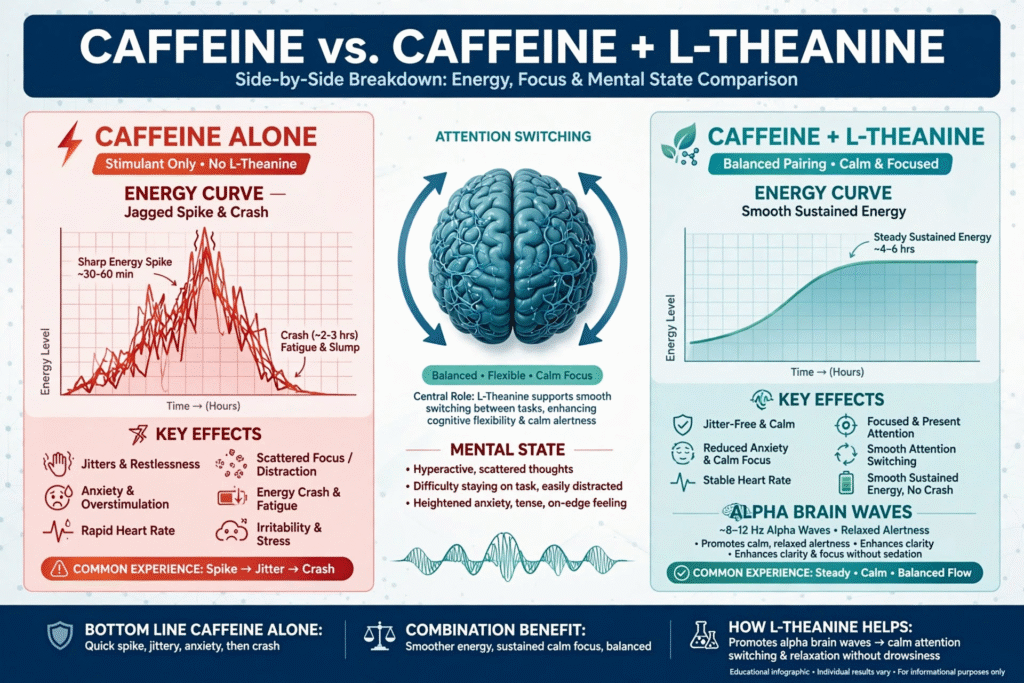
Caffeine plus L-theanine: the nootropics pick that actually works fast
If you’ve ever had a cup of good tea and felt alert without feeling wired, you’ve met this combination. Tea contains both caffeine and the amino acid L-theanine, and supplement makers sell them together.
The evidence is the best of the lot for short-term effects. Caffeine on its own reliably improves alertness and reaction speed. Adding theanine seems to smooth the edges. A meta-analysis of ten acute trials found the pair improved alertness and the accuracy of attention switching. A 2024 review pooling randomised trials (50 in all, 15 usable for meta-analysis) concluded that theanine, with or without caffeine, possibly improves attention and mood, though it also said the doses varied, the number of trials was small, and the size of the effect was uncertain. That’s a fair summary: probably real, probably modest.
Typical doses in the studies are 50 to 100 mg of caffeine (a small cup of coffee) with 100 to 200 mg of L-theanine, often at roughly a 1:2 ratio. Higher doses of both appear in some trials too. Theanine on its own looks very safe in studies, and caffeine is fine for most adults up to about 400 mg a day. Pregnant women are usually advised to stay under 200 mg.
The trap: caffeine is the active ingredient doing most of the lifting, and tolerance builds quickly. If you already drink three chais a day, adding theanine will feel like very little. And caffeine late in the day wrecks sleep, which will cost you far more focus than any capsule can buy back. Our guides to sleep hygiene and light hygiene and circadian health matter more than this entire article.
Cheapest way to test it: a cup of green tea or matcha, or your normal coffee plus a theanine tablet. You don’t need a branded “focus stack”.
Creatine: the boring nootropics pick that surprised researchers
Creatine is usually filed under gym supplements. Your brain, though, uses a lot of energy, and it stores and recycles creatine too. That’s the logic behind testing it for thinking.
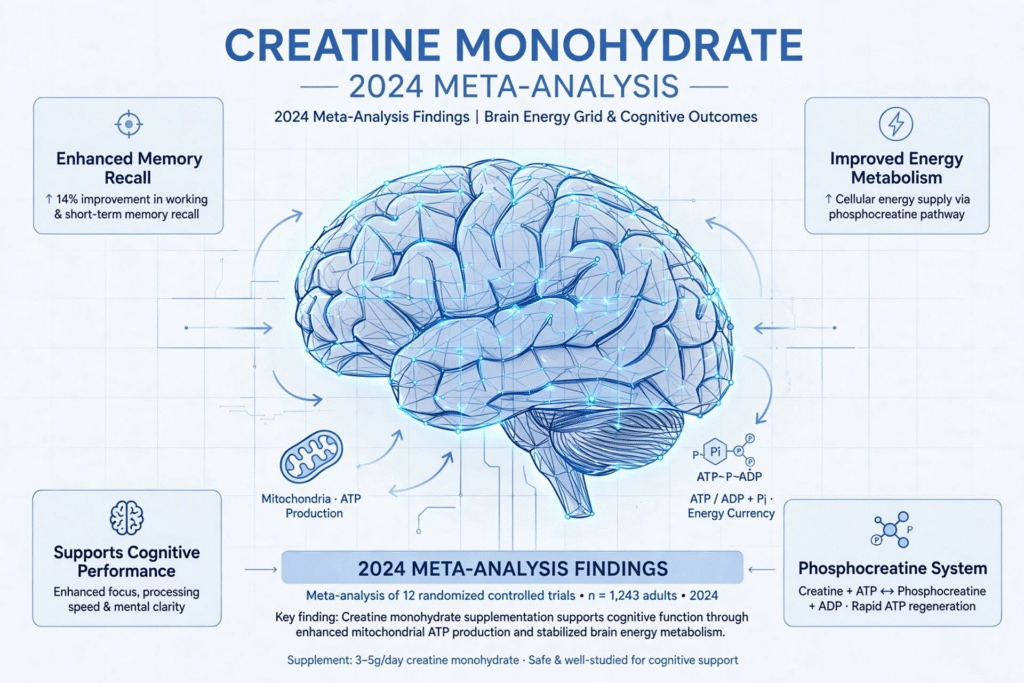
Here’s what the research shows. A 2024 systematic review and meta-analysis pooled 16 randomised trials involving 492 adults aged 20 to 76. It found creatine monohydrate improved memory (a modest effect, standardised mean difference around 0.3), and also shortened attention time and processing speed. It did not find broad improvements across overall cognition or executive function, and the quality of evidence was rated moderate for memory and lower for the rest.
The signal gets stronger when the brain is under strain. In a small crossover experiment of 15 healthy adults kept awake for about 21 hours, a single large dose (0.35 g per kg of body weight, roughly 20 to 25 g for most adults) partially reduced the decline on several mental tasks. That doesn’t mean creatine replaces sleep. The participants were still sleep-deprived, and the study is tiny. But it fits with a bigger pattern: creatine seems to help most when energy supply is stressed, which is why researchers have looked at sleep loss, ageing and vegetarian diets (vegetarians start with lower creatine stores since meat and fish are the main dietary sources).
In healthy, well-rested young adults doing ordinary mental work, the effect is small to nonexistent. I’d rather say that plainly than sell it as a smart pill.
Dose: 3 to 5 g a day of creatine monohydrate, the cheapest and most studied form. A loading phase isn’t necessary for most people, and the very high doses in sleep-loss studies are experimental. Safety: in healthy adults, studies up to several years long haven’t found kidney harm at standard doses. It can cause stomach upset if you take a lot at once, and it commonly causes a bit of water retention early on. Creatine can slightly raise the blood marker creatinine without damaging your kidneys, so tell your doctor you take it before any kidney test. People with existing kidney disease should ask first.
Women get a footnote of their own. Small trials in peri- and postmenopausal women have reported improved attention and reduced fatigue, though the evidence is early. If brain fog is part of your perimenopause, our guide to perimenopause symptoms and how to manage them covers the wider picture, and our guides to protein powder for women and sex-specific nutrition show where creatine fits into a muscle-and-nutrition plan.
Verdict: the best value per rupee among these nootropics, with a modest, real effect on memory in some groups, and no proof it makes a healthy 25-year-old smarter.
Omega-3: great for your heart, a letdown among nootropics
Fish oil is the supplement most people assume helps the brain. DHA, one of the two main omega-3 fats, is a structural part of brain cell membranes, so the idea isn’t silly.
The trouble is that trials in healthy older adults, including large ones and reviews by the Cochrane group, haven’t shown that omega-3 supplements prevent cognitive decline or boost memory in people who aren’t deficient. If you rarely eat fish, you might get more from supplementation than someone who eats it twice a week, since baseline intake matters. There’s more support for EPA-rich fish oil in depression, and there are good reasons to eat oily fish for your heart. But “omega-3 for focus” has far less behind it than the bottles imply.
Safety notes worth knowing: very high doses can thin the blood a little, so mention fish oil if you take anticoagulants or have surgery coming. Several trials have linked doses above roughly 1 g a day of omega-3 with a higher rate of atrial fibrillation in some people. Vegetarians can use algal oil, which contains DHA and EPA without fish.
Verdict: if you want it for your heart or mood, fine. As a nootropic for a healthy brain, thin.
Bacopa (Brahmi): the slow nootropics option
Bacopa monnieri is a staple of Ayurveda, where it’s usually called Brahmi. Many Indian families have a bottle of Brahmi syrup somewhere. One point of confusion worth clearing up: “Brahmi” is also the common name for Centella asiatica (gotu kola) in parts of north India, and the two plants are different. The trials I’m describing used Bacopa monnieri, standardised to its active compounds, called bacosides. A generic “brahmi powder” from a market stall isn’t comparable.
A systematic review of randomised controlled trials, covering six studies that each ran 12 weeks, found Bacopa improved performance on 9 of 17 tests of memory free recall. Doses were 300 to 450 mg of extract a day. The reviewers concluded there was some evidence for memory recall, but that research on other thinking skills was thin and the field was in its early days. A meta-analysis of randomised trials in 2014 reported small improvements mostly in the speed of attention.
Two features matter. First, it’s slow. In these trials, benefits appeared after weeks, not hours, so Bacopa is not an exam-morning supplement. Second, it commonly causes digestive side effects such as nausea, cramps and loose stools, especially on an empty stomach, so take it with food. It may interact with medicines that act on the cholinergic system, thyroid medication and sedatives, and it isn’t recommended in pregnancy, so check with a clinician.
Verdict: the most interesting herbal option among nootropics, with a plausible memory effect over about three months, a modest size, and a real chance of an upset stomach.
Lion’s mane: the most hyped of the nootropics
You’ll have seen lion’s mane everywhere, in coffee, in gummies, in “brain” blends. It’s a shaggy-looking edible mushroom, and the claims go well beyond what’s known. For a closer look at the mushroom-coffee trend, see our piece on mushroom coffee.
Here’s how the human trials stack up. The study nearly every claim traces back to is a 2009 Japanese trial in about 30 older adults with mild cognitive impairment. They took roughly 3 g a day of lion’s mane powder for 16 weeks, scored higher than the placebo group on a cognitive scale at weeks 8, 12 and 16, and then slipped back after they stopped. That’s one small trial, run in a specific group.
For healthy people, there’s much less. A 2023 UK pilot in 41 healthy adults aged 18 to 45 gave 1.8 g a day for 28 days. The researchers tentatively reported faster performance on a task and a trend towards lower subjective stress, and described the results as preliminary. The “stress” result narrowly missed the usual threshold for significance.
So the honest summary: preliminary evidence for memory in older adults who already have mild impairment, and essentially unproven for anyone else. Reported side effects are mostly mild stomach upset, though rashes and allergic reactions have been described, and people with mushroom allergies should avoid it. Product quality varies wildly. Many products are mostly mycelium grown on grain rather than the fruiting body the studies used, and many don’t list the amount of actual mushroom.
Verdict: thin. Fine to try if you like it, but don’t pay a premium for it.
Rhodiola: the nootropics option for running on fumes
Rhodiola rosea is an adaptogen, a plant used traditionally in Russia and Scandinavia to resist fatigue. It’s best studied for tiredness and stress, not for memory in rested people.
A systematic review of 11 controlled trials found some evidence that rhodiola reduces mental fatigue, but the authors flagged serious flaws in how many studies were done. One often-cited trial in 161 military cadets found that a single dose of standardised extract (370 or 555 mg) had an anti-fatigue effect during mentally demanding tasks, with no meaningful difference between the doses. Typical doses are about 200 to 600 mg of standardised extract daily.
What that suggests is that rhodiola is less about lifting your performance above normal and more about helping you hold it when you’re tired, stressed or sleep-short. That’s useful, but it’s also what proper sleep does for free. It can feel mildly stimulating, so it can cause trouble sleeping or irritability if you take it late. People with bipolar disorder should avoid it without medical advice, and it may interact with antidepressants and other medicines. For other herbs in the same family, see our adaptogens articles and our review of shatavari and adaptogens beyond ashwagandha, and our guides to cortisol and stress for the biology behind it.
Verdict: situational. A possible help during a stressful, tiring stretch, not a daily brain booster.
What a realistic effect from nootropics looks like
Let’s be blunt about the size of nootropics effects. The effects of nootropics in these studies are small to moderate on specific tests: remembering a word list slightly better, reacting a bit faster, feeling a little less tired. They are not IQ boosters, and none of them replaces sleep, learning or discipline. The people who describe “limitless” effects are usually describing caffeine, or expectation, or a bad week turning into a better one.
A few things to keep in mind when you read a nootropics claim:
- Placebo is strong with focus. Cognition and mood are subjective and hugely expectation-driven, which is why blinded trials matter.
- Most trials are short and small. Many last weeks, in small groups, often funded by the manufacturer.
- Lab tests aren’t life. Beating placebo on a word-recall test doesn’t tell you whether you’ll do better at work or in an exam.
- Results depend on who you are. Older people, vegetarians, the sleep-deprived and the stressed tend to respond; well-rested, well-fed 25-year-olds mostly don’t.
Reading nootropics labels (and watching your money)
The supplement aisle is where nootropics turn into a consumer finance problem. A few habits will save you real money:
- Avoid “proprietary blends”. If a label lists a blend total and not the amount of each ingredient, you can’t compare it with trial doses, and the cheap ingredients are probably doing the filling.
- Check the dose per serving against the trials. A capsule with 50 mg of bacopa isn’t the same product as 300 mg of standardised extract.
- Look for standardisation. Bacopa should state bacosides, rhodiola should state rosavins and salidroside, and lion’s mane should say fruiting body.
- Prefer single ingredients. One-at-a-time products let you work out what helps. Blends make that impossible.
- Look for third-party testing. Seals from independent labs matter, because contamination and mislabelling are known problems in the supplement market.
- Do the cost-per-effective-dose sum. Divide the price by servings, then by the amount of active ingredient per serving, and compare it with the trial dose. Creatine at 3 to 5 g a day costs far less per month than most “brain stacks”, for stronger evidence.
- Give it a fair test, then stop paying. Twelve weeks for bacopa. A couple of weeks for caffeine and theanine. If you can’t point to a difference in a diary, the money isn’t earning its place.
Nootropics safety: who should be careful
- Pregnancy and breastfeeding: avoid bacopa, rhodiola and lion’s mane unless a clinician says otherwise. Keep caffeine under about 200 mg.
- Children and teenagers: don’t use nootropics for exam prep. Sleep, food and routine do the work, and the safety data in young people is scant.
- Medicines: check with your doctor or pharmacist if you take antidepressants, blood thinners, thyroid medication, sedatives, diabetes drugs or blood pressure medicine.
- Existing conditions: kidney disease (creatine), bipolar disorder (rhodiola), anxiety or heart rhythm problems (caffeine), allergies to mushrooms or fish.
- Surgery coming up: tell your surgeon about fish oil and herbal products.
- Stacking nootropics: the more things you add, the harder it is to know what’s helping or hurting, and the more interactions you risk. Add one at a time.
For general guidance on using supplements wisely, our supplement safety articles are a good start, and our piece on functional protein and next-gen collagen walks through the same kind of “hype versus evidence” reading.
What beats every one of the nootropics on the shelf
I’d feel dishonest ending an article on nootropics without this. If your focus is poor, check these before spending a rupee on capsules:
- Sleep. Even a couple of short nights can cut attention and memory more than any supplement can restore.
- Movement. Regular exercise has some of the strongest evidence for brain health.
- Food and deficiencies. Low iron, B12, vitamin D, or thyroid problems commonly cause brain fog. See our guide to iron deficiency and anemia in women.
- Stress and mood. Depression and anxiety masquerade as poor concentration. Our Mental Health section can help.
- Attention habits. Constant notifications fragment focus. Low-friction prevention is a good primer on building habits that stick.
- Hormonal changes. Perimenopause and thyroid disease are classic, underdiagnosed causes. See women’s hormonal health.
- ADHD and other conditions. If you’ve struggled with focus all your life, ask about assessment instead of self-treating.
A sensible twelve-week nootropics experiment
If you’re curious, run it like a trial on yourself.
- Week 0: note your sleep, caffeine, exercise and stress. Rate focus, memory and mental fatigue from 1 to 10 for a week.
- Pick one thing. For most people, creatine (3 to 5 g daily) or a theanine-with-coffee routine is the sensible place to start. Add nothing else.
- Keep everything else steady for the full period.
- Rate yourself weekly, ideally on the same day and time.
- At week 12, compare your numbers. If you can’t see a difference, stop.
- Only then consider a second item, and repeat.
When to see a doctor instead of buying nootropics
A supplement isn’t the answer to any of these. See a doctor if you notice:
- Memory loss that’s getting worse or interfering with daily life
- Sudden confusion, trouble speaking, or changes in personality
- Repeatedly getting lost, or struggling with familiar tasks
- Persistent low mood, anxiety, or sleep problems
- Brain fog alongside weight change, heavy periods, hair loss, or unusual tiredness
If you’ve been looking things up online first, our article on AI self-diagnosis and digital health explains how to use online tools without letting them make the decision. And for another example of a wellness claim running well ahead of its evidence, see our look at grounding sheets and earthing.
Where to go next
- Mushrooms and adaptogens: Mushroom coffee, Adaptogens, Shatavari and adaptogens
- Sleep, stress and focus: Light hygiene, Sleep hygiene, Cortisol and stress
- Women’s brain fog: Perimenopause symptoms, Women’s hormonal health, Iron deficiency in women
- Supplements and protein: Supplement safety, Protein powder for women, Functional protein and collagen
- More hype vs evidence: NAD+ precursors, Grounding sheets, AI self-diagnosis
- More guides: Nutrition & Diet, Health & Wellness
Questions people ask about nootropics
What are nootropics?
Nootropics are supplements or drugs taken to improve memory, focus or other thinking skills. The term was coined in 1972, and it has no strict legal meaning, so almost any “brain supplement” can use it. Evidence ranges from decent (caffeine with theanine) to nearly nonexistent.
Do nootropics actually work?
Some do, modestly, and mostly for specific jobs. Caffeine with L-theanine helps short-term attention. Creatine modestly helps memory, especially in older adults, vegetarians and the sleep-deprived. Most other ingredients have thin evidence in healthy people.
What is the best of the nootropics for focus?
For short-term focus, caffeine with L-theanine has the best evidence, and you can get it from tea or coffee plus a theanine tablet. For longer-term memory, creatine and, more slowly, bacopa have the most support.
Is creatine one of the nootropics worth taking for the brain?
A 2024 meta-analysis of 16 trials found creatine modestly improved memory and processing speed. The effects are strongest under stress, such as sleep loss, and in older adults or vegetarians. In healthy, well-rested young adults the effect is small.
Does lion’s mane improve memory?
Preliminary trials suggest it may help memory in older adults with mild cognitive impairment. Evidence in healthy adults is very limited, and results are mixed. It isn’t proven as a memory booster for most people.
How long does bacopa take to work?
In trials, benefits appeared after about 12 weeks of daily use of 300 to 450 mg of standardised extract. It isn’t an instant effect, and it commonly causes stomach upset, so take it with food.
Does omega-3 work as one of the nootropics for brain function?
Large trials in healthy older adults haven’t shown that omega-3 supplements improve memory or prevent cognitive decline. It’s still worthwhile for heart health and, in some forms, mood, but it isn’t a reliable nootropic.
Is rhodiola good for focus and stress?
Rhodiola has some evidence for reducing mental fatigue during stress or sleep shortage, though many studies had weaknesses. It may cause jitteriness or insomnia, and isn’t suitable for everyone, including people with bipolar disorder.
Are nootropics safe to take every day?
Caffeine, L-theanine and standard-dose creatine have good safety records in healthy adults. Bacopa, lion’s mane and rhodiola have less long-term data and can interact with medicines. Check with a doctor or pharmacist if you take any prescription drugs, are pregnant, or have a medical condition.
What should I do before buying nootropics?
Sort out sleep, exercise, diet, stress and possible deficiencies like iron, B12 and vitamin D first. Then pick one single-ingredient product with a trial-matched dose and third-party testing, and judge it after a fair trial period.
The short version
Nootropics are a category where the marketing is a decade ahead of the evidence. Caffeine with L-theanine does what it says for short bursts. Creatine has real, modest evidence for memory, particularly if you’re older, vegetarian or short of sleep. Bacopa might help recall over three months and might upset your stomach. Lion’s mane, rhodiola and omega-3 are thin for healthy brains. None of them beats a good night’s sleep, a walk and a diagnosed deficiency treated.
If you want one practical takeaway, spend your first ₹500 on a decent night’s sleep, not a bottle of capsules. If you still want to experiment after that, change one thing at a time and write down what happens.
Disclaimer: this article is general education and not medical advice. Always consult a qualified healthcare professional before starting any supplement, especially if you’re pregnant, take medication or have a medical condition. See our full disclaimer.
Research referenced: the 2024 systematic review and meta-analysis of tea, L-theanine and L-theanine plus caffeine on cognition, sleep and mood; the 2021 systematic review of caffeine and L-theanine; the 2024 creatine and memory meta-analysis and the single-dose creatine sleep deprivation study summary; the systematic review of Bacopa monnieri RCTs; the 2023 lion’s mane pilot study in young adults and the overview of lion’s mane human trials; and the overview of nootropic evidence including rhodiola.






Leave a Reply