
Ask almost any Indian family for Ayurvedic remedies for hair fall and you’ll get three answers before you finish the sentence: amla, bhringraj, and a warm oil massage on Sunday. None of the three is wrong. But the way most people use them, a bottle of oil and a lot of hope, skips the question that decides whether anything will work: what kind of hair fall do I have?
That’s the gap this guide to Ayurvedic remedies for hair fall tries to fill. I went through the human trials on amla, bhringraj and scalp massage, added the newer options with real evidence (rosemary oil, a standardised massage routine, pumpkin seed oil), and built a step-by-step plan that puts testing first and traditional care alongside it. You’ll also get a home oil recipe that’s safe to make, an honest look at what Ayurvedic products can and can’t promise, and the signs that mean you should see a dermatologist before wasting another three months.
General information only. Sudden patchy hair loss, a painful or burning scalp, or hair loss with other symptoms should be seen by a doctor.
Before Ayurvedic remedies for hair fall: is it hair fall or normal shedding?
Everyone sheds. The commonly quoted figure is 50 to 100 hairs a day, and a 2025 case-control study in women found controls losing about 70 a day on average, against about 105 in women with a shedding disorder. So finding hair on your pillow doesn’t mean much. A change in pattern does: more hair in the drain than usual, a ponytail that feels thinner, a wider parting, bald patches, or hair coming out in handfuls.
Here’s the thing most advice on Ayurvedic remedies for hair fall glosses over. “Hair fall” isn’t one condition. The main types behave very differently.
| What you notice | Likely type | What usually helps |
|---|---|---|
| Sudden diffuse shedding 2 to 3 months after fever, childbirth, surgery, crash diet or a stressful period | Telogen effluvium | Fix the trigger and any deficiency; it usually settles in 6 to 12 months |
| Wider parting, thinning on top, receding temples, slow over years | Androgenetic alopecia (pattern loss) | Medical treatment (minoxidil, finasteride in men) plus supports |
| Round, smooth bald patches | Alopecia areata (autoimmune) | See a dermatologist |
| Scaly, itchy, patchy areas, broken hairs | Fungal infection (tinea capitis) | Needs antifungal treatment, not oil |
| Redness, pain, burning, pus, scarring | Scarring alopecia | Urgent dermatology; it can destroy follicles |
| Thinning plus irregular periods, acne, facial hair | Possible PCOS or hormonal cause | Medical evaluation |
| Hair breaking mid-shaft rather than coming out from the root | Damage from heat, chemicals, tight styling | Gentler hair care; oils may help |
A simple check dermatologists use is the pull test: gently pull a small bunch of about 50 to 60 hairs, and if more than roughly 10% come away, that points to active shedding. It isn’t a diagnosis, and it’s best done by someone who knows what they’re looking at.
The tests nobody mentions in a list of Ayurvedic remedies for hair fall
If you have diffuse shedding, a few blood tests are worth more than a month of oils: a complete blood count, ferritin (your iron stores), thyroid function (TSH), vitamin D and vitamin B12. If you also have irregular periods, acne or excess facial hair, a doctor may check hormones for PCOS.
Iron deserves special attention in India. A 2025 case-control study found mean ferritin of about 24 ng/mL in women with telogen effluvium against about 45 in controls, and a systematic review of studies in women with non-scarring hair loss found ferritin lower by about 18 ng/mL than in women without hair loss, with around one in five having clear iron deficiency. The catch: nobody agrees on the target. Labs flag ferritin as low at 10 to 15, studies often use 30 as a threshold, and some dermatologists aim for 40 to 70 or higher for hair. The honest position is that low ferritin goes with shedding, and that the best level for hair hasn’t been settled. Taking iron when your levels are normal won’t help, and too much isn’t harmless, so get tested first. Our guides to iron deficiency and anemia in women, women’s hormonal health and inositol for PCOS explain what the results mean and what to ask for.
What Ayurvedic remedies for hair fall get right
I want to give the tradition its due. Ayurveda ties hair health to digestion, sleep, stress and regular routines, and that matches the modern causes of shedding better than most of the oils on the shelf do. Telogen effluvium really is driven by physical and emotional stress, poor nutrition and illness. The weekly head massage really is a form of scalp massage, which has some evidence. And the traditional emphasis on a nourishing diet is sound.
Where Ayurvedic remedies for hair fall run into trouble is the claim that a single herb or oil can fix any type of hair fall, and the bundle of modern products marketed on that claim. So let me take the big three Ayurvedic remedies for hair fall one at a time.
Amla (Indian gooseberry) as one of the Ayurvedic remedies for hair fall: what the research shows
Amla (Phyllanthus emblica) is rich in vitamin C and polyphenols, and it’s the most-cited herb for hair in Ayurveda and Persian traditional medicine.
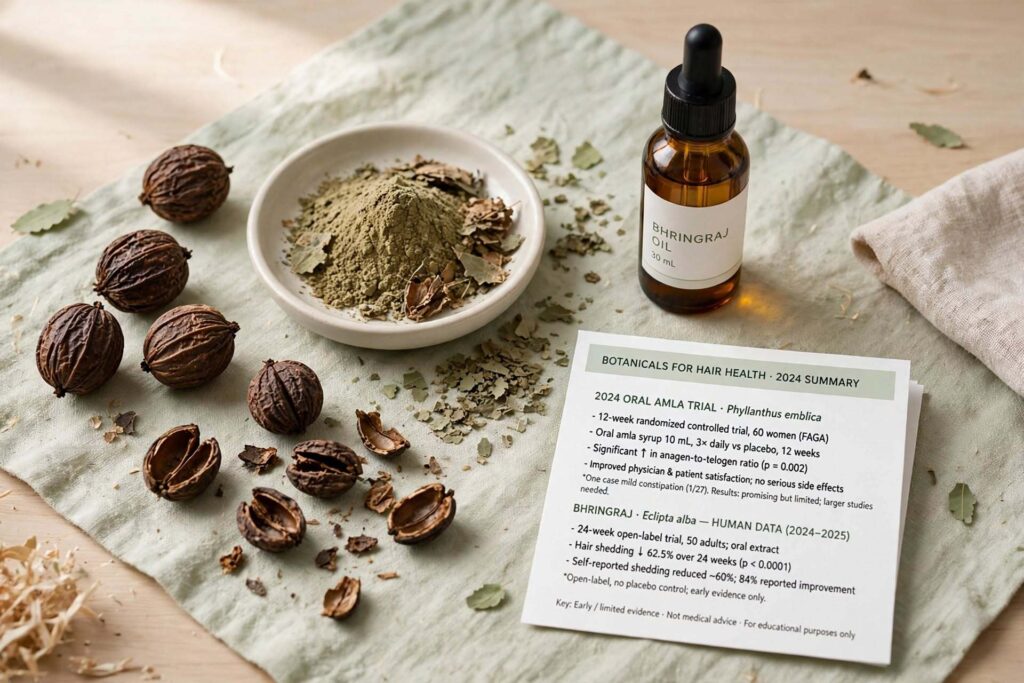
The best human evidence is a triple-blind, randomised, placebo-controlled trial published in the Journal of Ethnopharmacology in 2024 (Iranian researchers, using a traditional-medicine formulation). Women with female pattern hair loss took an oral amla syrup for 12 weeks. About 27 in the amla group and 25 on placebo completed it. The proportion of growing (anagen) to resting (telogen) hairs rose significantly in the amla group compared with placebo, and both the doctors and the women rated the amla group as improved. Side effects were minimal, with one case of mild constipation.
That’s encouraging for Ayurvedic remedies for hair fall, and it’s one small, short trial in one type of hair loss, using a specific syrup. It doesn’t tell us about amla oil on the scalp, which is how most people use it. For topical amla, the evidence is mostly lab and animal work, plus company claims. I found a patent filing describing a 10-person amla seed extract study, which is the kind of thing that sounds like science and isn’t.
There’s also a practical, less glamorous benefit: amla is a rich source of vitamin C, which helps your body absorb the plant-based iron in dal, spinach and legumes. If low iron is part of your hair fall, a bit of amla (or lemon, or guava) with an iron-rich meal is a sensible habit, though it’s not a substitute for treating a real deficiency.
Caution: large amounts of amla may lower blood sugar slightly and may affect clotting. If you take diabetes medicines or blood thinners, check with your doctor before using it as a supplement. Dried amla powder, candies and murabba with lots of sugar don’t count.
Bhringraj among Ayurvedic remedies for hair fall: what the research shows
Bhringraj (Eclipta alba, also called Eclipta prostrata) is the classic hair herb in Ayurvedic oils, and its reputation rests on a surprisingly thin base.
Most of the data are in animals. A widely cited mouse study reported that an Eclipta extract promoted hair regrowth about as well as, or better than, minoxidil. Mouse hair and human hair are different, and the follicle cycles aren’t the same, so that result is a reason for curiosity, not a treatment.
In humans, I found one recent report: a 2025 single-blind, placebo-controlled trial of a commercial Ayurvedic bhringraj-based oil, which was reported to increase follicular density by about 20% and cut hair fall by more than 40% over four months. I couldn’t access the original paper, it tested one branded multi-herb product, and company-linked trials deserve extra scrutiny, so I’d call it promising but unconfirmed. And “bhringraj oil” on a label can mean a pure herb-infused oil, a multi-herb blend, or a cosmetic oil with bhringraj as a marketing name.
Oil massage in Ayurvedic remedies for hair fall: it’s the massage doing the work
This is the part of Ayurvedic remedies for hair fall I find most interesting. The weekly oil massage among Ayurvedic remedies for hair fall has better evidence than most of the herbs, but probably not for the reason you’d expect.
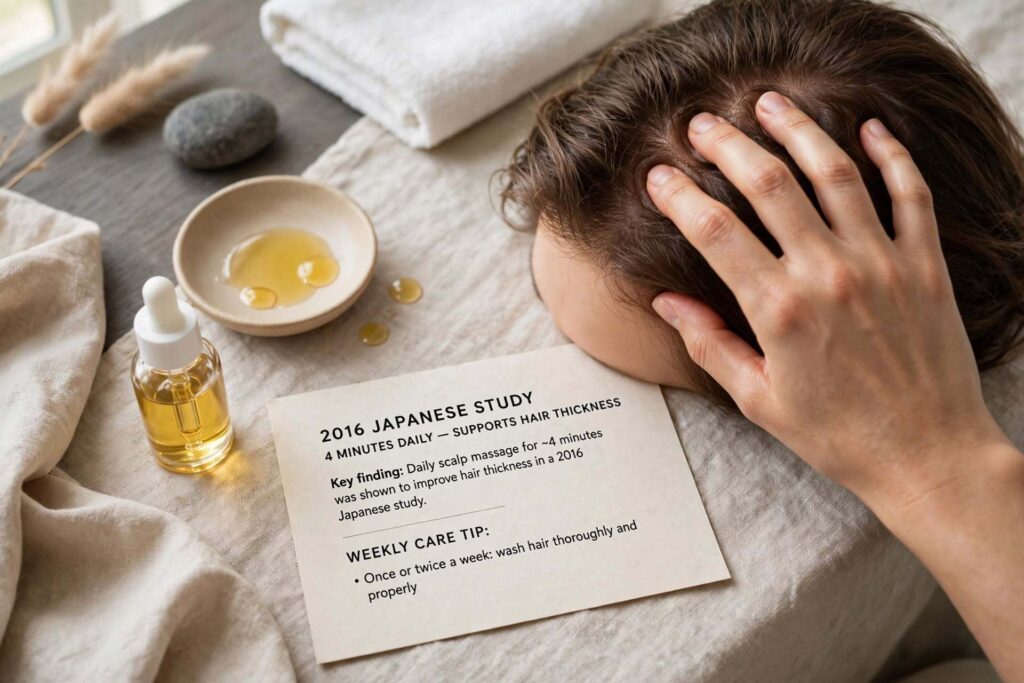
A 2016 Japanese study (Koyama and colleagues) had healthy men use a standardised scalp-massage device for four minutes a day for 24 weeks. Hair thickness increased, and the researchers argued that the stretching forces from massage act on the dermal papilla cells at the base of the follicle. The study was small, and it was about thickness rather than the number of hairs, but it’s a real, measured result. A later survey of men with pattern hair loss who massaged daily for around 11 to 20 minutes reported subjective improvement. A survey isn’t a trial, but it points the same way.
What about the oil itself in Ayurvedic remedies for hair fall? Oil doesn’t “feed” the follicle. What the research does support is that coconut oil reduces protein loss from the hair shaft and helps protect against damage from combing and washing, which means fewer broken hairs, not more hairs growing. So oiling is a good answer to breakage and dry, brittle ends, and a limited answer to hair that falls out from the root.
A few cautions:
- Don’t leave oil on for days. On an oily or dandruff-prone scalp, heavy oil left for long periods may make seborrhoeic dermatitis (dandruff) worse, because the yeast involved feeds on oils. Wash within a few hours to overnight, and shampoo properly, twice if needed.
- Don’t massage roughly or pull wet hair, which causes breakage and traction.
- Don’t overheat the oil. Warm, not hot.
- Tight oily braids are a common cause of traction hair loss at the hairline.
Newer additions to Ayurvedic remedies for hair fall, with real evidence
Here are the newer additions to Ayurvedic remedies for hair fall, ranked by how strong the human data are. Think of these as the additions that give Ayurvedic remedies for hair fall more punch.
Rosemary oil: the best-studied natural addition to Ayurvedic remedies for hair fall
A 2015 randomised trial published in SKINmed (Panahi and colleagues) compared rosemary oil with 2% minoxidil in about 100 people with pattern hair loss over six months. At three months neither showed a significant gain. At six months both groups had a significant increase in hair count, with no significant difference between them. Scalp itching was reported more with minoxidil.
That’s a striking result, and the right way to read it is carefully. It’s a single trial with no placebo group, 2% minoxidil is not the strongest dose, and the result needs independent replication. But rosemary is a legitimate, tested option for mild pattern thinning. It has to be diluted. Standard practice is a 1 to 3% concentration of rosemary essential oil in a carrier oil. Patch-test first, avoid it in pregnancy and with epilepsy, and stop if your scalp gets irritated.
A standardised scalp-massage routine for Ayurvedic remedies for hair fall
Based on the Japanese work, here’s a routine that’s easy to follow. Use your finger pads, not your nails. Press firmly enough to move the scalp over the skull, not just slide over the hair. Work in slow circles across the whole scalp for about four minutes a day, ideally at the same time each day. You can do it dry or with oil. The consistency is what matters, so attach it to something you already do, which is the idea behind our guide to low-friction prevention.
Pumpkin seed oil capsules
A 2014 randomised, double-blind, placebo-controlled trial in Evidence-Based Complementary and Alternative Medicine (Cho and colleagues) gave 76 men with mild to moderate pattern hair loss either 400 mg of pumpkin seed oil a day or placebo for 24 weeks. Hair count rose by about 40% in the pumpkin seed group, against about 10% in the placebo group. The oil is thought to act on the same hormone pathway as finasteride, but more weakly. The study was in men, and there’s no comparable evidence that rubbing it on your scalp does anything, so this is a supplement question, not a topical one.
Onion juice
A small trial from 2002 reported hair regrowth with onion juice in people with patchy alopecia areata. It’s an old, small study, the smell and scalp irritation put many people off, and there’s no evidence it helps pattern loss or stress shedding. If you have patchy hair loss, see a dermatologist first. Don’t try to treat alopecia areata at home.
Ayurvedic remedies for hair fall with little or no human evidence
Methi (fenugreek), curry leaves, hibiscus, brahmi, neem, aloe vera, castor oil and most “hair growth” kashayams all have traditional uses and some lab data. Good human trials are scarce. Most are fine to use as part of a hair routine, as long as you aren’t relying on them to treat a medical cause.
The treatments that beat all Ayurvedic remedies for hair fall
Here’s where I’ll be blunt about Ayurvedic remedies for hair fall, because it’s the thing that saves people the most time and money. For pattern hair loss, topical minoxidil (2% or 5%) has decades of data and is approved for the purpose, and finasteride works well in men. None of the Ayurvedic remedies for hair fall has beaten them in a head-to-head human trial. The closest is rosemary, in that one trial against the weaker dose. If you have pattern thinning, the sensible sequence is to see a dermatologist, start the treatment with the best evidence, and add traditional care alongside it. Waiting a year on oils while the thinning progresses means follicles may be shrinking for good.
Minoxidil can cause a temporary increase in shedding in the first weeks, and finasteride isn’t for women who may become pregnant, which is why a doctor should guide that choice.
Food, supplements and the biotin myth in Ayurvedic remedies for hair fall
Hair is made of protein, and it’s one of the first things your body shuts down when supply drops. Crash diets, very low-calorie plans and long gaps in protein can trigger telogen effluvium a couple of months later. Aim for protein at each meal (dal, curd, eggs, paneer, fish, chicken, soy), plus iron-rich foods, and don’t cut calories drastically. Our guides to sex-specific nutrition for women and protein powder for women cover how much is enough.
Vegetarians in India are particularly prone to low vitamin B12, and low vitamin D is common across the country. Both are checked with a simple blood test and treated if low.
Biotin is everywhere in hair supplements, but it only helps if you’re actually deficient, which is uncommon. High-dose biotin can also interfere with some blood tests, including thyroid and heart tests, so tell any lab or doctor if you take it. Our supplement safety pages are a good general guide.
Stress, sleep and Ayurvedic remedies for hair fall
Stress-triggered shedding is real, but it’s about a major or prolonged stressor, not a bad week. If that’s your situation, the fix is the stressor and the recovery, not another oil. Sleep, daylight and stress management support recovery. Our guides to sleep hygiene, cortisol and stress and nervous system regulation are good places to start. Ashwagandha and other adaptogens are popular for stress. Their evidence for hair specifically is thin, and our pieces on adaptogens and shatavari and adaptogens beyond ashwagandha explain what they can and can’t do.
The advanced protocol: a layered plan around Ayurvedic remedies for hair fall
Here’s how I’d combine all of these Ayurvedic remedies for hair fall into something you can actually follow. The idea is simple: diagnose, fix the cause, add what has evidence, then layer the traditional care on top, and measure what’s happening.
Layer 1: Find out what you’re dealing with (week 0 to 2). See a doctor or dermatologist if shedding is heavy, patchy or lasting more than a few weeks. Get CBC, ferritin, TSH, vitamin D and B12 checked. Take clear photos of your parting and hairline in the same light, so you can compare later.
Layer 2: Fix the drivers (week 0 onward). Treat any deficiency or thyroid problem. Eat enough protein and calories. Sleep properly. If a trigger (illness, childbirth, surgery, crash diet, big stress) is behind the shedding, remember that recovery takes months after it ends.
Layer 3: Add the scalp routine (week 2 onward). Four minutes of daily scalp massage. A traditional oil massage once or twice a week, washed out properly. Gentle handling: no tight styles, no hot tools, no rough towel drying.
Layer 4: Add an active, if your type calls for it (week 2 to 4). For pattern thinning, ask your dermatologist about minoxidil. If you prefer to start with something plant-based for mild thinning, use diluted rosemary oil, understanding that its evidence is a single trial.
Layer 5: Ayurvedic remedies for hair fall as supports (any time). Amla in your food, bhringraj or other herbal oils in your massage, a balanced diet. These are reasonable additions that cost little and may help comfort and hair quality, even where their effect on regrowth is unproven.
Layer 6: Measure and be patient (every 4 weeks). Repeat your photos and note shedding. Change one thing at a time so you know what worked. Give any approach at least three to six months before judging, because hair grows slowly and follicles take time to respond. If your trigger-driven shedding isn’t improving at six months, go back to your doctor.
| Timeline | What to expect |
|---|---|
| Weeks 0 to 4 | Little visible change; shedding may even continue or briefly increase with minoxidil |
| Months 2 to 3 | Shedding often starts to slow in telogen effluvium once the cause is fixed |
| Months 3 to 6 | First visible regrowth and thickness changes if the approach is working |
| Months 6 to 12 | Fuller recovery in telogen effluvium; pattern loss needs ongoing treatment to hold gains |
A home oil formula for Ayurvedic remedies for hair fall that you can make safely
If you enjoy making your own Ayurvedic remedies for hair fall, here’s a simple, safe oil recipe that combines the traditional herbs with the best-studied addition. I’ll be clear: this combined formula hasn’t been tested in a trial, and the benefit of each part is different. Treat it as a nice massage oil, not a medicine.
What you need
- 100 ml coconut oil or sesame oil (coconut has the better evidence for protecting hair from breakage; sesame is the traditional choice)
- 10 g fully dried bhringraj leaf (or powder)
- 10 g fully dried amla (slices or powder)
- Rosemary essential oil, about 20 to 40 drops for a 1 to 2% dilution (optional; skip in pregnancy or epilepsy)
- A clean glass jar, a double boiler, muslin cloth and a dark glass bottle
How to make it
- Make sure the herbs are completely dry. Moisture grows mould in oil.
- Put the herbs and oil in a heatproof glass jar and set it in a pot of simmering water (a double boiler). Warm gently for 30 to 45 minutes. Don’t let the oil smoke or boil.
- Let it cool, then leave it to steep for a week or two in a cool, dark place if you like a stronger infusion.
- Strain very well through muslin, because fine herb powder left in the oil can irritate and spoil it.
- Once it’s completely cool, stir in the rosemary oil, if using.
- Store in a dark glass bottle away from heat. Use within two to three months, and discard if it smells off.
How to use it
- Patch-test on your inner arm for 24 hours first.
- Warm a small amount (a tablespoon or two is plenty) and massage into the scalp with your finger pads for four minutes.
- Leave it for 1 to 2 hours, or overnight if your scalp isn’t dandruff-prone, then shampoo thoroughly.
- Use it once or twice a week. More isn’t better.
Buying Ayurvedic remedies for hair fall: what to watch
The Ayurvedic hair oil aisle is huge, and buying Ayurvedic remedies for hair fall is where money disappears. A few checks:
- Look for a clear ingredient list with quantities, not just a list of herbs and “proprietary blend” language.
- Be careful with promises like “stops hair fall in 7 days” or “regrow lost hair”. They’re a red flag.
- Check the manufacturer is a reputable one with a proper licence.
- Beware of adulteration. Studies of Ayurvedic medicines, including a widely cited 2008 JAMA survey of products sold online, found that about one in five contained detectable lead, mercury or arsenic. That study was about oral products, but it’s a reminder to buy from trustworthy sources, particularly for anything you swallow. Some “herbal” hair tonics have also been found to contain undeclared steroids.
- Do the cost sum. Divide the price by the number of weeks it lasts, and compare it with what the evidence says it does. A ₹500 oil that makes your scalp feel nice is fine. A ₹3,000 monthly regimen promising regrowth with no trial behind it isn’t. Topical minoxidil, which has the best evidence for pattern loss, is usually inexpensive compared with branded Ayurvedic regimens.
When to see a doctor instead of Ayurvedic remedies for hair fall
Don’t wait three months if you notice:
- Patchy hair loss, smooth round bald patches, or loss of eyebrows and eyelashes
- A red, painful, burning or scaly scalp, pus, or areas that look shiny and scarred
- Sudden heavy shedding after a new medicine, illness or surgery
- Shedding that continues beyond six months
- Hair loss with fatigue, weight change, irregular periods, acne or facial hair, which can point to thyroid problems, PCOS or iron deficiency
- Hair loss in a child
- Thinning that’s progressing, such as a widening parting or receding hairline, because earlier treatment preserves more hair
If you’ve been searching your symptoms online first, our article on AI self-diagnosis and digital health explains how to use that research without letting it make the diagnosis. And our broader guide to hair fall solutions covers non-Ayurvedic approaches.
Where to go next
- Hair fall overview: Hair fall solutions and natural remedies
- Causes to rule out: Iron deficiency and anemia in women, Women’s hormonal health, Inositol for PCOS, Perimenopause symptoms
- Nutrition: Sex-specific nutrition for women, Protein powder for women, Habits to quit for better health
- Stress and sleep: Sleep hygiene, Cortisol and stress, Nervous system regulation
- Herbs and safety: Adaptogens, Shatavari and adaptogens, Supplement safety
- Habits that stick: Low-friction prevention
- More guides: Health & Wellness
Questions people ask about Ayurvedic remedies for hair fall
Do Ayurvedic remedies for hair fall really work?
Some help, depending on the type of hair fall. Scalp massage has small but real evidence for hair thickness, and an oral amla syrup improved hair-cycle measures in women with pattern loss in one trial. Bhringraj evidence is mostly animal studies. None has beaten minoxidil in head-to-head human trials, so pattern loss usually needs medical treatment as well.
Is amla one of the best Ayurvedic remedies for hair fall?
Possibly. One triple-blind randomised trial found oral amla syrup improved the ratio of growing to resting hairs in women with female pattern hair loss over 12 weeks. Evidence for amla oil on the scalp is much thinner. Amla also supplies vitamin C, which helps iron absorption.
Does bhringraj oil work among Ayurvedic remedies for hair fall?
There’s no solid proof it regrows hair in humans. Animal studies are encouraging, and one company-linked 2025 trial of a branded oil reported less hair fall and higher follicle density. Quality and formulation vary a lot between products.
How should I do an oil massage as one of the Ayurvedic remedies for hair fall?
Warm a small amount of oil and massage it into the scalp with your finger pads, moving the scalp over the skull, for about four minutes. Leave it on for one to two hours (or overnight if you aren’t dandruff-prone), then shampoo well. Once or twice a week is plenty. The massage itself is the part with evidence.
Is rosemary oil a good addition to Ayurvedic remedies for hair fall, and as good as minoxidil?
In one 2015 trial of about 100 people with pattern hair loss, rosemary oil and 2% minoxidil produced similar hair-count gains at six months, and there was no placebo group. It’s promising but needs replication, and 5% minoxidil has far more evidence. Dilute rosemary essential oil to 1 to 3% and avoid it in pregnancy and epilepsy.
How long do Ayurvedic remedies for hair fall take to work?
Expect at least three to six months. Hair grows slowly, and shedding from a trigger like illness or childbirth typically settles over six to twelve months. If you see no improvement after six months, see a doctor.
What blood tests should I get before Ayurvedic remedies for hair fall?
A complete blood count, ferritin, TSH, vitamin D and vitamin B12, and hormone tests if you have signs of PCOS. Low ferritin is common in women with diffuse hair loss, though the ideal level for hair is debated.
Does biotin help hair fall?
Only if you’re actually deficient, which is uncommon. High-dose biotin can interfere with some blood tests, so tell your doctor if you take it.
Are Ayurvedic remedies for hair fall safe?
Most are, if you patch-test and buy from reputable makers. Some herbal products have been found to contain heavy metals or undeclared steroids, particularly oral ones. Avoid oils with unclear ingredients, and don’t use essential oils like rosemary in pregnancy without advice.
When should I see a doctor instead of using Ayurvedic remedies for hair fall?
For patchy loss, a painful or scaly scalp, sudden heavy shedding, shedding beyond six months, loss with other symptoms like fatigue or irregular periods, or thinning that keeps progressing. Early treatment preserves more hair.
The short version
The best Ayurvedic remedies for hair fall are the ones that fit the cause. Amla and bhringraj are reasonable, low-risk additions with modest evidence, scalp massage has better evidence than most herbs, and rosemary oil is the best-studied plant-based topical. But testing for iron, thyroid and vitamin deficiencies comes first, and pattern hair loss needs medical treatment that traditional care can support but not replace.
If you do one thing for Ayurvedic remedies for hair fall this week, get your ferritin and thyroid tested, take a clear photo of your parting, and start four minutes of daily scalp massage. Then give it three months before you buy another bottle.
Disclaimer: this article is general education, not medical advice. Always consult a qualified healthcare professional about hair loss, supplements and any herbal or essential oil use, especially if you are pregnant, take medication or have a medical condition. See our full disclaimer.
Research referenced: the 2024 Journal of Ethnopharmacology randomised trial of an oral Amla product in female androgenetic alopecia; the 2025 case-control study of serum ferritin in women with telogen effluvium and the systematic review of iron deficiency and non-scarring alopecia in women (Skin Appendage Disorders); Koyama et al., 2016, Eplasty, on standardised scalp massage and hair thickness; Panahi et al., 2015, SKINmed, rosemary oil versus minoxidil 2%; Cho et al., 2014, Evidence-Based Complementary and Alternative Medicine, pumpkin seed oil in men with androgenetic alopecia; and Saper et al., JAMA, 2008, on heavy metals in Ayurvedic medicines sold online.







Leave a Reply