
Somewhere between the first sensor and the fortieth screenshot of a post-oats glucose curve, a lot of people decide that a line going up must mean something is wrong. That reaction is the real story of CGM for non-diabetics. The device itself is clever and, for people with diabetes, proven. What’s unproven, and what the wellness marketing quietly skips, is whether a healthy person who wears one ends up healthier.
I went looking for the honest answer on CGM for non-diabetics. This guide to CGM for non-diabetics covers what a continuous glucose monitor actually measures, what “normal” looks like on one, how people without diabetes are using them (food testing, exercise, “metabolic flexibility”, longevity), what the evidence does and doesn’t show, who might genuinely get something out of it, who almost certainly doesn’t need one, and how to read a spike without panicking. It ends with a two-week plan that treats a CGM like an audit, not a subscription.
General information only. A CGM can’t diagnose prediabetes or diabetes. If you have symptoms such as excessive thirst, frequent urination or unexplained weight loss, see a doctor and get lab tests.
What a CGM for non-diabetics actually measures
A continuous glucose monitor, the device behind CGM for non-diabetics, is a small sensor, usually worn on the back of the upper arm, with a thin filament under the skin. It doesn’t measure the glucose in your blood. It measures glucose in the fluid between your cells (interstitial fluid), every few minutes, around the clock, and sends the readings to an app.
Three consequences are easy to miss.
There’s a lag. Glucose shows up in that fluid a few minutes after it appears in the blood, so the sensor trails reality by roughly 5 to 15 minutes. After a meal or a run, the curve tells you where you were a little while ago.
It’s an estimate. Accuracy is decent on average, but sensors can be off by a noticeable margin, especially during fast changes and at the lower end. A “low” at 3 a.m. can sometimes be a sensor pressed under your sleeping body, not a real low. If a reading surprises you, the old-fashioned fingerstick is the check.
It measures glucose and nothing else. Not insulin, not how well you switch between burning carbs and fat, not your “metabolic health” as a whole. That last point matters, because a lot of wellness content slides from “glucose curve” to “metabolic flexibility” as if they were the same thing. Metabolic flexibility is usually assessed with tests of fuel use during rest and exercise. A CGM can’t show it.
What “normal” looks like on a CGM for non-diabetics (and why even experts disagree)
Most people trying CGM for non-diabetics have no idea what normal is, and there’s less agreement than you’d expect.
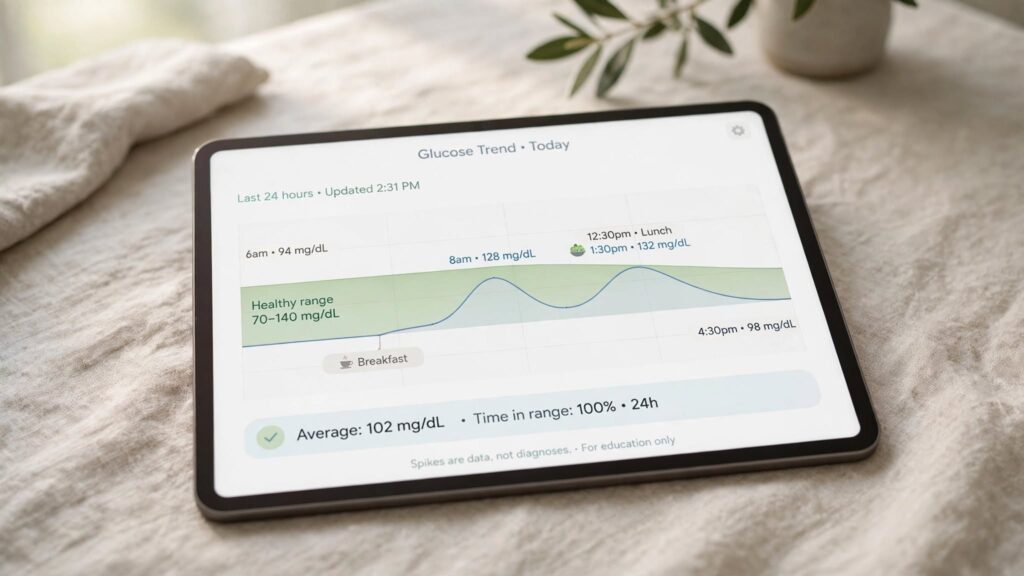
A multicentre study in the Journal of Clinical Endocrinology & Metabolism (Shah and colleagues, 2019) used a modern sensor on healthy, non-obese, non-diabetic children and adults to establish reference ranges. Average glucose was about 98 to 99 mg/dL (5.4 to 5.5 mmol/L) in all age groups except people over 60, whose average was around 104. The median time spent between 70 and 140 mg/dL was 96%. Time above 140 averaged about 2% of the day (roughly 30 minutes), and time below 70 about 1% (around 15 minutes).
Now the awkward bit. A Stanford study in 2018 (Hall and colleagues, PLoS Biology) wore CGMs on people considered normal by standard lab tests and found that their glucose reached the prediabetic range about 15% of the time and the diabetic range about 2% of the time. That study looked at a different, smaller group, with different devices and a mix of participants, and it grouped people into “glucotypes” with patterns that varied a lot. Even so, it was widely read as “your normal glucose might not be normal”.
So which is it? Both. Healthy, lean people mostly sit in a tight band, and a fair number of people with normal lab results still show bigger swings than expected. The honest conclusion is that researchers are still working out what a healthy glucose profile looks like in the real world, and that clinicians reading the same CGM trace in someone without diabetes can reach different conclusions.
| Measure | Typical healthy adult on CGM (Shah 2019) | What it means for you |
|---|---|---|
| Average glucose | About 98–99 mg/dL (higher after 60) | A reference, not a target to chase |
| Time between 70 and 140 mg/dL | Around 96% | Brief excursions above 140 are ordinary |
| Time above 140 mg/dL | About 2%, ~30 min a day | Occasional, not constant |
| Time below 70 mg/dL | About 1%, ~15 min a day | Some “lows” are sensor artefacts |
How people are using CGM for non-diabetics
The most common uses of CGM for non-diabetics, roughly in order of popularity:
- Food testing. “What does white rice do to me compared with my friend’s?” This is the main draw, and it has a legitimate scientific basis. In the well-known Israeli study led by Eran Segal’s group (Zeevi and colleagues, 2015, about 800 people), identical foods produced very different glucose responses in different people. A banana might spike one person and barely touch another.
- Exercise and recovery. Watching how a workout, a walk after dinner, or poor sleep changes your numbers.
- Weight loss. Using the feedback to cut down on foods that cause big spikes, or as a motivator.
- “Metabolic flexibility”. As discussed, not something a CGM measures.
- Longevity and performance. The idea that a flatter glucose line equals a longer, healthier life. This is the weakest link, and I’ll get to it.
- Early warning. Catching a drift toward prediabetes before it shows up on a lab test.
In 2024 the US FDA cleared two over-the-counter CGMs for adults not using insulin: Dexcom’s Stelo in March and Abbott’s Lingo in June. Both are labelled for wellness use, to help people understand how diet and exercise affect their glucose, and the FDA said people shouldn’t make medical decisions from the output without talking to a health professional. The agency also advised people with a history of disordered eating to speak to a clinician before using one. In India, sensors usually reach consumers through diabetes-device channels or app-based wellness programmes, and pricing and availability change often, so check what’s current.
The honest evidence gap for CGM for non-diabetics
Let me be blunt about CGM for non-diabetics, because the marketing isn’t.
No large randomised trial has shown that wearing a CGM improves health outcomes or prevents diabetes in people without diabetes. A May 2025 review in Clinical Correlations noted there is no large RCT addressing whether CGMs help adults without diabetes change their diet and exercise, and framed the question in two steps: do CGMs change behaviour, and are those changes actually beneficial? The author thought it likely that a CGM paired with sensible diet and exercise changes would help, but that’s reasoning, not data.
A 2026 systematic review pulling together studies of CGM in non-diabetic populations found hints that CGM use may improve mean blood glucose and help people stick with an intervention, but said that evidence on measurement accuracy and glucose variability was limited, and that studies were scattered across very different designs and groups. A speaker at an endocrinology meeting in late 2025, Dr Viral Shah, said much more work is needed on CGM as a tool for people without diabetes, and noted that clinicians reading CGM profiles of people without diabetes interpret them differently.
On the longevity claim for CGM for non-diabetics: some observational research links bigger glucose swings with higher cardiovascular risk, and the Hall paper cites this. But observational links don’t show that reducing your spikes lowers your risk, and nobody has shown that a flatter line in a healthy person extends life.
So here’s where that leaves CGM for non-diabetics. CGM for non-diabetics is a plausible tool with real mechanisms, a decent logic and a very thin evidence base. It might help some people eat better. It might also just generate numbers.
Who might genuinely benefit from CGM for non-diabetics
These are the groups where I think a short CGM trial could be worth discussing with a doctor, ideally alongside lab tests.
Prediabetes. If your HbA1c is 5.7% to 6.4% or your fasting glucose is 100 to 125 mg/dL, seeing how specific meals, walks and sleep affect your numbers can be motivating and practical. Our guides to blood sugar and insulin resistance cover the basics. In India this matters a lot. One national survey (the ICMR-INDIAB study, published in 2023) estimated roughly 100 million adults with diabetes and more than 130 million with prediabetes, and South Asians tend to develop insulin resistance at lower body weights than people in Western countries. Treat those survey figures as approximate.
PCOS, especially with insulin resistance. Many women with polycystic ovary syndrome have insulin resistance, and glucose patterns can help guide food and activity choices. The evidence specific to CGM in PCOS is small, so I’d call this plausible, not proven. Our guides to inositol for PCOS and women’s hormonal health cover the wider picture, and cycle syncing touches on how insulin sensitivity can shift across the month.
Metabolic syndrome or obesity. Large waist, high triglycerides, low HDL, raised blood pressure. A CGM can make the link between meals, movement and numbers tangible.
Previous gestational diabetes, or a strong family history of type 2 diabetes.
Perimenopause and menopause, where insulin sensitivity often changes. Our guide to perimenopause symptoms and how to manage them explains why.
People using weight-loss injections who want to understand their responses. Our GLP-1 foods articles cover food choices.
In every one of these CGM for non-diabetics cases, the first step is cheap: a fasting glucose and HbA1c test. A sensor adds a layer of detail, and it doesn’t replace the lab test. It’s also worth saying that if you already have a diagnosis of diabetes, the decision on CGM belongs with your care team.
Who probably doesn’t need CGM for non-diabetics
I’d say CGM for non-diabetics is unlikely to repay the cost and effort if you:
- Are healthy, lean, active, have normal HbA1c and fasting glucose, and no family history. Your glucose is almost certainly doing what a healthy body does.
- Are curious but easily anxious about numbers. Constant data can become constant worry.
- Have a history of disordered eating, orthorexia or strong food anxiety. The FDA specifically cautions about this. Labelling foods as “bad” because of a spike can make restriction worse.
- Are pregnant, because these devices aren’t cleared for that purpose.
- Are expecting a shortcut to weight loss or longevity.
- Have sensitive skin or adhesive allergies, which are a common reason people stop wearing them.
- Are tempted to chase a flat line. Healthy glucose isn’t flat.
If you’re an athlete eating a lot of carbohydrate around training, big rises after workouts and meals are expected. And if the thought of an app grading your breakfast makes you tense, our guide to nervous system regulation is a better investment than a sensor.
Reading glucose spikes on a CGM for non-diabetics without fear
This is the part of CGM for non-diabetics I most want you to take away. A spike isn’t a diagnosis. It’s data, and the data need context.
Three questions will sort most of what you see.
1. How high, and how often? A rise to 140 or 150 after a meal, now and then, is ordinary physiology and shows up in healthy people. A pattern of readings repeatedly above 160 to 180 after most meals, or a fasting baseline that sits high, is worth taking to a doctor with a lab test.
2. How fast does it come back? What many clinicians care about more than the peak is whether glucose returns toward your baseline within a couple of hours. A quick up-and-down is typically a sign of a responsive system. A glucose that stays high for long stretches is more worrying.
3. Is it the food, or something else? Glucose responds to far more than what’s on your plate.
- Sleep. Even a short night can raise glucose and make the same meal look worse the next day.
- Stress and cortisol. A tense meeting can push readings up with no food involved. Our pages on cortisol and stress and sleep hygiene explain why.
- Exercise. Intense workouts often raise glucose briefly as your liver releases fuel. That’s normal, not a problem.
- Illness and medication. Infection and some medicines raise it.
- Alcohol and large late meals.
- The dawn effect. Many people see a rise in the early morning as hormones increase before waking.
- Heat, hydration and sensor placement.
- Compression lows. A sudden dip overnight when you lie on the sensor.
A fear-free reading guide
| What you see | Likely meaning | What to do |
|---|---|---|
| Rise to 140–160 after a meal, back near baseline in 2–3 hours | Common, often normal | Nothing needed. Note the pattern, don’t chase it |
| Big spike after one specific food, repeated three times | A genuine personal response | Try a smaller portion, pair it with protein and fibre, or add a short walk |
| Sudden drop below 70 overnight, no symptoms | Possibly a compression low | Check with a fingerstick if it worries you; reposition the sensor |
| Fasting baseline creeping above 100 over days | Worth checking | Book a lab test: fasting glucose and HbA1c |
| Frequent readings above 180 after meals | Needs medical attention | See a doctor soon |
| Dizziness, shakiness or sweating with a low reading | A real low is possible | Eat something and speak to a doctor |
What lowers spikes on a CGM for non-diabetics (and how good the evidence is)
If a particular food gives you a big spike, these approaches have decent support, though the effects are modest and personal.
- Move after eating. Even a 10-minute walk after a meal lowers the rise in many studies. It’s the least glamorous and probably the best-supported tip, and it fits the old Indian habit of a short walk after dinner. Our low-friction prevention guide shows how to make it stick.
- Pair carbs with protein, fibre and fat, rather than eating them alone. Rice with dal and vegetables behaves differently from a bowl of plain rice.
- Eat vegetables and protein first, with carbohydrate last. Small trials suggest food order can flatten a meal’s glucose rise. The studies are small, so I’d treat it as worth trying, not a rule.
- Mind portion size and timing. Large, late meals often look worse. Our piece on circadian fasting and time-restricted eating explores timing.
- Build muscle. Resistance training improves how your body handles glucose. Our guides to protein powder for women and sex-specific nutrition for women cover supporting it with food.
- Sleep and stress. Boring and effective.
What I’d skip: cutting entire food groups because of one reading, buying “glucose-lowering” supplements, or treating white rice and mangoes as enemies. The point of a CGM is to find out how your body responds, then make small adjustments, not to ban foods.
A two-week CGM for non-diabetics experiment (audit, not subscription)
Here’s where I’ll bring the finance angle to CGM for non-diabetics. A CGM for non-diabetics subscription is a recurring cost, and its value is in the first few weeks, when everything is new. After that you’ve learned most of what it can tell you. So run it like an audit.
Before you start: if you have risk factors, get a fasting glucose and HbA1c test first. They’re cheap and they answer the diagnostic questions the sensor can’t.
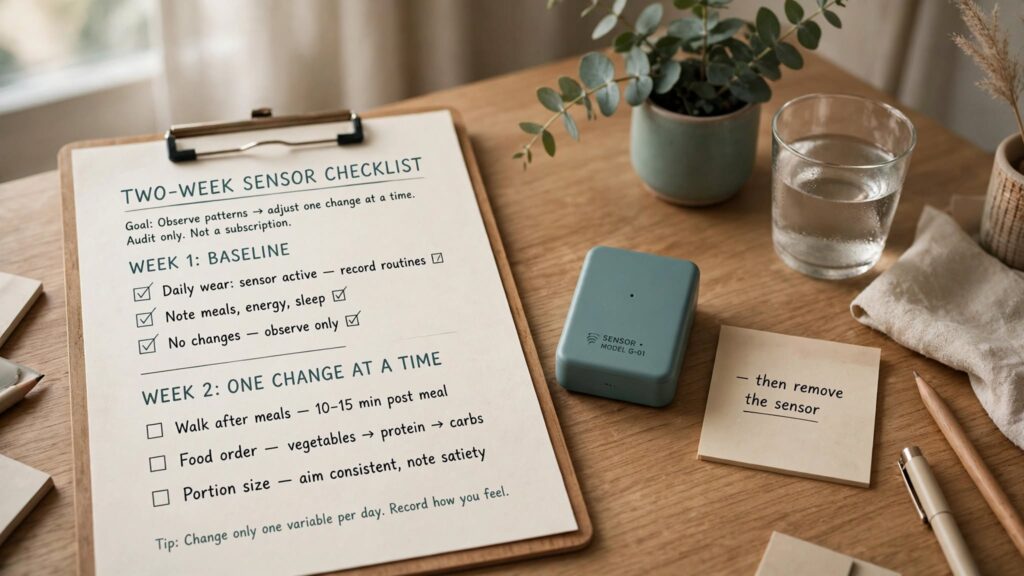
Week 1: baseline. Eat and live normally. Log meals, sleep, stress and activity in a notebook or app. Don’t try to “perform”. Look at your fasting numbers, your overnight line and your usual meals.
Week 2: one change at a time.
- Pick your three most common meals.
- Test one change each: a 10-minute walk afterward, protein or vegetables first, a smaller portion.
- Repeat each test at least three times before concluding anything. A single reading is noise.
- Note which swaps actually changed your curve, and by how much.
At the end: write down the two or three things you learned, then remove the sensor. If a result worried you, take it to a doctor with a lab test. If you want a second round, wait a few months and see whether your changes held.
Add up the cost per useful insight of CGM for non-diabetics. A sensor set costs a meaningful sum for each two-week cycle (prices vary by country and plan), against a lab test that costs a small fraction of that. If your goal is a diagnosis, the lab test wins. If your goal is behaviour change, one or two cycles may be enough, and ongoing wear-and-tear in return for diminishing information rarely pays off.
The downsides of CGM for non-diabetics nobody puts in the ad
- Anxiety. Numbers on your phone all day can create hypervigilance and food fear. If you’re checking constantly, stop.
- Over-interpretation. Normal variation gets labelled as “bad spikes”.
- Restriction. Some users cut out entire food groups, with less variety and sometimes lower enjoyment or nutrient intake.
- Skin and adhesive reactions, and sensors that peel in sweaty, humid weather.
- Accuracy limits, especially in the normal range and during fast changes. Some medicines and supplements can interfere with certain sensors, so check your device’s list.
- Privacy. Glucose data is health data. Read the app’s privacy policy and consider who it’s shared with.
- Cost. Ongoing subscriptions add up.
Our article on AI self-diagnosis and digital health covers how to use wearable data without letting it make medical decisions for you, and our piece on nootropics shows the same pattern of a plausible idea running ahead of the evidence.
When to see a doctor instead of relying on a CGM for non-diabetics
Don’t rely on a sensor if you notice:
- Excessive thirst, frequent urination or constant hunger
- Unexplained weight loss, blurred vision or slow-healing wounds
- Persistent fatigue
- Dark, velvety patches of skin on the neck or armpits (acanthosis nigricans)
- Irregular periods, acne and excess hair growth (possible PCOS)
- Fasting glucose of 100 mg/dL or higher, or HbA1c of 5.7% or more on a lab test
- A history of gestational diabetes
- Dizziness, sweating, shakiness or confusion with a low glucose reading
Where to go next
- Blood sugar and metabolism: Blood sugar, Insulin resistance, GLP-1 foods
- Women’s health: Inositol for PCOS, Women’s hormonal health, Cycle syncing, Perimenopause symptoms
- Food and timing: Circadian fasting, Protein powder for women, Sex-specific nutrition
- Sleep, stress and habits: Sleep hygiene, Cortisol and stress, Low-friction prevention, Nervous system regulation
- Gut and metabolism: Postbiotics
- Hype vs evidence: AI self-diagnosis, Nootropics
- More guides: Nutrition & Diet, Health & Wellness
Questions people ask about CGM for non-diabetics
Is CGM for non-diabetics worth it?
It depends on your goal and your risk. For people with prediabetes, PCOS with insulin resistance or metabolic syndrome, a short trial can be informative alongside lab tests. For healthy, lean people with normal results, it’s rarely worth the cost, and there’s no trial showing that wearing one improves health outcomes.
What is a normal glucose range on a CGM for non-diabetics?
In a reference study of healthy, non-obese people, average glucose was about 98 to 99 mg/dL and people spent around 96% of the day between 70 and 140 mg/dL. Brief rises above 140 after meals happen in healthy people, and they aren’t a sign of disease on their own.
Can CGM for non-diabetics diagnose prediabetes or diabetes?
No. Diagnosis relies on laboratory tests: fasting glucose, HbA1c or a glucose tolerance test. A CGM can show patterns that prompt you to get tested, but it can’t make the diagnosis.
What do glucose spikes mean in CGM for non-diabetics?
Often not much. Spikes after meals are normal physiology. What matters more is how high, how often and how quickly glucose comes back to baseline. Sleep, stress, exercise and illness also move glucose, so a spike isn’t automatically about food.
Is CGM for non-diabetics accurate?
Reasonably accurate on average, but they measure glucose in the fluid between cells with a lag of several minutes, and they can be less reliable in the normal range and during rapid changes. Overnight “lows” can be compression artefacts. Verify surprising readings with a fingerstick.
Do CGMs measure metabolic flexibility?
No. A CGM measures glucose only. Metabolic flexibility, the ability to switch between fuels, is assessed with other tests. Claims that a CGM shows it overstate what the device does.
Can CGM for non-diabetics help me lose weight?
Possibly by prompting changes in what and how you eat, and some studies suggest users stick with interventions better. There’s no strong trial showing a CGM itself causes weight loss in people without diabetes.
Which CGMs can you buy over the counter?
In the US, the FDA cleared Dexcom’s Stelo in March 2024 and Abbott’s Lingo in June 2024 for adults not using insulin. Availability, prices and regulations differ elsewhere, including India, so check current options.
Who should not try CGM for non-diabetics without medical advice?
People with a history of eating disorders or strong food anxiety, anyone pregnant, and anyone with diabetes who takes insulin or other glucose-lowering medicine. If a reading worries you, speak to a doctor.
How long should I use CGM for non-diabetics?
For most people, one or two sensor cycles of about two weeks each is enough to learn how your body responds to common meals, exercise and sleep. Beyond that, the extra information usually diminishes while the cost continues.
The short version
CGM for non-diabetics is a genuinely interesting tool with a thin evidence base. It can show you that your body responds to white rice differently from your friend’s, which is a real and useful insight. It can’t diagnose anything, it doesn’t measure metabolic flexibility, and no trial has shown that a flatter line in a healthy person extends life. Spikes are normal. Context matters more than peaks.
If you’re curious about CGM for non-diabetics, start with a lab test, run a two-week audit, change one thing at a time, then take the sensor off. And if you’re someone who finds numbers stressful, give it a miss. A walk after dinner and a decent night’s sleep will do more than any graph.
Disclaimer: this article is general education, not medical advice. Always consult a qualified healthcare professional about blood sugar, diabetes risk or symptoms. See our full disclaimer.
Research referenced: Shah et al., 2019, Journal of Clinical Endocrinology & Metabolism, on CGM profiles in healthy non-diabetic participants; Hall et al., 2018, PLoS Biology, “Glucotypes reveal new patterns of glucose dysregulation”; Zeevi et al., 2015, Cell, on personalised glycaemic responses to food; the May 2025 review “Could Adults Without Diabetes Benefit from Continuous Glucose Monitoring?”; the 2026 systematic review of CGM in non-diabetic populations; Healio’s report on the research gap and the late-2025 endocrinology talk; and the FDA clearance of Dexcom Stelo and its update on use in children and eating-disorder cautions.






Leave a Reply