
Search for lymphatic drainage and within about a minute someone will tell you that a ten-minute neck massage, a trampoline or a stiff brush will “flush toxins” out of your body. It’s a lovely story and it has almost nothing behind it. What’s frustrating is that the real thing, manual lymphatic drainage as a medical treatment, does have decent evidence in a couple of situations, and the hype keeps burying it.
So I went looking for the dividing line in lymphatic drainage. Below you’ll find what your lymphatic system does all day (not what TikTok says it does), why it doesn’t need “detoxing”, where drainage genuinely helps, how to do a safe version of self-massage at home, and what to make of rebounding and dry brushing. I’ll also be straight about the gaps. Some of the studies are tiny, and a lot of the sales pitch doesn’t survive contact with the research.
General information only. New, one-sided or painful swelling can be a blood clot or infection and needs a doctor, not a massage. Red flags are listed near the end.
What your lymphatic system actually does
Think of it as the body’s drainage and surveillance network. It’s made of thin vessels that run alongside your blood vessels, a few hundred lymph nodes (the usual figure is roughly 600 to 700) clustered in the neck, armpits, groin and abdomen, plus the spleen, thymus and tonsils.
It has three jobs, and none of them is “holding toxins”.
It returns fluid. Your blood vessels leak a little fluid into the tissues all day long. The lymphatic vessels scoop up that fluid, along with leaked proteins, and carry it back toward the bloodstream. We’re talking a few litres a day, which is why when the system fails, tissue swells.
It watches for trouble. Lymph passes through nodes, which act as checkpoints packed with immune cells. When you have a throat infection and the glands in your neck swell, that’s the nodes doing their job, not a sign of a jammed drain. (If you’ve ever wondered why, our guide to natural remedies for cold, flu and sore throat covers when swollen glands are normal.)
It absorbs fat from your gut. Tiny vessels in the intestinal lining carry dietary fats into the circulation.
Unlike blood, lymph has no central pump. It moves because your muscles squeeze the vessels when you walk, because your diaphragm pulls and pushes fluid as you breathe, because one-way valves stop it flowing backwards, and because the vessel walls pulse on their own. That last point matters, and I’ll come back to it: the best everyday “lymphatic drainage” is simply moving around.
Why lymphatic drainage isn’t a detox: your system doesn’t need one
“Detox” is a word that tends to turn up without ever being defined. Which toxins? Measured how? Removed through which route? The wellness answer is usually a shrug and a price tag.
Here’s the physiology. Your liver chemically processes the substances your body wants to get rid of. Your kidneys filter the blood and send waste out in urine. Your gut, lungs and skin handle some more. The lymphatic system isn’t a rubbish bin that fills up and needs emptying, and healthy lymph vessels don’t get “stagnant” because you skipped a massage. There’s no test that shows a healthy person has lymph congestion, and there’s no study showing that a lymphatic massage lowers any measurable “toxin” in a person without a medical condition.
If you want the longer version of how the organs that do clear your body work, our piece on liver health beyond detox is a better place to put your attention than a lymph brush.
A caution, because this is a place where money goes missing: teas, cleanses and “lymph support” supplements are usually just diuretics, laxatives or herbs with little evidence. If you’re tempted, our supplement safety articles are worth a look first.
Where lymphatic drainage has real evidence
This is the part most “myth-busting” articles skip, because it complicates a clean message. Lymphatic drainage, done properly by a trained therapist, is a real clinical technique with a place in treating swelling. It just isn’t a detox.
Lymphedema: the strongest case for lymphatic drainage
Lymphedema is persistent swelling that happens when the lymphatic system can’t drain fluid properly. The most common cause in wealthy countries is cancer treatment, especially breast cancer surgery or radiation that removes or damages lymph nodes. A Cochrane review notes that more than one in five breast cancer patients develop breast cancer-related lymphedema. Other causes include infection, trauma, obesity and inherited conditions.
The standard treatment is called complete (or complex) decongestive therapy, which combines four things: manual lymphatic drainage, compression bandaging or garments, exercises, and skin care. And here is the honest reading of the evidence on the drainage part.
A 2015 Cochrane review of manual lymphatic drainage (MLD) for breast cancer-related lymphedema concluded that MLD is safe and may offer additional benefit when added to compression bandaging. In the pooled trials, adding MLD to an intensive course of bandaging reduced swelling by roughly another 7%. The reviewers noted that people with mild-to-moderate lymphedema seemed the likeliest to benefit, and that some trials were too different to combine. A later systematic review in the Journal of Cancer Survivorship, covering 17 studies, found mixed results: some studies found extra benefit for volume, quality of life and symptoms, and others found no added benefit from MLD within decongestive therapy. It suggested MLD might help early after surgery to prevent progression and might add something in mild lymphedema, but probably doesn’t add much in moderate to severe cases.
Put simply, compression is the backbone, exercise and skin care matter, and MLD is a helpful extra in some people, not a standalone cure. If you’ve been diagnosed, that is a good reason to see a trained lymphedema therapist and follow the full programme, not to rely on weekly massages alone.
Lymphatic drainage after surgery: promising, but thin
Plastic surgeons and physiotherapists often recommend MLD after procedures like liposuction or tummy tucks, and plenty of clinics sell it as standard. The research is smaller and weaker than the marketing suggests.
In one randomised comparison of 20 women after abdominoplasty with liposuction, those who received MLD twice a week for three weeks (starting six weeks after surgery) had less swelling than those who only wore compression garments, but the difference wasn’t statistically significant. Another uncontrolled study of 18 women combined MLD with therapeutic ultrasound and reported reduced swelling, fibrosis and pain, but with no comparison group, you can’t tell what the drainage added. Several other reports are low-quality or come from small clinics.
My reading: it’s plausible, it’s generally safe when done by a trained person, and it may make recovery feel more comfortable. But the evidence that it speeds healing or improves your final result is weak. Timing and technique matter, so ask your surgeon, not the spa. Never book sessions before your surgeon says it’s fine. Deep, vigorous “massage” over fresh surgical sites can do harm.
Lymphatic drainage for sports and “recovery”
Lymphatic drainage is popular with athletes and gym-goers, and the sales pitch is that it clears metabolic waste and eases soreness. Research on this is sparse and mixed, and I couldn’t find strong trials showing it beats a normal massage, a walk, or rest. What helps muscle recovery, most reliably, is boring: sleep, enough food and protein, gradually building training, and light movement. Our guides to sex-specific nutrition for women and protein powder for women cover the nutrition side.
A local footnote worth knowing: lymphatic filariasis
If you live in India, lymphatic drainage has a second context that Western articles skip. Lymphatic filariasis, called “hathi paon” in Hindi, is a mosquito-borne parasitic disease that damages lymph vessels and causes chronic swelling of the legs, arms, breasts or genitals. India carries a large share of the world’s burden, often quoted at nearly 40% of cases. The government’s 2025 mass drug administration campaign covered 111 endemic districts across 13 states, with a national target to eliminate the disease by 2027. Reported cases in 2021 included over half a million people with lymphoedema.
Two things follow from this. First, if you live in an endemic district and the community health worker offers the annual preventive tablets, take them. Second, if you have persistent swelling and fevers, particularly with recurrent red, hot, painful episodes in a limb, get it checked, because careful skin hygiene and treatment can slow the damage. This isn’t a case for self-massage or a spa.
What the evidence says about lymphatic drainage, claim by claim
| Claim | What the evidence shows | Verdict |
|---|---|---|
| “Detoxes your body” | No evidence; liver and kidneys do the clearing | Marketing |
| Reduces lymphedema swelling | Cochrane review: safe, may add benefit to compression; mixed in later reviews | Real, modest, part of a programme |
| Speeds recovery after cosmetic surgery | Small trials, non-significant or uncontrolled | Plausible, unproven |
| Reduces muscle soreness | Sparse and mixed | Thin |
| Reduces cellulite or “fat” | No good evidence | Marketing |
| Boosts immunity | No evidence in healthy people | Marketing |
| Rebounding “flushes lymph” | No trial showing it | Marketing, but it’s still exercise |
| Dry brushing “stimulates lymph” | No trial showing it | Marketing |
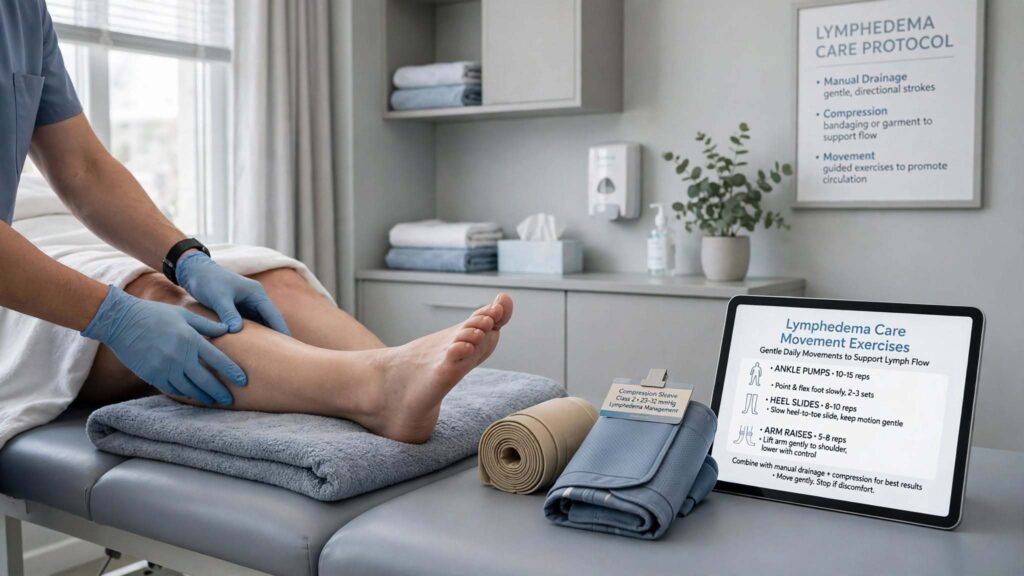
Lymphatic drainage self-massage: a gentle version you can do at home
Before I go further: if you have lymphedema, have had lymph nodes removed, are recovering from surgery or have any heart, kidney or clotting condition, don’t improvise. Learn a routine from a trained therapist who has assessed you. Everything below is for people with ordinary puffiness who are otherwise healthy.
The thing nearly everyone gets wrong is pressure. Lymph vessels sit just under the skin, so the technique works on the skin itself, not the muscle. Pressing hard collapses the delicate vessels and does nothing useful. Think of the pressure you’d use to stroke a cat. You’re just stretching the skin gently and letting it spring back.
A simple ten-minute sequence:
- Breathe first (1 minute). Lie or sit back and take five slow belly breaths. Diaphragmatic breathing helps move lymph in the chest and abdomen. Our guide to the vagus nerve reset shows a slow-breathing pattern that works well here.
- Open the drains (2 minutes). Place your fingertips just above the collarbones and make slow, gentle circles or small stretches of the skin downward and toward the centre, around ten times. Then gently pump the armpits or the creases of the groin, depending on which area you’re working on.
- Work the limb from top to bottom, but stroke toward the body (5 minutes). For a leg: start at the thigh and stroke lightly toward the groin, then work the knee and calf with short, light strokes upward, then the ankle and foot upward. Repeat each area five to ten times, always light and slow.
- Finish (2 minutes). Elevate the leg or rest, and take a few more slow breaths.
Most people do it for ten to fifteen minutes a day, some of them just a few times a week. It’s worth noting that, in the Cochrane review, one trial compared therapist-delivered MLD against self-administered simple lymphatic drainage plus a compression sleeve, and it found a significant difference in swelling volume in favour of the therapist, though not for percentage reduction, in only 31 people. That fits what I’d say from experience: self-massage is fine for comfort and everyday puffiness, but it isn’t a replacement for professional treatment when you have a diagnosed problem.
Facial “lymphatic drainage” (gua sha, rollers, light massage). A gentle face massage can temporarily reduce morning puffiness, mainly by moving fluid and by cold if you use a chilled tool. It’s a cosmetic effect that wears off in hours. Persistent facial swelling, especially with other symptoms, is a medical question.
What helps everyday swelling more reliably than lymphatic drainage
For normal, healthy puffiness, like swollen feet after a long train journey, a desk day, a salty meal, or premenstrual bloating, these have a stronger track record than any massage:
- Move. Calf muscles are the pump for your legs. Walk, do ankle circles, stand up every half hour.
- Elevate. Put your feet above hip level for 15 to 20 minutes, a few times a day.
- Compression socks for long flights, standing jobs or mild leg swelling.
- Go easy on salt and heavy processed food if you notice a pattern.
- Drink enough fluids. Dehydration makes the body hang on to water.
- Look at your hormones. Swelling and bloating that follow your cycle, or that arrive in perimenopause, are common. Our guides to women’s hormonal health and perimenopause symptoms and how to manage them go into why.
- Build it into your day. Our article on low-friction prevention is about attaching small habits to routines you already have, which is the only way any of this sticks.
Rebounding and lymphatic drainage: good exercise, not a lymph flush
Bouncing on a mini-trampoline is often described as the best lymph-moving exercise, thanks to the up-and-down gravity changes. A 1980s NASA study is often quoted, but it measured oxygen use during bouncing compared with running, not lymph flow. I couldn’t find any trial showing rebounding improves lymphatic drainage in healthy people, or that it removes toxins.
What it does give you is exercise: it’s low-impact, many people enjoy it, and any movement helps lymph flow the same way walking does. If you like it, brilliant. Just don’t buy a trampoline for the detox. Avoid it if you have balance problems, joint pain, pelvic floor symptoms (jumping can trigger leaking, see our guide to pelvic floor health), or during pregnancy without medical advice.
Dry brushing and garshana
Dry brushing, scrubbing the skin with a stiff bristle brush towards the heart, is sold as a lymph stimulator and a cellulite remover. There’s no good evidence for either claim. A traditional Ayurvedic cousin, garshana, uses raw silk gloves for a similar dry massage, and the same applies.
What it does do is exfoliate, and some people like the way their skin feels afterwards. Pressure that’s too hard causes redness and irritation. Don’t use it on broken skin, sunburn, eczema, psoriasis or varicose veins, and stop if it hurts. Treat it as a skin-care routine, not a detox.
Lymphatic drainage gadgets and spa packages: do the money maths
Lymphatic drainage has become a spa product, and prices vary wildly. A few honest points from the consumer-finance side of my brain:
- A medical therapist is not a spa. A trained lymphedema therapist has completed specific training, usually hundreds of hours, and treats diagnosed conditions. A “lymphatic massage” in a salon may be a light massage with a nice name. Ask about training.
- Don’t prepay for packages of ten sessions on day one. If you’ve had surgery, ask your surgeon how many sessions they actually recommend.
- Pneumatic compression devices (inflatable sleeves or boots) are used in lymphedema management under clinical guidance. The consumer “lymphatic boots” sold for wellness have far less evidence for healthy users.
- Compression garments are the unglamorous best value if you have a diagnosed problem. They cost more than a massage session but do the work every day.
- Ask for the evidence behind any claim. If the answer is “detox”, walk away.
Our articles on grounding sheets and nootropics show the same pattern: a plausible idea, some small studies, and a price tag running well ahead of the science.

When lymphatic drainage is unsafe
Manual lymphatic drainage is generally safe in the right hands, but there are situations where it can do harm and needs medical clearance first:
- Active infection or cellulitis (hot, red, painful skin). Massage can spread infection.
- Deep vein thrombosis or suspected clot. Massage could, in theory, dislodge a clot.
- Heart failure that isn’t well controlled. Moving extra fluid toward the heart can overload it.
- Kidney failure.
- Untreated or active cancer, unless your oncology team agrees.
- Fresh surgical wounds, seromas or drains until your surgeon says it’s okay.
- Severe asthma or certain conditions affecting the neck for neck work.
When to see a doctor (not a lymphatic drainage therapist)
Get medical help promptly if you notice:
- Sudden swelling in one leg or arm, especially with pain, warmth or redness (possible clot or infection)
- Swelling with breathlessness or chest pain. Treat this as an emergency.
- Swelling in both legs with breathlessness, weight gain or tiredness (could be heart, kidney or liver problems)
- A hot, red, painful swollen limb with fever
- Swelling after cancer treatment, or a feeling of heaviness, tightness or a ring or sleeve that suddenly fits tighter
- Swelling that doesn’t improve after a few weeks
- A hard, fixed or growing lump in the neck, armpit or groin, particularly with weight loss, night sweats or persistent fever
- Swelling in pregnancy with headache, vision changes or high blood pressure
- Persistent swelling in a filariasis-endemic area
If you’ve been searching symptoms online first, our guide to AI self-diagnosis and digital health explains how to use that research without letting it make the decision.
What a proper assessment looks like
A lymphedema therapist or specialist will take a history, measure the limbs (often with tape or a device), check skin and tissue, and look for the cause. They’ll then design a programme, usually involving compression, exercise, skin care and possibly MLD, and show you how to manage it long-term. Lymphedema is a chronic condition. The goal is control, with a plan you can keep up, not a one-off fix.
To find a trained therapist, look for people certified in complete decongestive therapy through a recognised programme. Your oncology team, surgeon or GP can usually refer you. In India, ask about physiotherapists with specific lymphoedema training in a larger hospital or oncology centre.
Where to go next
- Detox myths and your real clearing organs: Liver health beyond detox, Supplement safety
- Breathing and calm: Vagus nerve reset
- Women’s health and swelling: Women’s hormonal health, Perimenopause symptoms, Pelvic floor health
- Recovery and nutrition: Sex-specific nutrition, Protein powder for women
- Colds and swollen glands: Natural remedies for cold, flu and sore throat
- Hype vs evidence: Grounding sheets, Nootropics, AI self-diagnosis
- Habits that stick: Low-friction prevention
- More guides: Health & Wellness
Questions people ask about lymphatic drainage
What is lymphatic drainage?
Lymphatic drainage, or manual lymphatic drainage (MLD), is a very light massage technique that uses gentle skin stretches to encourage lymph fluid to move toward working lymph nodes. It’s used medically for conditions like lymphedema, and sold in spas as a wellness treatment.
Does lymphatic drainage detox your body?
No. Your liver and kidneys do the filtering and clearing, and there’s no evidence that lymphatic massage removes toxins from a healthy person. The lymphatic system returns fluid and supports immunity. It isn’t a toxin reservoir.
Does lymphatic drainage help with lymphedema?
Yes, as part of a full programme. A Cochrane review found MLD is safe and may add benefit to compression bandaging, especially in mild-to-moderate cases. Compression, exercise and skin care are the backbone, and MLD alone isn’t a standalone cure.
Does lymphatic drainage help after surgery?
It’s commonly recommended after liposuction or tummy tucks, but the evidence is small and weak. One small randomised trial found less swelling with MLD but not by a statistically significant amount. Always ask your surgeon before starting it.
Can I do lymphatic drainage at home?
Gentle self-massage with very light pressure is safe for most healthy people with ordinary puffiness. If you have lymphedema, a history of cancer treatment, recent surgery, or heart, kidney or clotting problems, learn from a trained therapist first.
Does dry brushing help lymph flow?
There’s no good evidence that it does, or that it reduces cellulite. It exfoliates the skin, and that’s about it. Avoid it on broken, sunburned or irritated skin.
Is rebounding good for the lymphatic system?
Rebounding is good exercise, and movement helps lymph flow like walking does. No trial shows it flushes lymph or toxins in healthy people. Avoid it if you have balance, joint or pelvic floor problems, or are pregnant, without medical advice.
How do I know if my lymphatic system is sluggish?
There’s no test for a “sluggish” lymphatic system in healthy people, and the term is mostly marketing. Real lymphatic problems show up as persistent swelling, heaviness or skin changes, and need medical assessment.
Who should avoid lymphatic drainage?
People with active infections, blood clots, uncontrolled heart failure, kidney failure, untreated cancer, or fresh surgical wounds should get medical clearance first. If you have any of these, don’t self-treat.
When should I see a doctor about swelling?
For sudden one-sided swelling, swelling with breathlessness or chest pain, hot red painful skin, swelling after cancer treatment, a hard growing lump in the neck, armpit or groin, or swelling that doesn’t improve after a few weeks.
The short version
Lymphatic drainage is a real clinical technique with a narrow, well-defined job: helping manage swelling like lymphedema, alongside compression, exercise and skin care, and possibly making post-surgical recovery more comfortable. It is not a detox, it doesn’t need to “unblock” a healthy body, and rebounding and dry brushing don’t have the evidence the videos imply. For ordinary puffiness, walking, elevation and compression socks do more for less money.
If you do one thing this week, take a ten-minute walk after your longest sit of the day and put your feet up afterwards. And if you’ve got swelling that’s one-sided, painful, new or persistent, skip the massage and book the appointment.
Disclaimer: this article is general education, not medical advice. Always consult a qualified healthcare professional about persistent or unexplained swelling, lymphedema, or recovery after surgery. See our full disclaimer.
Research referenced: the Cochrane review of manual lymphatic drainage for lymphedema following breast cancer treatment (2015) and its PEDro summary; the 2019 systematic review of manual lymphatic drainage for lymphedema in the Journal of Cancer Survivorship; the randomised comparison of MLD after abdominoplasty with core liposuction; the Indian Journal of Plastic Surgery study of MLD and ultrasound after liposuction; and India’s lymphatic filariasis elimination programme as described by Vikaspedia and IndiaSpend.






Leave a Reply