
Not long ago, postbiotics were a word only gut researchers used. Now it’s on supplement labels, skincare jars and pet food. Trend reports say searches for the term grew by roughly 1,000% year over year, that social conversation about it rose 101% (about three times the pace of probiotics at +31%), and that around a third of consumers worldwide now claim to be familiar with it. One market forecast puts the category at about $309 million by 2034, growing at 8.78% a year.
Those are lively numbers. They tell you almost nothing about whether the stuff works. I wanted to find out, so I went through the 2021 expert definition, the handful of human trials that exist, and the labels that keep getting this wrong. Below you’ll find what postbiotics are (and aren’t), what the research shows for specific ingredients, why the market numbers should make you more careful, not less, and a practical way to decide whether to spend money on them.
General information only. Supplements aren’t suitable for everyone, particularly people with weakened immune systems and young infants. Check with a doctor if that applies to you.
What postbiotics actually are (most pages get this wrong)
Search the term and you’ll see a definition repeated on a hundred sites: postbiotics are the “waste products” or metabolites that gut bacteria make, like short-chain fatty acids. It sounds sensible. It’s also not what the scientists agreed on.
In 2021, a panel convened by the International Scientific Association for Probiotics and Prebiotics (ISAPP) published a consensus definition. A postbiotic is “a preparation of inanimate microorganisms and/or their components that confers a health benefit on the host.” Read that again slowly. The key element is the dead (inactivated) microbe itself, or pieces of it, such as cell walls. Metabolites and other compounds can be present, but the panel was explicit that they aren’t required.
Under that definition, a few things follow that surprise people:
- A heat-killed or otherwise inactivated bacterial preparation counts, as long as it’s been shown to benefit health.
- Purified metabolites on their own don’t count. A butyrate supplement, for instance, is a useful molecule, but it isn’t a postbiotic under the ISAPP definition.
- A filtered “ferment” with no cell material in it doesn’t count. Many skincare and supplement “postbiotics” are exactly that.
- Vaccines and purely synthetic compounds are excluded.
- The benefit has to be demonstrated. Not hinted at in mice. Shown, ideally in a controlled human trial, for that particular preparation.
That last point is what makes the word useful, if people respected it. A postbiotic isn’t “anything made by or from bacteria”. It’s a specific, characterised product with evidence behind it. Many things sold under the label haven’t met that bar.
One more wrinkle. The lead author of the consensus paper said the group wanted to make clear that postbiotics are more than “heat-killed probiotics”, because different microbes respond differently to different ways of inactivation (heat, radiation, pressure and so on). In practice, though, heat-killed strains are what you’ll mostly meet on shelves.
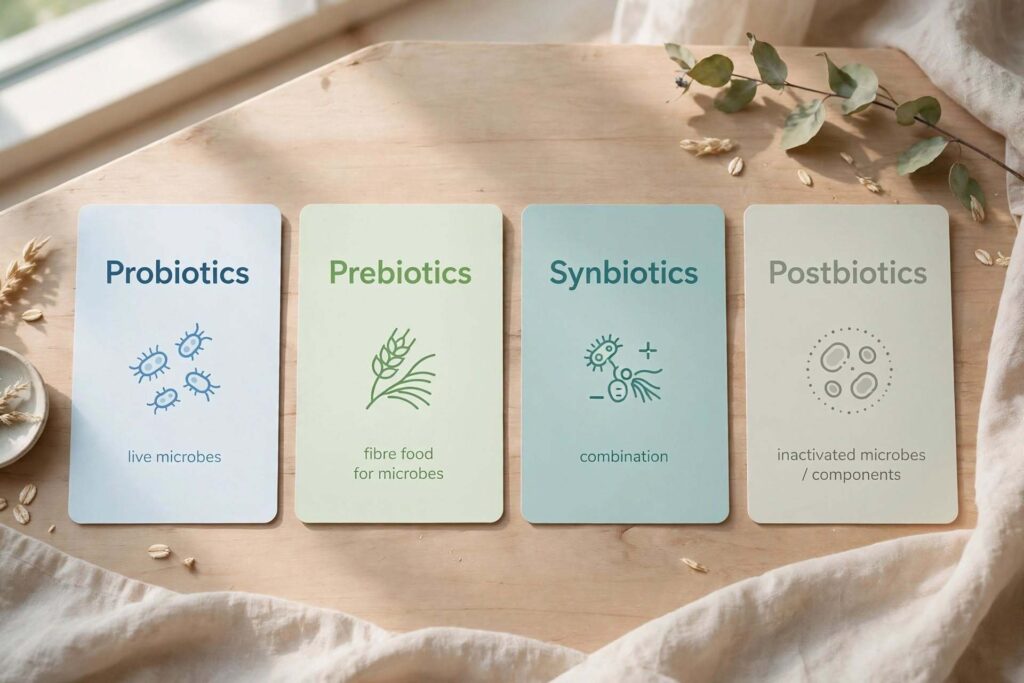
Probiotics, prebiotics, synbiotics, postbiotics: the quick map
| Term | What it is | Example |
|---|---|---|
| Probiotics | Live microbes that benefit health when you take enough of them | Certain Lactobacillus or Bifidobacterium strains in capsules or yogurt |
| Prebiotics | Food that selectively feeds helpful gut microbes | Inulin, resistant starch, some fibres |
| Synbiotics | A combination that works together | A probiotic plus a prebiotic fibre |
| Postbiotics | Inanimate microbes or their components with a proven benefit | Pasteurised Akkermansia muciniphila; heat-inactivated L. gasseri CP2305 |
If you want the wider picture of how your gut works day to day, our gut health pages are a good place to start.
Why would anyone want dead bacteria?
It sounds odd, but there are real reasons researchers like the idea.
Stability. Inactivated microbes don’t need to survive on a shelf. Many probiotics lose viability in heat, humidity and long supply chains, so the count on the label at manufacture isn’t the count in your stomach. A postbiotic doesn’t have that problem, which is a real advantage in a hot climate with patchy refrigeration.
A cleaner safety argument. Because the cells can’t grow or colonise, the theoretical risk of live bacteria spreading from the gut to the bloodstream goes down. That’s why researchers are interested in them for vulnerable groups, though it’s an area where you shouldn’t assume safety, and I’ll come back to it.
Standardisation. A defined, inactivated preparation is easier to dose consistently than live cultures.
Something that works even when alive-ness doesn’t matter. In some cases, the effect seems to come from cell wall components or other structures that your immune cells react to, so killing the microbe doesn’t switch off the benefit. The mechanisms are still being worked out, and I wouldn’t claim to know them for any specific product.
What the evidence actually shows
Here’s where I want to slow down, because the honest summary is: a few promising, small, strain-specific trials, and a very long list of claims that go well beyond them.
| Ingredient | What it is | Best human evidence | My read |
|---|---|---|---|
| Pasteurised Akkermansia muciniphila | A gut bacterium heat-treated before use | One pilot randomised trial: 40 overweight, insulin-resistant adults enrolled, 32 finished 3 months | Interesting; tiny; single group |
| Heat-inactivated Lactobacillus gasseri CP2305 | A strain studied for stress and gut symptoms | Randomised trials in medical students and young adults | Promising for sleep and stress; small |
| Heat-killed L. acidophilus L-92 | Studied for allergy and skin | Reduced atopic dermatitis symptoms in adults in trials | Early |
| Postbiotic lozenges and oral health products | Heat-killed strains in the mouth | Small trials: higher salivary IgA, better oral hygiene markers | Preliminary |
| Butyrate and other short-chain fatty acid supplements | Purified metabolites | Small trials in IBS and gut conditions | Not postbiotics by definition; separate evidence |
Pasteurised Akkermansia
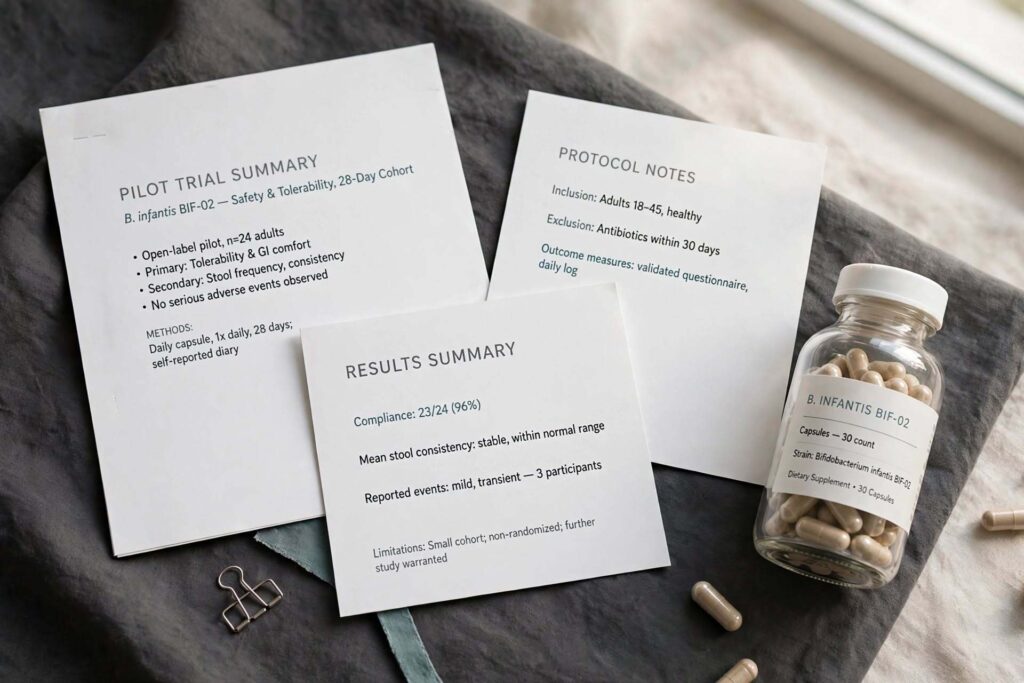
This is the best-known example. Akkermansia is a mucus-dwelling gut bacterium that tends to be less abundant in people with obesity and type 2 diabetes. In a 2019 proof-of-concept randomised trial published in Nature Medicine, 40 overweight or obese adults with insulin resistance took live Akkermansia, pasteurised Akkermansia or placebo for three months, and 32 completed the study. The pasteurised group improved insulin sensitivity by about 29% compared with placebo, with lower fasting insulin and lower total cholesterol, and no serious safety problems were reported. Weight loss wasn’t significant.
That’s an eye-catching result, and it’s also the whole story so far. It’s one small pilot, three months long, from one research group. Interestingly, the pasteurised form did better than live bacteria in that trial, which is part of why this product line took off. A larger study is needed before anyone should treat it as a metabolic treatment. If you’re curious about how blood sugar and insulin resistance work, our blood sugar and insulin resistance pages cover the basics, and no supplement replaces what’s in them.
Heat-inactivated L. gasseri CP2305
This strain is studied as a “psychobiotic”, meaning a microbe that may affect stress and mood through the gut-brain axis. In a trial of 69 medical students preparing for their national exam, 12 weeks of heat-inactivated CP2305 improved sleep quality on both a questionnaire and a one-channel sleep EEG, prevented a rise in salivary cortisol, and normalised bowel habits under stress, compared with placebo. A separate long-term trial in healthy young adults under chronic stress reported lower anxiety and less sleep disturbance, shorter time to fall asleep, and less waking after sleep onset.
Those are real findings. They’re also one strain, studied by a connected group of researchers, in young, healthy, stressed students. It doesn’t tell you that “postbiotics improve sleep”. It tells you that this specific preparation did, in this specific group. If sleep is your problem, start with the basics in our guides to sleep hygiene and light hygiene and circadian health, and see how stress fits in via nervous system regulation.
Other claims: skin, oral health, immunity
You’ll see postbiotics advertised for eczema, oral health, immunity, vaginal health and even hair. Some small trials exist, such as heat-killed L-92 in atopic dermatitis, and postbiotic lozenges increasing salivary IgA in small studies. Most are early, short, and specific to one strain. When a label promises “immune support” without naming a strain, a dose and a trial, that’s a reason to be sceptical.
Butyrate, short-chain fatty acids and “ferments”: real biology, different category
A lot of what gets called “postbiotics” online is actually short-chain fatty acids (SCFAs) like butyrate, which gut bacteria make when they ferment fibre. Butyrate is a real and important molecule: it feeds the cells lining your colon and plays a part in gut barrier function. Small trials of butyrate supplements in irritable bowel syndrome and other gut conditions have been done, with modest results.
But under the ISAPP definition, a bottle of purified butyrate isn’t a postbiotic. That doesn’t make it useless. It means the evidence for it should be judged separately, not borrowed from the “postbiotic” buzz. Likewise, a skincare “ferment filtrate” with no microbial cell material is outside the definition.
The cheaper way to get more butyrate is to feed the bacteria that make it, which brings us to food.
The food-first route (and what my kitchen has to do with it)
Fibre is the backbone. Your gut bacteria turn it into SCFAs, which is the same chemistry the supplement industry is trying to bottle.
- Pulses and legumes: dal, rajma, chana, lobia
- Whole grains and oats
- Vegetables and fruit, with skins where you can
- Cooked-and-cooled starches: rice or potatoes that have been chilled contain more resistant starch, which fermenting bacteria love
- Nuts and seeds
- Fermented foods: dahi (curd), chaas (buttermilk), idli and dosa batter, kanji, pickles made by fermentation, kimchi, sauerkraut
A caution on that last group. Fermented foods are healthy, but they aren’t automatically “postbiotics” in the ISAPP sense. Whether a fermented food counts depends on whether it contains defined inanimate microbes with a proven benefit, and the research hasn’t done that for most foods. Eat them because they’re good food, not because of a label.
For general advice on what your gut wants, our guides to protein powder for women and sex-specific nutrition for women cover protein and fibre balance, and our piece on circadian fasting and time-restricted eating looks at meal timing and digestion.
What the market numbers really tell you
This is the part where I’ll take off my health hat and put on my finance one.
A 1,000% rise sounds enormous, and it starts from almost nothing. When a term has barely been searched, growing tenfold means very little in absolute terms. The same goes for social conversation, where a smaller category growing faster than a larger one (postbiotics at +101% against probiotics at +31%) mostly reflects the small base and the novelty.
“A third of consumers are familiar” is a self-reported figure. Familiar can mean “I’ve seen the word on a label”, not “I know what it is”. Given how many sites define it wrongly, that familiarity is shakier than it sounds.
A forecast is a sales document. A projection of about $309 million by 2034 at 8.78% a year is a modelled estimate, usually by market-research firms selling reports to supplement makers. It’s a useful sign of where companies are placing bets. It isn’t evidence that the products work, and its assumptions are rarely public. For perspective, $309 million is modest next to the wider probiotics industry, which tells you how early this category is.
Hype brings label inflation. When a word is hot, brands attach it to anything vaguely adjacent: fermented extracts, filtrates, blends that quietly include live probiotics, or products with no named strain at all. The faster the trend, the more you should read the back of the box.
I haven’t been able to trace those specific trend figures to a primary source, so treat them as industry reported rather than verified. The direction of the trend is obvious. The precise numbers aren’t something I’d stake a decision on.
How to buy postbiotics without wasting money
If you decide to try one, here’s the checklist I’d use. It’s basically the same logic as our guides to functional protein and next-gen collagen and nootropics: compare against the trial, not the marketing.
- Look for a named strain. A genus and species isn’t enough. You want the full strain designation, like L. gasseri CP2305. If the label just says “postbiotic blend”, walk away.
- Find the trial for that exact strain. Search the strain name plus “randomised”. If there’s none, you’re buying a guess.
- Check what it’s been inactivated with and how much you get. Reputable products state the dose in cells or cell equivalents, and match what the trial used.
- Be wary of the word “metabolites” with nothing else. That’s likely a filtrate, which falls outside the ISAPP definition.
- Avoid proprietary blends. If you can’t see the amount of each ingredient, you can’t compare it with a study.
- Prefer third-party testing, for contents and contaminants.
- Work out the cost per effective dose. Divide the price by the number of servings, and compare it to what the trial dose would cost. A shelf-stable capsule that matches a trial is better value than a lovely tub of vague promises.
- Set a deadline. Eight to twelve weeks is the length of most trials. If you can’t tell a difference in a diary, stop paying.
- Take one product at a time, so you know what’s doing what.
Safety: who should be careful
Postbiotics are generally considered well tolerated in the trials, with mild digestive complaints the main issue. But “can’t colonise” doesn’t mean “risk-free”.
- Weakened immune systems, severe illness, central lines or recent major surgery: ask your specialist first. The safety evidence in these groups is limited.
- Premature or very young infants: don’t give supplements unless a paediatrician recommends them. Infant products are tightly regulated for good reason.
- Pregnancy and breastfeeding: there isn’t much research on most products. Talk to your clinician.
- Allergies: products can contain milk, soy or other ingredients.
- Persistent gut symptoms: a supplement isn’t a diagnosis. See the next section.
- Quality: supplements aren’t regulated like medicines in most countries, and contents vary, so third-party testing matters. Our supplement safety articles are a good general guide.
Realistic expectations
If a postbiotic works for you, the effect is likely to be modest and specific: slightly better sleep under stress, slightly better insulin markers over months, a bit less irritation in a particular situation. It isn’t going to repair your gut, rebalance your microbiome or undo a poor diet. None of the trials show that. Think of it as an experiment with a small potential upside, not a foundation. The foundations are fibre, sleep, movement and managing stress, which is where our low-friction prevention guide and nervous system regulation piece come in. The gut-brain connection also explains why breathing practices like those in our vagus nerve reset article sometimes help digestion.
When to see a doctor
A supplement isn’t the answer if you have:
- Persistent diarrhoea, constipation or bloating lasting more than a few weeks
- Blood in your stool, or black, tarry stools
- Unexplained weight loss, night sweats or fever
- Severe or worsening abdominal pain
- Symptoms that wake you at night
- Iron-deficiency anaemia with no clear cause (see our guide to iron deficiency and anemia in women)
- A family history of bowel cancer, coeliac disease or inflammatory bowel disease
- Difficulty swallowing or persistent heartburn (our acid reflux and GERD guide covers red flags)
If you’ve been searching symptoms online first, our article on AI self-diagnosis and digital health explains how to use that research without letting it make the decision.
Where to go next
- Gut and digestion: Gut health, Acid reflux and GERD
- Metabolic health: Blood sugar, Insulin resistance, Circadian fasting
- Sleep and stress: Sleep hygiene, Light hygiene, Nervous system regulation, Vagus nerve reset
- Supplements and protein: Supplement safety, Functional protein and collagen, Protein powder for women
- Hype vs evidence: Nootropics, Lymphatic drainage, AI self-diagnosis
- More guides: Nutrition & Diet, Health & Wellness
Questions people ask about postbiotics
What are postbiotics?
Under the 2021 ISAPP consensus definition, postbiotics are preparations of inanimate (inactivated) microorganisms and/or their components that confer a health benefit. They’re not simply bacterial waste products. Purified metabolites alone, filtrates without cell material, vaccines and synthetic compounds are excluded.
What’s the difference between probiotics and postbiotics?
Probiotics are live microbes. Postbiotics are inactivated microbes or their components. Postbiotics can’t grow or colonise the gut, which makes them more stable on the shelf, but they still need evidence for a specific benefit.
Do postbiotics work?
For a few specific preparations, early trials suggest benefits, such as pasteurised Akkermansia for insulin sensitivity in a 32-person pilot, and heat-inactivated L. gasseri CP2305 for sleep and stress in students. The evidence is small and strain-specific, and doesn’t support general claims.
Are butyrate supplements postbiotics?
Not under the ISAPP definition, which excludes purified metabolites. Butyrate is a short-chain fatty acid with real biological roles, and small trials exist in gut conditions, but its evidence should be judged separately.
Are postbiotics better than probiotics?
Not proven. Postbiotics have practical advantages, like stability and no need for refrigeration, and a cleaner theoretical safety profile. But neither category is better across the board. It depends on the specific strain and the condition.
Are postbiotics safe?
In trials, they’ve generally been well tolerated, with mild digestive complaints the main issue. People with weakened immune systems, serious illness or central lines, premature infants, and pregnant or breastfeeding women should check with a doctor first.
What foods contain postbiotics?
Fermented foods like curd, buttermilk, idli batter, kimchi and sauerkraut are healthy, but they don’t automatically count as postbiotics, since that requires defined inactivated microbes with a proven benefit. Fibre-rich foods help your gut bacteria produce short-chain fatty acids.
Can postbiotics help with sleep or stress?
One heat-inactivated strain, L. gasseri CP2305, improved sleep quality and reduced stress markers in small trials in students. That doesn’t mean other postbiotics will do the same. Sleep basics matter more.
How do I choose a postbiotic supplement?
Look for a named strain with a randomised trial, a dose that matches the trial, third-party testing and no proprietary blends. Compare cost per effective dose, and give it a fair 8 to 12 weeks.
When should I see a doctor about gut symptoms?
If you have blood in your stool, unexplained weight loss, persistent diarrhoea or constipation, severe or night-time abdominal pain, anaemia, or a family history of bowel disease or cancer. A supplement isn’t a substitute for a diagnosis.
The short version
Postbiotics are a real scientific category with a precise definition, and a handful of promising, small, strain-specific trials. They’re also a marketing word that’s currently being stretched over ferments, filtrates and blends that don’t meet it. The market numbers show how hot the trend is, not whether the products work.
If you’re tempted, buy a named strain with its own trial, match the dose, give it three months, and judge it by your own diary. And spend the first part of your budget on fibre, sleep and decent food. They’re less glamorous and far better evidenced.
Disclaimer: this article is general education, not medical advice. Always consult a qualified healthcare professional before starting any supplement, especially if you’re pregnant, immunocompromised or giving anything to an infant. See our full disclaimer.
Research referenced: the 2021 ISAPP consensus definition of postbiotics and its coverage; Depommier et al., 2019, in Nature Medicine, on pasteurised Akkermansia muciniphila; Nishida and colleagues’ 2019 trial of heat-inactivated L. gasseri CP2305 and the related medical student study; and the overview of postbiotics summarising oral-health trials. Market and trend figures are as reported in industry commentary and weren’t independently verified.





Leave a Reply