
Almost everyone searching for home remedies for piles is doing it late at night, in pain, and a little embarrassed. So let me start with the reassuring part about home remedies for piles: most piles settle down with simple care, and the things with the best evidence behind them are cheap and already in your kitchen. Now the less reassuring part. A lot of the “bawasir ke gharelu upay” lists circulating online mix a few good ideas with a few that don’t work and a couple that can hurt you. One of them tells you to put vinegar-soaked cotton inside your back passage. Please don’t.
I went through the current surgical guidelines on home remedies for piles, the Cochrane reviews and a recent study on toilet habits to see what holds up. Below you’ll find what piles actually are, which home remedies for piles have real evidence, which ones are folklore, how to do each useful thing properly, and the red flags that mean you should stop treating yourself. That last section matters more than all the rest. Bleeding from the bottom is not always piles, and treating it as if it were can cost you years.
General information only. If you’re bleeding from the rectum for the first time, are over 40, or the bleeding keeps coming back, please get it examined. Don’t assume it’s piles.
What piles actually are, before you try home remedies for piles
Piles (haemorrhoids, bawasir, arsh) aren’t a disease you catch, and they aren’t “veins that burst”. Everyone has haemorrhoidal tissue: soft, blood-filled cushions lining the anal canal that help you stay continent. You only get “piles” when those cushions swell, slip down or become inflamed, and cause symptoms.
There are two kinds, and the difference explains most of what you feel.
Internal piles sit inside the canal, above a point where there are few pain nerves. That’s why they usually bleed without hurting. The classic sign is bright red blood on the paper or dripping into the bowl after a motion. They’re graded by how far they come down:
- Grade I: they bleed but don’t come out.
- Grade II: they come out during a motion and go back by themselves.
- Grade III: they come out and you have to push them back.
- Grade IV: they stay out and can’t be pushed back.
External piles form under the skin around the anus, where the nerves are plentiful. They itch, swell and hurt. If a clot forms inside one (a thrombosed pile), it appears suddenly as a hard, painful, blue-purple lump, and the pain usually peaks within the first couple of days.
Traditional Indian descriptions divide piles into khooni (bleeding) and badi (non-bleeding, painful) types. That matches the modern picture loosely: bleeding with little pain usually means internal, and pain and a lump usually means external or thrombosed. But the labels don’t tell you how severe something is, and a doctor will use the grades above.
How common are piles, and who tries home remedies for piles?
Very. A widely quoted figure is that around half of adults will have symptoms by the age of 50, though estimates vary with how researchers count. They’re particularly common in late pregnancy and after delivery, in people who are constipated or sit for long periods, and in people who are overweight or lift heavy loads. Plenty of cases settle on their own within days to a few weeks, with or without home remedies for piles.
Is it really piles? Check before using home remedies for piles
This is the part most pages on home remedies for piles skip, so I’ll spend time on it. Several conditions look like piles from the outside, and the treatments are completely different.
| What you notice | More likely | Why it matters |
|---|---|---|
| Painless bright-red blood after a motion | Internal piles | The classic picture, but bleeding still needs checking if new or persistent |
| Sharp, tearing pain during a motion, a few streaks of blood | Anal fissure (a small tear) | Needs different care; fibre helps, but so does prescribed ointment |
| Constant throbbing pain, swelling, fever near the anus | Abscess | Needs urgent drainage, not remedies |
| A track that leaks pus or blood near the anus | Fistula | A surgical problem; it is not a late stage of piles |
| Dark, maroon or mixed-in blood, mucus, change in bowel habit, weight loss | Could be something higher up, including bowel cancer | Needs a colonoscopy |
| Itching and moisture around the anus | Hygiene, skin conditions, worms, or piles | Often not piles |
Two of the most common myths about home remedies for piles deserve a plain correction. Piles do not turn into cancer. And a fistula is not what piles become if you ignore them. A fistula usually starts with an infection in a small gland near the anus that forms an abscess. What is true is that bowel cancer can bleed, the bleeding can look just like piles, and people sometimes blame the piles for years. The American Society of Colon and Rectal Surgeons (ASCRS) says exactly this: most people with symptoms suggestive of haemorrhoids don’t have colon cancer, but bleeding from colon cancer is often misattributed to haemorrhoids.
What the evidence says about home remedies for piles
Here’s the honest ranking of home remedies for piles, from best-supported to folklore. I’ll explain each one properly after the table.
| Remedy | What the research shows | Verdict |
|---|---|---|
| More fibre (isabgol, vegetables, fruit, whole grains) | Cochrane review: persistent symptoms about 53% lower; less bleeding | Best-supported |
| Enough fluids and soft stools | Part of the fibre advice; supports it | Do this |
| Better toilet habits (short, no phone, no straining) | A 2025 study links phone use on the toilet with 46% higher risk; observational | Sensible and free |
| Warm sitz bath | Guidelines say it may help local pain and itching; evidence thin | Reasonable comfort measure |
| Flavonoid medicines (diosmin–hesperidin) | Cochrane review of 24 trials: less bleeding and discharge; trial quality mixed | Ask your doctor; not strictly “home” |
| Short-course over-the-counter creams | Can ease pain and itching; guidance is mixed on long use | Short term only |
| Ice or cold pack | Commonly advised for swelling; little formal evidence | Harmless, may help |
| Aloe vera gel on the skin | No good trials for piles | Probably harmless on skin; no proof |
| Eating large amounts of aloe pulp | No evidence; contains laxative compounds | Avoid |
| Apple cider vinegar | No clinical evidence; acidic and irritating | Skip; never apply inside |
| Coconut husk ash, jeera paste, lemon-ginger-honey | No clinical trials | Folklore |
The home remedies for piles that actually work, done properly
Fibre: the home remedy for piles with real evidence
This is the backbone of home remedies for piles. A Cochrane review of randomised trials, pooling around 380 people, found that adding fibre reduced the risk of persistent symptoms by about 53% compared with usual care without fibre, and it consistently reduced bleeding. The reviewers noted that publication bias was possible and study quality only moderate, so it’s strong support, not proof beyond doubt. Every major guideline recommends it anyway, because it’s cheap and safe.
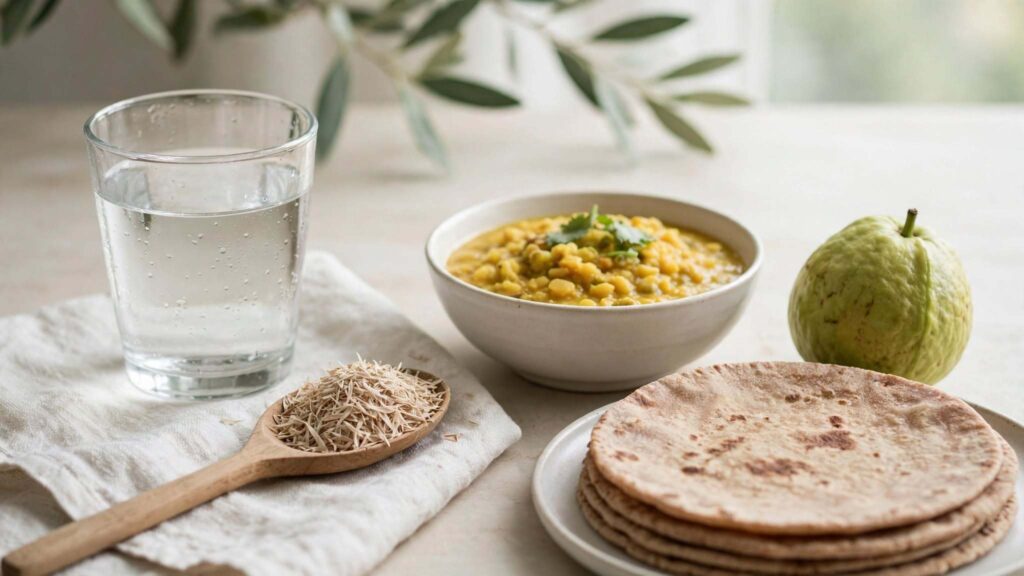
What to aim for is about 25 to 30 grams of fibre a day. That’s more than most people in cities eat. Here’s how to get there with ordinary Indian food:
- Isabgol (psyllium husk). The best-studied bulking agent and the easiest. Start with one teaspoon in a full glass of water at night, and increase gradually over a week or two to one to two teaspoons, once or twice a day. You must drink plenty of water with it, or it can make you more constipated. Take it two hours apart from other medicines.
- Dal, rajma, chana, lobia at least once a day.
- Whole-wheat roti, oats, daliya, brown rice in place of refined flour.
- Vegetables and salads with every meal, and fruit with the skin on where possible: guava, apple, pear, papaya, ripe banana, orange.
- Flaxseed or chia in a small spoon, with water.
- Soaked figs (anjeer) or prunes in the morning. Some people find these helpful for constipation.
Increase fibre slowly when using home remedies for piles. Doubling it overnight gives you gas and bloating, and people give up. If your gut is sensitive, our gut health pages cover how to build up. The same fibre also feeds the bacteria that make short-chain fatty acids, which is part of the story in our guide to postbiotics.
Water: the overlooked home remedy for piles
Fibre without fluid sets like cement, so home remedies for piles need water too. Drink enough that your urine stays pale yellow through the day. Buttermilk (chaas) and plain water both count. If you have heart or kidney disease and have been told to limit fluids, follow your doctor’s advice.
Fix the toilet routine: the free home remedy for piles
This is the quiet one among home remedies for piles, with surprisingly good support. In 2025, researchers at Beth Israel Deaconess Medical Center in Boston studied 125 adults having screening colonoscopies. About two-thirds used a smartphone on the toilet. Phone users were far more likely to sit for more than five minutes (about 37% against 7% of non-users), and after adjusting for age, weight, fibre, exercise and straining, phone use was linked to a 46% higher risk of haemorrhoids. Interestingly, straining itself wasn’t independently linked in that study. It’s one observational study, so it doesn’t prove cause, but it fits what surgeons have said for years: long, unsupported sitting loads the veins.
What to do:
- Leave the phone outside. Aim for a few minutes at most.
- Go when you feel the urge, don’t hold it. Holding makes stools drier and harder.
- Don’t push or hold your breath. If nothing comes after a couple of minutes, get up and try later.
- Raise your feet. If you use a commode, put a small stool under your feet so your knees sit above your hips. It mimics a squat, and many people find it makes emptying easier. The evidence for piles specifically is limited, but it’s harmless.
- Clean gently with water, and pat dry. Skip scented wipes, harsh soap and vigorous rubbing.
If you want the same logic applied to other daily habits, our guide to low-friction prevention covers how to attach small changes to routines you already have.
Warm sitz bath as a home remedy for piles
Sit in a basin or tub of warm (comfortably warm, not hot) plain water for 10 to 15 minutes, two or three times a day and after bowel movements. The guidelines say it may help local pain, itching and burning, though the research behind it is thin. It relaxes the muscle around the anus, which is probably why it feels good. Don’t add salts, essential oils or antiseptics unless your doctor suggests them, and dry the area gently afterwards.
Cold pack for swelling: a simple home remedy for piles
A cloth-wrapped ice pack held against a swollen external pile for around 10 minutes can ease throbbing. There’s little formal research, but it’s safe if you wrap it and don’t leave it on long.
Over-the-counter creams and tablets alongside home remedies for piles
Short courses of creams containing a local anaesthetic or a mild steroid can reduce pain, itching and swelling, and the ASCRS guidance lists them as an option. Opinions differ on how strong the evidence is, and prolonged use of steroid creams can thin and irritate the skin, so use them for a week or so, not for months, and check with a pharmacist or doctor.
Flavonoid tablets (usually a combination of diosmin and hesperidin) are different. A Cochrane review of 24 trials with over 2,300 people found they reduced bleeding and discharge and improved overall symptoms compared with placebo, though the trials varied in quality. They’re prescribed by doctors, often for a few weeks to three months, and are one of the better-supported medicines. If your piles bleed repeatedly, ask your doctor about them.
For pain, paracetamol is usually the safer choice. Avoid codeine-type painkillers, which cause constipation, and ask before using anti-inflammatories if you’re bleeding.
Home remedies for piles I’d skip, and why
Apple cider vinegar, especially on cotton wool inside the anus. I’ve seen this recommended widely among home remedies for piles. There’s no clinical evidence it helps piles. Vinegar is an acid, the skin inside the anal canal is delicate, and chemical burns and worse pain are a real possibility. Drinking diluted vinegar isn’t proven either, and it can irritate your stomach.
Large amounts of aloe pulp. Eating 200 to 250 grams of aloe pulp a day is a lot. Raw aloe contains latex compounds that act as a strong laxative and can cause cramps and diarrhoea. A thin layer of purified aloe vera gel on the skin around the anus is unlikely to hurt, although there’s no good trial for it in piles, so treat it as a soothing extra, and patch-test first.
Coconut husk ash, jeera paste, nimbu-adrak-shahad: home remedies for piles without trials. Traditional, and with no clinical trials showing they do anything for piles. They’re mostly harmless in food. Putting pastes on irritated skin can make it worse.
Unregulated “piles tablets” and herbal powders, the risky home remedies for piles. Some products sold online or by street vendors contain undeclared ingredients. A 2008 survey of Ayurvedic medicines sold online found roughly one in five contained detectable lead, mercury or arsenic. If you want to use an Ayurvedic preparation, buy from a reputable manufacturer and tell your doctor. Our supplement safety articles are a good general guide.
Ayurveda, in fairness. Some Ayurvedic home remedies for piles have decent logic. The emphasis on fibre-rich food, buttermilk, regular meals and avoiding constipation matches the evidence well, and isabgol and triphala are both traditional bowel-regulating remedies. One legitimate Ayurvedic procedure, kshar sutra, has been studied mainly for anal fistula, not piles, and is done by trained surgeons. The point isn’t to dismiss Ayurveda. It’s to separate the parts that line up with the evidence from the claims that don’t.
Habits that keep piles away beyond home remedies for piles
- Keep stools soft. The fibre and fluid advice again, every day, not just during a flare-up.
- Move. Walking, yoga or any regular exercise helps bowel movement and circulation. Avoid sitting for hours at a stretch.
- Watch your weight, since extra weight raises pressure in the abdomen.
- Lift sensibly. Exhale on effort and avoid holding your breath, which also protects your pelvic floor (see our guide to pelvic floor health).
- Limit alcohol and heavy, fried, spicy meals if they trigger constipation or irritation for you. Spicy food itself isn’t proven to cause piles, but it can sting on the way out for some people, so notice your own pattern.
- Don’t ignore constipation. If it’s a constant fight, tell your doctor.
Home remedies for piles in pregnancy and after delivery
Pregnancy pushes the risk up, because progesterone slows the gut, the growing uterus presses on pelvic veins, and constipation is common. Straining during delivery adds to it. Most of the steps above are safe: fibre, fluids, sitz baths, a footstool, short toilet visits. Avoid strong laxatives and herbal remedies without asking your doctor or midwife, and check any cream or tablet first. Our guides to women’s hormonal health and iron deficiency and anemia in women are worth a read, because heavy or repeated bleeding on top of pregnancy and blood loss at birth can lower your iron quickly. You’ll find more in our Women’s Health section.
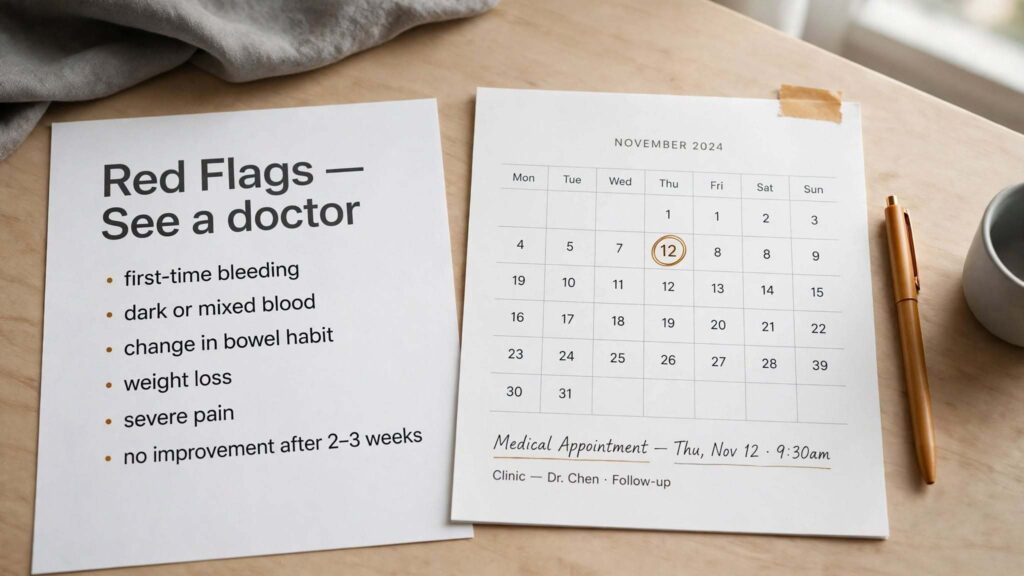
When home remedies for piles aren’t enough: the red flags
Stop home treatment and see a doctor if you notice any of these:
- Rectal bleeding for the first time, particularly if you’re over 40, or bleeding that keeps coming back
- Blood that’s dark, maroon or mixed in with the stool, or black, tarry stools
- A change in bowel habits that lasts more than a few weeks (new constipation, looser stools, a feeling of not emptying)
- Unexplained weight loss, tiredness, breathlessness or paleness (possible anaemia from slow blood loss)
- Abdominal pain or a lump
- A family history of bowel cancer or inflammatory bowel disease
- Symptoms that don’t improve after two to three weeks of proper care
- A pile that stays out and can’t be pushed back, or is very painful, hard and blue-purple
- Fever with severe pain near the anus
Go to an emergency department for heavy bleeding, dizziness or fainting, or being unable to pass urine.
The ASCRS guideline says a colonoscopy should be considered when there’s no obvious source of bleeding, when there’s abdominal pain or new or progressive constipation, or when bleeding continues despite successful treatment of the piles. Colorectal cancer rates in younger adults have been rising in many countries, and screening in several countries now starts at 45. So please don’t feel silly for getting checked. The cost of an unnecessary examination is a few uncomfortable minutes, and the cost of missing something is years.
Bleeding also leads to anaemia when it’s chronic. If you’re tired, pale or short of breath, ask for a blood count. Our guide to iron deficiency and anemia in women explains what to ask for. And if you’ve been searching your symptoms online first, our article on AI self-diagnosis and digital health explains how to use that without letting it make the decision.
What a doctor can do when home remedies for piles don’t work (it’s less scary than you think)
One of the most damaging myths is that surgery is the only treatment for piles, and that they always return afterwards. Neither is true.
- Most piles are managed without surgery. Fibre, fluids, toilet habits and medicines are first-line, and most people improve.
- Office procedures treat grade I to III internal piles that keep bleeding or slipping. Rubber band ligation, the most common, places a tiny band around the base of a pile so it shrinks away. Sclerotherapy and infrared coagulation are other options. They’re usually done without a general anaesthetic, in a clinic, in minutes.
- Surgery (haemorrhoidectomy and related operations) is mainly for larger, grade III to IV piles, or when other treatments fail. Recovery involves several days to weeks of soreness.
- Recurrence is real, but it’s not inevitable. The same habits (fibre, short toilet time) that treat piles help prevent them from returning.
- A thrombosed external pile seen within the first two to three days can sometimes be drained to relieve pain faster. After that, it’s usually managed with comfort measures while it settles.
A word on “pakka ilaaj” ads and home remedies for piles
Walk through any Indian city and you’ll see boards promising a guaranteed, painless, one-day cure for piles. Some are run by trained surgeons. Many aren’t. A few honest checks: does the person examine you properly (including a rectal exam or anoscopy)? Do they tell you which grade you have and why they recommend a specific procedure? Are they a qualified surgeon, and do they discuss alternatives and recurrence honestly? Be wary of anyone promising a cure that rules out recurrence, anyone who pushes surgery without trying basic treatment on mild piles, and “laser” claims that sound like a magic fix. Some newer techniques may mean less pain for some people, but they cost more, and the long-term results aren’t always better than standard methods. Ask for a written plan and a second opinion if the cost or advice seems out of proportion.
A realistic two-week plan using home remedies for piles
Here’s how I’d tell a friend to use home remedies for piles with mild, uncomplicated symptoms and no red flags.
Day 1 to 3: start isabgol (one teaspoon at night, with a full glass of water), drink water through the day, take the phone out of the bathroom, and do warm sitz baths twice a day. Use a cold pack if swollen.
Day 4 to 10: build fibre from food to about 25 to 30 g a day, put a footstool under your feet, keep toilet visits short, and keep up the sitz baths as needed. Use a short course of a cream only if itching or pain persists.
Day 11 to 14: reassess. Most mild piles are much better. If you’re still bleeding, in pain or noticing changes, see a doctor. If you’re better, keep the habits. They’re the real treatment.
Where to go next
- Gut and digestion: Gut health, Postbiotics
- Pelvic floor and pregnancy: Pelvic floor health, Women’s hormonal health, Women’s Health
- Blood loss and tiredness: Iron deficiency and anemia in women
- Habits and prevention: Low-friction prevention
- Supplements and herbal safety: Supplement safety
- Using online health tools wisely: AI self-diagnosis and digital health
- More guides: Nutrition & Diet, Health & Wellness
Questions people ask about home remedies for piles
What are the best home remedies for piles?
The best-supported are more fibre (especially isabgol, vegetables, fruit and whole grains), enough water, short toilet visits without a phone or straining, and warm sitz baths for comfort. A cold pack can ease swelling. These are the home remedies for piles with the most evidence behind them.
Does isabgol work as a home remedy for piles?
Yes. It’s a form of psyllium fibre, and fibre is the best-evidenced treatment. A Cochrane review found fibre lowered the risk of persistent symptoms by about half and reduced bleeding. Take it with a full glass of water, and increase the dose gradually.
Does apple cider vinegar work as a home remedy for piles?
No. There’s no clinical evidence it helps, and putting it on cotton wool inside the anus can burn the delicate lining. It’s one of the riskiest home remedies for piles circulating online.
Is aloe vera one of the good home remedies for piles?
There are no good trials. A little purified aloe gel on the skin around the anus is unlikely to hurt, but eating large amounts of aloe pulp isn’t supported and can act as a strong laxative.
How long do home remedies for piles take to work?
Mild piles often settle within a few days to a couple of weeks with fibre, fluids and sitz baths. Thrombosed external piles can take two to three weeks. If symptoms last beyond two to three weeks, get them checked.
Can piles turn into cancer?
No, piles don’t turn into cancer. But bowel cancer can cause bleeding that looks like piles, and it’s sometimes blamed on piles for too long. Get new, persistent or recurring rectal bleeding examined, especially if you’re over 40.
Is surgery the only option if home remedies for piles fail?
No. Most piles improve with fibre, fluids, toilet habits and medicines. Office procedures like rubber band ligation treat many internal piles, and surgery is mainly for larger or stubborn ones.
Is blood in the stool always piles?
No. Fissures, polyps, inflammatory bowel disease and bowel cancer can all cause it. Dark, maroon or mixed-in blood, black stools, a change in bowel habit, weight loss or anaemia need medical assessment.
Can I use home remedies for piles during pregnancy?
Fibre, fluids, sitz baths and short toilet visits are generally safe. Avoid strong laxatives, herbal remedies and unprescribed creams without asking your doctor or midwife.
When should I see a doctor instead of using home remedies for piles?
If you’re bleeding for the first time (especially over 40), the bleeding is dark or keeps returning, you have a change in bowel habits or weight loss, feel weak or pale, have severe pain or a lump that won’t go back, or haven’t improved after two to three weeks of proper care.
The short version
The most effective home remedies for piles are the dull ones: fibre, water, a short toilet routine with no phone, and a warm bath when it hurts. Folk recipes with vinegar, ash and kitchen pastes either have no evidence or carry real risk. And the most important thing isn’t a remedy at all. It’s knowing that rectal bleeding that’s new, persistent or unusual needs a doctor, because piles are common and so are the things that pretend to be them.
If you try one of these home remedies for piles tonight, leave your phone outside the bathroom, and start a spoonful of isabgol with a full glass of water. Then book that appointment if anything on the red-flag list sounds like you.
Disclaimer: this article is general education, not medical advice. Always consult a qualified healthcare professional about rectal bleeding, pain or persistent symptoms. See our full disclaimer.
Research referenced: the ASCRS clinical practice guideline for the management of hemorrhoids, as summarised by the American Academy of Family Physicians (the guideline itself: Diseases of the Colon & Rectum, 2024; 67(5):614-623); the Cochrane review of laxatives and fibre for hemorrhoids; the Cochrane review of phlebotonics for haemorrhoids (24 studies, 2,334 participants), as discussed in a clinical summary and an evidence review of conservative treatments; the 2025 PLOS One study of smartphone use on the toilet and hemorrhoid risk (Ramprasad et al.); and Saper et al., JAMA, 2008, on heavy metals in Ayurvedic medicines sold online.




Leave a Reply