Zone 2 cardio has been marketed for the past few years as something close to a miracle intensity — the “golden ticket” for longevity, fat burning, and mitochondrial health, popularized heavily by longevity-focused doctors and podcasts. The underlying physiology is real. But a 2025–2026 peer-reviewed review that directly examined the evidence found something the hype cycle mostly leaves out: for many people, Zone 2 isn’t actually the optimal intensity it’s been sold as.
Here’s what Zone 2 cardio actually is, what the adaptations really are, and the honest research pushback that deserves far more attention than it’s gotten.
What Zone 2 Cardio Actually Is
Zone 2 cardio is aerobic exercise performed at roughly 60–70% of your maximum heart rate — an effort level where you can comfortably hold a conversation but wouldn’t want to give a speech. Physiologically, it’s defined more precisely as exercise below your first lactate threshold (blood lactate under roughly 2.0 mmol/L), a zone where your body relies primarily on fat oxidation for fuel and can clear lactate about as fast as it’s produced.
Heart rate alone is an imprecise way to define this zone, since individual variability is high — two people at “70% of max heart rate” can be in meaningfully different physiological states depending on fitness level, so the conversational “talk test” is often a more practical, individualized proxy than a fixed heart rate number.
The Real, Documented Adaptations
To be clear from the outset: the physiological adaptations attributed to Zone 2 training are genuinely real and well-documented, not invented marketing. At this intensity, your body primarily recruits Type I muscle fibers, which are richest in mitochondria. Regular training at this intensity is associated with increased mitochondrial density, improved fat oxidation capacity, better muscle capillarization, and increased parasympathetic tone, which supports recovery and may help counter chronic stress. None of that is in dispute.
The Research Pushback Most Content Skips
Here’s what most Zone 2 content leaves out entirely: a 2025–2026 narrative review published in the International Journal of Sports Physiology and Performance, led by researchers including Kristi Storoschuk and Martin Gibala, directly examined whether Zone 2 is actually the optimal intensity for improving mitochondrial and fatty acid oxidative capacity — and concluded that current evidence does not support Zone 2 as the optimal intensity for these outcomes. The review found that for people training fewer than 6 hours per week, evidence actually suggests prioritizing higher intensities (above Zone 2) is more effective for maximizing cardiometabolic health benefits.
A separate analysis reached a similar conclusion: available data show Zone 2 exercise generally produces modest or no meaningful change in a key marker of muscle energy stress (the AMP/ADP:ATP ratio) that’s understood to trigger some of the cellular adaptation pathways associated with mitochondrial improvement — pathways that respond more robustly to higher-intensity efforts.
The core issue is time efficiency, not that Zone 2 doesn’t work at all. If your weekly training volume is limited — say, 3–4 hours per week — higher intensities (Zone 3 and Zone 4) have been shown to produce comparable or superior VO2max adaptations in less total time than the same time investment in Zone 2.
Zone 2 vs. Higher Intensity: What Actually Matters
Based on the current, more complete picture, here’s a fair way to frame the actual tradeoff:
| Factor | Zone 2 | Higher Intensity (Zone 3–4) |
|---|---|---|
| Mitochondrial adaptation per hour trained | Real, but not shown to be superior | Comparable or superior in limited-volume research |
| Recovery demand | Low — sustainable most days | Higher — requires more recovery between sessions |
| Time efficiency | Lower — reaching adaptation may take more total hours | Higher — similar adaptations achievable in less time |
| Sustainability and injury risk | High — low physical and psychological strain | Lower for some — higher intensity is harder to sustain daily |
| Best fit | High weekly training volume, recovery-focused days | Limited weekly training time |
The honest takeaway: Zone 2 isn’t a wasted effort, and it isn’t the singular “magic zone” it’s been marketed as either — it’s one legitimate tool that fits certain training situations better than others.
Who Zone 2 Genuinely Makes Sense For
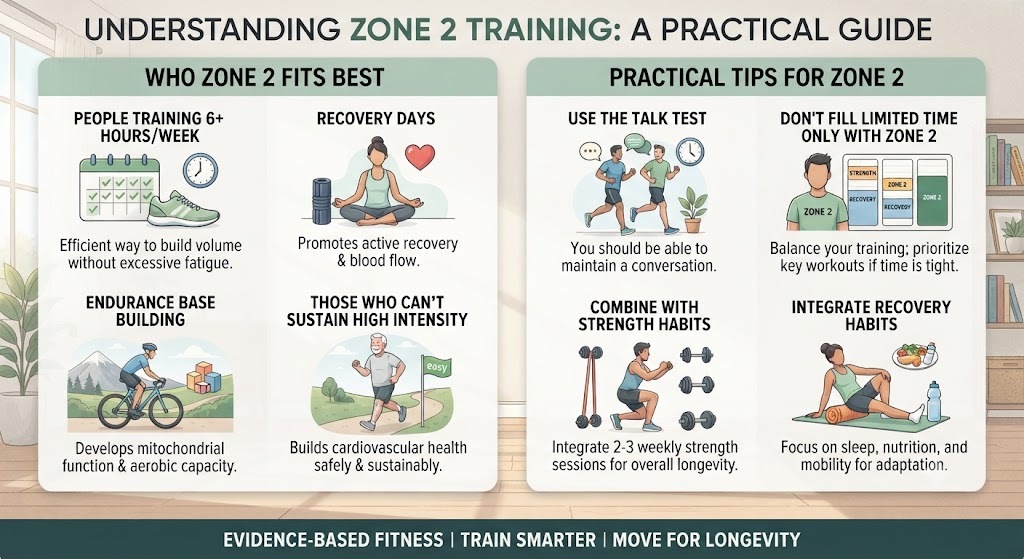
Based on the evidence, Zone 2 training makes the most sense for:
- People who already train 6+ hours per week, where Zone 2 sessions serve as genuinely valuable lower-stress volume alongside higher-intensity work, rather than competing with it for limited time
- Recovery days between harder sessions, since the low physiological and psychological strain supports genuine recovery while still providing training stimulus
- Building an aerobic base for endurance athletes, where sustainable, high-volume training at lower intensity has a long, well-established role distinct from the specific “optimal mitochondrial adaptation” claim under scrutiny here
- Anyone who finds higher-intensity training unsustainable, since a training approach you’ll actually do consistently generally outperforms a theoretically superior one you abandon after a few weeks
If you’re building any structured training plan, our guide on strength training for beginners covers the same progressive overload principle that applies here — the specific method matters less than a sustainable, consistent approach applied over months, not days.
A Practical, Honest Approach
Given the genuinely mixed picture, a reasonable approach for most people balances both:
- If you have limited weekly training time (under ~4 hours), prioritizing some higher-intensity work is better supported by the current evidence than filling that limited time exclusively with Zone 2
- If you already train more than 6 hours per week, Zone 2 sessions are a legitimate, low-strain way to add volume without compromising recovery for your higher-intensity work
- Use the talk test as your practical guide — comfortable conversation pace — rather than obsessing over a precise heart rate number, given how much individual variability affects heart rate zones
- Don’t treat Zone 2 as a longevity cure-all — it’s one training tool among several, not a substitute for strength training, adequate protein, sleep, or stress management, several of which we cover in more depth in our guides on creatine for women and walking for anxiety, where the actual evidence for other movement-based interventions is laid out with the same evidence-first approach
Frequently Asked Questions
Does Zone 2 cardio actually work? Yes, in the sense that it produces real, documented adaptations — improved mitochondrial density, fat oxidation, and capillarization. However, a 2025–2026 peer-reviewed review found current evidence does not support Zone 2 as uniquely optimal for these adaptations compared to higher-intensity training, particularly for people with limited weekly training time.
What heart rate is Zone 2 cardio? Zone 2 is generally defined as roughly 60–70% of maximum heart rate, corresponding to an effort level where you can comfortably hold a conversation. Because individual variability in heart rate response is high, the “talk test” is often considered a more practical guide than a fixed heart rate number.
Is Zone 2 cardio better than high-intensity training? Not necessarily. A 2025–2026 narrative review found that for people training fewer than 6 hours per week, higher-intensity training produced comparable or superior cardiometabolic adaptations in less total time than Zone 2. Zone 2 may be more valuable for people already training high weekly volumes who want lower-strain recovery sessions.
How much Zone 2 cardio should I do per week? There’s no single settled answer, since the evidence doesn’t support it as a uniquely essential training zone. Some research on cardiometabolic health has used roughly 3–4 sessions of 45–90 minutes weekly, but the appropriate amount depends heavily on your total weekly training volume and goals.
A Note From Health Morph
This article is for informational and educational purposes only and reflects published research as of 2026. It isn’t a substitute for personalized fitness or medical advice. If you have an existing heart condition or other health concerns, consult a doctor before starting a new exercise program.
For more evidence-based fitness guidance, explore our Fitness & Exercise section, or read our related guides on strength training for beginners and creatine for women.







Leave a Reply