Mouth taping for sleep has become one of the most viral sleep trends on social media — a strip of porous tape over the lips, sold as a fix for snoring, dry mouth, poor sleep quality, and even jawline definition. Part of the underlying logic is genuinely sound: nasal breathing does put less mechanical stress on the airway than mouth breathing. But a 2025 systematic review that pooled the actual clinical evidence reached a far more cautious conclusion than the trend suggests — and flagged a real risk of harm for some people trying it.
Here’s what the research actually shows, who might see a narrow benefit, and who should never try this.
The Idea Behind Mouth Taping
The premise has real physiological grounding: computational airflow research shows oral breathing creates roughly twice the negative pressure inside the airway compared to nasal breathing, and that extra suction effect can make the airway more prone to collapse — the core mechanical problem in obstructive sleep apnea (OSA) and snoring. Nasal breathing produces lower airflow velocity and less mechanical stress on airway walls, which is the legitimate physiological reasoning proponents point to.
Where the trend runs ahead of the evidence is in leaping from “nasal breathing has real benefits” to “taping your mouth shut is therefore a safe, effective sleep hack for everyone.” It’s a pattern we’ve seen before with other viral wellness trends — a real underlying mechanism gets stretched into an oversold, one-size-fits-all claim, similar to what we found when we looked into the actual evidence behind cortisol detox trends.
What the Research Actually Shows
A 2025 systematic review published in PLOS One pooled 10 studies examining mouth taping and related oral occlusion methods for mouth breathing, sleep-disordered breathing, and OSA. Its conclusion was direct: the evidence for mouth taping as a treatment is minimal in most patient populations outside mild OSA, and not clinically significant — and the review explicitly does not support mouth taping as a sound intervention for the general population.
The most frequently cited supporting study is small: 20 patients with mild OSA who were habitual mouth breathers saw their breathing disruptions per hour drop by 47% (from 8.3 to 4.7 events) after taping, with about 65% classified as “responders” whose snoring dropped by at least half. A separate 2022 pilot study of 30 mild OSA patients found reduced snoring intensity and subjective sleep quality improvements — but had no control group, meaning results can’t be confidently attributed to the tape itself rather than a placebo effect or other factors.
A sleep medicine expert at CU Anschutz summarized the overall picture plainly: the evidence for mouth taping isn’t high quality, and results are mixed.
The Real Safety Risk Most Content Skips
This is the part that separates honest coverage from trend-chasing content: the same 2025 systematic review flagged serious risk of harm for people with nasal obstruction who tape their mouths shut. If your nose is blocked — from congestion, a deviated septum, allergies, or an undiagnosed structural issue — and your mouth is taped closed, you’ve removed your backup airway. This isn’t a minor side effect; it’s a genuine asphyxiation risk in the wrong circumstances.
Beyond that extreme case, more common side effects include skin irritation from the tape itself, general discomfort, and — in a genuinely counterproductive twist — disrupted sleep from the sensation of restriction, especially in the first several nights of use.
Who Might See a Narrow Benefit
Based on the available evidence, the population most likely to see a real benefit is fairly specific: people with mild OSA who are habitual mouth breathers and have already confirmed, ideally through a sleep specialist, that their nasal airway is clear. Within that narrow group, a retrospective survey found 65% reported reduced snoring and 58% reported improved sleep quality after at least four weeks of consistent use — a real, if modest, signal.
Outside that specific group — people with moderate-to-severe OSA, undiagnosed sleep apnea, or any nasal obstruction — the evidence doesn’t support a benefit, and the risk profile changes considerably. If daytime stress and nervous system tension are part of what’s disrupting your sleep more broadly, our guide on walking for anxiety covers a genuinely well-evidenced, zero-risk intervention worth prioritizing over a trend with this much uncertainty.
The Debunked Claims
Several claims driving mouth taping’s social media popularity aren’t supported by the evidence at all:
- Jawline or facial bone reshaping in adults. Nasal breathing genuinely supports healthy facial and dental development in children, but there’s no evidence it changes adult bone structure. This specific claim is not supported by current research.
- General sleep quality improvement in healthy people. Most of the existing research was conducted in clinical populations with mild OSA specifically — not in healthy people without a diagnosed breathing issue seeking a general sleep upgrade, which is how the trend is most often marketed.
- A substitute for CPAP or other apnea treatment. Mouth taping should never replace a prescribed treatment for diagnosed sleep apnea; the evidence doesn’t support it as a standalone treatment even for the mild cases where some benefit has been observed.
Safer Alternatives With Better Evidence
If your goal is reducing snoring or mouth breathing, a few options carry a better evidence-to-risk ratio than taping your mouth shut:
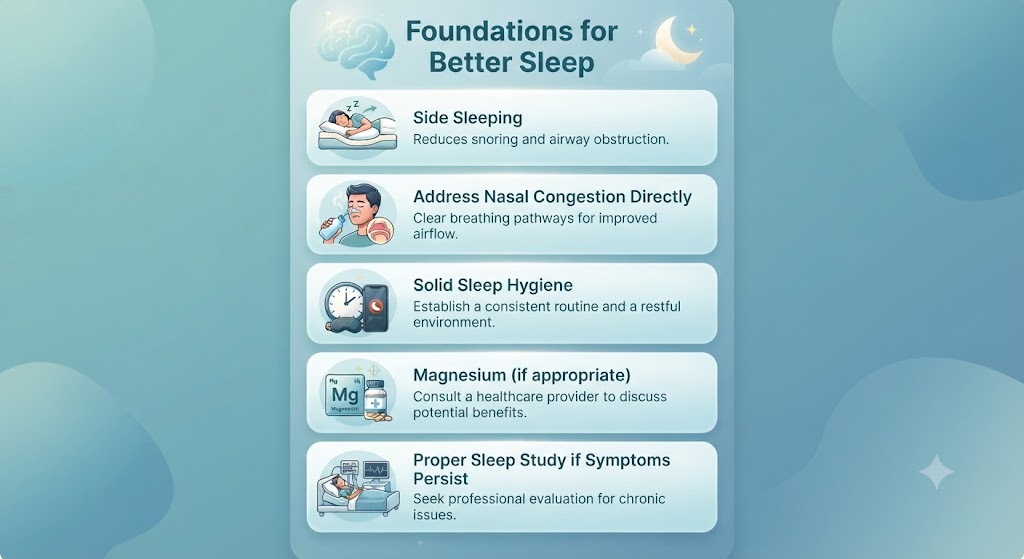
- Side sleeping. Decades of research show that both people with and without OSA snore less sleeping on their side rather than their back — a well-established, essentially risk-free alternative. A supportive mattress and pillow can make this position easier to maintain through the night.
- Addressing nasal congestion directly, through allergy management or a doctor’s evaluation, rather than working around a blocked nose with tape
- General sleep hygiene fundamentals — consistent sleep and wake times, a cool dark bedroom, and reduced evening light exposure — which we cover in more depth in our guide on sleep optimization without gadgets, and which have a far broader and stronger evidence base than mouth taping specifically
- Magnesium supplementation, if sleep quality rather than snoring specifically is your main concern — our guide on magnesium for sleep and anxiety covers which specific form has the strongest supporting research
- A proper sleep study, if snoring or daytime fatigue is persistent, since this identifies whether you’re dealing with simple snoring or a genuine breathing disorder that needs real treatment
Who Should Never Try This
Based on the safety data, mouth taping should be avoided by:
- Anyone with moderate-to-severe sleep apnea, diagnosed or suspected
- Anyone with nasal obstruction — chronic congestion, a deviated septum, or seasonal allergies that block nasal airflow
- Anyone with undiagnosed snoring or daytime fatigue who hasn’t yet had a proper sleep evaluation
- Children, without direct medical guidance, given the different developmental context
- Anyone currently using CPAP or another prescribed apnea treatment — mouth taping isn’t a substitute and shouldn’t be combined without a sleep specialist’s input
Frequently Asked Questions
Does mouth taping actually work for sleep? The evidence is limited and mixed. A 2025 systematic review found minimal, not clinically significant evidence outside people with mild obstructive sleep apnea who are habitual mouth breathers. For the general healthy population seeking better sleep, there’s little supporting research.
Is mouth taping safe? Not for everyone. It carries a serious risk for people with nasal obstruction, since taping the mouth removes the backup airway if the nose is blocked. It’s not considered dangerous for most healthy adults who can breathe freely through their nose, but anyone with sleep apnea or nasal congestion should avoid it or consult a doctor first.
Can mouth taping treat sleep apnea? No. Mouth taping is not a proven treatment for sleep apnea and should never replace CPAP or another prescribed treatment. A small benefit has been observed only in mild OSA cases in limited studies, and even there, it’s not considered a standalone treatment.
Does mouth taping change your jawline or face shape? No, not in adults. Nasal breathing supports healthy facial and dental development in children, but there’s no evidence it reshapes bone structure in adults. This claim, common on social media, is not supported by current research.
A Note From Health Morph
This article is for informational and educational purposes only and reflects published research as of 2026. It isn’t a substitute for personalized medical advice. If you snore regularly, experience daytime fatigue, or suspect sleep apnea, please see a doctor or sleep specialist for proper evaluation rather than trying mouth taping or any other self-directed remedy.
For more evidence-based sleep guidance, explore our Mental Health section, or read our related guide on sleep optimization without gadgets.







Leave a Reply