
By Health Morph — Nutrition & Diet — Last Updated: July 31, 2026
This article is for educational purposes only and is not a substitute for professional medical advice. Talk to your doctor before starting any new supplement, especially if you take other medications or have kidney concerns.
Quick Answer
Magnesium for sleep and anxiety has real, if modest, evidence behind it. A 2025 randomized controlled trial found that 250mg of magnesium bisglycinate daily produced a small but statistically significant improvement in insomnia symptoms over four weeks. Evidence for anxiety specifically is less consistent — some studies show improvement, others don’t reach statistical significance. Magnesium appears most helpful for people who are actually low in it, rather than as a universal fix for anyone with poor sleep or anxiety.
Why Magnesium Is Even in This Conversation
If you’ve searched for natural sleep or anxiety support, you’ve almost certainly run into recommendations for magnesium for sleep and anxiety — and there’s a real biological reason it keeps coming up, not just wellness-trend momentum.
Magnesium plays a role in several systems directly relevant to sleep and stress:
- GABA activity — magnesium helps regulate GABA, the brain’s primary calming neurotransmitter, which is part of why low magnesium is linked to nervous system hyperexcitability.
- NMDA receptor regulation — magnesium moderates this receptor system, which is involved in stress and neuronal excitability.
- Cortisol and the stress response — magnesium is involved in regulating your body’s cortisol response, relevant to both sleep onset and anxiety symptoms.
- Serotonin production — magnesium supports the conversion of tryptophan into serotonin, which has downstream effects on mood.
This is a genuinely broad mechanistic footprint — which is exactly why researchers have been motivated to test it directly, rather than relying on theory alone. Magnesium isn’t the only mineral where deficiency quietly affects how you feel day to day — our guide on iron deficiency and anemia in women covers a similarly underdiagnosed nutrient gap with its own effects on energy and mood.
What the Research Actually Shows
Here’s where it’s worth being precise, since a lot of magnesium content either oversells the evidence or ignores it entirely.
The strongest recent evidence is for sleep, not anxiety specifically. A randomized, double-blind, placebo-controlled trial published in August 2025 in Nature and Science of Sleep (Schuster et al.) enrolled 155 healthy adults aged 18–65 with self-reported poor sleep. Participants took either 250mg of elemental magnesium as bisglycinate or a placebo daily for four weeks. The magnesium group showed a significantly greater reduction in Insomnia Severity Index scores than placebo (−3.9 vs. −2.3 points), though the researchers themselves described the effect as modest, with a small effect size.
A 2024 systematic review published in Cureus examined the broader body of research on supplemental magnesium for self-reported anxiety and sleep quality. Its overall conclusion was consistent with the single-trial finding above: real but modest benefits, more reliably demonstrated for sleep than for anxiety, with meaningful variation between studies in dose, form, and study population.
A smaller 2024 crossover pilot trial (31 adults with poor sleep, using objective Oura Ring tracking alongside questionnaires) found that magnesium supplementation significantly improved sleep duration, sleep efficiency, and mood compared to placebo. Notably, the same study did not find a statistically significant improvement on its specific anxiety inventory — a useful reminder that “helps with sleep and mood” and “clinically reduces anxiety” aren’t automatically the same claim.
A 2026 review in the EJIFCC summarizing magnesium’s broader role in health noted that daily magnesium doses around 500mg/day have been associated with improvements in insomnia severity and sleep efficiency in the literature, alongside magnesium’s established role in the tryptophan-to-serotonin pathway relevant to mood regulation.
The honest summary: magnesium has real, replicated evidence for modestly improving sleep quality, particularly in people with poor baseline sleep. The evidence for anxiety specifically is present but less consistent — treat “magnesium cures anxiety” claims with real skepticism, and think of it as one small, reasonable piece of a broader approach rather than a stand-alone fix. This same “modest evidence, not a miracle” pattern shows up in our breakdown of the Ayurvedic approach to arthritis and joint pain, which is worth reading if you want another example of what genuinely evidence-based natural health writing looks like versus hype. If anxiety is significantly affecting your daily life, that’s a conversation for a doctor or therapist, not a supplement aisle.
Which Type of Magnesium Actually Matters Here
Not all magnesium supplements are the same, and the form matters for both effectiveness and side effects:
- Magnesium glycinate/bisglycinate — the form used in the strongest recent sleep trial above. Generally well absorbed with minimal digestive side effects, which is likely part of why it’s the most commonly recommended form for sleep and anxiety specifically.
- Magnesium threonate — marketed heavily for cognitive and brain-related effects, based on early research suggesting it may cross into brain tissue more effectively than other forms. Research here remains genuinely limited compared to glycinate.
- Magnesium citrate — well absorbed, but more likely to have a laxative effect at higher doses — often chosen for constipation relief rather than sleep specifically.
- Magnesium oxide — cheap and widely available, but poorly absorbed relative to other forms, and more likely to cause digestive upset. Not generally the best choice if sleep or anxiety is your specific goal.
If you’ve read our comparison of best ashwagandha supplements, the same lesson applies here: the specific form and preparation of a supplement often matters as much as the ingredient itself.
Dosage and Safety
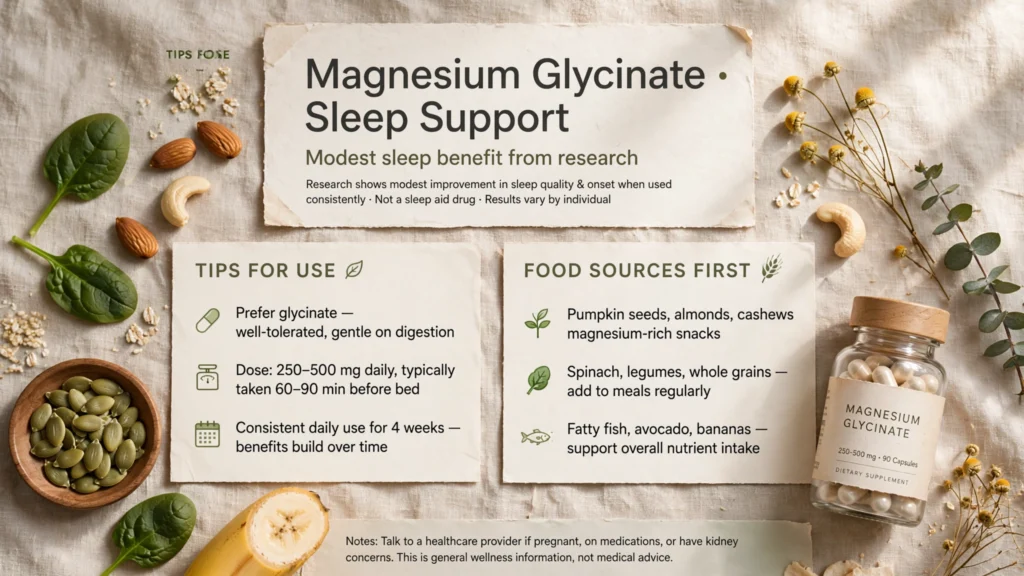
Elemental magnesium doses used in the sleep research above ranged from 250mg to 500mg daily. It’s worth knowing the distinction between dietary intake and supplemental intake: getting magnesium from food carries essentially no risk of overdose, but the tolerable upper limit specifically for supplemental magnesium is commonly cited around 350mg per day for adults, since doses above that are more likely to cause digestive side effects like diarrhea and cramping.
Magnesium supplements can interact with certain medications, including some antibiotics, diuretics, and medications for osteoporosis, and require caution in people with kidney disease, since impaired kidneys are less able to clear excess magnesium. This is exactly the kind of detail worth running past your doctor or pharmacist before starting, especially if you’re already taking other medications — the same caution applies to natural remedies more broadly, as we cover in our guide to herbal teas and diabetes medication interactions.
Who Is Most Likely to Actually Benefit
The research above is more encouraging for a specific group than for the general population: people who are genuinely running low on magnesium to begin with. Common contributors to lower magnesium status include:
- High intake of processed or refined foods (magnesium is lost during food refining)
- High stress levels or high caffeine/alcohol intake, both of which increase magnesium excretion
- Certain medications, including some diuretics and proton pump inhibitors
- Digestive conditions that affect nutrient absorption
If your diet is already rich in magnesium-containing foods and your sleep issues stem from something else entirely — screen time before bed, an irregular schedule, or unmanaged stress — supplementing is unlikely to be the fix, no matter how good the form or dose. Diet quality itself is worth a closer look too — our breakdown of ultra-processed foods covers how heavily refined diets can quietly strip out minerals like magnesium in the first place.
Food Sources Worth Knowing First
Since food-based magnesium carries no overdose risk and often comes packaged with other beneficial nutrients, it’s generally worth trying dietary changes before or alongside supplementation:
- Pumpkin seeds and almonds
- Spinach and other leafy greens
- Black beans and other legumes
- Dark chocolate (70%+ cocoa)
- Avocado
- Whole grains like brown rice and quinoa
Getting enough magnesium from food ties into the broader question of nutrient needs as you age — our guide on protein requirements after 40 covers a related shift in what your body actually needs from food at different life stages.

Expert Tips for Trying Magnesium for Sleep and Anxiety Thoughtfully
- Give it real time before judging results. The strongest trial above ran four full weeks before showing a measurable difference — a few nights isn’t enough of a trial to know whether it’s working for you specifically.
- Take it consistently, not just on bad nights. Since magnesium’s effect appears to build over sustained intake rather than acting like a fast-acting sedative, daily consistency matters more than timing it around a specific stressful day.
- Track your sleep with more than just “how I feel.” A simple sleep diary, or a wearable if you have one, gives you more reliable signal than memory alone, especially since placebo effects are well documented in sleep research.
- Don’t stack multiple new interventions at once. If you start magnesium, a new bedtime routine, and cut caffeine all in the same week, you won’t know what’s actually responsible for any improvement — introduce one variable at a time.
- Reconsider if you notice digestive symptoms. Loose stools or cramping are a common sign you’ve exceeded a comfortable dose or picked a less-absorbable form — switching to glycinate or reducing the dose usually resolves this.
Consistency matters here the same way it does with physical training — our strength training for beginners guide covers a similar “give it real weeks, not days” mindset that applies just as much to supplementation as it does to exercise.
Common Misconceptions Worth Clearing Up
- “Magnesium will fix my anxiety.” The evidence for sleep is more consistent than the evidence for anxiety specifically. Treat it as a possible modest support, not a replacement for therapy or medical treatment for significant anxiety.
- “More magnesium is always better.” Beyond a certain point, extra magnesium mostly just causes digestive side effects rather than extra benefit — this isn’t a “more is better” supplement.
- “All magnesium supplements are basically the same.” Form genuinely matters, both for how well it’s absorbed and how likely it is to cause side effects. Oxide and glycinate are not interchangeable in practice.
- “If I’m not deficient, magnesium won’t help at all.” The research above included generally healthy adults, not diagnosed deficiency cases — so there may be modest benefit even without a formal deficiency, though it’s most reliably helpful for people running low. Building any new habit around consistent daily rhythm, similar to the principles in our Dinacharya guide, tends to make it easier to judge honestly whether a supplement is actually helping.
Frequently Asked Questions
Does magnesium actually help with sleep? Yes, according to a 2025 randomized controlled trial, 250mg of magnesium bisglycinate daily produced a statistically significant, though modest, improvement in insomnia symptoms over four weeks compared to placebo.
Does magnesium help with anxiety specifically? The evidence is less consistent than for sleep. Some studies show improvement in anxiety-related measures, while others — including a 2024 crossover trial — found improvements in sleep and mood but not a statistically significant change on a formal anxiety inventory.
What type of magnesium is best for sleep and anxiety? Magnesium glycinate (also called bisglycinate) has the most direct recent research support and tends to cause fewer digestive side effects than forms like citrate or oxide, which is likely why it’s the most commonly recommended form for this specific use.
How much magnesium should I take for sleep? Research studies showing benefit have generally used doses between 250mg and 500mg of elemental magnesium daily. The commonly cited safe upper limit for supplemental magnesium specifically is around 350mg per day, so it’s worth discussing your specific situation with a doctor before going higher.
Can I take too much magnesium? Magnesium from food carries essentially no overdose risk, but supplemental magnesium above roughly 350mg daily is more likely to cause digestive side effects like diarrhea and cramping. People with kidney disease should be especially cautious, since impaired kidneys clear excess magnesium less effectively.
The Bottom Line
Magnesium for sleep and anxiety isn’t a myth, but it isn’t a miracle either — the honest picture from current research is a modest, real benefit for sleep quality, with more mixed evidence specifically for anxiety. It’s most likely to help if your diet or lifestyle has left you genuinely low on magnesium, and it works best as one piece of a broader approach — alongside consistent sleep habits, stress management, and movement — rather than a stand-alone fix. If sleep or anxiety issues are significantly affecting your daily life, that’s worth bringing to a doctor directly, alongside anything you learn here.
For other evidence-based, non-pharmacological approaches to anxiety, see our guide on walking for anxiety, and if stress and cortisol are a bigger part of your picture than sleep alone, our comparison of best ashwagandha supplements covers another well-researched option worth understanding alongside this one.







Leave a Reply