
It’s become almost impossible to scroll through a wellness feed without seeing the term “ultra-processed foods” attached to some alarming headline. Cancer, depression, early death, infertility — at this point, ultra-processed foods (often shortened to UPFs) get blamed for nearly every modern health problem. Documentaries have been made about them. Governments are drafting policy around them. And yet, dig into the actual research, and the picture is considerably more nuanced than the scariest headlines suggest.
This matters because the term “ultra-processed” has started to function less like a scientific classification and more like a moral judgment — as if any food that touches a factory is automatically dangerous. That’s not quite what the evidence shows, and treating all UPFs as equally harmful can actually make healthy eating harder for people who don’t have the time, money, or access to cook everything from scratch.
What Does “Ultra-Processed” Actually Mean?
The term comes from the NOVA food classification system, developed by researchers at the University of São Paulo. Despite sometimes being written in all caps, NOVA isn’t an acronym — it’s simply the name of the system, which sorts foods into four groups based on the degree and purpose of processing they’ve undergone:
- Group 1: Unprocessed or minimally processed foods (fresh vegetables, plain oats, eggs)
- Group 2: Processed culinary ingredients (oils, butter, sugar, salt)
- Group 3: Processed foods (canned vegetables, cheese, freshly baked bread)
- Group 4: Ultra-processed foods — industrial formulations typically containing ingredients you wouldn’t find in a home kitchen, such as emulsifiers, artificial flavorings, and preservatives designed to extend shelf life and enhance palatability
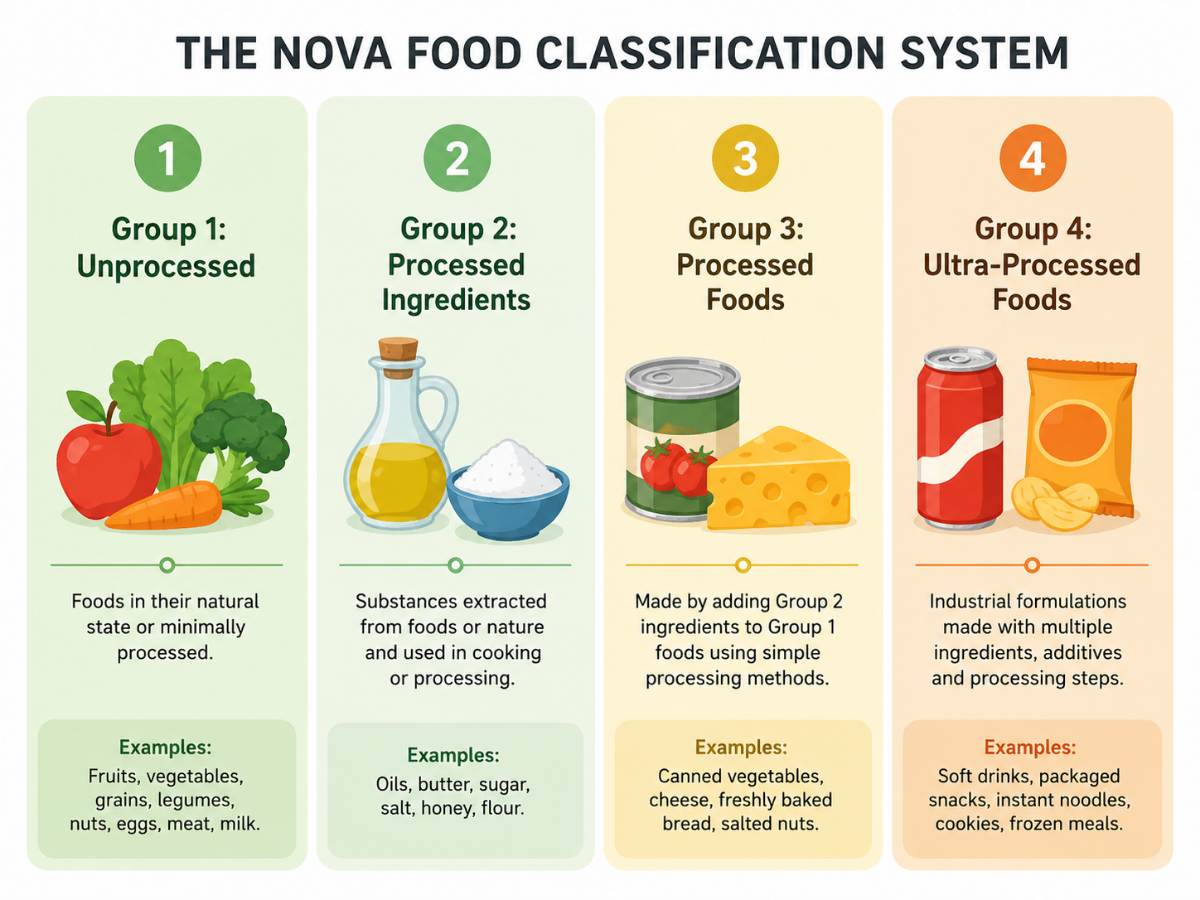
This is where a lot of confusion starts. Group 4 includes obvious examples like sugary sodas, packaged candy, and instant noodles — but it also includes things like flavored yogurt, whole-grain packaged bread, plant-based milk alternatives, and even some infant formulas. The classification is based on how something is made, not necessarily on its nutritional content, which is part of why nutrition researchers themselves are increasingly divided on how useful the category really is.
What the Research Actually Shows
There’s genuinely strong evidence linking high overall UPF consumption to increased risk of obesity, type 2 diabetes, cardiovascular disease, and even earlier death. A recent analysis found that for every 10% increase in the proportion of ultra-processed food in someone’s diet, measurable increases in risk showed up across several of these conditions.
But here’s the part that rarely makes the headlines: most of this evidence comes from observational studies, which can show a strong association but can’t fully prove that ultra-processing itself is the direct cause, separate from the fact that diets high in UPFs also tend to be higher in added sugar, refined carbohydrates, and unhealthy fats, while being lower in fiber and micronutrients. Some researchers have specifically called for more caution before drawing strict causal conclusions from this type of research.
An important and often overlooked finding from more recent reviews is that the category isn’t uniform in its effects. Sugar-sweetened beverages consistently show harmful associations across studies. But other Group 4 foods, like fortified breakfast cereals or certain packaged dairy products, have shown neutral or even mildly protective associations in some analyses. In other words, not all ultra-processed foods behave the same way in the body, even though they technically sit in the same classification bucket.
Why the Blanket “UPFs Are Bad” Message Can Be Misleading
A useful way to think about this: a store-bought hummus made with chickpeas, tahini, and a stabilizing gum is technically ultra-processed under NOVA. But nutritionally, it’s a far better choice than a bag of chips or a candy bar, which are also Group 4. Treating both as equally harmful doesn’t reflect what’s actually happening nutritionally, and it can unfairly discourage convenient, reasonably healthy options for people who don’t have time to make hummus from scratch.
This is one of the central critiques nutrition scientists have raised about NOVA: it’s a binary system, sorted purely by how a food is manufactured, that doesn’t account for actual nutrient density, fortification benefits, or the broader dietary context someone is eating within. A single ingredient list doesn’t tell the whole story of a food’s health impact.
What Seems to Matter Most: Ingredients, Not Just Processing
If you look past the “ultra-processed” label itself, a clearer pattern emerges. The foods most consistently linked to negative health outcomes tend to share specific traits: they’re high in added sugar, refined starch, and unhealthy fats, low in fiber and protein, and engineered to be easy to overeat quickly. Sugary drinks, packaged sweets, and reformed meat products fall into this category most reliably across the research.
Meanwhile, foods that are technically ultra-processed but retain reasonable nutrient density, fiber, or protein — think fortified cereals, certain plant-based milks, or minimally sweetened yogurt — don’t carry the same weight of evidence against them. This lines up with what many researchers now argue: it may be more useful to focus on a food’s actual nutritional composition rather than treating “processing level” as a standalone health verdict.
There’s also emerging interest in how UPFs might affect the gut microbiome specifically, given their typically low fiber content and additive load. Since gut health plays such a central role in inflammation, mood, and metabolic function, this is an area worth watching. If you want to go deeper on how gut bacteria influence overall health, our piece on the gut-brain connection and how your microbiome affects mood and anxiety covers this relationship in detail.
A More Practical Way to Think About This
Instead of trying to eliminate every ultra-processed item from your kitchen — which is genuinely difficult and, for most people, unnecessary — it’s more useful to focus on a few practical distinctions:
Foods worth limiting most:
- Sugar-sweetened beverages (sodas, sweetened juices, energy drinks)
- Packaged sweets, pastries, and candy
- Processed and reformed meats (many packaged sausages, deli meats)
- Instant noodles and heavily salted packaged snacks
Ultra-processed foods that are reasonable in moderation:
- Whole-grain packaged breads
- Plain or lightly sweetened yogurt
- Fortified breakfast cereals with reasonable sugar content
- Plant-based milk alternatives
- Store-bought hummus or similar bean-based dips
The bigger-picture habit that matters more than any single label: Building meals around whole foods most of the time — vegetables, fruit, whole grains, legumes, and lean protein — while treating the most heavily engineered, sugar-and-refined-carb-heavy products as occasional rather than everyday choices. This overlaps closely with the kind of eating pattern that supports healthy blood sugar and metabolic function more broadly. If that’s something you’re actively working on, our guide on natural foods that support metabolic health and satiety walks through specific, practical food choices in more depth.
Who Should Be More Cautious
People managing diabetes, cardiovascular disease, or working closely with blood sugar levels may want to be more deliberate about limiting the highest-risk UPF categories specifically — sugary drinks and refined snack foods — since these show the most consistent and strongest associations with metabolic harm. If you’ve been curious about how specific foods affect your own blood sugar in real time, our article on continuous glucose monitors for non-diabetics explains what these devices can reveal about individual responses to different foods, processed or not.
Frequently Asked Questions
1. Are all ultra-processed foods equally unhealthy? No. Research shows meaningful differences within the category — sugar-sweetened beverages and processed meats consistently show the strongest links to health risks, while some fortified or minimally sweetened UPFs show neutral or even mildly positive associations.
2. Does eating some ultra-processed food ruin an otherwise healthy diet? Not necessarily. The overall pattern of your diet matters far more than any single food. Someone eating mostly whole foods with occasional store-bought bread or yogurt is in a very different position than someone whose diet is dominated by sugary drinks and packaged snacks.
3. Is the NOVA classification system scientifically reliable? It’s widely used and endorsed by organizations including the World Health Organization, but nutrition scientists have raised valid critiques about its binary, ingredient-based structure, which doesn’t account for actual nutrient density or fortification benefits.
4. What’s the single most important change I can make regarding UPFs? Reducing sugar-sweetened beverages and heavily processed meats tends to have the strongest, most consistent evidence behind it, more so than trying to eliminate every packaged or processed item from your diet.
5. Can eating fewer ultra-processed foods improve gut health? It’s a reasonable hypothesis, since UPFs are often low in fiber, which your gut bacteria depend on. Research in this specific area is still developing, but prioritizing whole, fiber-rich foods is well-supported for gut health regardless of how the UPF research ultimately settles.
The Bottom Line
The alarm around ultra-processed foods isn’t baseless — there’s real, meaningful evidence connecting high overall UPF consumption to serious health risks. But the all-or-nothing framing that’s taken over social media oversimplifies a genuinely more nuanced picture. Not every packaged or industrially made food behaves the same way in your body, and demonizing convenience foods across the board isn’t necessarily supported by the data, nor is it realistic for most people’s daily lives. A more useful approach is paying closer attention to the highest-risk categories — sugary drinks, processed meats, and refined snack foods — while not stressing over every ingredient list, and building your overall diet around whole foods as the foundation rather than the exception.
This article is for informational purposes only and is not a substitute for professional medical or nutritional advice. If you have specific dietary concerns or health conditions, please consult a doctor or registered dietitian.







Leave a Reply