Search for best ashwagandha supplements and you’ll find dozens of nearly identical-looking bottles, most simply labeled “ashwagandha root extract.” That label tells you almost nothing useful. The extract type, standardization, and withanolide content — not the brand name or packaging — determine whether you’re buying a therapeutic dose backed by real clinical trials or, in some documented cases, plain herb powder delivering a fraction of what a study actually used.
Here’s how to evaluate an ashwagandha product properly, based on what the clinical research actually studied.
Why “Ashwagandha” on a Label Tells You Almost Nothing
Ashwagandha’s active compounds, called withanolides, vary enormously depending on the part of the plant used, the extraction method, and whether the product is standardized at all. This is the single biggest thing separating a legitimate ashwagandha supplement from an underdosed one: the same “600 mg of ashwagandha” claim can mean wildly different actual withanolide content depending on what’s behind that label.
KSM-66 vs. Sensoril: The Real Difference
Two branded, trademarked extracts dominate the actual clinical evidence, and they come from different parts of the plant:
KSM-66 is a full-spectrum, root-only extract standardized to a minimum of 5% withanolides, produced using a proprietary water-based (rather than harsh solvent) extraction process. It’s the most extensively studied ashwagandha extract available, backed by 20+ published clinical trials covering stress and cortisol reduction, testosterone support in men, exercise recovery, and sleep quality. The landmark trial — Chandrasekhar et al., 2012, published in the Indian Journal of Psychological Medicine and one of the most-cited ashwagandha studies in the medical literature — found KSM-66 reduced serum cortisol by roughly 27.9% compared to placebo. Typical studied doses run 300–600 mg daily.
Sensoril is a root-and-leaf extract standardized to at least 10% withanolide glycoside conjugates. It has its own separate body of clinical research, tends to be more sedating than KSM-66, and shows up frequently in sleep- and anxiety-focused formulas specifically because of this profile. Typical studied doses run considerably lower, at 125–250 mg daily.
One important nuance: Sensoril’s higher withanolide percentage doesn’t automatically mean it’s “stronger” than KSM-66. The two extracts standardize to different compound classes measured differently, so the percentages aren’t directly comparable, and each has its own separate research base rather than one being a strictly better version of the other.
A few other branded extracts — Shoden, Sabinsa Shagandha, Witholytin, and Zenroot — appear on some labels with emerging clinical research, though none currently has an evidence base as extensive as KSM-66 or Sensoril.
The Generic Root Powder Problem
This is the detail that matters most for anyone comparing our list of best ashwagandha supplements against a cheap, unstandardized alternative: raw, unextracted ashwagandha root powder naturally contains only about 0.3% to 0.5% withanolides by weight, depending on growing conditions and harvest timing. That means a typical 600 mg capsule of plain root powder delivers roughly 1.8 to 3 mg of actual withanolides — compared to the 15 to 30 mg per serving used in the clinical trials that actually showed meaningful cortisol reduction.
In practical terms: a bottle of unstandardized “ashwagandha root powder” and a bottle of properly standardized KSM-66 or Sensoril can differ in active compound delivery by roughly 10-fold, even if both bottles say “600 mg” on the label.
Why Third-Party Testing Matters
Even among products claiming a standardized extract, label accuracy isn’t guaranteed. Independent testing organizations, including ConsumerLab, have found some ashwagandha products deliver less than 50% of their labeled withanolide content — meaning the standardization claim on the bottle doesn’t always match what’s actually inside.
Looking for third-party verification — USP, NSF Certified for Sport, Informed Choice/Informed Sport, or an accessible Certificate of Analysis (CoA) from an independent lab — is one of the few practical ways to confirm a product’s real quality without lab-testing it yourself.
What to Actually Look for on a Label
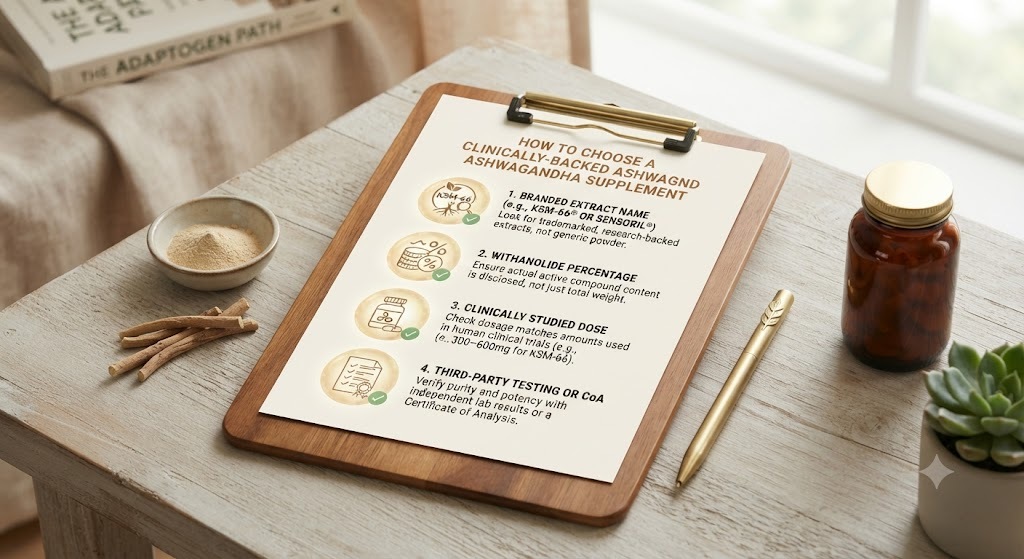
Based on the evidence above, a genuinely useful ashwagandha product should clearly disclose:
- The specific branded extract name — KSM-66, Sensoril, or another named, clinically studied extract — not just “ashwagandha extract” or “ashwagandha root”
- The actual withanolide percentage, not just total extract weight
- A dose within the clinically studied range for that specific extract (300–600 mg for KSM-66, 125–250 mg for Sensoril)
- Third-party testing or a certificate of analysis, ideally from USP, NSF, or a comparable independent body
- Root-only vs. root-and-leaf labeling, since some sources — including a 2026 review of 127 clinical trials — note that leaf extract has more contested safety and efficacy evidence than root-only extracts, and some regulatory bodies outside the U.S. have flagged concerns specifically about leaf extract in therapeutic supplements
Which Extract Fits Which Goal
Based on where the clinical evidence actually points:
- Daytime stress, cortisol management, or exercise recovery: KSM-66 has the broadest, most consistent research record
- Sleep support or evening use: Sensoril’s more sedating profile and lower studied dose make it a more targeted fit for this specific goal
- General adaptogen use with the most published safety data: KSM-66’s larger trial base gives it a slight edge simply due to the volume of research behind it
If you’re also exploring ashwagandha’s role in a broader Ayurvedic context, our complete ashwagandha guide covers its traditional Rasayana classification and dosha-specific considerations alongside this same clinical research.
Safety and Dosing Notes
A 2026 review of 127 clinical trials found ashwagandha’s overall safety profile to be strong, provided products are properly manufactured and standardized — reinforcing that most safety concerns trace back to product quality rather than the herb itself. That said, a few cautions remain worth knowing:
- Thyroid conditions: ashwagandha can increase thyroid hormone levels, so anyone with a thyroid condition should consult a doctor first
- Drug interactions: caution is warranted alongside sedatives, immunosuppressants, and thyroid medications
- Cycling: some practitioners recommend a defined period of use (commonly cited as roughly 8 weeks on, 2 weeks off) rather than indefinite continuous use, though this isn’t universally established in the research
- Rare liver toxicity reports exist in the broader literature, making it worth discussing with a doctor if you have underlying liver conditions
Frequently Asked Questions
What is the difference between KSM-66 and Sensoril ashwagandha? KSM-66 is a full-spectrum, root-only extract standardized to 5% withanolides with the broadest clinical trial base (20+ studies), typically dosed at 300–600 mg. Sensoril is a root-and-leaf extract standardized to 10% withanolide glycoside conjugates, more sedating, and typically dosed lower at 125–250 mg, with stronger representation in sleep-focused research.
Is generic ashwagandha root powder worth buying? Generally not, if you’re seeking the effects shown in clinical trials. Unextracted root powder naturally contains only about 0.3–0.5% withanolides, delivering roughly 1.8–3 mg per 600 mg capsule — far below the 15–30 mg used in studies showing meaningful benefit.
How do I know if an ashwagandha supplement’s withanolide claim is accurate? Look for third-party testing or certification (USP, NSF Certified for Sport, Informed Choice/Sport) or an accessible Certificate of Analysis, since independent testing has found some products deliver less than half their labeled withanolide content.
Is ashwagandha safe to take long-term? A 2026 review of 127 clinical trials found ashwagandha’s safety profile strong when products are properly manufactured, though some practitioners recommend cycling (periods on and off) rather than continuous indefinite use, and certain groups — those with thyroid conditions or on specific medications — should consult a doctor first.
A Note From Health Morph
This article is for informational and educational purposes only and reflects published research as of 2026. It isn’t a substitute for personalized medical advice. Talk to a doctor before starting ashwagandha, particularly if you have a thyroid condition, take other medications, or have an existing liver condition.
For more evidence-based supplement and Ayurvedic guidance, explore our Natural Remedies & Ayurveda section, or read our related guide on cortisol and chronic stress, where ashwagandha’s cortisol-reducing







Leave a Reply