Gut microbiome testing has grown into a genuinely massive industry — send in a stool sample, get back a detailed report on your gut bacteria, and follow personalized diet and supplement recommendations built from it. The consumer market was valued around $1.8 billion in 2025 and is projected to more than triple by 2034. There’s just one significant problem, confirmed by the most rigorous study on this topic to date: when the exact same sample was sent to seven different testing companies, the results were dramatically, sometimes wildly, different.
Here’s what the actual research shows, why this matters for anyone considering a test, and what has real evidence behind it instead.
The Study That Changes the Conversation
In February 2026, researchers led by Stephanie L. Servetas at the National Institute of Standards and Technology (NIST) published findings in the peer-reviewed journal Communications Biology that should reshape how anyone thinks about at-home gut microbiome testing. The team ordered three kits each from seven different direct-to-consumer testing companies — 21 kits total — and sent every single company the exact same standardized reference stool sample.
If these tests were reliably measuring the same underlying biology, the results should have looked essentially identical across all seven providers. They didn’t. The study found major discrepancies both within and across providers, and — this is the detail worth sitting with — the variability between different testing companies was on the same scale as the natural biological variability between different people’s guts. In other words, two results from different companies analyzing the identical sample could differ about as much as two results from two completely different people.
This wasn’t an isolated finding either. A 2021 comparative study published in Nature Biotechnology found similarly dramatic differences in microbial identification and relative abundance across testing companies years before the NIST study confirmed the same fundamental problem still existed in 2026.
Why the Results Vary So Much
The core issue is a lack of standardization across the entire testing pipeline. Analytical methods differ significantly between companies at every stage — sample collection procedures, sequencing technology, reference databases used for identifying microbes, and the computational methods used to interpret raw genetic data into a final report. Because there’s no industry-wide standard method, each company is effectively building its own measurement system, and those systems don’t agree with each other.
This matters enormously for anyone using a result to make dietary or supplement decisions: if two different companies would give you two different, sometimes contradictory pictures of your own gut from the identical sample, no single company’s result can be treated as a definitive, objective measurement of what’s actually happening in your body.
What This Means If You’ve Already Taken a Test
If you’ve already gotten a gut microbiome test result, the honest takeaway isn’t that the report is meaningless — it’s that it should be treated as a rough snapshot and a possible motivator, not a precise diagnostic tool. As one researcher explained it, at-home microbiome tests “straddle the line” between medical devices and wellness products, without the analytical and clinical validation standards required of an actual diagnostic test.
Test results are more reasonably used as a conversation-starter or a nudge toward better habits — like eating more fiber or diversifying your diet — than as a conclusion to build major health decisions around, especially expensive supplement regimens marketed specifically off a single test’s recommendations.
Are Any Tests Worth Taking?
Given the current evidence, a genuinely honest answer is: proceed with real skepticism, and if you do try one, treat the results loosely. A few practical filters if you’re considering a specific provider:
- Look for transparency about methodology — sequencing technology used and reference databases referenced, rather than a black-box report
- Be skeptical of tests claiming to address mood, skin, or fatigue specifically through gut analysis — the microbiome’s role in these areas is still being actively researched and isn’t well-established enough to support confident, individualized recommendations
- Don’t expect consistency between providers — the NIST findings mean a “second opinion” from a different company isn’t a meaningful way to verify your first result, since methodological differences, not biological reality, likely explain most disagreement
- Recognize no test is currently FDA-approved as a diagnostic tool in the U.S., which tells you something about where the regulatory and scientific community currently stands on their clinical reliability
What Actually Has Strong Evidence Instead
This is genuinely good news: you don’t need an expensive, unreliable test to meaningfully support your gut microbiome, since the habits with real research behind them are free or low-cost and don’t depend on a lab’s proprietary methodology:
- Dietary diversity is one of the most consistently supported levers — eating a wide variety of plant-based foods (vegetables, legumes, whole grains, fruits, nuts, seeds) supports a more diverse, beneficial microbiome, with some researchers suggesting a target of 30 or more different plant foods per week
- Regular exercise appears to improve microbial diversity independent of diet
- Fermented foods like yogurt, kefir, and kimchi may introduce beneficial bacteria directly, an angle we cover from a different tradition in our guide on neem leaves for gut health
- Managing chronic stress and prioritizing sleep round out the picture, since both affect gut function through well-documented gut-brain axis pathways — themes we cover in more depth in our guides on cortisol and chronic stress and sleep optimization without gadgets
Unlike a test result that might vary depending on which company processes it, these lifestyle levers have a consistent, reproducible body of evidence behind them — a pattern that echoes what we found looking honestly at whether detox diets actually work: the boring, foundational habits often outperform the trendy, expensive product marketed as a shortcut.
The Regulatory Gray Zone
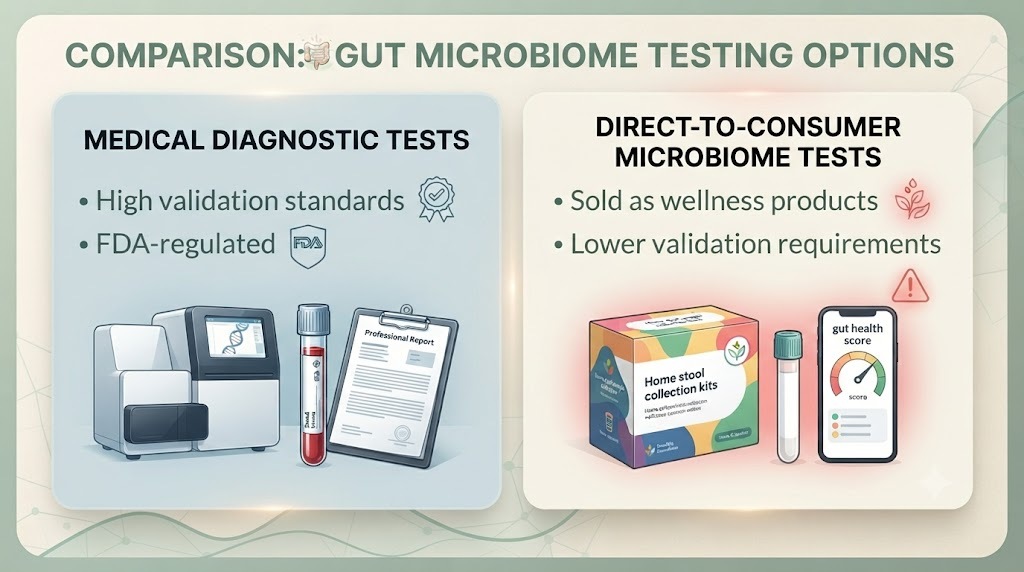
A 2024 editorial in The Lancet Gastroenterology & Hepatology specifically called for tighter regulation of direct-to-consumer microbiome tests, noting that in the U.S., they aren’t regulated as medical devices at all — they’re sold as general wellness products, a category with far lower validation requirements than an actual diagnostic test. As of early 2026, no clinical microbiome diagnostic test is approved by regulatory authorities in the United States, and even Europe’s CE-marked options face public skepticism from professional microbiology bodies. This regulatory gap is exactly why a company can sell a compelling, detailed-looking report without the same evidence bar a doctor’s diagnostic test would need to clear.
Frequently Asked Questions
Are at-home gut microbiome tests accurate? Current evidence says no, not reliably. A 2026 NIST-led study published in Communications Biology found major discrepancies when the same stool sample was sent to seven different testing companies, with inter-company variability on the same scale as natural biological differences between people.
Is it worth paying for a gut microbiome test? Given current reliability concerns, most researchers recommend treating any test result as a loose motivator rather than a precise or actionable diagnostic tool. The habits with the strongest supporting evidence for gut health — dietary diversity, exercise, fermented foods, stress management — don’t require paying for a test at all.
Why do different microbiome testing companies give different results for the same sample? Analytical methods vary significantly between companies at every stage, including sequencing technology, reference databases, and computational interpretation methods. Without industry-wide standardization, each company essentially operates its own measurement system.
Are gut microbiome tests FDA-approved? No. As of 2026, no clinical microbiome diagnostic test is approved by the FDA for clinical use in the United States. Direct-to-consumer tests are sold as general wellness products, not regulated medical devices.
A Note From Health Morph
This article is for informational and educational purposes only and reflects published research as of 2026. It isn’t a substitute for personalized medical advice. If you have a diagnosed digestive condition or persistent gut health concerns, please see a doctor rather than relying on an at-home microbiome test result.
For more evidence-based guides on gut and digestive health, explore our Natural Remedies & Ayurveda section, or read our related guide on whether detox diets actually work.







Leave a Reply