
If you’ve ever lain there at 1 a.m. searching how to fall asleep faster on your phone, you already know the internet’s advice is a mess — a pile of TikTok “military methods,” breathing patterns with suspiciously specific numbers, and warnings about blue light that may or may not actually matter as much as everyone insists. We went through the actual research behind the most popular sleep-onset techniques, and the honest picture is a genuinely useful mix: some viral advice holds up better than skeptics assume, some “proven” tricks rest on a single unverified 1980s claim nobody ever tested properly, and the single most effective approach is one almost nobody’s heard of because it’s not flashy enough to go viral.
Why Falling Asleep Fast Is Harder Than It Should Be
Sleep onset isn’t really something you can force directly — trying harder to fall asleep almost always backfires, since the effort itself keeps your brain alert. What you’re actually doing when you “fall asleep faster” is removing the things keeping your nervous system activated: racing thoughts, an elevated core body temperature, cognitive arousal from screens or stress, and a mismatch between when your body is biologically ready for sleep and when you’re actually trying to sleep. Nearly every technique that genuinely works, works by targeting one of these mechanisms specifically — which is also exactly why techniques that ignore them (herbal teas with vague “calming” claims, most supplement stacks) tend to underperform compared to what actually gets studied in sleep labs.
CBT-I: The Gold Standard Nobody Talks About on Social Media
If there’s one thing this entire guide should leave you with, it’s this: Cognitive Behavioral Therapy for Insomnia (CBT-I) is considered the gold-standard, first-line treatment for chronic insomnia by the American Psychological Association and the American College of Physicians — ahead of sleep medication, not behind it. Multiple meta-analyses of randomized controlled trials show medium-to-large effect sizes for improving sleep onset latency and sleep efficiency, and unlike medication, the improvements tend to hold up long after treatment ends.
CBT-I isn’t one single trick — it’s a structured combination of techniques, and you can borrow the core pieces without a formal program:
- Stimulus control: Only get into bed when you’re actually sleepy, and if you’re not asleep within roughly 20 minutes, get up and do something calm and boring in dim light until you feel drowsy again. This retrains your brain to associate the bed specifically with sleep, not with lying awake frustrated — which, ironically, is the opposite of what most people do when they can’t sleep.
- Sleep restriction (used carefully): Temporarily tightening your time in bed to more closely match your actual average sleep time increases sleep efficiency, though this specific technique is best done with guidance rather than improvised, since done poorly it can backfire into excessive daytime sleepiness.
- Cognitive restructuring: Directly addressing anxious or catastrophic thoughts about sleep itself (“I’ll be a disaster tomorrow if I don’t sleep now”) — which, counterintuitively, is often the actual thing keeping you awake more than any external factor.
If sleep difficulty is a regular, ongoing pattern rather than an occasional bad night, a CBT-I program (many are available as structured apps or through a sleep specialist) is genuinely the most evidence-backed next step — more so than any single nighttime ritual covered below.
The Warm Bath Effect: Real, Well-Studied, and Widely Underused
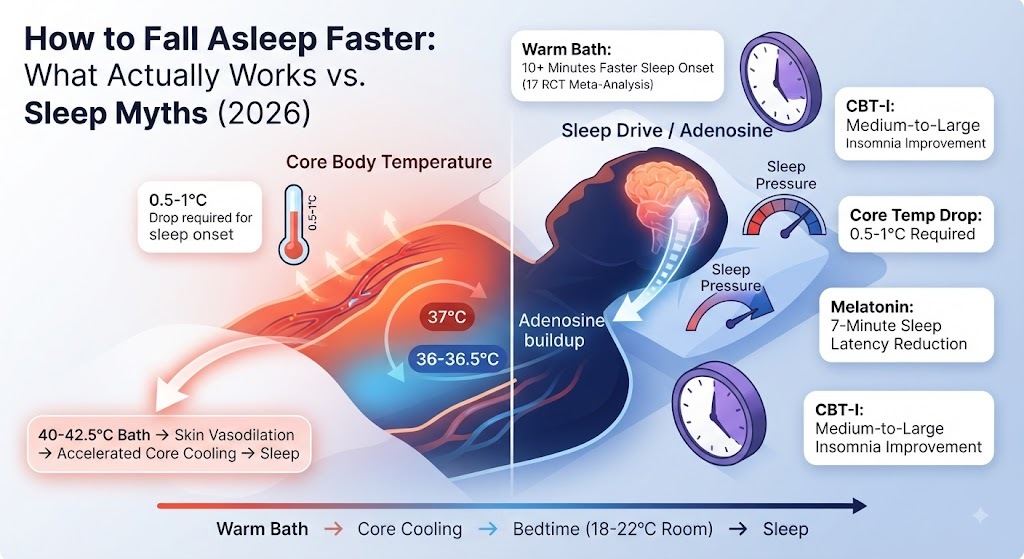
This is one of the more satisfying findings in sleep research, because it’s both genuinely well-supported and almost nobody actually uses it correctly. A 2019 systematic review and meta-analysis in Sleep Medicine Reviews, pooling 13 human trials, found that passive body heating through a warm bath or shower — water temperature between 40–42.5°C (104–108.5°F), for as little as 10 minutes, timed 1–2 hours before bed — reduced sleep onset latency by an average of 36% and improved sleep efficiency.
The mechanism is worth understanding because it explains why timing matters so much: your core body temperature naturally needs to drop to initiate sleep, and warm water immersion triggers increased blood flow to your hands and feet, which paradoxically accelerates that core temperature drop once you get out, through heat dissipation at the skin’s surface. Taking a bath or shower too close to bedtime — right before getting into bed rather than 60–120 minutes earlier — can actually delay sleep instead, since your core temperature is still elevated when you lie down. This is the same body-temperature-regulation principle behind why a genuinely cool bedroom (discussed below) matters as much as it does.
Sleep Hygiene Basics That Still Hold Up
Some of the “obvious” advice is obvious precisely because the evidence behind it is strong and consistent:
- A cool, dark, quiet room. This isn’t an optional enhancement — core body temperature needs to drop to initiate sleep, light suppresses melatonin production, and disruptive sounds interrupt sleep onset even when they don’t fully wake you. Most sleep researchers recommend a bedroom temperature around 65–68°F (18–20°C) as a starting point.
- A consistent wake time, even on weekends, does more for your circadian rhythm than a consistent bedtime does — your body’s clock anchors more strongly to when you wake up and get light exposure than to when you go to bed.
- Limiting stimulating input in the 30–60 minutes before bed — work email, intense news, emotionally charged content — reduces cognitive arousal, which is a real and measurable barrier to falling asleep quickly, separate from the blue-light question specifically.
- Caffeine timing matters more than most people account for, since caffeine has a half-life of roughly 5–6 hours, meaning a 3 p.m. coffee is still meaningfully active in your system at bedtime for many people.
Diet plays a role here too — if blood sugar swings are part of your evening pattern, it’s worth reading alongside our guide to how much protein you actually need, since stable blood sugar across the day supports more consistent sleep onset, not just daytime energy.
The Military Sleep Method: Fact-Checked
This is the technique that dominates sleep-hack content on social media, and it deserves an honest, split verdict rather than a simple yes-or-no.
The claim: a five-step relaxation sequence — relaxing your face and jaw, dropping your shoulders, releasing tension through your arms and legs, exhaling deeply, then clearing your mind for 10 seconds by picturing something calm or repeating “don’t think” — supposedly developed for U.S. Navy pilots, with a widely repeated statistic that 96% of practitioners could fall asleep within two minutes after six weeks of practice.
Here’s the honest fact-check: that statistic traces back to a single 1981 book, Relax and Win, by Olympic coach Bud Winter, and it has never been independently peer-reviewed or replicated in a controlled study. That doesn’t make the technique useless — quite the opposite. Sleep clinicians have pointed out that the individual components are genuinely well-validated: the muscle-relaxation steps are essentially progressive muscle relaxation, a technique with real evidence behind it and one that’s actually used within formal CBT-I programs, and the breathing and mental-imagery components align with established relaxation science. What’s not well-supported is the specific “96% in two minutes” claim, and the honest expectation for most people isn’t a dramatic 2-minute or 10-second result — it’s a genuine, meaningful reduction from a 45-minute sleep onset down to something closer to 10–20 minutes, especially with regular practice.
The realistic takeaway: worth trying, genuinely grounded in real relaxation science, just don’t expect the viral statistic to hold up to scrutiny — and don’t feel like a failure if it doesn’t work by week one, since the original claim itself was based on six weeks of consistent practice, not a single attempt.
What About Melatonin, Magnesium, and Other Sleep Supplements?
Supplements are a common next stop once someone’s tried the basics, and the evidence quality varies a lot by product. Melatonin has real, if modest, evidence for shifting sleep timing — genuinely useful for jet lag or shift work — but weaker evidence for chronic insomnia in people whose circadian rhythm isn’t actually the problem. If you’re curious about magnesium specifically, it’s one of the more commonly recommended sleep supplements, and it’s worth understanding the dosage and evidence properly rather than assuming any form works the same — a topic that overlaps with our look at ashwagandha’s real evidence for sleep and stress, since both supplements get oversold in similar ways online.
If sleep struggles connect to broader anxiety or a racing mind at night, it’s also worth ruling out whether stress hormones are genuinely part of the picture rather than assuming a supplement will fix an underlying pattern — our fact-check on cortisol and what actually lowers it covers the evidence-backed version of that connection.
Putting It Together: A Realistic Nightly Routine
Based on what the research actually supports, here’s a sequence that reflects the real evidence rather than a randomly assembled checklist:
- 90 minutes before bed: Take a warm shower or bath (104–108.5°F, 10+ minutes) to trigger the core-temperature drop that promotes sleep onset
- 60 minutes before bed: Step away from work email, intense news, or emotionally activating content
- 30 minutes before bed: Dim the lights, keep the bedroom cool (65–68°F), and do something calm and low-stimulation — this pairs naturally with the Ayurvedic evening version of a wind-down ritual, even though that guide focuses on mornings specifically
- In bed: If sleep doesn’t come within 20 minutes, get up rather than lying there frustrated — this is stimulus control, the single most evidence-backed piece of CBT-I you can self-apply
- If your mind is racing: Try the muscle-relaxation and breath-focus elements of the military method — genuinely grounded technique, just without the inflated statistic attached to it
When Trouble Falling Asleep Needs More Than a Routine
Occasional difficulty falling asleep is normal and usually responds to the strategies above. It’s worth talking to a doctor or a sleep specialist if you’re experiencing:
- Regular trouble falling or staying asleep for three or more nights a week, lasting longer than three months
- Loud snoring, gasping, or pauses in breathing during sleep (possible signs of sleep apnea)
- Significant daytime impairment — falling asleep unintentionally, serious difficulty concentrating, or safety concerns like drowsy driving
- Sleep difficulty that consistently tracks with anxiety, low mood, or a specific life stressor that isn’t resolving on its own
Chronic insomnia is genuinely treatable — CBT-I in particular has strong, durable evidence — but it usually needs more structure than a nightly routine alone can provide once it’s been going on for months rather than days.
Frequently Asked Questions
What is the fastest scientifically proven way to fall asleep? There’s no single “fastest” method with strong direct evidence for immediate results, but CBT-I techniques — particularly stimulus control — have the strongest overall evidence base for improving sleep onset over time. For a same-night approach, a warm bath or shower 1–2 hours before bed has solid meta-analytic support for meaningfully shortening sleep onset latency.
Does the military sleep method actually work? The individual components (progressive muscle relaxation, breath focus, mental imagery) are grounded in real, validated relaxation science. The specific “96% success in two minutes” statistic, however, comes from a single unreplicated 1981 claim and hasn’t been independently verified in controlled research.
How long before bed should I take a shower to help me sleep faster? Research suggests 1 to 2 hours before bed, for at least 10 minutes, at a water temperature of 104–108.5°F. Showering immediately before getting into bed can actually delay sleep, since your core body temperature is still elevated.
Is melatonin an effective way to fall asleep faster? Melatonin has reasonably good evidence for shifting sleep timing in situations like jet lag or shift work, but weaker evidence for general insomnia where circadian timing isn’t the core issue. It’s not a strong substitute for addressing the behavioral factors CBT-I targets.
What should I do if I can’t fall asleep after 20 minutes in bed? Get up and do something calm and low-stimulation in dim light until you feel drowsy, then return to bed. This is the stimulus control principle from CBT-I, and it’s specifically designed to prevent your brain from associating the bed with wakeful frustration.
The Bottom Line
Learning how to fall asleep faster comes down to working with your body’s actual sleep mechanisms rather than fighting them — dropping your core temperature at the right time, reducing cognitive arousal before bed, and, if you can only take one thing from this guide, understanding that CBT-I’s stimulus control principle (get up if you’re not asleep in 20 minutes) is more evidence-backed than almost anything trending on social media. The warm bath effect is real and underused. The military method’s individual techniques are legitimately useful even though its headline statistic isn’t verified. And if sleep trouble has been a pattern for months rather than an occasional rough night, that’s a signal to bring in real, structured treatment rather than layering on one more nighttime ritual.
This article is for informational purposes only and is not a substitute for personalized medical advice. If sleep difficulty is persistent, severe, or affecting your daily functioning, consult a physician or sleep specialist rather than relying on self-directed techniques alone.






Leave a Reply