
A real patient story and research-backed guidance on how to protect your knees before surgery ever becomes necessary.
If you’ve been searching for home remedies for knee pain, this guide is exactly what you need. Knee pain, stiffness, and discomfort while climbing stairs have become an increasingly common complaint, especially after the age of 35-40. In most cases, this pain isn’t simply a calcium deficiency — it’s a sign that the joint cartilage is gradually wearing down. The encouraging part is that with the right knowledge and a few consistent lifestyle changes, this wear-and-tear process can be significantly slowed, and in many cases, knee replacement surgery can be delayed or even avoided altogether.
A Real Case: Sunita’s Story
During a recent trip to Malaysia, we happened to meet one of our own subscribers — 55-year-old Sunita — who had been struggling with knee pain for a long time. Despite being on medication, she wasn’t finding much relief. Her doctor had told her that her knee cartilage was wearing down, and if left unaddressed, she might eventually need knee replacement surgery. Understandably, this news left her quite anxious — and honestly, that fear wasn’t unfounded.
Why Does Knee Cartilage Wear Out? Understanding The Root Cause
Between the two bones in your knee sits a rubber-like cushion called joint cartilage. It functions much like a car’s shock absorber — just as a shock absorber softens the impact of bumps on the road, cartilage protects your knees from the stress of every step you take.
After the age of 35, this cartilage naturally starts to wear down a little each year, and by the time pain becomes noticeable, considerable internal damage may have already occurred. This is exactly why simply taking calcium supplements often doesn’t make a meaningful difference — the real issue usually isn’t a calcium deficiency, it’s cartilage degeneration. For more background on this, check out our related guide on causes and prevention of joint pain.
Now let’s look at the four practical ways to slow this wear-and-tear process.
1. Turmeric: The Most Overlooked Remedy Sitting In Your Kitchen
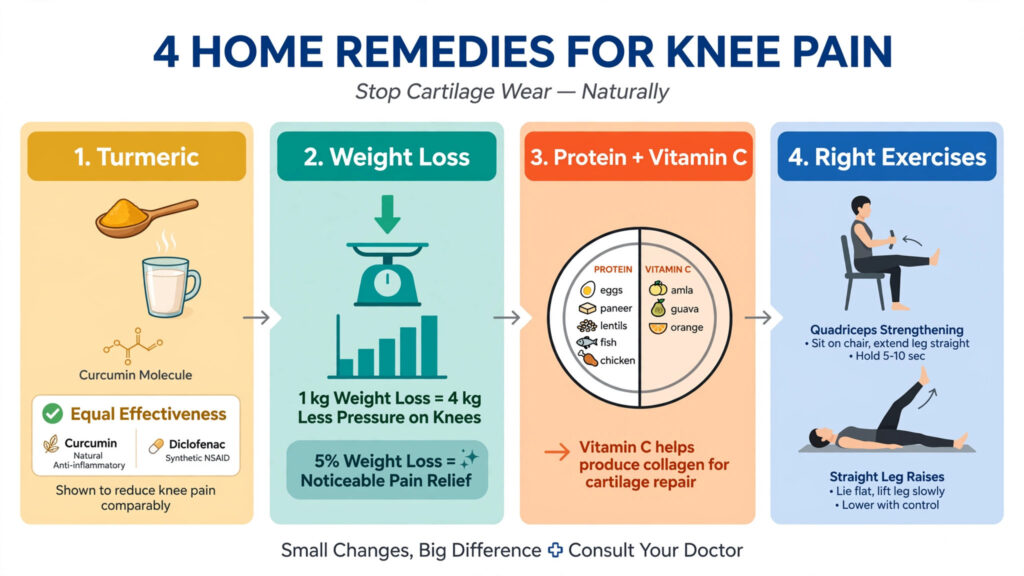
Turmeric contains a compound called curcumin, which helps calm inflammation inside the joints. In one randomized clinical trial, curcumin was compared against diclofenac, a commonly used painkiller, and both showed roughly similar effectiveness in reducing knee pain — while those taking curcumin reported noticeably fewer stomach-related side effects.
How to take it:
- Have a cup of warm milk (or warm water if milk doesn’t suit you) before bed
- Mix in half a teaspoon of turmeric powder and a pinch of freshly ground black pepper
- Optionally, add a little ghee or a few drops of olive oil
- Continue this consistently for 21 days
Important note: If you tend to get acidity or gas easily, take turmeric after a meal rather than on an empty stomach. If you experience excess body heat, live in a hot climate, or deal with mouth ulcers or burning sensations in the hands and feet, keep the turmeric quantity on the lower side, since it has a naturally warming effect. For most healthy individuals, though, it’s completely safe. You can also explore more benefits of this spice in our article on health benefits of turmeric.
2. Losing A Little Weight — The Most Underrated Remedy
This is arguably the single most important step, yet it’s the one people tend to overlook the most. An 18-month clinical study found that for every 1 kg of body weight lost, the load on the knees decreases by roughly four times that amount. In other words, losing just 1 kg means your knees carry 4 kg less pressure with every single step. Multiply that across the thousands of steps we take daily, and the cumulative difference adds up to tonnes of reduced stress over time — and less load directly translates to less wear.
Research also shows that losing just 5% of body weight can produce a measurable, noticeable improvement in knee pain. If you’re carrying a little extra weight, no medication or surgery is likely to help your knees as much as this one change. For a safe, sustainable approach, see our guide on effective weight loss tips.
3. Protein And Vitamin C — The Raw Material Your Cartilage Needs To Repair Itself
The first two remedies help manage pain, but this third one works directly on the root cause — helping the cartilage repair itself from within.
Cartilage, along with the muscles surrounding it, is largely made of protein. If your diet lacks sufficient protein, your body simply doesn’t have the raw material it needs for repair. Make sure to include protein-rich foods such as lentils, paneer, eggs, fish, chicken, or soybeans — whichever suits your diet — on a daily basis.
However, protein alone isn’t enough. Without vitamin C, your body can’t properly produce collagen — the specific protein that forms cartilage. For vitamin C, include amla (Indian gooseberry), guava, and oranges in your diet, or consider a vitamin C supplement after consulting your doctor. For a full list of protein-rich foods, check our high-protein diet guide.
4. The Right Exercises — Movements That Heal, Not Harm, Your Knees
A common misconception is that resting completely and avoiding all movement is the best response to knee pain. In reality, this often makes things worse — movement improves blood circulation around the joints, which helps deliver nutrients to the cartilage and speeds up recovery. That said, not every exercise is safe for painful knees, so here are two low-impact movements you can safely do at home.
Quadriceps Strengthening
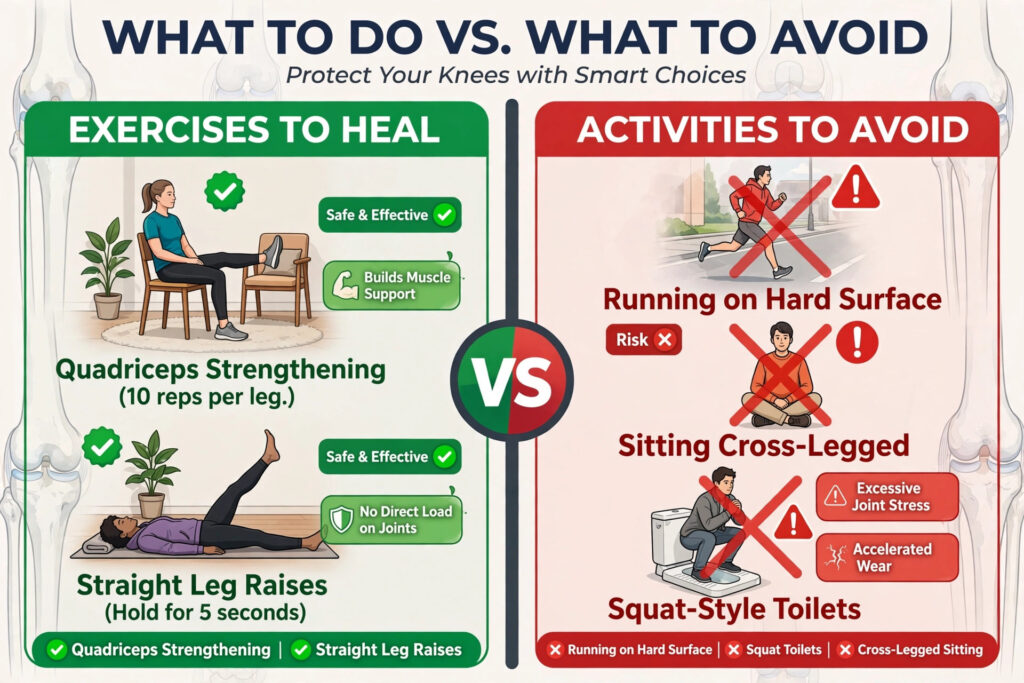
Sit upright in a chair and slowly straighten one leg out in front of you, fully extending the knee. Hold this position for 5 seconds, then slowly bend the knee and lower your foot back down. This strengthens the muscles at the front of your thigh, which in turn provides better support and stability to the knee joint. Repeat 10 times per leg, once a day.
Straight Leg Raises
Lie flat on your back with both legs extended straight out. Keeping one leg fully straight, lift it just 3-4 inches off the ground (no higher), hold for 5 seconds, and lower it slowly.
Neither of these exercises places direct load on the knee joint itself, but both strengthen the supporting muscles around it — making them ideal for anyone already dealing with knee pain or cartilage wear. If your age and circumstances allow, swimming and cycling are also excellent low-impact options, since they strengthen muscles without putting weight-bearing stress on the joints. For more safe options, see our best exercises for joint pain at home.
What To Avoid If You Have Knee Pain
Following the right remedies matters, but avoiding certain habits is just as important. If you experience knee pain, try to steer clear of:
- Running or jogging on hard pavement or concrete floors — opt for grass or softer, uneven ground for walks instead
- Skipping rope or high-impact jumping — this places excessive stress directly on the knee joints
- Frequent stair climbing — use elevators or ramps whenever possible, especially during flare-ups
- Sitting cross-legged for long periods, or sitting on a low stool while bathing
- Using squat-style (Indian) toilets — a western-style toilet places significantly less strain on the knees
The Takeaway: Small Changes, Big Difference
Sunita was given the exact same four recommendations — taking turmeric the right way, losing a modest amount of weight, focusing on protein and vitamin C intake, and doing safe, targeted exercises. Together, these four changes don’t just reduce pain — they can meaningfully slow cartilage wear and help delay or avoid the need for surgery altogether. If you’re dealing with persistent pain or swelling, it’s important to get evaluated by an orthopedic specialist. This article is meant for general information and isn’t a substitute for professional medical advice.
Frequently Asked Questions About Knee Pain Relief
What is the most effective home remedy for knee pain? A combination approach works best: weight management, the correct use of turmeric, a protein and vitamin C-rich diet, and safe strengthening exercises like quadriceps strengthening — used together rather than relying on just one.
Does turmeric really help with knee pain? Yes. Curcumin, the active compound in turmeric, helps reduce inflammation in the joints. Clinical trials have found its effectiveness comparable to common painkillers, though individual results can vary.
How much weight loss is needed to notice a difference in knee pain? Research suggests that losing just 5% of your body weight can produce a measurable improvement in knee pain symptoms.
Should you exercise or rest when you have knee pain? Complete rest can actually be counterproductive. Low-impact exercises like quadriceps strengthening and straight leg raises build supporting muscle strength without putting direct load on the knee joint.
At what age does knee cartilage typically start to wear down? Cartilage generally starts to naturally degrade after age 35, which is why proactive joint care becomes especially important from this age onward.
This article is intended for general informational purposes only and is not a substitute for professional medical advice. If you experience persistent knee pain, swelling, or worsening symptoms, please consult a qualified orthopedic doctor. For more health guides, explore: Causes And Prevention Of Joint Pain, Health Benefits Of Turmeric, Effective Weight Loss Tips, High-Protein Diet Guide, Best Exercises For Joint Pain At Home







Leave a Reply