
Scroll through any wellness feed and you’ll see magnesium described as a near-miracle sleep fix — pop a supplement, sleep like you did as a kid. Magnesium and sleep genuinely are connected, but the honest research picture is considerably more nuanced than the marketing around magnesium supplements tends to suggest, and it’s worth understanding what’s actually been shown versus what’s still being studied before deciding whether this is something worth your attention. This guide walks through what magnesium actually does in the body, what the research genuinely supports about its role in sleep, which forms of magnesium researchers have studied specifically for this purpose, and how to think about food sources versus supplementation without overstating what the evidence currently shows. It’s worth reading alongside our broader guide on what a balanced diet actually looks like, since magnesium is just one piece of a much larger nutritional picture.
What Does Magnesium Actually Do in the Body?
Magnesium is an essential mineral involved in several hundred biochemical processes throughout the body, including muscle and nerve function, blood sugar regulation — the same blood sugar mechanics behind why sugar cravings happen — blood pressure regulation, and protein synthesis. Relevant specifically to sleep, magnesium plays a role in regulating neurotransmitters and the nervous system pathways involved in relaxation and the transition into sleep, along with some involvement in melatonin regulation, the hormone most directly tied to your sleep-wake cycle. This biological plausibility is part of why magnesium’s connection to sleep has drawn genuine, ongoing scientific interest — the mechanism makes sense — but a plausible mechanism and consistently proven clinical benefit are two different things, and it’s worth being clear about which one the current research actually supports.
What Does the Research Actually Show?
This is where it’s worth being genuinely careful rather than repeating the more confident claims you’ll see elsewhere. Observational research has associated higher magnesium levels or intake with better self-reported sleep quality, longer sleep duration, and less daytime exhaustion — but observational association isn’t the same as proof that increasing magnesium intake directly causes better sleep for someone with normal levels to begin with. Correlation research like this can suggest a real relationship, but it can’t rule out other explanations, like people who already sleep well also tending to eat more magnesium-rich whole foods for unrelated reasons.
The stronger form of evidence — randomized, placebo-controlled trials — tells a more mixed story than headlines usually suggest. An older meta-analysis combining several randomized controlled trials in older adults found only a modest improvement in sleep time that didn’t reach statistical significance, and the researchers behind that analysis were fairly blunt about it, concluding the existing evidence at the time was insufficient for doctors to make confident, well-informed recommendations about magnesium for sleep. More recent trials, particularly ones testing specific, more bioavailable forms of magnesium, have shown more promising results on measures like sleep quality and daytime functioning — but these are still generally smaller studies, and it’s worth noting that some have been funded or supported by supplement manufacturers with a direct commercial interest in positive results, which doesn’t necessarily mean the findings are wrong, but is a genuinely relevant detail when weighing how much confidence to place in any single study.
The honest summary: there’s a real, biologically plausible connection between magnesium and sleep, genuine research interest, and some promising newer findings — but it currently falls short of settled, unambiguous proof that supplementation reliably improves sleep for the average person who isn’t magnesium deficient to begin with. Research in this area is actively ongoing, and the picture may well become clearer as more and larger trials are published. This same principle — following what the evidence actually supports rather than the more confident marketing claims — is exactly the approach we took in our guide on protein requirements by age and activity level, where the research similarly doesn’t support some of the more dramatic claims commonly repeated online.
Not All Magnesium Is the Same: Common Forms
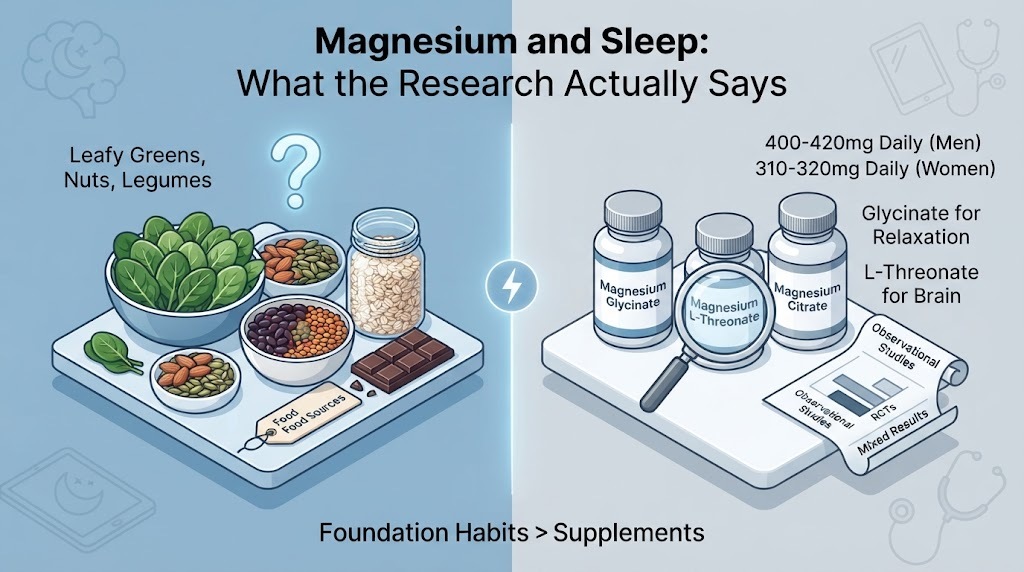
Part of why the research picture looks inconsistent is that “magnesium” isn’t one single thing — different forms have different absorption profiles, and studies testing one form don’t necessarily tell you anything about another. Magnesium citrate is commonly used and reasonably well absorbed, though it’s also associated with a laxative effect at higher doses, which is actually why it’s frequently used specifically for that purpose rather than for sleep. Magnesium glycinate (sometimes called bisglycinate) is often marketed specifically for relaxation and sleep, and has been used in some of the more recent, more promising trials. Magnesium oxide is inexpensive and widely available but is generally less well absorbed than other forms, making it a less efficient choice if the specific goal is raising magnesium levels. Magnesium L-threonate is a newer, more specialized form specifically studied for its ability to cross into the brain more effectively, and it’s the form behind some of the more encouraging recent sleep-specific research, though it also remains less studied overall and considerably more expensive than more common forms. If you’re specifically researching a form for sleep rather than general supplementation, it’s worth knowing which type any given study or product is actually referring to, since the research doesn’t automatically generalize across all of them equally — the same care worth applying to any nutrition claim, including the kind of source-by-source scrutiny we applied in our guide on high-protein vegetarian diet ideas.
How Much Magnesium Do You Need?
General dietary guidelines put adult magnesium needs at roughly 400–420mg per day for men and around 310–320mg per day for women, with the exact figure varying slightly by age and specific health authority — the same kind of general population guideline used for daily fiber targets, which is worth reading alongside this if you’re generally trying to close nutrient gaps through diet. This is a general population guideline, not a personalized recommendation, and it’s worth being clear that this article isn’t suggesting any specific supplemental dose — decisions about supplementation, particularly at doses above what a typical diet provides, are worth discussing with a doctor rather than following generic advice found online, especially for anyone with kidney concerns, since the kidneys are what regulate magnesium levels and impaired kidney function changes how magnesium supplementation should be approached entirely.
Food Sources of Magnesium
Given the genuine uncertainty around supplementation specifically for sleep, getting magnesium through whole foods is a reasonable, low-risk starting point regardless of how the supplement research eventually settles, since these foods bring broader nutritional value along with the magnesium itself. Leafy greens — spinach, Swiss chard — are among the most magnesium-dense whole foods available. Nuts and seeds, particularly almonds, cashews, and pumpkin seeds, contribute meaningful amounts in a small serving. Legumes — black beans, chickpeas, lentils — bring magnesium alongside the fiber and protein benefits already covered in our guides on fiber and why it matters and high-protein vegetarian diet ideas. Whole grains, especially oats and brown rice, retain considerably more magnesium than their refined counterparts. And dark chocolate, in moderation, is a genuinely magnesium-rich food that occasionally gets left off these lists despite being one of the better sources available. A diet built around these whole foods, similar to the structure covered in our guide on what a balanced diet actually looks like, makes hitting adequate magnesium intake fairly straightforward without needing to think about it as a separate, isolated goal.
Magnesium Deficiency and Sleep
Where the research is on genuinely firmer ground is the relationship between actual magnesium deficiency and poor sleep. Since magnesium is involved in nervous system regulation, a genuine deficiency can plausibly disrupt normal sleep patterns, and correcting a real deficiency would reasonably be expected to help. This is a meaningfully different situation from someone with adequate magnesium levels supplementing further in hopes of an additional sleep boost — the research support is considerably stronger for correcting an actual shortfall than for supplementing beyond what’s already sufficient. If you suspect an actual deficiency — which can come with other symptoms beyond just poor sleep, such as muscle cramps or fatigue — that’s a conversation worth having with a doctor, including possible testing, rather than something to self-diagnose from a symptom list and address purely through unsupervised supplementation. Building a genuinely nutrient-dense diet in the first place, along the lines covered in our balanced diet guide, remains the more reliable starting point than reaching for a supplement in response to a single symptom.
Magnesium Isn’t a Substitute for Good Sleep Habits
Even in the most optimistic reading of the current research, magnesium — through food or supplementation — works best as one small piece alongside genuinely foundational sleep habits, not as a replacement for them. Consistent sleep and wake times, a dark and cool sleep environment, reduced screen exposure before bed, and limiting caffeine later in the day all have considerably stronger, more consistent research support than magnesium supplementation does on its own. This connects to a point already covered in our guide on why sugar cravings happen — poor sleep disrupts the hormones that regulate hunger and appetite, which is exactly the kind of foundational sleep-health connection worth prioritizing before looking to any single supplement as a fix.
Should You Take a Magnesium Supplement for Sleep?
This isn’t a question this guide can answer for you individually, and it’s worth being direct about that rather than offering a confident yes or no that the evidence doesn’t actually support either way. What can be said generally: if your diet already includes regular magnesium-rich whole foods — the same fiber-rich legumes, whole grains, nuts, and seeds that show up across most of our nutrition guides — you may already be meeting your needs without any additional supplementation. If you suspect you’re falling short, prioritizing the food sources above is a reasonable, low-risk first step. And if you’re considering a supplement specifically for sleep, particularly at a meaningful dose, that’s a genuinely reasonable thing to discuss with a doctor, who can weigh your individual health history, any medications that might interact with magnesium, and your kidney function — all things a general article like this one simply can’t account for on an individual basis.
Frequently Asked Questions
Does magnesium actually help you sleep better? The research is mixed — there’s a real, biologically plausible connection and some promising newer studies on specific forms, but the evidence isn’t yet strong or consistent enough to call it a proven, reliable sleep aid for everyone.
What’s the best form of magnesium for sleep? Magnesium glycinate and magnesium L-threonate have been used in some of the more recent, more promising sleep-specific studies, though research on both is still relatively limited compared to how widely they’re marketed.
Can I get enough magnesium from food alone? Yes, for most people — leafy greens, nuts, seeds, legumes, whole grains, and dark chocolate together make it fairly achievable to meet general magnesium guidelines through diet alone.
What are signs of magnesium deficiency? Muscle cramps, fatigue, and disrupted sleep can all be associated with deficiency, though these symptoms aren’t specific to magnesium alone, which is exactly why a doctor’s evaluation, rather than self-diagnosis, is the appropriate next step if you suspect a genuine shortfall.
Is it safe to take magnesium supplements every day? For most healthy adults, moderate supplementation is generally considered safe, though anyone with kidney issues or who takes other medications should talk to a doctor first, since magnesium can interact with certain drugs and kidney function directly affects how the body handles it.
How long does it take for magnesium to affect sleep, if it does at all? Studies showing benefits have generally used several weeks of consistent use rather than a single dose, so this isn’t something the research suggests would show an immediate, one-night effect either way.
How HealthMorph Approaches Sleep and Nutrition
At HealthMorph, the goal is always to give you an honest, evidence-grounded picture rather than overselling any single nutrient or supplement as a fix-all — magnesium and sleep is a genuinely good example of a topic where the real research is more nuanced than most headlines suggest. Foundational habits, a balanced diet, and paying attention to how sleep connects to broader patterns like sugar cravings will generally do more for you than any single supplement, magnesium included.
Final Thoughts
Magnesium plays a genuine, biologically plausible role in sleep regulation, and the research interest in this area is real and ongoing — but the current evidence, taken honestly, supports “promising and worth further study” more than it supports “proven sleep fix.” Whole-food sources are a reasonable, low-risk way to support adequate intake regardless of how the supplement research eventually settles, and any decision about supplementing beyond diet, especially at a meaningful dose, is worth making alongside a doctor rather than based on a single article or product claim.
(Note: this article covers general research information and isn’t a substitute for personalized medical advice — anyone considering magnesium supplementation, particularly for a specific health concern, should consult a doctor. The healthmorph.com URLs above are placeholder slugs based on the prior HealthMorph articles drafted in this conversation.)







Leave a Reply