Red light therapy has gone from a niche clinical treatment to something you can buy as a $200 face mask on Amazon, and the marketing hype has outpaced the science in a lot of places online. This guide takes the opposite approach: instead of listing every benefit anyone has ever claimed for red light therapy, it breaks down what’s actually well-supported by research, what’s promising but still early, and what you should treat with real skepticism — so you can make a genuinely informed decision, not just a hopeful one.
What Red Light Therapy Actually Is
Red light therapy — also called photobiomodulation (PBM) or low-level laser therapy (LLLT) — exposes your skin and underlying tissue to specific wavelengths of red and near-infrared light, delivered through an LED panel, mask, laser, or bed. Unlike tanning beds, it doesn’t use UV light, and unlike a laser used for cutting or ablation, the light intensity is too low to burn or damage tissue. It doesn’t hurt, and it doesn’t heat your skin the way an infrared sauna does — those are genuinely different technologies that get confused with each other constantly.
The proposed mechanism is fairly specific: red and near-infrared light is absorbed by cytochrome c oxidase, an enzyme inside your cells’ mitochondria, which appears to boost the mitochondria’s production of ATP — the energy your cells run on. More cellular energy, the theory goes, means better capacity for repair, reduced inflammation, and improved local circulation through nitric oxide release. This mechanism gives red light therapy a genuinely plausible biological basis, which is part of why it’s taken more seriously in dermatology and pain research than a lot of other wellness trends — but plausible mechanism and proven clinical benefit are two different things, and it’s worth keeping them separate as you read the evidence below.
Wavelength Actually Matters More Than Marketing Claims
Before getting into what red light therapy can and can’t do, it’s worth understanding why not all “red light” devices are equal. Two wavelength ranges do most of the therapeutic work:
- 630–670nm (visible red light) penetrates roughly 1 to 2 cm into tissue, making it well-suited for skin-level effects — collagen, wound healing, and surface inflammation.
- 800–850nm (near-infrared, invisible to the eye) penetrates considerably deeper, roughly 3 to 5 cm, reaching muscle, joints, tendons, and even bone.
Wavelengths under 630nm generally show limited therapeutic effect, and wavelengths above roughly 1000nm are mostly absorbed as heat rather than triggering the photobiomodulation mechanism described above. This matters practically: a cheap LED strip glowing red doesn’t necessarily deliver a therapeutic dose just because it looks the part. Irradiance — the actual light output at the skin’s surface, usually measured with a spectrometer — matters more than the wattage number printed on a box, since wattage describes electrical draw, not delivered light energy. If you’re evaluating an at-home red light therapy device, look for published irradiance figures at the wavelengths studied in research, not just marketing claims about power.
Where the Evidence for Red Light Therapy Is Genuinely Strong
Skin, Collagen, and Wrinkles — Moderate, Fairly Well-Studied Evidence
This is one of the better-researched applications of red light therapy. A randomized controlled trial published in Photomedicine and Laser Surgery found that participants treated with 633nm light showed measurable improvements in skin complexion, roughness, and collagen density — verified by ultrasound, not just visual assessment — after a few weeks of consistent treatment. A separate 2014 study in Dermatologic Surgery found that combined 660nm and 830nm light significantly improved periorbital wrinkles and skin texture compared to a sham treatment. Research also supports its use for improving signs of sun damage and, in some studies, acne. If you’re specifically researching skin and anti-aging treatments, red light therapy is genuinely one of the more evidence-backed non-invasive options available, though sustained use over weeks to months is typically what studies actually measured — not a one-time treatment.
Joint Pain, Muscle Recovery, and Tendinopathy — Moderate Evidence
Clinical trials on photobiomodulation for joint conditions including osteoarthritis, fibromyalgia, and some chronic muscle and nerve pain show moderate-quality evidence of benefit, with effects linked to reduced inflammatory markers and improved local blood flow. A review of 17 clinical trials specifically on tendinopathy — a painful, function-limiting tendon condition — found low-to-moderate quality evidence that red light therapy can help relieve pain and improve function. This is a meaningfully positive result for a condition that’s often difficult to treat, though “low-to-moderate quality” is an important qualifier — it means the trials showed a real signal, but weren’t always large or rigorously controlled enough to call the case fully settled. If chronic pain management is what brought you here, our joint pain relief guide covers how red light therapy compares against other non-drug pain management approaches.
Hair Growth — Moderate Evidence, FDA-Cleared for a Specific Condition
Multiple reviews of red light therapy for androgenic alopecia (genetic pattern hair loss) — including one review pooling 11 separate studies — found improvements in both hair density and thickness with consistent use. This is strong enough evidence that FDA-cleared photobiomodulation devices exist specifically for this condition, which is a meaningfully higher bar than most wellness claims clear. If hair thinning is your specific concern, our hair loss treatment options page covers where red light therapy fits alongside other evidence-based approaches.
Wound Healing and Cancer-Treatment Side Effects — Clinically Recognized, Narrow Use Cases
Red light therapy has real, clinically supported utility for managing certain side effects of cancer treatment, such as oral mucositis, and shows moderate support for general wound healing. This is a good example of why nuance matters: it’s a legitimate, clinically useful tool in these specific contexts — but it is not a cancer treatment or cure, and no credible practitioner or study suggests otherwise. Be wary of any marketing that blurs this distinction.
Where the Evidence Is Weaker — Treat These Claims With Real Skepticism
Not every claim attached to red light therapy holds up equally well. Weight loss, cognitive enhancement, and hormone optimization are all claims you’ll see attached to red light therapy products, and the supporting evidence for these specific outcomes is considerably weaker and less consistent than the skin, pain, and hair research above. Some early research has explored red light and near-infrared light for mood support, including in combination with other depression treatments, but this remains an early-stage area, not an established clinical application. If a product page leans heavily on these claims without citing specific trial data, that’s a reasonable signal to be more skeptical of everything else the page tells you too.
It’s also worth being upfront that there isn’t full consensus across the scientific community on red light therapy’s overall benefit profile. The field has thousands of published studies at this point, but study quality varies considerably — small sample sizes, inconsistent protocols, and industry-funded research are all common limitations worth keeping in mind as you weigh any individual claim.
Is Red Light Therapy Safe?
Generally, yes, for most people, when used as directed. Red light therapy doesn’t involve UV exposure, doesn’t burn or heat the skin meaningfully, and is considered non-invasive and drug-free. That said, “generally safe” isn’t the same as “appropriate for everyone in every situation.” If you’re pregnant, have a light-sensitivity condition, are taking photosensitizing medication, or have an active skin condition you haven’t had evaluated, it’s worth checking with a doctor or dermatologist before starting — particularly before using an at-home device without professional guidance. If you’re unsure whether a specific skin or health concern warrants a home device versus a clinical visit, our guide on when to see a dermatologist can help you think through that decision.
Home devices are also generally less powerful than the equipment used in clinical or dermatology-office settings, which is worth factoring into your expectations — a home mask or panel may take longer to show results than a treatment protocol you’d receive in a clinical setting, simply due to the difference in output.
How to Actually Use Red Light Therapy
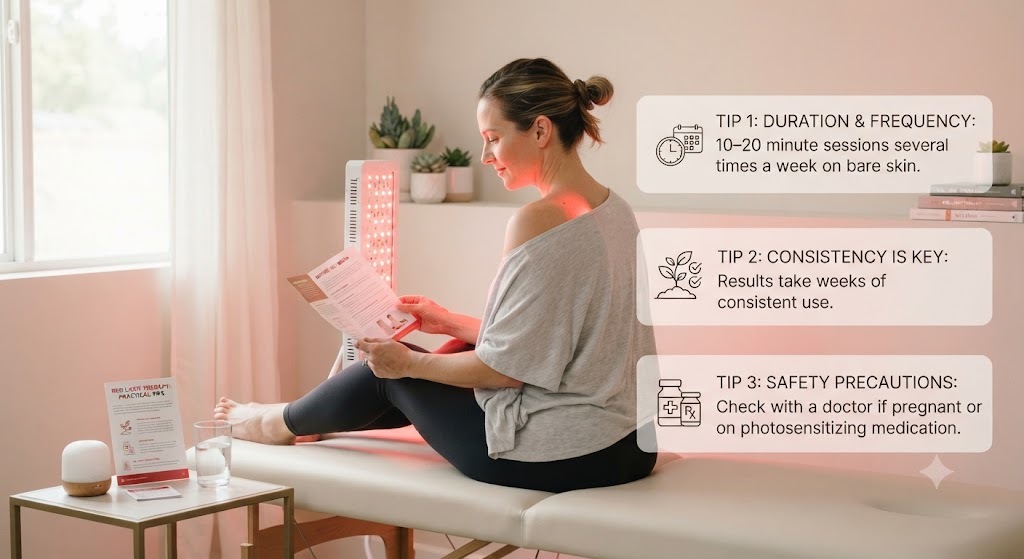
Most research protocols involve sessions of roughly 10 to 20 minutes, several times a week, applied directly to bare skin — clothing, even thin fabric, meaningfully reduces how much light actually reaches your tissue, though near-infrared wavelengths penetrate slightly better through fabric than visible red light does. Results in skin studies typically became measurable after several weeks of consistent use rather than after a single session, which is a useful expectation to set going in: this is a cumulative treatment, not a one-time fix.
The Bottom Line
Red light therapy has a genuinely plausible biological mechanism and real, moderate-quality clinical evidence behind several specific applications — skin rejuvenation, certain types of joint and tendon pain, and hair density in androgenic alopecia are the strongest-supported use cases. Broader claims around weight loss, cognitive performance, and hormone optimization are considerably less substantiated and deserve a more skeptical read. If you’re considering red light therapy for one of the well-supported applications, prioritize devices with published, wavelength-specific irradiance data over marketing claims, be realistic about home-device power compared to clinical equipment, and give it the several weeks of consistent use that the actual research protocols used before judging whether it’s working for you.
Frequently Asked Questions
Does red light therapy actually work, or is it just a wellness trend? For specific applications — skin rejuvenation, certain joint and tendon pain conditions, and hair density in androgenic alopecia — there’s genuine moderate-quality clinical evidence of benefit. For broader claims like weight loss or cognitive enhancement, the evidence is considerably weaker and shouldn’t be treated with the same confidence.
Is red light therapy safe to use at home? Generally yes for most people, since it doesn’t involve UV exposure and doesn’t burn the skin. However, anyone who is pregnant, taking photosensitizing medication, or managing an active skin condition should check with a doctor or dermatologist before starting home use.
How long does it take to see results from red light therapy? Most clinical studies measuring skin improvements showed results after several weeks of consistent treatment, not after a single session. Treat it as a cumulative therapy rather than an instant fix.
What’s the difference between red light and near-infrared light therapy? Visible red light (roughly 630–670nm) penetrates about 1–2cm and works best for skin-level effects. Near-infrared light (roughly 800–850nm) penetrates deeper, around 3–5cm, and is better suited for muscle, joint, and tendon applications.
Can red light therapy replace medical treatment for a health condition? No. It has clinically recognized supporting roles in specific contexts, such as managing certain cancer-treatment side effects, but it is not a substitute for medical treatment or a cure for underlying conditions. Always consult a healthcare provider for diagnosis and treatment of any medical condition.
This article is for informational purposes only and is not a substitute for professional medical advice, diagnosis, or treatment. Always consult a qualified healthcare provider before starting any new therapy, especially if you are pregnant, managing a medical condition, or taking medication.







Leave a Reply