
Last Updated: August 2026
Quick Answer
Intermittent fasting and Ayurveda align on several core principles — both value giving your digestive system real rest between meals, eating within a consistent daily window, and not eating late at night. Where they diverge is nuance: Ayurveda cares deeply about what, when, and how you break your fast, and it treats fasting as something that should be adjusted to your individual constitution (dosha), not applied the same way to everyone. Combined thoughtfully, intermittent fasting and Ayurveda can complement each other well — but combined carelessly, an aggressive fasting window layered onto an already-depleting lifestyle can backfire, especially for women’s hormonal health.
Why I Started Digging Into This
I came to intermittent fasting the way a lot of people do — through fitness content promising better focus, fat loss, and “metabolic reset.” It worked reasonably well for a while, and then it didn’t. I started feeling wired but tired, my sleep got worse, not better, and a friend who’s been studying Ayurveda for years gently pointed out that I was fasting in a way that completely ignored what Ayurveda has said about eating rhythms for centuries. That conversation sent me down a genuinely useful rabbit hole: how do intermittent fasting and Ayurveda actually relate to each other, and where do they agree or conflict?
This article is what I found — not a hype piece for either approach, but an honest look at where they overlap, where they don’t, and what I’d actually tell a friend considering combining the two.
What Intermittent Fasting Actually Is
Intermittent fasting (IF) is an eating pattern that cycles between periods of eating and periods of not eating, rather than dictating what you eat. The most commonly used pattern is a 16:8 window — eating within an 8-hour stretch of the day and fasting for the remaining 16 hours, including overnight sleep. Other variations exist (14:10, alternate-day fasting, 5:2), but 16:8 is by far the most widely adopted starting point, largely because it fits naturally around skipping breakfast or having an early dinner.
The appeal is mostly about simplicity — no calorie counting, no food restrictions, just a defined eating window. Some people also find it genuinely easier to stick to than traditional dieting, since there’s no daily decision fatigue about what to eat, only when.
What Ayurveda Actually Says About Fasting
This is where things get more interesting than most “intermittent fasting and Ayurveda” content online actually covers. Ayurveda has practiced fasting, or upavasa, for thousands of years — but it was never treated as a universal, one-size-fits-all protocol. Ayurveda’s approach to eating centers on agni, your digestive fire, and the idea that eating (and fasting) should support strong, consistent digestion rather than stress it.
A few Ayurvedic principles that matter a lot here:
- Eating with the sun’s rhythm — a substantial meal at midday when digestive fire is naturally strongest, and a lighter meal well before sunset, rather than a heavy dinner late at night. This lines up closely with our guide on Dinacharya, the Ayurvedic daily routine, which covers this rhythm in more depth beyond just fasting.
- Dosha-specific guidance — Ayurveda holds that fasting suits some constitutions better than others. A Vata-dominant person (naturally lighter, more prone to anxiety and irregular digestion) is generally cautioned against aggressive or prolonged fasting, since it can aggravate an already unstable system. A Kapha-dominant person (naturally heavier, slower metabolism) often tolerates fasting better and may even benefit more noticeably.
- How you break a fast matters as much as the fast itself — Ayurveda places real emphasis on easing back into eating with warm, easily digestible food, rather than breaking a fast with something heavy, cold, or hard to digest.
Where Intermittent Fasting and Ayurveda Genuinely Align
I went into this expecting more conflict between the two than I actually found. The real overlap:
- Both value digestive rest. Ayurveda has long emphasized giving digestion a break between meals rather than constant grazing — which is functionally very similar to the core premise of intermittent fasting.
- Both discourage late-night eating. An early, lighter dinner is standard Ayurvedic advice and also happens to align naturally with a time-restricted eating window that closes in the evening.
- Both value consistency over extremes. Neither tradition, done properly, endorses erratic, unpredictable eating patterns — both favor a steady, repeatable daily rhythm.
Where They Genuinely Disagree
- Ayurveda is far more individualized. Mainstream intermittent fasting content tends to treat 16:8 as broadly appropriate for most people. Ayurveda would push back hard on that, arguing that a Vata-dominant person, someone under significant stress, or someone with irregular digestion may do worse, not better, on an aggressive fasting window.
- Ayurveda cares about seasonal timing. Fasting during naturally lighter, warmer seasons is generally considered more appropriate than fasting during colder months when the body’s needs shift, a nuance most intermittent fasting guidance completely ignores.
- Women’s cycles matter more in Ayurveda’s framing. This is genuinely one of the more important points I found. Ayurveda is cautious about aggressive or prolonged fasting for women, particularly around menstruation, pregnancy, and breastfeeding, given fasting’s potential effect on hormonal balance. Modern research on intermittent fasting and women’s hormonal health is still evolving, but plenty of women report exactly this experience — that a fasting window that works fine for their partner doesn’t sit well with their own cycle.
A More Ayurvedic Way to Approach Intermittent Fasting
If you want to genuinely combine intermittent fasting and Ayurveda rather than just doing standard IF with an Ayurvedic label on it, here’s what I’d actually adjust:
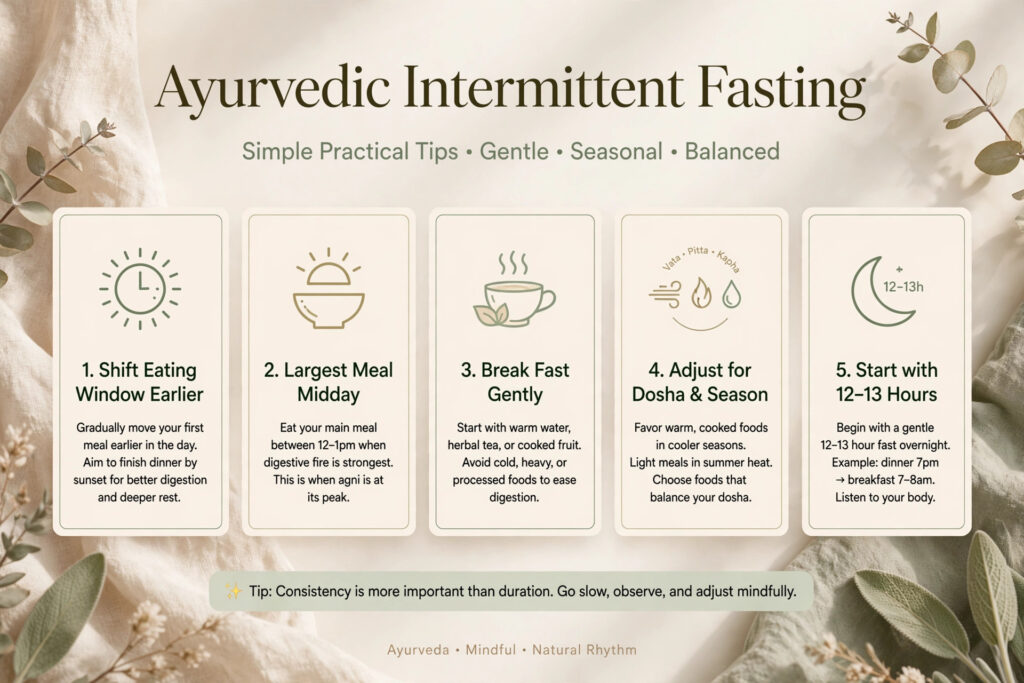
- Shift your eating window earlier, not later. Instead of the common “skip breakfast, eat until 8 PM” pattern, an Ayurvedic-aligned window front-loads eating earlier in the day and closes well before sunset — closer to a 10 AM to 6 PM window than a midday-to-evening one.
- Make your largest meal midday, not at night. This matches when digestive fire is naturally strongest, rather than saving your biggest meal for a fasting-window dinner.
- Break your fast gently. Warm, cooked, easily digestible food — not a large, cold, or heavy meal — eases digestion back into gear more comfortably.
- Pay attention to your own constitution and cycle, not just the clock. If you’re naturally more anxious, prone to irregular digestion, under high stress, or navigating a hormonally sensitive period, a shorter or more flexible fasting window is more in line with Ayurvedic caution than pushing through a rigid 16:8 regardless of how you feel.
- Treat the season as a variable. Lighter fasting in warmer months, more flexibility and nourishment in colder ones, rather than a fixed year-round protocol.
Who Should Be Cautious About Combining the Two
- Anyone with a history of disordered eating should approach any structured eating-window protocol carefully, ideally with professional guidance, since fasting rules can sometimes reinforce restrictive patterns.
- Pregnant or breastfeeding women — Ayurveda is explicitly cautious here, and most fasting research excludes this group entirely, so it’s not the time to experiment.
- People managing diabetes or blood sugar conditions — fasting affects blood sugar regulation directly and should only be adjusted under medical supervision.
- Anyone with a diagnosed digestive condition should talk to a doctor before adopting either approach, since both fasting and Ayurvedic dietary changes can interact with existing conditions in ways worth discussing first. If digestion has been a recurring issue for you generally, our guide on digestion and nutrient absorption covers related ground, even outside a fasting context.
What I’d Actually Recommend
Start slower than most intermittent fasting content suggests, and pay closer attention to how you actually feel than to hitting a specific number of fasting hours. A 12-13 hour overnight fast (essentially just not eating between an early dinner and a reasonably timed breakfast) is a genuinely gentle starting point that aligns with Ayurvedic timing principles, without jumping straight to a more aggressive window. If that feels good after a few weeks, extending gradually makes more sense than starting at 16:8 and forcing your way through discomfort.
If stress is a bigger underlying issue for you than food timing, that’s worth addressing directly too — our piece on walking for anxiety covers one simple, low-risk way to bring overall stress down, which matters more for digestion and hormonal balance than most fasting protocols acknowledge.
Final Thoughts
Intermittent fasting and Ayurveda aren’t opposites, and they aren’t a perfect match either — they’re two frameworks that overlap significantly on the basics (digestive rest, consistent timing, no late-night eating) while genuinely disagreeing on how individualized the approach needs to be. My honest take after digging into both: the Ayurvedic emphasis on adjusting to your own constitution, cycle, and season is a genuinely useful corrective to how rigidly intermittent fasting gets marketed online. If you’re going to try combining the two, start gentle, pay attention to how your body actually responds, and don’t force a protocol that isn’t working just because it’s “supposed to.”
For more on Ayurvedic approaches to daily rhythm and natural wellness, our Natural Remedies & Ayurveda section covers related topics in more depth, and our Nutrition & Diet section has more on building sustainable eating habits generally.
Frequently Asked Questions
Can I follow intermittent fasting and Ayurveda principles at the same time? Yes, in many cases they complement each other well, since both value digestive rest, consistent timing, and avoiding late-night eating. The main adjustment is shifting your eating window earlier in the day and paying attention to your individual constitution rather than following a rigid, one-size-fits-all fasting schedule.
Does Ayurveda recommend intermittent fasting for everyone? No. Ayurveda treats fasting as something to individualize based on your dosha, current health, stress levels, and even the season, and it specifically cautions certain constitutions and situations — like pregnancy or a Vata-dominant nature — against aggressive fasting.
Is intermittent fasting safe for women’s hormonal health? This varies by individual, and research is still evolving. Ayurveda is notably cautious about aggressive or prolonged fasting for women, particularly around menstruation, pregnancy, and breastfeeding, and many women report needing a gentler approach than standard fasting guidance suggests.
What’s the best time to eat according to Ayurveda if I’m doing intermittent fasting? Ayurveda favors an earlier eating window, with the largest meal at midday when digestive fire is considered strongest, and a lighter meal finished well before sunset, rather than a fasting window that ends with a late dinner.
Should I start with a 16:8 fasting window if I’m new to this? Not necessarily. A gentler starting point, such as a 12-13 hour overnight fast, aligns more closely with Ayurvedic timing principles and gives your body time to adjust before considering a longer fasting window.
This article is for general informational purposes and reflects common lifestyle and traditional wellness practices. It is not medical advice. Please consult a qualified doctor before starting intermittent fasting, especially if you’re pregnant, breastfeeding, managing diabetes or another health condition, or have a history of disordered eating.







Leave a Reply