
If you’ve ever stood in the supplement aisle staring at a wall of fish oil bottles wondering whether any of it actually does anything, you’re not alone. The omega-3 benefits you’ve heard about — sharper thinking, a healthier heart, less joint pain — aren’t just supplement-industry marketing. They’re backed by decades of nutrition research on two specific fatty acids: EPA (eicosapentaenoic acid) and DHA (docosahexaenoic acid). And here’s the part that surprises most people: recent global research suggests that more than three out of four people on the planet simply aren’t getting enough of them, even in wealthy countries with easy access to seafood and supplements.
This isn’t a “take more of everything” story. It’s a “you’re probably missing one specific nutrient family” story — and once you understand what EPA and DHA actually do in your body, the reasons to close that gap become pretty hard to ignore. If you’re also looking into related nutrients, our guide on Vitamin D benefits and deficiency signs pairs well with this one, since the two are often deficient together.
What Is Omega-3, Exactly? (ALA vs. EPA vs. DHA)
Omega-3 fatty acids are a family of polyunsaturated fats your body cannot make on its own — you have to get them from food or supplements. There are three main types worth knowing:
- ALA (alpha-linolenic acid) — found in plant sources like flaxseed, chia seeds, walnuts, and soybean oil. It’s a “precursor” fat, meaning your body can theoretically convert it into EPA and DHA, but the conversion rate is inefficient — often under 10%.
- EPA (eicosapentaenoic acid) — found mainly in fatty fish and fish oil. Known for its role in reducing inflammation and supporting cardiovascular and mental health.
- DHA (docosahexaenoic acid) — also found in fatty fish and algae oil. It’s a structural building block of brain tissue, the retina, and cell membranes throughout the body.
This is why nutrition scientists usually talk about “EPA + DHA” as the real target, rather than total omega-3 intake. ALA matters, but it isn’t a reliable substitute for the long-chain forms your organs actually use.
EPA vs. DHA: What’s the Real Difference?
People often assume EPA and DHA are interchangeable. They’re related, but they specialize in different jobs:
| Fatty Acid | Primary Role | Best Known For |
|---|---|---|
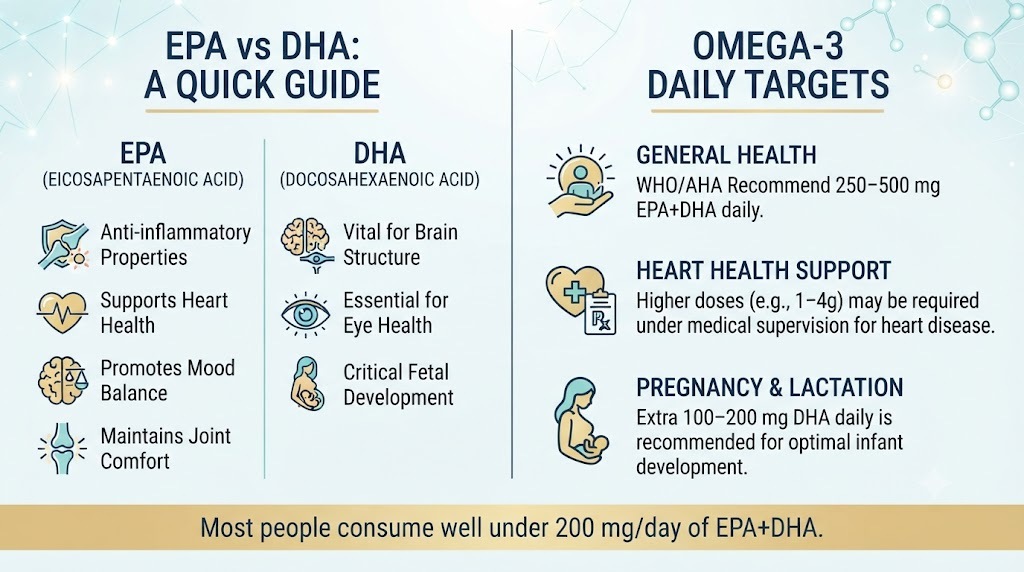
| EPA | Anti-inflammatory signaling, mood regulation | Heart health, joint comfort, mental wellness |
| DHA | Structural component of cell membranes | Brain function, eye health, fetal development |
In practice, most quality fish oil and algae oil supplements contain a blend of both, because the body uses them together rather than in isolation. If you’re comparing supplement labels, our breakdown of how to read a supplement facts panel can help you figure out the EPA-to-DHA ratio that fits your goals.
The Real, Research-Backed Omega-3 Benefits
1. Cardiovascular and Heart Health
This is where the omega-3 research base is deepest. A 2020 review of 86 studies involving 162,796 people found that increasing EPA and DHA slightly reduced the risk of coronary events and coronary death. A separate 2019 analysis of 13 major omega-3 supplementation studies covering 127,477 participants showed that marine omega-3 supplementation lowered the risk of heart attack, coronary heart disease death, and total coronary heart disease. The proposed mechanisms include improvements in triglycerides, blood pressure, endothelial function, and reduced platelet clumping — all contributors to long-term cardiovascular disease risk.
2. Brain Function and Cognitive Health
DHA makes up a significant portion of the fatty acid content in the brain’s gray matter, which is why researchers have linked adequate omega-3 status to better cognitive performance and a potentially reduced risk of age-related cognitive decline. This is also why prenatal and infant nutrition guidelines place such heavy emphasis on DHA — it’s directly tied to the developing brain and visual system.
3. Mental Health and Mood
EPA, in particular, has been studied for its role in mood regulation. Omega-3 status has been associated in research with lower rates of anxiety and depressive symptoms, likely tied to its anti-inflammatory effects, since chronic low-grade inflammation is increasingly linked to mood disorders.
4. Joint Comfort and Inflammation
Because EPA and DHA are converted into signaling molecules that actively resolve inflammation (rather than just blocking it), regular omega-3 intake is commonly associated with reduced joint stiffness and improved comfort, particularly for people managing inflammatory joint conditions.
5. Eye Health
DHA is heavily concentrated in the retina. Adequate intake supports normal visual development in infants and is being studied for its role in age-related eye health in adults.
6. Pregnancy and Early-Life Development
Because DHA accumulates rapidly in the fetal brain during the third trimester, most international nutrition bodies recommend an additional 100–200 mg of DHA per day during pregnancy on top of the standard adult intake target.
7. Healthy Aging and Longevity Markers
Higher omega-3 tissue levels have been associated in long-term cohort studies with lower rates of all-cause mortality, likely reflecting the cumulative cardiovascular and anti-inflammatory benefits described above rather than a single standalone mechanism.
If you’re building out a broader wellness routine, it’s worth reading our related piece on anti-inflammatory foods and lifestyle habits, since diet and omega-3 status tend to move together.
Signs You Might Not Be Getting Enough Omega-3
Deficiency isn’t always dramatic, but common signals include:
- Dry, flaky skin or brittle nails
- Joint stiffness that seems disproportionate to activity level
- Difficulty concentrating or mild “brain fog”
- Low mood without an obvious cause
- Dry eyes
- Rarely eating fatty fish (less than twice a week)
None of these are diagnostic on their own, but taken together — especially in someone who eats little to no seafood — they’re a reasonable prompt to look at intake.
How Much Omega-3 Do You Actually Need Per Day?
This is where a lot of confusion comes from, because recommendations vary by organization. Here’s the current landscape:
- The World Health Organization advises a combined daily intake of 250–500 mg of EPA and DHA for general health, particularly cardiovascular health.
- The American Heart Association recommends a similar 250–500 mg per day for healthy adults, with higher doses of 1,000 mg or more suggested for people with existing cardiovascular disease, under medical supervision.
- The European Food Safety Authority recommends 250 mg per day of combined EPA and DHA to support normal heart function.
- A recent global review found the most frequently recommended intake across national guidelines was 250 mg per day of EPA plus DHA, with an additional 100–200 mg per day of DHA recommended during pregnancy.
The catch: typical global intake sits well below 200 mg of EPA plus DHA per day, and intake is especially limited among vegans and vegetarians who don’t eat fish. That gap is exactly why the search interest in “omega-3 benefits” keeps climbing — people are realizing the average diet quietly underdelivers on this nutrient.
For a more personalized target, some functional medicine practitioners use the omega-3 index — a blood test measuring EPA and DHA as a percentage of total fatty acids in red blood cells — rather than relying on generic daily targets. It’s a more precise way to see where you actually stand rather than guessing from food logs.
Best Food Sources of Omega-3
Marine Sources (EPA + DHA)
- Salmon
- Mackerel
- Sardines
- Anchovies
- Herring
- Trout
- Oysters
Plant Sources (ALA only)
- Flaxseed and flaxseed oil
- Chia seeds
- Walnuts
- Hemp seeds
- Soybean and canola oil
Algae-Based Sources (EPA + DHA, plant-based)
- Algal oil supplements — currently the only significant vegan source of true EPA and DHA, not just the ALA precursor.
Federal dietary guidelines recommend adults eat roughly 8 ounces of a variety of seafood per week, which corresponds to an average daily intake of about 250 mg of EPA and DHA — a useful mental benchmark if you’d rather eat your way to the target than supplement it.
Fish Oil vs. Krill Oil vs. Algae Oil: Which Supplement Is Best?
| Supplement Type | Source | Best For | Notes |
|---|---|---|---|
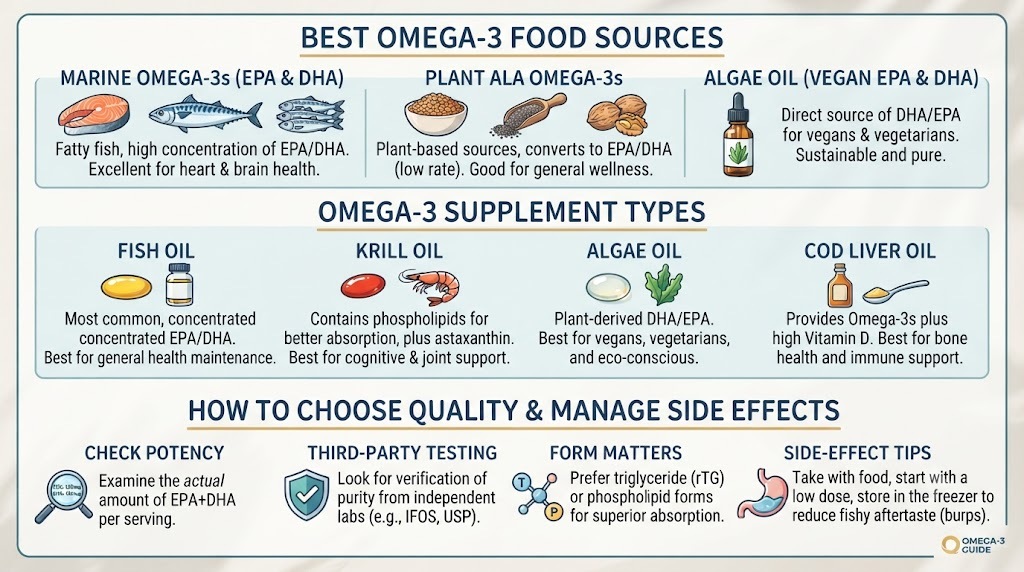
| Fish oil | Fatty fish | Most people, budget-conscious buyers | Widely studied, generally well-tolerated |
| Krill oil | Krill (small crustaceans) | Those wanting better absorption | Phospholipid-bound, may absorb more efficiently, higher cost |
| Algae oil | Marine algae | Vegans, vegetarians, those avoiding fish | Only source of true EPA + DHA without fish |
| Cod liver oil | Cod fish liver | Those also wanting vitamin A and D | Higher fat-soluble vitamin content — watch total vitamin A intake |
How to Choose a High-Quality Omega-3 Supplement
- Check the EPA + DHA amount, not just “fish oil 1000mg.” A 1,000 mg fish oil capsule might only contain 300 mg of actual EPA and DHA — the rest is other fats.
- Look for third-party testing (IFOS, USP, or NSF certification) to confirm purity and low oxidation.
- Choose triglyceride or phospholipid form over ethyl ester form when possible — absorption tends to be better.
- Store it properly. Omega-3 oils oxidize easily; keep capsules away from heat and light, and discard anything with a strong “fishy” or rancid smell.
- Match the dose to your goal. General wellness sits around 250–500 mg/day; higher therapeutic doses should be discussed with a healthcare provider.
For a deeper look at supplement quality standards generally, see our guide on how to evaluate supplement third-party testing.
Possible Side Effects and Precautions
Omega-3 supplements are generally well tolerated, but a few things are worth knowing:
- Fishy aftertaste or mild digestive upset is the most common complaint — often improved by taking the supplement with food or choosing an enteric-coated capsule.
- Blood-thinning effect at high doses. If you’re on anticoagulant medication or scheduled for surgery, talk to your doctor before starting high-dose omega-3s.
- Mercury and contaminant exposure is a valid concern with some fish oils; third-party testing largely addresses this.
- Vitamin A toxicity risk with cod liver oil specifically, if taken in excess, due to its naturally high vitamin A content.
This article is for general education and isn’t a substitute for personalized medical advice — if you have a cardiovascular condition, are pregnant, or take prescription medication, check with your doctor before starting any new supplement.
The Bottom Line
The omega-3 benefits backed by research — heart protection, brain support, mood stability, joint comfort — are real, but they hinge almost entirely on actually getting enough EPA and DHA, not just any fat labeled “omega-3.” Given how far short most diets fall of even the modest 250–500 mg/day targets set by major health organizations, this is one of the few supplement categories where the science-to-hype ratio is genuinely favorable. Start with your plate — a couple of servings of fatty fish per week — and use a quality fish oil or algae oil supplement to close the rest of the gap.
Frequently Asked Questions
1. What is the difference between omega-3 and fish oil? Omega-3 is the broader category of fatty acids (ALA, EPA, DHA). Fish oil is simply one delivery source of the EPA and DHA forms of omega-3 — it’s a supplement, not a separate nutrient.
2. How long does it take to see omega-3 benefits? Blood markers like triglycerides can shift within 4–8 weeks of consistent intake. The omega-3 index (a tissue-level measure) typically takes around 4 months to fully stabilize at a new intake level, since red blood cells turn over roughly every 120 days.
3. Can you get enough omega-3 from diet alone? Yes, if you eat fatty fish two to three times per week. In practice, most people don’t eat fish that often, which is why supplementation is common even among people who otherwise eat well.
4. Is it better to take omega-3 in the morning or at night? Timing doesn’t meaningfully affect absorption. Taking it with a meal containing some fat improves absorption more than the time of day does.
5. What’s the best omega-3 source for vegans? Algae oil is currently the only supplement source that provides true EPA and DHA without any fish or animal input. Flaxseed and chia only provide ALA, which converts to EPA/DHA very inefficiently.
6. Can omega-3 supplements interact with medication? Yes — primarily blood thinners (warfarin, aspirin, and similar medications), where high-dose omega-3 can add an additional mild anti-clotting effect. Always check with a doctor if you’re on such medication.
7. Do children need omega-3 supplements? Children can generally meet needs through diet, but DHA is particularly important during the first two years of life for brain and eye development. Pediatric-specific dosing should be guided by a pediatrician rather than adult supplement labels.
8. What’s the omega-3 index and why does it matter? It’s a blood test measuring EPA and DHA as a percentage of total fatty acids in red blood cell membranes. It reflects your actual tissue-level omega-3 status over the past few months, rather than a single day’s intake — making it a more reliable measure than diet recall alone.
9. Are omega-3 supplements safe to take every day long-term? For most healthy adults, yes, within the commonly recommended 250–1,000 mg/day range. Very high doses (several grams daily) for extended periods should be supervised by a healthcare provider due to potential bleeding risk and vitamin A concerns with certain formulations.
10. Why do some fish oil supplements cause a fishy burp? This usually happens when the oil is lower quality or has started to oxidize, or when it’s taken on an empty stomach. Enteric-coated capsules, freezing capsules before use, or switching to a triglyceride-form oil often resolves it.
11. Is krill oil really better than fish oil? Krill oil’s phospholipid-bound omega-3s may absorb somewhat more efficiently than the triglyceride form found in most fish oil, but the clinical benefit difference is still debated. Fish oil remains the more thoroughly studied and cost-effective option for most people.
Related reading: Vitamin D Benefits and Deficiency Signs · Anti-Inflammatory Foods Guide · How to Read a Supplement Label · Understanding Third-Party Supplement Testing







Leave a Reply