
Most advice on probiotics for gut health stops at “take a probiotic,” which is a bit like telling someone with a headache to “take a medication” without saying whether they need ibuprofen, an antihistamine, or a blood pressure pill — the category is almost meaningless without the specific compound. Probiotics work the exact same way: they are not one interchangeable category of “good bacteria,” they are hundreds of distinct strains, and the clinical research is unambiguous that effects are strain-specific, not species-specific and certainly not genus-specific. A strain that resolves antibiotic-associated diarrhea will do nothing for bloating. A strain studied for IBS abdominal pain won’t necessarily survive stomach acid to reach the colon at all. This guide replaces the vague “probiotics are good for you” advice with an actual strain-by-strain breakdown of what’s been studied, at what dose, for how long, and for which specific symptom — the level of detail that’s genuinely missing from almost every competing article on this topic.
Why “Take a Probiotic” Is Nearly Useless Advice
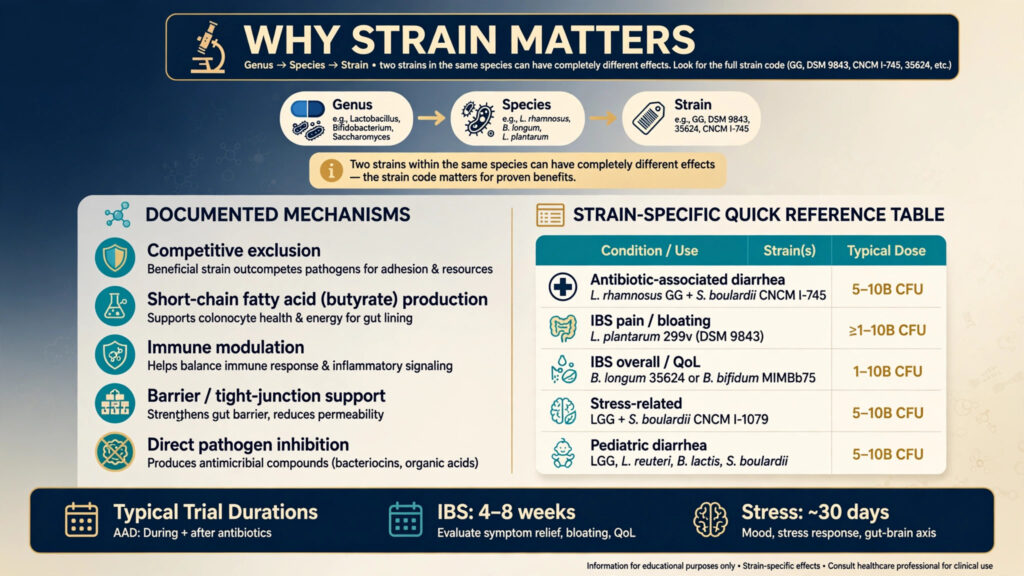
Here’s the core problem with most probiotic content: it discusses “Lactobacillus” or “Bifidobacterium” as if naming the genus tells you anything useful. It doesn’t. Bacterial classification works like this:
Genus → Species → Strain
Lactobacillus (genus) → rhamnosus (species) → GG, ATCC 53103 (strain)
Two strains within the same species can have completely different effects — one might survive stomach acid and reach the colon intact, while another dies in transit. One might produce specific short-chain fatty acids that calm inflammation, while a close relative produces none. The World Gastroenterology Organisation’s own clinical guidance is explicit on this point: probiotics belong to the category of dietary supplements, which are not required to demonstrate a specific mechanism of action or even efficacy before being sold, which is exactly why the market is flooded with products carrying a genus and species name on the label but zero strain-specific human trial data behind them.
The practical takeaway: when shopping for a probiotic, the label needs to show the full strain designation (species name plus a strain code, like GG, DSM 9843, or CNCM I-745) — not just “Lactobacillus acidophilus” with nothing after it. If the strain code is missing, you’re buying based on faith, not evidence.
How Probiotics Actually Work in the Gut
Before the strain breakdown, it’s worth understanding the mechanisms researchers have actually documented, because they explain why strain specificity matters so much:
- Competitive exclusion — beneficial strains occupy space and resources that pathogenic bacteria would otherwise use
- Short-chain fatty acid production — certain strains ferment fiber into compounds like butyrate, which nourishes colon cells and reduces inflammation
- Immune modulation — probiotics interact with gut-associated immune tissue, influencing inflammatory signaling
- Barrier function support — some strains strengthen the tight junctions between intestinal cells, reducing what’s sometimes called “leaky gut”
- Direct pathogen inhibition — certain strains produce antimicrobial compounds that suppress harmful bacteria directly
Because these mechanisms are strain-dependent, a probiotic that supports barrier function won’t necessarily do anything for short-chain fatty acid production, and vice versa. This is also deeply connected to mental health outcomes, since gut bacteria communicate with the brain through the vagus nerve and neurotransmitter production — a connection covered in detail in this research-based guide on the gut-brain axis and the link between gut health and mental health, which is worth reading alongside this one if mood or anxiety symptoms are part of your picture.
The Strain-Specific Guide: What Actually Works for What
This is the core of the article — organized by the symptom or condition you’re actually trying to address, not by brand name.
For Antibiotic-Associated Diarrhea
Best-evidenced strains: Lactobacillus rhamnosus GG (LGG) and Saccharomyces boulardii CNCM I-745
This is one of the best-documented use cases in all of probiotic research. A large multicenter, randomized, double-blind, placebo-controlled trial testing a high-dose mix containing S. boulardii, L. rhamnosus GG, and several other Lactobacillus and Bifidobacterium species specifically for antibiotic-associated diarrhea prevention found meaningful protective benefit. A separate systematic review with meta-analysis specifically on S. boulardii for antibiotic-associated diarrhea confirmed the effect independently.
- Dosage used in trials: LGG at roughly 6–10 billion CFU/day; S. boulardii at roughly 5–10 billion CFU/day
- Timing: Start alongside the antibiotic course, not after symptoms begin, and continue for several days past the last dose
- Why S. boulardii specifically: It’s a yeast, not a bacterium, which means it’s naturally resistant to antibiotics and won’t be wiped out by the same drug you’re trying to protect your gut from
For IBS — Abdominal Pain and Bloating Specifically
Best-evidenced strain: Lactobacillus plantarum 299v (DSM 9843)
This strain has some of the strongest strain-specific evidence for a very particular symptom cluster: multiple randomized controlled trials show it specifically reduces the frequency and severity of abdominal pain and bloating in IBS, with typical study duration of around 4 weeks. This is a good example of why genus-level advice fails — not every Lactobacillus plantarum product carries the 299v designation, and generic versions haven’t been studied for this outcome.
For IBS — Overall Symptom Severity and Quality of Life
Best-evidenced strains: Bifidobacterium longum 35624 (formerly labeled B. infantis 35624) and Bifidobacterium bifidum MIMBb75
B. longum 35624 is, per the World Gastroenterology Organisation’s IBS guidelines, likely the most extensively studied single probiotic strain for IBS specifically, backed by research spanning mechanistic, clinical, and safety domains. It has shown measurable improvement across the IBS Symptom Severity Score, quality of life, abdominal pain, bowel disturbance, and bloating, typically over 4–8 weeks of use.
B. bifidum MIMBb75, tested in both live and heat-inactivated forms, has also shown benefit for pain, overall IBS-SSS score, and quality of life over a similar 4–8 week window.
A separate strain-specific systematic review with meta-analysis covering 32 randomized controlled trials across 10 different probiotic strains in IBS patients reinforces the central theme of this entire guide: efficacy is strain-dependent, and results don’t generalize across a species, let alone a genus.
For Mental Health and Stress Symptoms Tied to the Gut
Studied combination: Lactobacillus rhamnosus GG (6 billion CFU/day) plus Saccharomyces boulardii CNCM I-1079 (5 billion CFU/day)
A randomized, double-blind, placebo-controlled trial specifically studied this combination for examination-related stress in healthy medical students over 30 days — a genuinely clever study design, since exam periods reliably produce measurable psychological stress in a controlled population. This reflects the broader and rapidly growing research area sometimes called “psychobiotics,” where specific strains are studied for anxiety and mood outcomes rather than purely digestive ones. If chronic stress and gut symptoms seem to be feeding each other for you, this connects directly with what’s covered in this guide on ashwagandha for anxiety and stress, since both the herbal and probiotic approaches ultimately act on overlapping stress-response and inflammatory pathways.
For Children’s Acute Diarrhea and Rotavirus
Best-evidenced strains: Lactobacillus rhamnosus GG, Lactobacillus reuteri, Bifidobacterium lactis, and Saccharomyces boulardii
A review of 15 clinical studies in children found that participants receiving probiotics were meaningfully less likely to experience gastrointestinal disorders, with effects described as both strain-dependent and dose-dependent. Separately, research on rotavirus-related diarrhea specifically found that Lactobacillus acidophilus, Lactobacillus rhamnosus, Bifidobacterium longum, and Saccharomyces boulardii reduced the duration of vomiting compared to controls. A broader meta-analysis of 34 randomized placebo-controlled studies on acute diarrhea, most involving LGG specifically, found a significant reduction in diarrhea incidence, with the strongest effect in pediatric populations.
For Immunocompromised Patients and Cancer-Related GI Symptoms
Research in cancer patients found that probiotics may reduce both the severity and frequency of diarrhea and lower the need for anti-diarrheal medication, though the evidence base here is described as still developing and should always be discussed directly with an oncology team before use, since immunocompromised status changes the risk-benefit calculation for any live organism supplement.
For Gut Barrier Support and Tissue Repair
Studied strains: Bifidobacterium lactis, Lactobacillus acidophilus, Lactiplantibacillus plantarum, and Saccharomyces boulardii (in combination)
Laboratory research on human intestinal cells found that this specific four-strain combination increased expression of wound-healing factors including collagen type I and III, fibronectin, and tissue-repair-related chemokines. Interestingly, the combined mixture produced more balanced results than any single strain alone, some of which showed increases while others showed decreases in isolation — a good illustration of why some multi-strain formulations are deliberately engineered rather than just being a marketing gimmick.
For General Digestive Regularity and Cholesterol Support
Notable strain: Lactobacillus helveticus
Beyond digestive regularity, some Lactobacillus strains — including specific L. helveticus isolates — have been studied for cholesterol-lowering activity, adding to the growing body of evidence that gut bacteria influence lipid metabolism, not just digestion. This connects to broader dietary cholesterol strategies; if you’re building a full cholesterol-management plan, this guide on how to lower cholesterol naturally covers the dietary fiber and fat strategies that work alongside gut-focused approaches like this.
Strain-Specific Quick Reference Table
| Symptom / Goal | Best-Evidenced Strain | Typical Studied Dose | Typical Duration |
|---|---|---|---|
| Antibiotic-associated diarrhea | L. rhamnosus GG + S. boulardii CNCM I-745 | 5–10 billion CFU/day each | Through antibiotic course + several days |
| IBS pain and bloating | L. plantarum 299v (DSM 9843) | Per product label | ~4 weeks |
| IBS overall symptoms/QoL | B. longum 35624 | Per product label | 4–8 weeks |
| IBS pain, QoL (alternative) | B. bifidum MIMBb75 | Per product label | 4–8 weeks |
| Stress-related symptoms | L. rhamnosus GG + S. boulardii CNCM I-1079 | 6B + 5B CFU/day | 30 days |
| Pediatric acute/rotavirus diarrhea | LGG, L. reuteri, B. lactis, S. boulardii | Strain-dependent, pediatric dosing | Days |
| Gut barrier/tissue repair | B. lactis + L. acidophilus + L. plantarum + S. boulardii combo | Research-stage | Ongoing research |
How to Read a Probiotic Label Like a Clinician Would
This is a content gap most consumer articles skip entirely, and it’s the single most useful practical skill from this guide.
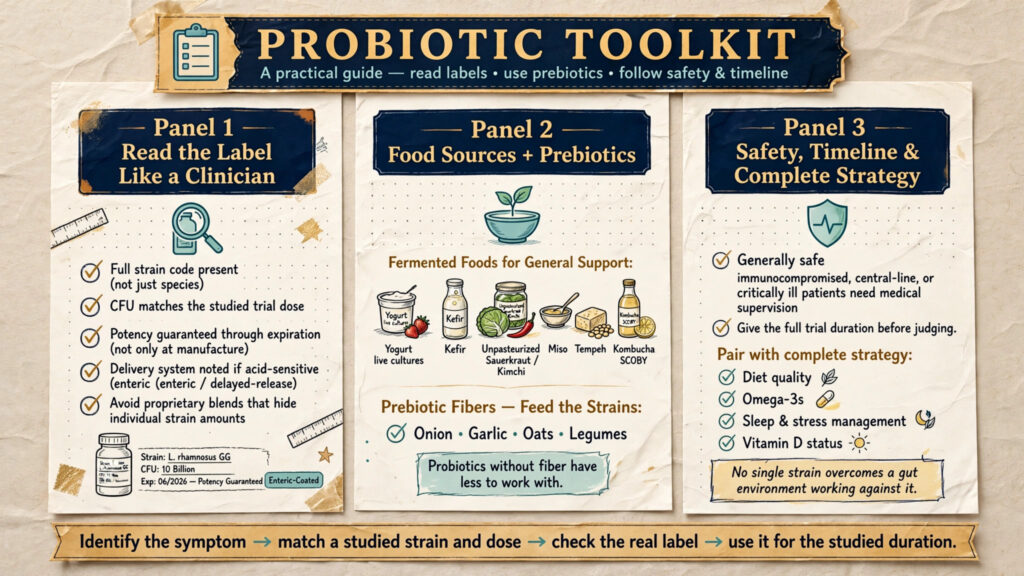
- Check for the strain code, not just the species. “Lactobacillus rhamnosus GG” is a real, studied strain. “Lactobacillus rhamnosus” alone tells you almost nothing.
- Match the CFU count to the trial dose. If a strain was studied at 6 billion CFU/day and your bottle contains 1 billion, you’re not replicating the study — you’re guessing.
- Check the expiration date against CFU guarantee. Many labels guarantee CFU count “at time of manufacture,” not at expiration. Live organisms die over time; look for brands that guarantee potency through the expiration date.
- Note the delivery mechanism. Some strains are acid-sensitive and need enteric coating or delayed-release capsules to survive stomach acid and reach the colon alive. A strain proven effective in a clinical trial using a specific delivery system may behave differently in a cheap capsule without one.
- Ignore proprietary blends with no individual strain amounts listed. If a label lists a “probiotic blend” total CFU without breaking down each strain’s individual amount, you cannot verify it matches any published trial.
Food Sources vs. Supplements: Do You Need a Pill?
Fermented foods provide naturally occurring probiotic bacteria, though typically in less standardized amounts and strain compositions than a clinical-grade supplement:
- Yogurt with live active cultures (check the label specifically for this phrase)
- Kefir, which generally contains a broader diversity of strains than yogurt
- Sauerkraut and kimchi (unpasteurized varieties only — pasteurization kills the live cultures)
- Miso and tempeh
- Kombucha
Food sources are a reasonable foundation for general gut health, but if you’re targeting a specific clinical outcome — IBS symptoms, antibiotic protection, a documented stress response — you need the exact studied strain and dose, which fermented foods simply can’t guarantee. Think of food as the daily maintenance layer and a targeted supplement as the specific-outcome tool.
Prebiotics: The Half of the Equation Most Probiotic Content Ignores
Probiotics need fuel to survive and colonize, and that fuel comes from prebiotic fiber — a category most single-topic probiotic articles leave out entirely, which is a meaningful content gap. Fermentable fibers found in foods like onions, garlic, oats, and legumes feed beneficial bacteria and support the short-chain fatty acid production mentioned earlier. Raw onion in particular contains fructans that function as a genuine prebiotic substrate, on top of its other documented benefits — this guide on the benefits of eating raw onion is worth pairing with any probiotic strategy, since prebiotics and probiotics work synergistically rather than independently. A probiotic strain introduced into a gut environment starved of fermentable fiber has less to work with, regardless of how well-studied the strain itself is.
Safety Considerations and Who Should Be Cautious
Probiotics are generally well tolerated, but this section is worth taking seriously rather than skipping.
- Immunocompromised individuals (active cancer treatment, organ transplant recipients, severe illness) face a small but documented risk of the probiotic organism itself causing infection (bacteremia or fungemia in rare cases) and should only use probiotics under direct medical supervision.
- Central line or feeding tube patients carry additional infection risk pathways and need specific medical guidance.
- Mild initial side effects — temporary gas, bloating, or changes in stool — are common in the first 1–2 weeks as the gut adjusts, and typically resolve without stopping the product.
- Not all strains are appropriate for infants; pediatric use should follow strain-specific pediatric dosing guidance, not an adult-dose reduction.
- Quality control varies significantly between manufacturers, since supplements aren’t required to prove label accuracy before sale — independent testing has periodically found products containing fewer live organisms than labeled, or contamination with unlisted strains.
Probiotics Work Best as Part of a Complete Gut Strategy
No single strain compensates for a gut environment working against it. A few connected factors worth addressing alongside any probiotic protocol:
Diet quality: Refined sugar and heavily processed foods feed less favorable bacterial populations and can undermine the benefit of even a well-chosen probiotic strain. Auditing your typical breakfast is a good starting point, since it’s where many people unknowingly do the most damage — this breakdown of the worst foods for breakfast you should avoid covers exactly which common morning choices work against gut health.
Omega-3 intake: Omega-3 fatty acids influence the same inflammatory pathways that gut bacteria interact with, and low intake has been associated with less favorable gut microbial diversity in some research. This guide on omega-3 benefits, EPA, and DHA explains the dosing.
Sleep: Gut bacterial composition follows a circadian rhythm of its own, and poor sleep has been linked to reduced microbial diversity. If sleep is a weak link in your routine, this practical guide on using nutmeg for sleep naturally is a reasonable starting point.
Stress management: The gut-brain connection runs in both directions — chronic stress alters gut motility and microbial composition, not just the reverse. This is covered in more depth in the gut-brain axis guide linked earlier.
Vitamin D status: Vitamin D receptors are present throughout the gut lining and influence barrier function and immune regulation, making deficiency a relevant but often-overlooked factor in gut health strategies; this guide on vitamin D deficiency symptoms and how much you need is worth checking.
How Long Before You Should See Results
This varies meaningfully by what you’re targeting, based on the actual trial durations cited throughout this guide:
- Antibiotic-associated diarrhea prevention: Effect is protective from the start of co-administration; there’s no “loading period”
- IBS symptoms: Most positive trials measured outcomes at 4 weeks, with some extending to 8 weeks for full effect
- Stress-related outcomes: The studied protocol ran 30 days
- General digestive regularity: Many people notice initial changes within 1–2 weeks, though meaningful microbiome shifts typically take longer
If you’ve used a specific, well-evidenced strain at the studied dose for the full trial duration and seen no improvement, that’s a legitimate signal to try a different strain rather than simply continuing indefinitely or assuming probiotics in general “don’t work for you.”
Frequently Asked Questions
1. What is the best probiotic strain for gut health overall? There isn’t a single best strain for “gut health” as a blanket goal, because effectiveness is strain-specific to particular symptoms and conditions. Lactobacillus rhamnosus GG has the broadest evidence base across multiple conditions including antibiotic-associated diarrhea and pediatric diarrhea, while Bifidobacterium longum 35624 is the most extensively studied single strain specifically for IBS.
2. Do probiotics actually work, or is it mostly marketing? The evidence genuinely supports specific, well-studied strains for specific conditions — antibiotic-associated diarrhea, certain IBS symptom clusters, and pediatric acute diarrhea all have solid randomized controlled trial support. The marketing problem is that most products on shelves either use unstudied strains or don’t disclose strain codes at all, which is where the “hype” reputation comes from.
3. How many CFU should a probiotic supplement contain? It depends entirely on the strain and the trial it’s based on — studied doses in this guide range from around 5 billion to 10 billion CFU per day for specific outcomes. More CFU isn’t automatically better if it’s the wrong strain; matching the dose used in the relevant clinical trial matters more than maximizing the number.
4. What’s the difference between Lactobacillus rhamnosus and Lactobacillus rhamnosus GG? Lactobacillus rhamnosus is the species, while GG (formally ATCC 53103) is a specific strain within that species that has been extensively studied in human clinical trials. A product listing only the species name, without the GG strain designation, may not deliver the same documented effects.
5. Can probiotics help with IBS bloating specifically? Yes, Lactobacillus plantarum 299v (DSM 9843) has multiple randomized controlled trials specifically showing reduced frequency and severity of abdominal pain and bloating in IBS patients, typically over about 4 weeks of use, making it one of the more targeted strain choices for this specific symptom.
6. Should I take probiotics while on antibiotics? For preventing antibiotic-associated diarrhea specifically, Lactobacillus rhamnosus GG and Saccharomyces boulardii have solid clinical trial support when started alongside the antibiotic course and continued for several days afterward. S. boulardii is often preferred here because, as a yeast rather than a bacterium, it isn’t killed by the antibiotic itself.
7. Are food-based probiotics like yogurt and kefir enough for gut health? Fermented foods provide a reasonable general foundation for gut health but typically don’t guarantee the specific strain or CFU dose used in clinical trials. For targeting a specific outcome like IBS symptoms or antibiotic protection, a supplement with a verified, studied strain is more reliable than relying on food sources alone.
8. How long does it take for probiotics to work? This depends on the goal: protection against antibiotic-associated diarrhea begins as soon as co-administration starts, most IBS symptom trials measured results at 4 to 8 weeks, and general digestive changes are often noticed within 1 to 2 weeks, though full microbiome shifts can take longer.
9. Are probiotics safe for everyone? Probiotics are generally well tolerated in healthy individuals, but people who are immunocompromised, undergoing cancer treatment, have a central line, or are critically ill face a small but real risk of infection from the probiotic organism itself and should only use them under direct medical supervision.
10. Why do proprietary probiotic blends list only a total CFU count instead of individual strains? This is often a way to obscure that a formula contains mostly cheap, unstudied filler strains alongside a small amount of an evidence-backed one, since disclosing individual strain amounts would reveal the actual composition. A trustworthy label lists the CFU count for each individual strain separately.
11. Can probiotics help with mood and stress, not just digestion? Emerging research, sometimes called “psychobiotics,” has studied specific combinations like Lactobacillus rhamnosus GG plus Saccharomyces boulardii for stress-related outcomes in controlled trials, reflecting the broader gut-brain axis connection where gut bacteria influence neurotransmitter activity and inflammatory signaling relevant to mood.
12. Do I need to take probiotics forever once I start? It depends on the goal. Short-term use makes sense for a defined situation like an antibiotic course, while ongoing use is more relevant for chronic conditions like IBS, where most trials studied continuous use over 4 to 8 weeks with symptoms often returning if supplementation stops, since probiotic strains generally don’t establish permanent colonization.
Final Thoughts
Probiotics for gut health stop being a vague wellness category the moment you start asking “which strain, at what dose, studied for how long, for which specific symptom” — and that shift in framing is genuinely the difference between a product that might help and one chosen almost at random off a shelf. The research is there; it’s just organized by strain rather than by marketing category, which is exactly why this guide is built the way it is. Identify the specific symptom or goal you’re targeting, match it to a strain with actual trial support at the studied dose, check the label carefully for the real strain code and individual CFU counts, and give it the same duration the clinical trials used before judging whether it’s working. Pair it with the fiber, sleep, and stress fundamentals that keep any probiotic strain fed and functional, and you’ve built an approach that’s actually grounded in evidence rather than a pastel-colored bottle’s promise.
This article is for informational purposes only and is not a substitute for professional medical advice. Consult your healthcare provider before starting a probiotic supplement, particularly if you are immunocompromised, pregnant, critically ill, or have a central line or feeding tube.







Leave a Reply