When it comes to red light therapy, science vs. hype is genuinely the right lens to view this through, because almost nothing in modern wellness sits this close to the line between legitimate medicine and marketing overreach at the same time. On one side, red light therapy — also called photobiomodulation or low-level laser therapy — has real FDA clearances, dozens of randomized controlled trials, and a plausible, well-mapped cellular mechanism. On the other side, the same red-glowing panels are being sold with claims about melting fat, boosting testosterone 30%, and reversing aging at the cellular level, most of which rest on animal studies, pilot trials with fewer than 30 people, or nothing at all. This guide goes claim by claim — skin and collagen, wound healing, pain and joint issues, muscle recovery, hair growth, weight loss, sleep, and even the cognitive claims — and tells you exactly which ones the evidence actually supports, which ones are plausible-but-unproven, and which ones are outright fabricated. No affiliate agenda, no device to sell you — just what the randomized controlled trials say.
What Red Light Therapy Actually Is
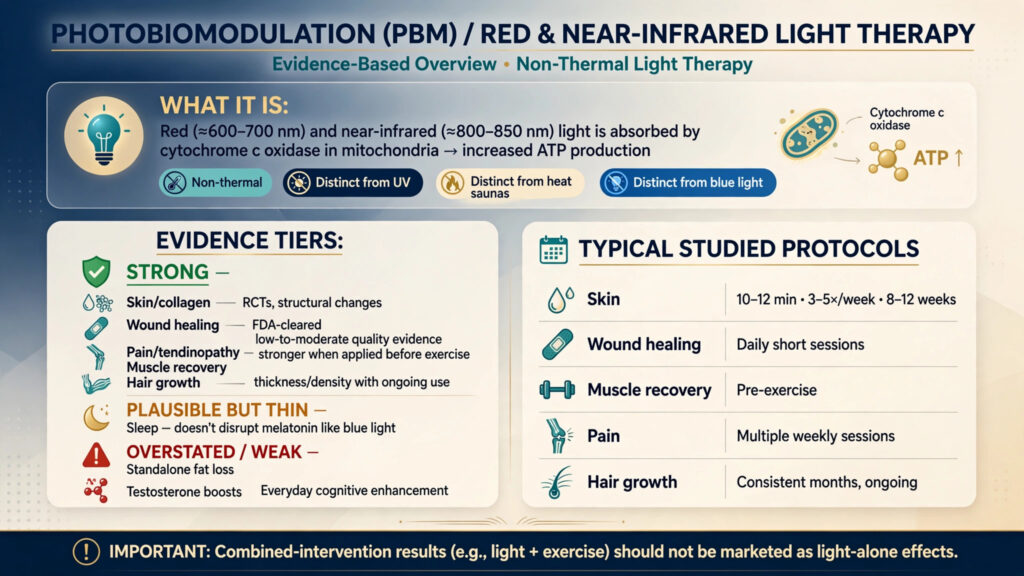
Red light therapy (RLT) uses specific wavelengths of red and near-infrared light — typically in the 600–700 nm (red) and 800–850 nm (near-infrared) ranges — to trigger biological responses in cells without producing meaningful heat. This distinguishes it clearly from:
- UV light (tanning beds), which damages DNA and is genuinely dangerous
- Infrared saunas, which work primarily through heat, not photobiomodulation
- Blue light therapy, which targets acne-causing bacteria through a different mechanism
Red light penetrates the skin to a depth of roughly 5–10 mm and is absorbed primarily by cytochrome c oxidase, an enzyme inside mitochondria — the energy-producing structures in your cells. Near-infrared light penetrates deeper, up to several centimeters depending on tissue type, and works through the same mitochondrial pathway. This absorption is thought to increase ATP (cellular energy) production, which is the foundational mechanism behind essentially every claim made about red light therapy. The mechanism itself is legitimate and well documented. The real question — where science and hype actually diverge — is what that mechanism produces in an actual human body for each specific use case.
Skin, Wrinkles, and Collagen: The Strongest Evidence Category
This is where red light therapy has its most credible research base, and it’s worth being specific about why.
A landmark study published in the Journal of the American Academy of Dermatology investigated low-level red and infrared light and found it increased the expression of collagen, elastin, and hyaluronic acid in human skin cells — the three structural components most responsible for youthful, firm skin. Multiple subsequent randomized, placebo-controlled, split-face clinical trials have confirmed measurable reductions in wrinkle depth, improved skin roughness, and increased intradermal collagen density, with one trial noting effects were still present at a 3-month follow-up — meaning the change was structural, not a temporary glow.
A 2025 systematic review pooling 27 studies on LED therapy and skin found it stimulates multiple healing-relevant pathways simultaneously: enhanced cell proliferation and migration, angiogenesis (new blood vessel formation), increased collagen deposition, and modulation of the inflammatory response.
Realistic expectations: Most clinical protocols use roughly 10–12 minutes per session, several times weekly, for 8–12 weeks before results become visible. The outcome is softer fine lines, improved texture, and modest collagen density increase — not a facelift, and not the tightening you’d get from clinical radiofrequency or ultrasound treatments. Some competing content cites a single “36% elasticity improvement” figure from one specific trial as if it’s the universal result — treat isolated headline numbers like that with caution, since individual trial results vary considerably by device, wavelength, and protocol.
Since collagen production is also heavily influenced by sleep quality, red light therapy works best as one piece of a skin-health strategy rather than a standalone fix. If your skin concerns are compounded by poor sleep, this guide on using nutmeg for sleep naturally addresses a factor that affects collagen synthesis just as directly.
Wound Healing: FDA-Cleared and Genuinely Well-Supported
Wound healing is arguably red light therapy’s strongest evidence category overall. The FDA has cleared multiple photobiomodulation devices specifically for wound healing applications — this isn’t a wellness claim, it’s a regulatory one.
A controlled in vitro and in vivo study on wound healing found LED therapy significantly enhanced keratinocyte (skin cell) viability, and in an animal model, clinical benefits were prominent by day 10, with LED therapy significantly decreasing pro-inflammatory markers (IL-1β, TNF-α) while modulating the healing cascade. The proposed mechanism: fibroblast activation and growth factor upregulation accelerate the proliferative phase of wound healing, while anti-inflammatory effects reduce the chronic low-grade inflammation that otherwise stalls tissue repair.
Pain, Tendinopathy, and Joint Issues: Solid, With Honest Caveats
Where devices carry regulatory clearance, temporary relief of minor muscle and joint pain is specifically one of the labeled uses. A systematic review of 17 clinical trials on tendinopathy (chronic tendon pain, like tennis elbow or Achilles issues) found low-to-moderate quality evidence that red light can help relieve pain or improve function. That phrasing matters — “low-to-moderate quality” is a real scientific classification, not hedge language, and it means the effect is likely real but the trial designs supporting it aren’t airtight.
A separate systematic review and meta-analysis on low-level laser therapy for musculoskeletal pain reached broadly similar conclusions: measurable pain reduction, but with substantial variation in study quality and protocol.
Muscle Recovery and Soreness: Encouraging, With One Counterintuitive Detail
This is the use case most relevant to anyone training seriously, and it’s genuinely one of the better-supported categories — with a twist that contradicts how most people actually use these devices.
A meta-analysis of randomized controlled trials found low-level laser therapy reduced muscular soreness and supported performance recovery in athletes. A separate systematic review and meta-analysis on near-infrared phototherapy found measurable effects on lower-limb muscle strength recovery and reduced exercise-induced injury markers.
The detail almost nobody mentions: several reviews found the effect is strongest when light is applied before exercise, not after — which runs directly against how most people use these panels (as a post-workout recovery tool). The research suggests photobiomodulation may work partly as a pre-conditioning strategy for the mitochondria, priming muscle tissue before the stress of training, rather than purely repairing damage afterward.
Practically, this means red light therapy works best as one part of a recovery stack that includes sleep, adequate protein, and smart training load — not a standalone fix that lets you skip the fundamentals. If muscle growth has stalled despite consistent training, red light won’t fix a protein gap; getting your intake right matters more, and this guide on protein powder for women breaks down exactly how much you need and when timing actually matters (spoiler: total daily intake beats precise post-workout timing there too). Recovery quality is also tightly linked to omega-3 intake, since it governs the inflammatory pathways involved in muscle repair — this guide on omega-3 benefits, EPA, and DHA explains dosing.
Hair Growth: Real, But Only With Consistency
Multiple reviews — including one covering 11 separate studies — found red light therapy improved outcomes for androgenic alopecia (genetic pattern hair loss), with improvements in both hair thickness and density. The proposed mechanism involves vasodilation: red light widens blood vessels near the scalp, increasing blood flow and nutrient delivery to hair follicles, similar to how topical minoxidil works through a different pathway.
The catch that matters: effects require sustained, consistent use over multiple months, and research indicates that when a person stops using red light, the benefits reverse. This isn’t a one-time fix — it’s a maintenance therapy, much like minoxidil itself.
Weight Loss and Fat Reduction: Where the Hype Genuinely Outpaces the Science
This is the category where marketing claims diverge most sharply from what trials actually demonstrate, so it deserves the most scrutiny.
What’s overstated: Claims that a red light session burns hundreds of calories or “melts” visceral fat have no credible evidence base. No peer-reviewed randomized controlled trial has demonstrated meaningful fat loss from at-home LED panel use in isolation. Body circumference reduction (“body contouring”) has been documented in some studies, but the research indicates this effect is likely temporary and related to fluid shifts, not actual fat loss.
What’s more nuanced: One notable trial in women with obesity added infrared-range red light therapy to a 20-week supervised exercise program. The combined group saw nearly double the fat loss compared to exercise alone (roughly 24.8 lbs vs. 12.8 kg in the placebo-exercise group), a substantially greater drop in insulin resistance (38% vs. 21%), and a small muscle gain rather than the muscle loss seen in the placebo group. This is a meaningfully different claim than “red light burns fat” — it’s “red light may modestly enhance the results of an existing structured exercise program,” which is a much more defensible finding.
The honest bottom line: if a clinic or device is telling you red light alone will produce weight loss without diet and exercise changes, that claim isn’t supported by the evidence. It may offer a modest boost alongside a genuine calorie deficit and training program — nothing more. For the actual proven levers of body composition change, a well-structured approach to cardiovascular training matters far more than any light panel; this guide on Zone 2 cardio and why it’s become so popular covers one of the most sustainable approaches backed by strong evidence.
Sleep and Circadian Claims: Plausible, But Thin
Some marketing suggests red light therapy improves sleep by supporting melatonin production, since red light (unlike blue light) doesn’t suppress melatonin the way screens do. The underlying logic is sound — red light genuinely doesn’t disrupt circadian rhythm the way blue light does. But direct evidence that active red light treatment meaningfully improves sleep quality currently depends on a narrow set of trials rather than a robust, replicated evidence base. The safer, better-supported claim is simply: red light won’t hurt your sleep the way screen use does, which is a much weaker statement than “red light therapy improves sleep.”
Testosterone and Cognitive Enhancement: Where the Evidence Runs Out
These are the claims most worth being skeptical of. Testosterone-boosting claims and cognitive enhancement claims for red light therapy generally rest on pilot studies with fewer than 30 participants or on animal models — not the kind of evidence base that should support confident marketing language like “boosts testosterone 30%.” Transcranial photobiomodulation (red/near-infrared light aimed at the brain) is a legitimate and active area of research for conditions like traumatic brain injury and depression, but it’s still an emerging field, and claims of everyday cognitive enhancement in healthy adults are running well ahead of what’s actually been demonstrated.
Is Red Light Therapy Safe?
Generally, yes. Because it’s non-thermal and non-ionizing (unlike UV light), red light therapy doesn’t burn skin, and it’s considered safe for all skin phototypes, including darker skin tones — a genuine advantage over some laser and heat-based treatments that carry higher risk for hyperpigmentation in darker skin. Reported side effects are minor and rare, occasionally including temporary redness or eye strain if eye protection isn’t used with high-intensity devices. It’s worth noting that some in vitro research has found near-infrared light can theoretically increase collagen-degrading enzyme activity (similar to a mechanism seen with UV radiation) under specific artificial lab conditions not representative of real-world device use — a nuance rarely mentioned in consumer marketing, though it hasn’t been shown to translate into meaningful harm in actual clinical trials.
How to Use It Based on What the Evidence Actually Supports
If you’re going to use red light therapy, the research points to a fairly consistent practical range:
| Use Case | Typical Studied Protocol | Realistic Timeline |
|---|---|---|
| Skin/collagen | 10–12 min, 3–5x/week | 8–12 weeks |
| Wound healing | Daily short sessions | Days to weeks |
| Muscle recovery | Pre-exercise application | Immediate to short-term |
| Pain/tendinopathy | Multiple weekly sessions | Weeks |
| Hair growth | Consistent, several months | 3–6+ months, ongoing |
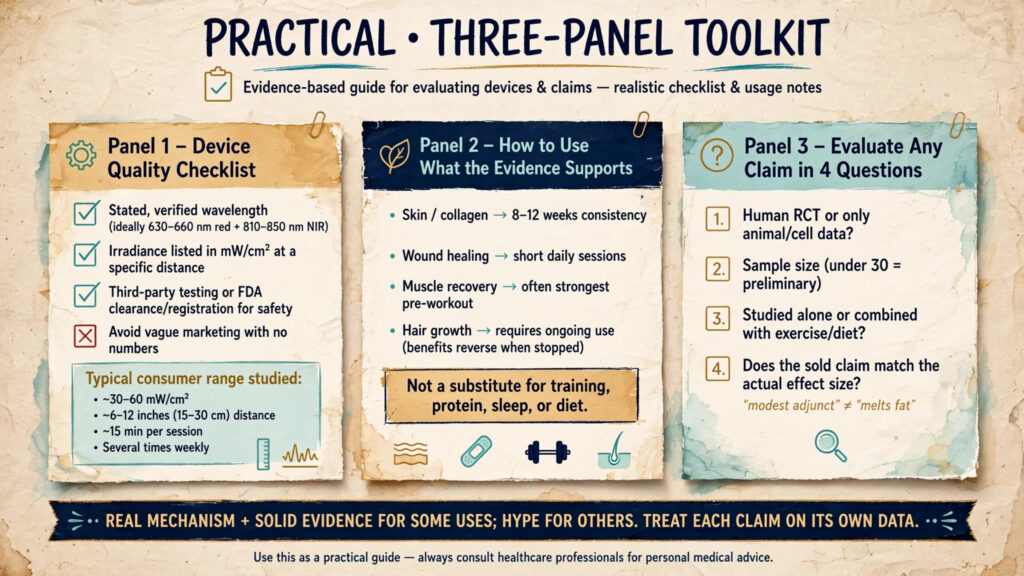
General consumer device guidance in the research literature centers around 30–60 mW/cm² irradiance, positioned roughly 6–12 inches from the panel, for about 15 minutes per session, several times weekly — staying within that range keeps you inside what’s actually been studied. Going well beyond it (more intense, more frequent, “more must be better”) isn’t supported by the evidence and simply increases cost without proven added benefit.
The Content Gap Most Articles Miss: Device Quality and Dosing Variability
Here’s something almost no consumer-facing article addresses clearly: study protocols vary wildly in wavelength, irradiance, session duration, and distance from the light source, which makes it genuinely difficult to compare results across trials or to know whether a specific consumer device matches what was actually studied. A cheap panel with unverified wavelength output and low irradiance is not automatically delivering the same photobiomodulation effect documented in a clinical trial using calibrated, medical-grade equipment. When shopping for a device, look for:
- A specified, verified wavelength (ideally combined 630–660 nm red and 810–850 nm near-infrared)
- Stated irradiance (mW/cm²) at a specific distance — vague marketing language without numbers is a red flag
- Third-party testing or FDA clearance/registration, which at minimum confirms basic safety standards
This is the same “check what’s actually in the product” principle worth applying to any wellness purchase — it’s the same reasoning behind checking third-party certification on supplements, a topic covered in more depth in this guide on protein powder for women, where the same contamination and quality-verification issue applies to a completely different product category.
Red Light Therapy Isn’t a Substitute for the Fundamentals
Whatever benefit red light therapy provides, it consistently performs best as an addition to existing healthy habits, not a replacement for them — the obesity-and-exercise trial above is the clearest illustration of that principle in the data itself. Inflammation, recovery, and tissue repair are also heavily influenced by diet; if your broader goal is reducing systemic inflammation alongside any red light protocol, this guide on the 5 worst foods for heart health Americans eat daily covers the dietary patterns that work against you regardless of what light therapy you’re using. Gut health also plays an underappreciated role in systemic inflammation and healing capacity, covered in this breakdown of the gut-brain axis and its effect on overall health. And since vitamin D deficiency independently affects skin health, muscle function, and inflammation — several of the same outcomes red light therapy targets — it’s worth ruling out as a confounding factor, which this guide on vitamin D deficiency symptoms and how much you need explains clearly.
A Simple Framework for Evaluating Any Red Light Claim
Use this whenever you see a new claim about red light therapy, whether from a device marketer, a clinic, or a social media post:
- Is there a randomized controlled trial in humans, or is this based on animal models or cell cultures alone?
- What was the sample size? Anything under 30 participants should be treated as preliminary, not proven.
- Was it studied in isolation, or combined with exercise/diet/another intervention? Combined-intervention results shouldn’t be attributed to red light alone.
- Does the claimed effect size match what’s being sold? “Modestly enhances results of an exercise program” and “burns fat” are not the same claim, even when the same study gets cited for both.
Frequently Asked Questions
1. Does red light therapy actually work, or is it mostly hype? It’s genuinely both, depending on the claim. Skin collagen production, wound healing, and pain relief have solid randomized controlled trial support and even FDA clearances for some uses. Weight loss, testosterone, and cognitive enhancement claims are largely unproven, resting on small pilot studies or animal research rather than robust human trials.
2. How long does it take to see results from red light therapy for skin? Most clinical trials showing measurable improvement in collagen density and wrinkle depth used consistent treatment for 8 to 12 weeks, with sessions of about 10 to 12 minutes several times a week. Results are typically gradual rather than immediate, and one trial found improvements were still present at a 3-month follow-up.
3. Is red light therapy FDA-approved? Several photobiomodulation devices have received FDA clearance for specific uses, including wound healing and temporary relief of minor muscle and joint pain. FDA clearance for a specific use doesn’t mean every claim made about red light therapy in general has been validated — clearances are use-specific, not blanket approvals.
4. Can red light therapy help with weight loss? Not on its own, according to the current evidence. No peer-reviewed randomized controlled trial has shown meaningful fat loss from red light panels used in isolation. One study did find that adding red light therapy to a structured 20-week exercise program nearly doubled fat loss compared to exercise alone, suggesting it may modestly enhance results when combined with genuine diet and exercise changes.
5. Is red light therapy safe for daily use? Generally yes. It’s non-thermal and non-ionizing, making it considered safe for all skin tones, with side effects that are minor and rare, such as temporary redness or eye strain without proper eye protection at higher intensities. Most studied protocols use it several times weekly rather than strictly daily, though daily use hasn’t been shown to cause harm in the research reviewed.
6. What’s the difference between red light therapy and infrared saunas? Red light therapy uses non-thermal photobiomodulation that works through a cellular mitochondrial mechanism without generating meaningful heat, while infrared saunas work primarily by raising body temperature. They are different modalities with different evidence bases, and claims about one shouldn’t be assumed to apply to the other.
7. Does red light therapy help with muscle soreness after exercise? Yes, this is one of the better-supported use cases. Multiple systematic reviews and meta-analyses found reduced muscle soreness and improved strength recovery in athletes using photobiomodulation, with several studies finding the effect was strongest when light was applied before exercise rather than after, which is the opposite of how most people currently use these devices.
8. Can red light therapy regrow hair? Multiple reviews, including one covering 11 separate studies, found improvements in hair thickness and density for androgenic alopecia (pattern hair loss) with consistent use over several months. The effect requires ongoing treatment, and research indicates benefits reverse once a person stops using the light therapy.
9. What wavelength of red light therapy is most effective? Most clinical research uses red light in the 600–700 nm range for skin-level effects and near-infrared light in the 800–850 nm range for deeper tissue penetration, with many effective protocols combining both. When choosing a device, look for a stated, verified wavelength rather than vague marketing language, since study protocols vary significantly and not all consumer devices match what was actually tested in trials.
10. How much does red light therapy cost, and is it worth it? At-home panels range widely in price, while professional sessions at clinics or recovery studios typically charge per session. Given that the strongest evidence supports skin, wound healing, pain, and muscle recovery applications rather than dramatic transformations, it’s reasonably worth considering for those specific, evidence-backed goals — but it shouldn’t be purchased expecting weight loss or cognitive enhancement results the current research doesn’t support.
11. Can red light therapy replace medical treatment for skin conditions or injuries? No. Red light therapy shows genuine promise as a supportive or adjunct treatment for conditions like wound healing, tendinopathy, and mild skin concerns, but it isn’t a replacement for medical evaluation and treatment of significant injuries, chronic pain conditions, or skin disease. Anyone with a persistent or worsening condition should still see a healthcare provider.
Final Thoughts
Red light therapy: science vs. hype ultimately comes down to treating each specific claim on its own evidence rather than accepting the halo effect that legitimate research in one area (skin, wound healing) lends to unproven claims in another (fat loss, testosterone). The mechanism is real, several use cases have genuinely solid randomized controlled trial support and FDA clearances, and it’s about as safe as a wellness intervention gets. But it works best — and is honestly studied — as an addition to real fundamentals: consistent training, adequate protein, good sleep, and a reasonable diet, not a shortcut around any of them. If you’re drawn to it for skin health, minor pain, or recovery support, the evidence genuinely backs you up. If you’re drawn to it expecting dramatic fat loss or a testosterone boost, that expectation is running well ahead of what any credible trial has shown.
This article is for informational purposes only and is not a substitute for professional medical advice. Consult a healthcare provider before using red light therapy for a specific medical condition, especially if you are pregnant, have a light-sensitivity disorder, or are taking photosensitizing medication.






Leave a Reply