Fatty liver disease now affects a striking share of adults worldwide, and the genuinely good news buried under that alarming statistic is this: for most people caught in the early-to-moderate stages, it’s one of the more reversible chronic conditions in modern medicine — a claim you can’t make about most metabolic diagnoses. What used to be called NAFLD (non-alcoholic fatty liver disease) was renamed in recent years to MASLD (metabolic dysfunction-associated steatotic liver disease), a shift that isn’t just semantic — it reflects a real change in medical understanding, explicitly tying the condition to insulin resistance, obesity, and metabolic dysfunction rather than treating it as a mysterious, unrelated liver problem. This guide covers exactly what the research supports for reversing liver fat: the specific dietary patterns with clinical trial backing, how much weight loss actually matters and why the percentage is more important than the pounds, what the exercise research really shows, which supplements have genuine evidence versus which ones are mostly marketing, and the realistic monitoring and timeline you should expect.
NAFLD to MASLD: Why the Name Changed (And Why It Matters for Treatment)
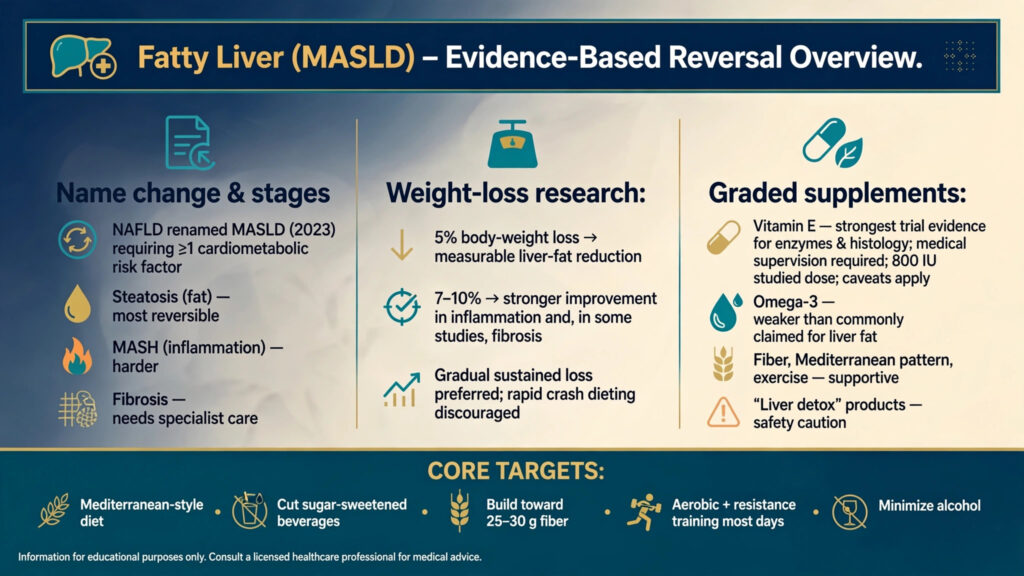
In 2023, the global hepatology community formally renamed NAFLD to MASLD. This wasn’t cosmetic. The new name explicitly requires at least one cardiometabolic risk factor for diagnosis — things like excess weight, elevated blood sugar, high blood pressure, or abnormal lipid levels — which means the diagnosis itself now points directly at the treatment target. You’re not managing a vague “fatty liver” anymore; you’re managing a condition defined by its connection to metabolic health, and that reframing is exactly why diet, exercise, and weight management dominate the evidence-based treatment landscape rather than liver-specific interventions.
MASH (metabolic dysfunction-associated steatohepatitis, formerly NASH) refers to the more advanced, inflammatory stage of the same disease spectrum, where fat accumulation has progressed to active liver cell inflammation and damage — this is the stage where fibrosis and, eventually, cirrhosis risk becomes real. Catching and reversing the condition at the simple fatty liver (steatosis) stage, before progression to MASH, is exactly why early action matters so much.
Is Fatty Liver Disease Actually Reversible?
Yes, for the majority of people, particularly at the earlier stages. This is genuinely one of the more encouraging messages in chronic disease management, and it’s worth stating clearly since a lot of competing content buries this reassurance under vague hedging: liver fat itself responds relatively quickly to sustained lifestyle change, often showing measurable reduction within weeks to a few months of consistent effort — faster than most other metabolic markers improve.
The caveat that matters: reversibility is strongest for the fat-accumulation (steatosis) stage. Once fibrosis has developed, the disease becomes harder to fully reverse, though progression can still often be slowed or halted with the same interventions. This is exactly why early screening and early action carry outsized value in fatty liver disease specifically.
The Weight Loss Research: Percentage Matters More Than Pounds
This is the single most consistently replicated finding across MASLD research, and it deserves to be stated with actual numbers rather than vague encouragement:
Losing 5–10% of body weight has been shown to significantly reduce liver fat. For a 200-pound person, that’s roughly 10–20 pounds — a genuinely achievable target for most people, not an extreme transformation.
Research suggests a graded relationship:
- ~5% weight loss is generally associated with measurable reduction in liver fat (steatosis)
- ~7–10% weight loss is more strongly associated with improvement in liver inflammation, and in some studies, fibrosis
This graded pattern is important because it reframes the goal. You don’t need to reach an “ideal” body weight to see real liver benefit — you need sustained, moderate loss, and the liver responds disproportionately well to that first meaningful chunk of weight lost compared to many other health markers.
One consistent caution across the research: extreme, rapid weight loss (crash dieting, very aggressive calorie restriction) is generally discouraged, since rapid fat mobilization can, in some cases, temporarily worsen liver inflammation rather than help it. Slow and sustained beats fast and aggressive here, which is a genuinely counterintuitive but well-supported point.
Dietary Patterns With Real Evidence
The Mediterranean Diet — The Best-Studied Pattern for MASLD Specifically
Even independent of weight loss, the Mediterranean diet is described in clinical guidance as a powerful tool against fatty liver disease on its own. It emphasizes vegetables, fruits, whole grains, legumes, nuts, olive oil, and lean protein (particularly fish), while limiting red meat, refined carbohydrates, and processed foods. Its benefit for liver fat appears to come through multiple simultaneous pathways: reduced inflammation, improved insulin sensitivity, and a favorable fat profile (high monounsaturated and omega-3 fat, low saturated and trans fat).
Carbohydrate Quality Over Carbohydrate Quantity
Research on carbohydrate versus fat restriction for MASLD hasn’t produced a definitive answer on which macronutrient approach is universally superior — but there’s much stronger consensus on carbohydrate quality. Refined carbohydrates and, in particular, added fructose (heavily concentrated in sugar-sweetened beverages and many processed foods) are specifically implicated in driving liver fat accumulation through a distinct metabolic pathway, since fructose is metabolized almost entirely by the liver itself and readily converted to fat when consumed in excess. Cutting sugar-sweetened beverages specifically is one of the most consistently recommended single changes across MASLD dietary guidance — arguably more impactful than general “carb reduction.”
If your mornings are a source of hidden sugar and refined carbohydrate load, this breakdown of the worst foods for breakfast you should avoid is a genuinely useful audit, since breakfast is where many people unknowingly consume the largest share of their daily refined carbohydrate and added sugar intake.
Fat Quality Matters As Much As Fat Quantity
Saturated and trans fats are more strongly associated with liver fat accumulation and inflammation than unsaturated fats. Swapping cooking fats and reducing processed food intake — which disproportionately carries trans and highly refined fats — connects directly to broader cardiovascular guidance; this deep dive into the 5 worst foods for heart health Americans eat daily overlaps significantly with what damages liver fat metabolism, since the two conditions share so much of the same underlying dietary drivers.
Fiber’s Underappreciated Role
Higher fiber intake supports MASLD improvement through several mechanisms: slower carbohydrate absorption (blunting the insulin spikes that drive fat storage), improved gut bacteria composition (relevant to the gut-liver axis), and better bile acid and cholesterol handling. Since most people fall well short of recommended fiber intake, this is a genuinely high-leverage, low-cost area to focus on; this practical guide on fibermaxxing and hitting 30g of fiber a day without bloating offers a realistic way to build this habit without the common pitfall of quitting due to bloating from increasing too fast.
Exercise: What the Research Actually Shows
Exercise appears to improve liver fat through mechanisms partly independent of weight loss itself — meaning you don’t necessarily need to lose significant weight to see some liver benefit from consistent movement, though the two together produce the strongest results.
The evidence gap worth being honest about: direct trial evidence on exercise specifically reversing MASLD is more limited than the dietary evidence, particularly in some populations like children, where research remains scarce. What exists is largely indirect — studies consistently show that a sedentary lifestyle, poor cardiovascular fitness, and low muscle mass are independently associated with worse MASLD outcomes, which supports movement as protective even where direct reversal trials are still developing.
Practical exercise guidance based on the current evidence:
- Both aerobic exercise and resistance training show benefit; a combination appears most effective
- Consistency over time matters more than intensity — sustainable, moderate activity performed regularly outperforms sporadic intense exercise
- Building muscle mass specifically may offer additional metabolic benefit beyond calorie expenditure alone, since muscle tissue is a major site of glucose disposal and improves insulin sensitivity
For a sustainable approach to building consistent aerobic activity without burning out or overtraining, this guide on Zone 2 cardio and why it’s become so popular is directly relevant, since the moderate, repeatable nature of that training style aligns well with what the MASLD exercise research actually supports — consistency, not intensity spikes. Building adequate muscle mass alongside this also requires sufficient protein intake; this guide on protein powder for women explains how much protein actually supports muscle-building goals, and the same principles apply broadly regardless of gender.
Supplements: An Honest, Evidence-Graded Breakdown
This is where most competing fatty liver content either oversells everything or dismisses everything — neither is accurate. Here’s the graded, honest picture.
Vitamin E — The Strongest Evidence, With Real Caveats
Vitamin E has the most substantial clinical trial support among supplements studied for MASLD. A 2024 systematic review of 11 studies found that vitamin E supplementation significantly reduces liver enzymes (ALT and AST) and improves histological features including steatosis and inflammation. This is genuinely meaningful evidence — not a single small trial, but a consistent pattern across multiple studies.
The important caveats almost no consumer article states clearly enough:
- Its role in resolving fibrosis specifically remains inconclusive — vitamin E appears to help fat and inflammation more than scarring
- Typical studied dosage is 800 IU/day of alpha-tocopherol — notably higher than a standard multivitamin dose
- High-dose vitamin E is not recommended for men with prostate cancer or at high risk of it, and carries a documented concern about increased risk of death at high doses in certain populations
- It is not recommended for MASLD without liver biopsy confirmation, for MASH with diabetes, or for MASH cirrhosis, per major gastroenterology guidance
- This is explicitly a supplement to use only under medical supervision, not a self-directed purchase
Omega-3 Fatty Acids — Weaker Than Commonly Claimed
This is a genuine content gap worth correcting directly: while some smaller, earlier studies suggested fish oil might reduce liver fat, evidence from larger, more recent trials has shown no significant benefit, including research on DHA in ethyl ester form, alone or combined with a synthetic vitamin E form. Omega-3s remain valuable for overall cardiovascular and inflammatory health — covered in this guide on omega-3 benefits, EPA, and DHA — but the specific claim that fish oil reduces liver fat in MASLD is weaker than widely repeated marketing suggests, and honest reporting on this topic should say so plainly.
Vitamin C
Higher dietary vitamin C intake (above roughly 146 mg/day) has been associated with lower MASLD risk in observational research, and one preliminary study suggested moderately high-dose vitamin C might improve liver function markers — but this remains unproven at the level of vitamin E’s evidence base.
Curcumin, Resveratrol, and Silymarin (Milk Thistle)
A 2024 systematic review and meta-analysis evaluating these three compounds together for MASLD found supportive evidence for liver fat and inflammation markers. As with most single-compound liver research, effects are described as modest and are best understood as complementary to dietary and lifestyle change, not a replacement for it.
Berberine
Berberine has documented evidence for improving insulin resistance and lipid profiles — both directly relevant to the metabolic drivers of MASLD — through mechanisms covered in detail in this dedicated guide on berberine for blood sugar and weight loss, which also explains the important medication interactions and safety considerations before use.
Probiotics — Emerging, Not Yet Established
Given the gut-liver axis connection, probiotics have been studied in children and adults with MASLD, but results remain equivocal rather than conclusive. This is an active, promising research area rather than an established treatment — if you’re interested in strain-specific probiotic evidence generally, this strain-specific guide to probiotics for gut health explains why “probiotics” as a blanket category is too vague a claim for any specific condition, MASLD included.
The Critical Safety Note: Not All “Liver Supplements” Are Safe
This deserves direct emphasis because it’s a genuine safety gap in most consumer content: high-dose iron, high-dose vitamin A, and certain herbal compounds marketed as “liver detox” or “liver cleanse” supplements can themselves be hepatotoxic — meaning they can actively harm liver function rather than support it. This is precisely the danger of the unregulated “detox” supplement category discussed in the companion guide on liver health beyond the detox myth, and it’s exactly why every supplement discussed in this section should be run past a doctor before use, particularly for anyone with a confirmed MASLD or MASH diagnosis.
A Realistic MASLD Reversal Framework
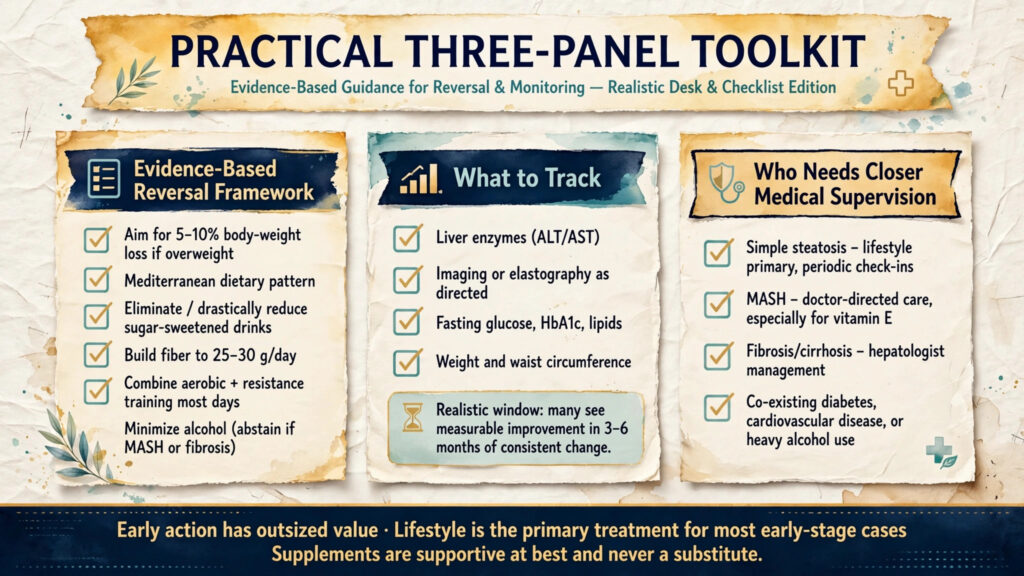
| Area | Evidence-Based Target |
|---|---|
| Weight loss (if overweight) | 5–10% of body weight, achieved gradually |
| Diet pattern | Mediterranean-style: vegetables, whole grains, legumes, olive oil, fish |
| Sugar-sweetened beverages | Eliminate or drastically reduce |
| Fiber intake | Build toward 25–30g/day |
| Exercise | Combination of aerobic + resistance training, most days |
| Alcohol | Minimize significantly; abstain if MASH or fibrosis is present |
| Supplements | Only vitamin E (under medical supervision, with biopsy confirmation) has strong evidence; others are supportive at best |
| Monitoring | Regular ALT/AST liver enzyme panels; imaging or elastography as directed by your doctor |
Monitoring Progress: What to Actually Track
Unlike many chronic conditions, MASLD progress can be tracked with reasonably accessible tools:
- Liver enzymes (ALT, AST) — a standard, inexpensive blood panel; improving trends over months are a good sign, though enzymes can be normal even with meaningful liver fat present, so this isn’t the whole picture
- Imaging — ultrasound is common for initial detection; specialized elastography (measuring liver stiffness, a proxy for fibrosis) offers more precise tracking over time when available
- Metabolic markers — fasting glucose, HbA1c, and lipid panel, since these track the underlying metabolic dysfunction driving the condition
- Weight and waist circumference — simple, practical, and directly tied to the strongest evidence-based intervention
Realistic timeline: many people see measurable improvement in liver enzymes and imaging findings within 3 to 6 months of consistent lifestyle change, though this varies significantly based on starting severity, consistency, and individual metabolic factors.
Who Needs Medical Supervision, Not Just a Diet Plan
MASLD spans a wide severity range, and this matters for how aggressively self-directed lifestyle change is appropriate:
- Simple steatosis (fat only, no significant inflammation) — lifestyle change is genuinely the primary treatment, and self-directed effort with periodic doctor check-ins is often appropriate
- MASH (steatohepatitis, active inflammation) — needs closer medical supervision, and supplement use (especially vitamin E) should be doctor-directed given the dosing and population-specific cautions covered above
- Fibrosis or cirrhosis — requires specialist (hepatologist) management; lifestyle change remains important but is no longer sufficient alone, and this stage carries real medical urgency
- Diabetes, existing cardiovascular disease, or heavy alcohol use alongside a MASLD diagnosis — these combinations significantly change risk and management and warrant more frequent medical monitoring
If you haven’t been formally diagnosed but suspect fatty liver based on risk factors (excess weight, elevated blood sugar, high triglycerides, or family history), a simple liver enzyme panel and conversation with your doctor is the right first step before starting an intensive self-directed protocol.
Frequently Asked Questions
1. Can fatty liver disease actually be reversed naturally? Yes, for most people, particularly at the earlier stages before fibrosis develops. Liver fat responds relatively quickly to sustained diet and exercise changes, often showing measurable reduction within weeks to a few months, though full reversal becomes more difficult once fibrosis has developed.
2. How much weight do I need to lose to reverse fatty liver? Research consistently shows that losing 5 to 10% of body weight significantly reduces liver fat, with the higher end of that range (7 to 10%) more strongly associated with improvements in liver inflammation and, in some studies, fibrosis. Gradual, sustained weight loss is recommended over rapid or extreme dieting, which can in some cases temporarily worsen liver inflammation.
3. What is the difference between NAFLD and MASLD? MASLD (metabolic dysfunction-associated steatotic liver disease) is the updated name for what was previously called NAFLD (non-alcoholic fatty liver disease), reflecting a 2023 terminology change that explicitly ties the diagnosis to at least one cardiometabolic risk factor like obesity, elevated blood sugar, or high blood pressure. It’s the same underlying condition, but the renaming better reflects its close connection to metabolic health.
4. What is the best diet for reversing fatty liver disease? The Mediterranean diet has the strongest evidence specifically for MASLD, emphasizing vegetables, whole grains, legumes, olive oil, and fish while limiting red meat, refined carbohydrates, and processed foods. Cutting sugar-sweetened beverages and refined carbohydrates specifically is one of the most consistently recommended single dietary changes, since fructose is metabolized directly by the liver and readily converted to fat.
5. Does vitamin E actually help with fatty liver disease? Vitamin E has the strongest clinical trial evidence among supplements for MASLD, with research showing it can reduce liver enzymes and improve inflammation and fat accumulation at a studied dose of around 800 IU/day. However, it’s not recommended for everyone, particularly men at risk of prostate cancer, and should only be used under medical supervision with a confirmed diagnosis.
6. Does fish oil (omega-3) help reduce liver fat? The evidence is weaker than commonly claimed. While some smaller earlier studies suggested benefit, larger and more recent trials have found no significant reduction in liver fat or improvement in liver enzymes from fish oil or DHA supplementation in MASLD specifically, even though omega-3s remain valuable for general cardiovascular health.
7. How much exercise is needed to improve fatty liver disease? Both aerobic exercise and resistance training show benefit, and a combination of the two appears most effective, with consistency over time mattering more than intensity. Exercise appears to improve liver fat through mechanisms partly independent of weight loss, though the strongest results come from combining exercise with dietary change.
8. What are the warning signs that fatty liver disease is getting worse? Progression from simple fatty liver to MASH or fibrosis often has few distinct symptoms early on, which is why monitoring through liver enzyme bloodwork and imaging matters more than waiting for symptoms. When symptoms do appear, persistent fatigue, upper right abdominal discomfort, and unexplained weight loss can signal progression and warrant prompt medical evaluation.
9. Can you have fatty liver disease without drinking alcohol? Yes, this is exactly what distinguishes MASLD from alcohol-related liver disease. MASLD is driven primarily by metabolic dysfunction, including insulin resistance, obesity, and elevated blood sugar, rather than alcohol consumption, though alcohol use can worsen the condition in people who already have it.
10. How long does it take to reverse fatty liver disease with diet and exercise? Many people see measurable improvement in liver enzymes and imaging findings within 3 to 6 months of consistent lifestyle change, though the exact timeline depends significantly on starting severity, consistency of effort, and individual metabolic factors. Regular monitoring with your doctor is the best way to track real progress rather than relying on how you feel alone.
11. Are liver detox supplements safe for someone with fatty liver disease? Not necessarily, and this is a genuine safety concern rather than general caution. Certain compounds sometimes marketed in “liver detox” or “liver cleanse” products, including high-dose iron and high-dose vitamin A, can actually be hepatotoxic and worsen liver function, which is why any supplement should be discussed with a doctor before use, particularly with a confirmed MASLD or MASH diagnosis.
12. Is fatty liver disease linked to diabetes and heart disease? Yes, strongly. MASLD shares underlying drivers with type 2 diabetes and cardiovascular disease, including insulin resistance and unfavorable lipid profiles, which is why a MASLD diagnosis often prompts screening for these related conditions and why treatment approaches overlap significantly across all three.
Final Thoughts
Fatty liver disease is one of the genuinely encouraging stories in modern metabolic health — unlike many chronic conditions, MASLD responds relatively quickly and measurably to the same interventions that improve nearly every other marker of long-term health: moderate, sustained weight loss, a Mediterranean-style diet with minimal added sugar, regular movement combining aerobic and resistance work, and significantly reduced alcohol intake. Supplements have a supporting role at best, with vitamin E the clear evidence leader and several others still developing — none of them substitute for the fundamentals, and some marketed “liver support” products can genuinely do harm rather than good. If you have risk factors or a suspected diagnosis, get the bloodwork done, build the lifestyle changes gradually and sustainably rather than aggressively, and track real markers over 3 to 6 months rather than judging progress by how you feel day to day. This is a condition where consistent effort has a real, measurable payoff.
This article is for informational purposes only and is not a substitute for professional medical advice. If you have or suspect fatty liver disease, work with your doctor or a hepatologist to confirm diagnosis, monitor progression, and determine whether supplements are appropriate for your specific situation.







Leave a Reply