
Fibermaxxing has taken over TikTok and Instagram over the past year, and unlike most viral nutrition trends, this one actually has nutrition professionals broadly nodding along instead of rolling their eyes — because the underlying problem it’s addressing is real. The average adult in the US eats somewhere around 15–16 grams of fiber a day, roughly half of what’s actually recommended, and that gap is quietly linked to higher rates of heart disease, colorectal cancer, and poor blood sugar control. Fibermaxxing, at its core, is simply the trend of deliberately building meals around fiber-rich foods rather than treating fiber as an afterthought — chia pudding at breakfast, beans layered into lunch, a piece of fruit instead of a processed snack. The problem isn’t the goal, it’s the execution: a huge share of people jumping into fibermaxxing go from 15 grams a day to attempting 30, 40, even 70+ grams overnight, and end up with such bad bloating and cramping that they quit within a week and conclude “fiber doesn’t agree with me.” This guide gives you the version that actually works — the real target number, a genuine content gap most fibermaxxing articles skip (the difference between food fiber and supplement fiber), high-fiber food lists organized by fiber type, a full 7-day fiber challenge, and the specific mistakes that turn a good trend into a bad week.
What Fibermaxxing Actually Means (and What It Doesn’t)
Fibermaxxing belongs to a broader family of “-maxxing” trends built around pushing one variable toward its ceiling. In practice, it looks like adding a fiber source to nearly everything you were already going to eat — what some corners of the internet call “fiber layering” — rather than restructuring your entire diet from scratch.
What it is: A conscious habit of choosing higher-fiber versions of foods you already eat, and adding fiber-rich ingredients into meals and snacks throughout the day.
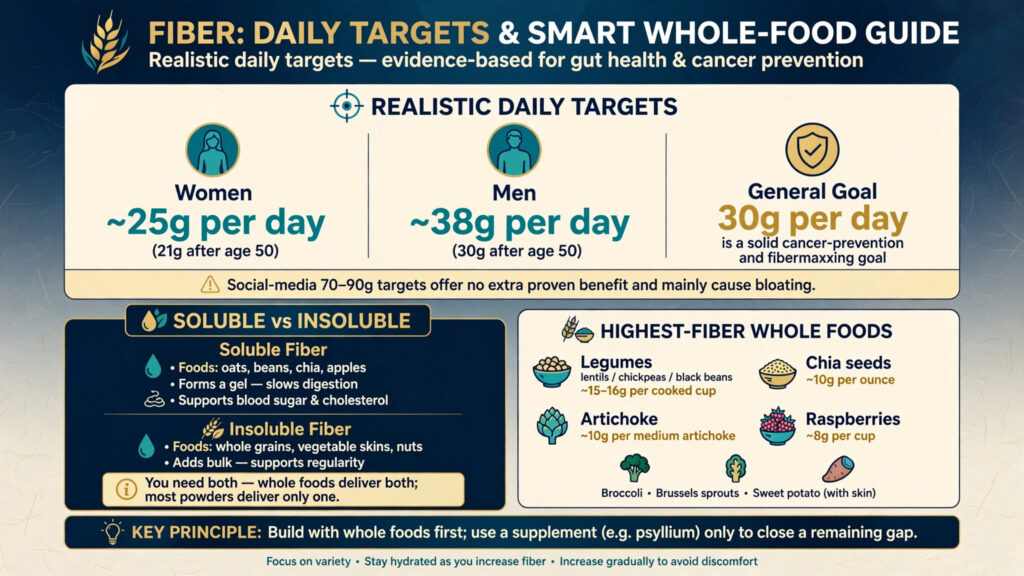
What it isn’t, and shouldn’t be: A race to the highest possible number. Some versions of this trend circulating online promote 70–90 grams a day — roughly triple the actual recommendation and well past anything the research supports as beneficial. There’s no documented benefit to fiber intake much beyond 30 grams daily, and pushing well past it mainly adds bloating, gas, and reduced mineral absorption without added health benefit.
The Actual Target Number (Not the Inflated Social Media Version)
This is where a lot of fibermaxxing content gets sloppy, so let’s be precise:
| Group | Recommended Daily Fiber |
|---|---|
| Women (general adult) | ~25 g |
| Men (general adult) | ~38 g |
| Women over 50 | ~21 g |
| Men over 50 | ~30 g |
| American Institute for Cancer Research (colorectal cancer risk reduction) | At least 30 g |
The widely cited “30 grams” figure that anchors most fibermaxxing content is a reasonable general target and aligns with cancer-prevention guidance, but it’s worth knowing your number can reasonably sit anywhere in the 21–38 gram range depending on your age and sex — there’s no single magic number that applies identically to everyone, and there’s no evidence that going dramatically higher (the 60–100 g/day some social content pushes) provides additional benefit over a typical high intake from whole foods.
Why Fibermaxxing Actually Works (The Science, Briefly)
Fiber does real, measurable things, split across two categories:
Soluble fiber dissolves in water to form a gel-like substance. It slows digestion, moderates blood sugar spikes, and helps manage cholesterol. Found in oats, beans, apples, and chia seeds.
Insoluble fiber doesn’t dissolve — it adds bulk and speeds material through the digestive tract, supporting regularity. Found in whole grains, vegetable skins, and nuts.
You need both, which is exactly why “just take a fiber supplement” isn’t the same strategy as fibermaxxing through whole foods — a single-ingredient powder brings one fiber type, while whole plant foods bring both types plus polyphenols and micronutrients you don’t get from a scoop of powder alone.
Beyond digestion, adequate fiber intake is consistently associated with lower all-cause mortality and reduced cardiovascular disease risk in large population studies — genuinely strong evidence, not wellness-trend hand-waving.
The Content Gap Almost Every Fibermaxxing Article Misses: Food Fiber vs. Supplement Fiber
Here’s something worth understanding clearly, because most competing fibermaxxing content treats “fiber” as one interchangeable pool of grams, when it isn’t:
- Naturally occurring fiber from whole food tends to be gentler and better tolerated, partly because it’s consumed alongside water content, other nutrients, and a mix of fiber types, and partly because intake is naturally self-limiting — high-fiber whole foods are less energy-dense and fill you up before you can overdo it by accident.
- Added or isolated fibers used as supplements or food ingredients (inulin, wheat dextrin, psyllium) are more concentrated and more likely to cause gas, bloating, diarrhea, or constipation if increased too quickly, precisely because you can consume a large dose in seconds that would take much longer to eat as whole food.
The practical guidance this produces: build your fibermaxxing approach primarily around whole foods first, and use a supplement like psyllium husk to close a specific remaining gap — not as your primary fiber source. If you want the detailed dosage, timing, and bloating-prevention protocol for using a supplement this way, this companion guide on psyllium husk: the fiber supplement that actually works covers exactly how to layer it in without the gas that isolated fibers can cause when rushed.
High-Fiber Food List, Organized by Type
Legumes (the highest-fiber category, gram for gram)
- Lentils — ~15–16 g per cooked cup
- Chickpeas — ~15–16 g per cooked cup
- Black beans — ~15 g per cooked cup
- Split peas — ~16 g per cooked cup
Whole Grains
- Oats/oat bran — ~4 g per half cup dry
- Quinoa — ~5 g per cooked cup
- Whole wheat bread — ~3–4 g per slice (check labels — aim for 3g+ per slice)
- Barley — ~6 g per cooked cup
Fruits
- Raspberries/blackberries — ~8 g per cup
- Pears (with skin) — ~5–6 g per medium fruit
- Apples (with skin) — ~4–5 g per medium fruit
- Bananas — ~3 g per medium fruit
Vegetables
- Broccoli — ~5 g per cooked cup
- Brussels sprouts — ~4 g per cooked cup
- Artichokes — ~10 g per medium artichoke
- Sweet potato (with skin) — ~4 g per medium potato
- Raw onion also contributes meaningfully to overall fiber intake alongside fructans that feed beneficial gut bacteria — this guide on the benefits of eating raw onion covers the full nutritional case for it
Seeds and Nuts
- Chia seeds — ~10 g per ounce (about 2 tablespoons)
- Ground flaxseed — ~2 g per tablespoon
- Almonds — ~3.5 g per ounce
- Pumpkin seeds — ~5 g per ounce
Practical Ways to “Layer” Fiber Into Meals You Already Eat
This is the actual habit-building mechanism behind fibermaxxing, and it’s more sustainable than overhauling your diet:
- Add chia or ground flaxseed to yogurt, oatmeal, or smoothies
- Swap white bread and white rice for whole-grain and brown/wild rice versions
- Add a half cup of beans or lentils to soups, tacos, salads, or pasta sauce
- Keep fruit with the skin on (apples, pears) instead of peeling
- Add spinach, shredded vegetables, or beans to omelets and sandwiches
- Choose whole fruit over fruit juice — juice strips out nearly all the fiber
- Roast a tray of mixed vegetables at the start of the week to add to any meal in seconds
Mistakes That Turn Fibermaxxing Into a Bad Week (Read This Before You Start)
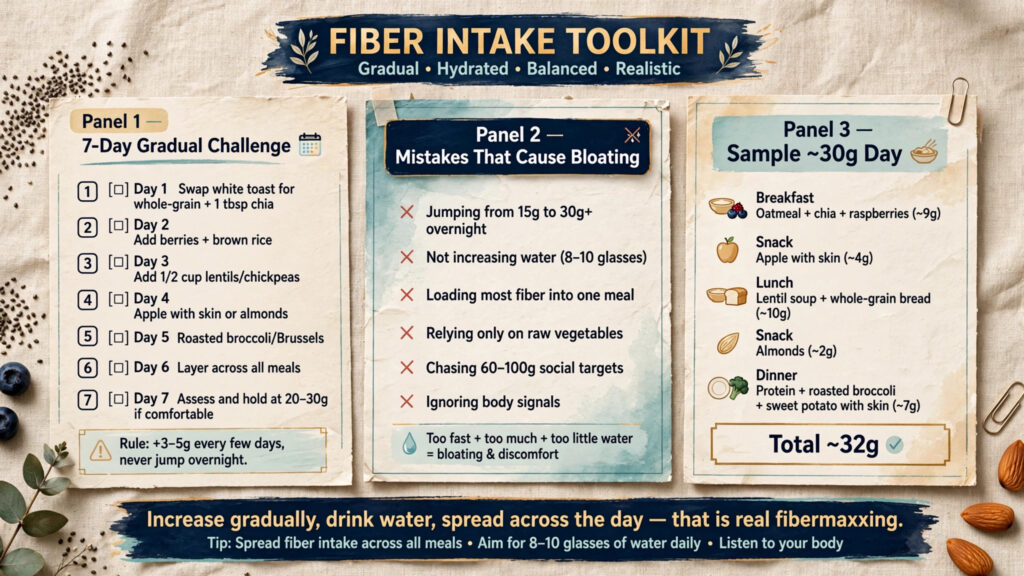
- Jumping from 15g to 30g overnight. This is the single most common mistake, and it’s almost always what’s actually behind “fiber doesn’t work for me” — a speed problem, not a fiber problem.
- Not increasing water intake alongside fiber. Fiber absorbs water in your digestive tract; without matching hydration, you can end up more constipated, not less — the opposite of the intended effect.
- Fibermaxxing in one single meal instead of spreading it out. Loading 20+ grams into one dinner overwhelms your gut far more than the same total spread across the day.
- Relying entirely on raw vegetables. Cooked vegetables and beans tend to be easier to digest and cause less bloating than large amounts of raw produce, especially early in the process.
- Chasing 60–100g/day social media numbers. There’s no documented additional benefit beyond roughly 30g daily for most people, and pushing well past it mainly adds digestive discomfort and can modestly reduce absorption of iron, zinc, and calcium.
- Ignoring your body’s actual signals. “Optimizing” isn’t the same as “maxing out.” The goal is a sustainable, comfortable fiber intake, not a number to win at.
The 7-Day Fiber Challenge
This is a realistic, gradual ramp — not a jump-straight-in plan — designed around the gradual-increase principle every gastroenterologist quoted on this topic emphasizes.
| Day | Fiber Focus | Target Add-On | Sample Swap |
|---|---|---|---|
| 1 | Baseline + breakfast | Add one high-fiber food | Swap white toast for whole-grain toast with a tablespoon of chia seeds |
| 2 | Build on Day 1 | Add ~5g | Add a half cup of berries to breakfast; swap white rice for brown at dinner |
| 3 | Introduce legumes | Add ~5g | Add a half cup of lentils or chickpeas to lunch |
| 4 | Snack upgrade | Add ~3–5g | Swap a processed snack for an apple with skin or a handful of almonds |
| 5 | Vegetable layering | Add ~5g | Add roasted broccoli or Brussels sprouts as a side at dinner |
| 6 | Full-day layering | Add ~5g | Combine strategies from days 1–5 across all three meals |
| 7 | Assess and hold | Reach your target range | Check your rough daily total (20–30g); if comfortable, hold here for a week before adjusting further |
Rules for the week: drink at least 8–10 glasses of water daily throughout, not just when you remember; favor cooked vegetables and legumes over large amounts of raw produce if you notice bloating; and if any day feels genuinely uncomfortable, repeat the previous day’s target rather than pushing forward — this is not a race.
Sample One-Day Fibermaxxing Meal Plan (~30g)
| Meal | Food | Approx. Fiber |
|---|---|---|
| Breakfast | Oatmeal with 1 tbsp chia seeds and half a cup of raspberries | ~9g |
| Snack | Apple with skin | ~4g |
| Lunch | Lentil and vegetable soup with a slice of whole-grain bread | ~10g |
| Snack | Small handful of almonds | ~2g |
| Dinner | Grilled protein, roasted broccoli, and a small sweet potato with skin | ~7g |
| Total | ~32g |
This kind of protein-and-fiber pairing also supports satiety and steadier blood sugar across the day — if you want to make sure your protein target is dialed in alongside your fiber goals, this guide on protein powder for women covers how much protein you actually need and how to build it into meals the same gradual, sustainable way this fiber challenge does.
What Happens If You Increase Fiber Too Fast (So You Know What You’re Avoiding)
Rapidly increasing fiber intake can cause bloating, gas, and abdominal discomfort, largely because your gut bacteria are fermenting more fiber than they’re currently adapted to, which produces hydrogen, methane, and carbon dioxide gas. You may also experience diarrhea or loose stools from highly fermentable fibers, or paradoxically, constipation if you increase fiber without increasing water intake to match. None of this means fiber is bad for you or that you’re “fiber intolerant” — in healthy individuals, high dietary fiber intake doesn’t carry adverse long-term health effects. It almost always means the ramp-up was too fast, which is exactly the mistake this guide’s 7-day challenge is built to avoid.
Does Fiber Intake Affect Nutrient Absorption?
This is a legitimate, evidence-based caveat worth including rather than glossing over: very high intake of phytate-rich fiber can modestly reduce the absorption of iron, zinc, and calcium. This isn’t a reason to avoid a reasonable, whole-food-based fiber target — it’s a reason to avoid chasing the extreme 60–100g/day versions of this trend that circulate online, where the theoretical downside starts to matter more relative to any additional upside, of which there’s little evidence beyond the 30g range anyway.
How Fibermaxxing Connects to Your Broader Gut Health
Fiber is essentially food for your gut bacteria — the fermentable portion feeds beneficial microbes and supports short-chain fatty acid production, which influences everything from inflammation to immune function to mood. This connection runs deeper than digestion alone; this research-based guide on the gut-brain axis and the link between gut health and mental health explains why a fibermaxxing habit can ripple out into areas that don’t seem obviously related to what you eat.
If you’re also using or considering a targeted probiotic strain alongside your fiber increase, it’s worth knowing the two work synergistically — probiotics need fermentable fiber to thrive, and fiber alone doesn’t guarantee the specific strain-level benefits certain probiotics are studied for. This detailed strain-specific guide to probiotics for gut health breaks down exactly which strain to pair with which goal.
And since a huge share of the average American’s fiber shortfall starts at breakfast — the meal most dominated by refined carbohydrates with almost no fiber at all — auditing your mornings specifically tends to produce the biggest single improvement. This breakdown of the worst foods for breakfast you should avoid is a good place to start if mornings are your weak point.
Frequently Asked Questions
1. How much fiber should I actually eat per day? General guidance recommends about 25 grams daily for women and 38 grams for men, dropping to roughly 21 grams and 30 grams respectively after age 50. The commonly cited “30 grams” fibermaxxing target is a reasonable general goal and aligns with cancer-prevention research, but your ideal number can reasonably fall anywhere in that broader range.
2. What is fibermaxxing and is it actually healthy? Fibermaxxing is a social media trend focused on deliberately increasing fiber intake by building meals around fiber-rich whole foods like legumes, vegetables, fruits, and whole grains. Nutrition professionals broadly support the underlying goal since most people eat well below the recommended amount, but it’s healthiest when approached gradually rather than as a race to the highest possible number.
3. Why does fiber make me bloated? Bloating from increased fiber intake usually comes from gut bacteria fermenting more fiber than they’re currently adapted to, producing hydrogen, methane, and carbon dioxide gas, and it’s almost always a speed problem rather than a sign fiber is bad for you. Increasing gradually over 2 to 4 weeks and drinking more water alongside it resolves this for most people.
4. How fast should I increase my fiber intake? Add roughly 3 to 5 grams every few days to a week, rather than jumping straight from a low-fiber diet to 30 grams overnight. This gradual approach gives your gut bacteria time to adapt and significantly reduces bloating, gas, and cramping compared to a sudden increase.
5. Can you eat too much fiber? Yes, in practice, though true medical harm from fiber alone is rare in healthy individuals. There’s no documented additional health benefit beyond roughly 30 grams daily for most people, and very high intakes (60 to 100+ grams, sometimes promoted online) can cause significant digestive discomfort and modestly reduce absorption of iron, zinc, and calcium.
6. What foods have the most fiber per serving? Legumes are the most fiber-dense whole food category, with lentils, chickpeas, and black beans delivering roughly 15 to 16 grams per cooked cup. Chia seeds are also notably concentrated at around 10 grams per ounce, and artichokes provide about 10 grams per medium vegetable.
7. Should I get my fiber from food or supplements? Whole food should be your primary fiber source, since it’s naturally self-limiting, comes with water content and multiple nutrients, and tends to be better tolerated than concentrated supplement fiber. A supplement like psyllium husk works well to close a specific remaining gap once you’ve built a solid food-based foundation, not as a replacement for it.
8. Does fibermaxxing help with weight loss? High-fiber foods tend to be less energy-dense and more filling, which naturally supports appetite regulation and can aid weight management indirectly, though fiber alone isn’t a weight-loss intervention. It works best as part of an overall diet pattern rather than a standalone strategy.
9. Can fiber affect nutrient absorption? Very high intake of phytate-rich fiber can modestly reduce absorption of iron, zinc, and calcium, though this is mainly a concern at the extreme end of fiber intake rather than at a typical, reasonable target around 25 to 30 grams daily from a varied diet.
10. What’s the difference between soluble and insoluble fiber for fibermaxxing? Soluble fiber dissolves in water to form a gel that slows digestion and supports blood sugar and cholesterol management, found in oats, beans, and chia seeds, while insoluble fiber adds bulk and speeds transit to support regularity, found in whole grains and vegetable skins. A well-rounded fibermaxxing approach includes both types rather than focusing on just one.
11. Is 30 grams of fiber a day too much for someone starting from a low-fiber diet? Not as a final target, but it shouldn’t be attempted overnight. Someone starting from 15 grams or less should build up gradually over 2 to 4 weeks using small, regular increases rather than jumping straight to 30 grams, which is the single most common reason people experience bloating and abandon the trend early.
Final Thoughts
Fibermaxxing is one of the rare viral wellness trends built on a genuinely sound premise — most people really are eating about half the fiber they should — but the execution people see online, with dramatic overnight jumps and 70–90 gram targets, is exactly what turns a good habit into a bad week and a permanent “fiber doesn’t agree with me” conclusion. Done properly, it’s simple: build toward roughly 25–30 grams daily using whole foods first, add fiber gradually over a couple of weeks rather than overnight, drink water at every increase, spread it across meals instead of front-loading one, and reach for a targeted supplement like psyllium only to close whatever gap food alone doesn’t cover. Follow the 7-day challenge above at whatever pace your gut actually needs, and this becomes a habit that sticks — not a trend you quit by Thursday.
This article is for informational purposes only and is not a substitute for professional medical advice. Consult your healthcare provider or a registered dietitian before significantly changing your fiber intake, particularly if you have IBS, a history of bowel obstruction, or another existing digestive condition.







Leave a Reply