
Pelvic floor health is one of those topics that most women hear about only twice: once during pregnancy, when someone says “do your Kegels,” and again years later, when a sneeze goes wrong. In between, almost nobody explains what these muscles do, how to tell whether yours are weak or tight, or why squeezing harder isn’t always the answer. This guide to pelvic floor health fills that gap. You’ll learn how the pelvic floor works, the signs that something is off (leaking, pain, heaviness, prolapse), what the best trials say about exercise, and how to handle postpartum recovery and menopause-related changes. You’ll also find clear advice on when to see a pelvic floor physiotherapist instead of fighting this alone.
Educational content only. It doesn’t replace an examination by a doctor or pelvic health physiotherapist.
What the Pelvic Floor Actually Does
Picture a hammock of muscle and connective tissue stretching from your pubic bone at the front to your tailbone at the back, and between your sitting bones at the sides. The bladder, uterus (or prostate in men) and bowel sit above it. The urethra, vagina and anus pass through it.
Those muscles have five jobs, and “holding in pee” is only one of them.
- Support. They hold the pelvic organs in position against gravity and every cough, jump and lift.
- Continence. They close the urethra and anus when you need them closed, and relax so you can empty properly when you don’t.
- Sexual function. They contribute to arousal, orgasm and comfortable penetration.
- Pressure management. They work with your diaphragm, deep abdominal muscles and back muscles to handle the pressure that builds in your abdomen during lifting, coughing and laughing.
- Circulation and stability. They help move blood and lymph and support your pelvis and spine.
The key idea in pelvic floor health is that a healthy pelvic floor isn’t just strong. It’s strong, coordinated and able to let go. A muscle that can only clench is as dysfunctional as one that can’t clench at all. Hold that thought, because it’s the reason generic Kegel advice often disappoints.
Why “Just Do Your Kegels” Falls Short for Pelvic Floor Health
Kegels aren’t useless for pelvic floor health. A well-taught pelvic floor muscle training programme is one of the best-supported treatments in women’s health. The trouble is the way the advice is delivered.
Many people squeeze the wrong muscles. It’s common to tighten the buttocks, thighs or abdomen, hold the breath, or push down instead of lifting. When a teaching clinician checks, a meaningful share of women can’t contract the pelvic floor correctly on their first attempt, and without feedback they’d never know.
Kegels train strength, but you also need endurance, speed and timing. Your pelvic floor has to hold for a long walk, snap shut in the half-second before a cough, and relax completely afterwards.
They ignore tightness. If your muscles are already overactive, 100 extra squeezes a day can make pain, urgency and pelvic discomfort worse.
They happen in isolation. The pelvic floor works as part of a system with your breathing, hips and core. Training it lying down for two minutes doesn’t automatically carry over to coughing on a staircase.
They fade without maintenance. Gains disappear when you stop. A programme that ends at week twelve with no plan afterwards usually ends with symptoms creeping back.
So the pelvic floor health question isn’t “should I do Kegels?” It’s “do I need to strengthen, relax, or both, and am I doing it right?”
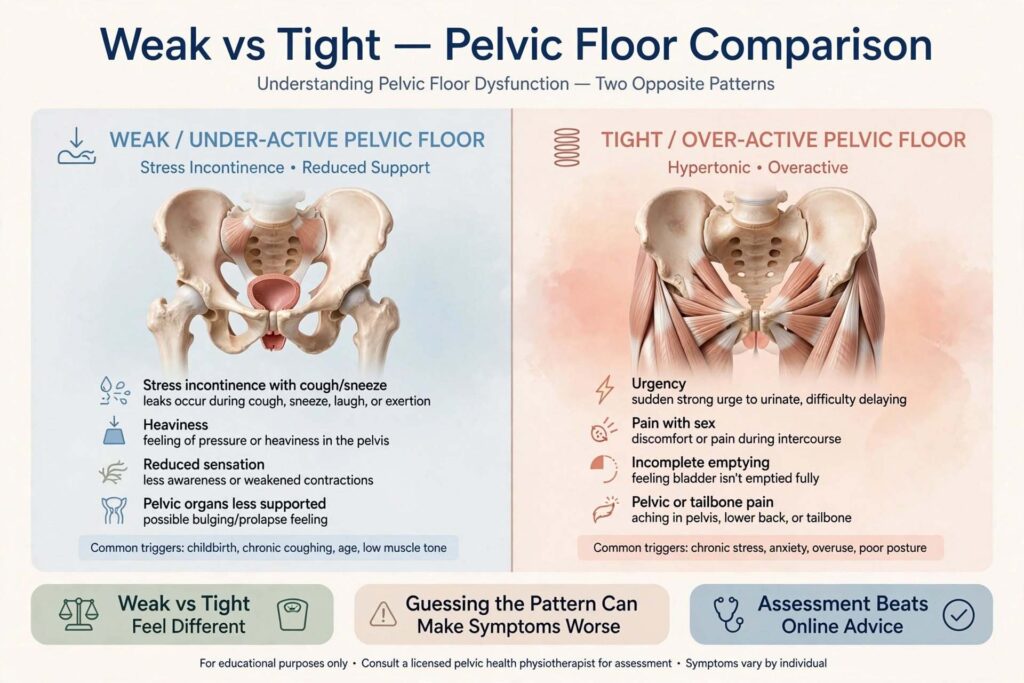
Pelvic Floor Health Warning Signs: Weak vs Tight Pelvic Floor
Both ends of the spectrum can cause bladder symptoms, which is why guesswork about pelvic floor health misleads. Here’s how they tend to differ.
| Weak or under-active | Tight or over-active | |
|---|---|---|
| Bladder | Leaking with cough, sneeze, laugh, jump or lifting (stress incontinence) | Frequent urination, urgency, hesitancy, slow or interrupted stream |
| Bowel | Trouble holding wind or stool | Constipation, straining, feeling of incomplete emptying |
| Pain | Usually painless | Pelvic, lower back, hip or tailbone pain; pain with sex or tampon use |
| Heaviness | Dragging or “something is falling out” sensation, worse at the end of the day | Pressure or burning, often not tied to standing |
| Sex | Reduced sensation, feeling “loose” | Pain on entry or deep thrusting, tightness that’s hard to relax |
| Typical profile | Postpartum, menopause, after surgery, chronic cough | Chronic stress, history of pelvic pain, endometriosis, high-intensity athletes, recurrent UTIs |
Plenty of people have a mix: a weak, uncoordinated muscle that’s also guarded and tense. Leaking is a common pelvic floor health complaint, but it isn’t a normal part of ageing or motherhood. Studies suggest somewhere between a quarter and 40% of adult women report some urinary incontinence, which makes it common and, importantly, treatable.
If you’ve been trying to figure out your symptoms with online tools, our guide to AI self-diagnosis and digital health explains how to use them safely as preparation for a real assessment.
Pelvic organ prolapse
Prolapse happens when the bladder, uterus, rectum or bowel drops into or out of the vaginal canal because the support structures have weakened. Common descriptions include a feeling of heaviness, a bulge you can see or feel, a sensation of sitting on a ball, trouble emptying the bladder or bowel, or discomfort that worsens as the day goes on.
It’s graded by how far the organs descend, and mild prolapse is very common and often causes no symptoms. Pelvic floor muscle training can improve symptoms for many women with mild to moderate prolapse, though evidence that it reverses the anatomical drop is more modest. Options also include vaginal pessaries (supportive devices) and, for severe cases, surgery. A pelvic floor physiotherapist or gynaecologist can tell you which category you’re in.
Who Is at Higher Risk?
- Pregnancy and vaginal birth, particularly with a long second stage, forceps or vacuum delivery, a large baby or significant tearing
- Caesarean births too, since pregnancy itself loads the pelvic floor
- Menopause, when falling estrogen thins and weakens pelvic tissues
- Chronic cough, constipation or straining (smoking, asthma, long-standing bowel habits)
- Heavy lifting in work or training, especially with breath-holding
- Higher body weight, which increases constant pressure on the pelvis
- Pelvic or abdominal surgery, including hysterectomy
- High-impact sport such as running, gymnastics, CrossFit and trampolining
- Joint hypermobility and connective tissue differences
- History of pelvic pain, trauma or abuse, which can lead to protective tightening
- Family history
Men aren’t exempt from pelvic floor health problems. After prostate surgery or with chronic pelvic pain, men can benefit from the same type of training, and most of what follows applies to them too.
What the Evidence Says About Pelvic Floor Health and Training
The research on pelvic floor health is among the more reassuring in everyday medicine.
It works. Cochrane reviews of pelvic floor muscle training in women conclude that it can cure or improve symptoms of stress incontinence and other types of urinary incontinence, and that women who trained were more satisfied and less likely to seek further treatment than controls. That’s why it’s recommended as first-line treatment.
Supervision matters. When researchers compared approaches, the strongest consistent finding was that women who had regular contact with a health professional did better than women left to exercise alone. In one pooled comparison for stress incontinence, around 10% of women with more frequent professional contact reported no improvement, versus about 43% of women who had only individual appointments. A 2023 meta-analysis found supervised programmes did better for quality of life and muscle function, and also found that unsupervised programmes can work when they include proper education and regular reassessment.
Dose and patience. Most successful programmes run for at least three months. Typical guidance, including from national guidelines, is around eight contractions, three times a day, though the optimal approach isn’t settled and a physiotherapist should tailor it.
Antenatal and postpartum benefits are real, but they don’t last on their own. Training during pregnancy and after birth reduces postpartum incontinence. A long-term follow-up of one large trial, however, found no group difference after seven years, which tells us the protection fades if training isn’t continued.
Prolapse evidence is more modest. Training helps symptoms, but results on prolapse progression are less consistent.
Put simply, the evidence on pelvic floor health supports training, with good teaching, regular check-ins and enough time. It doesn’t support guessing.
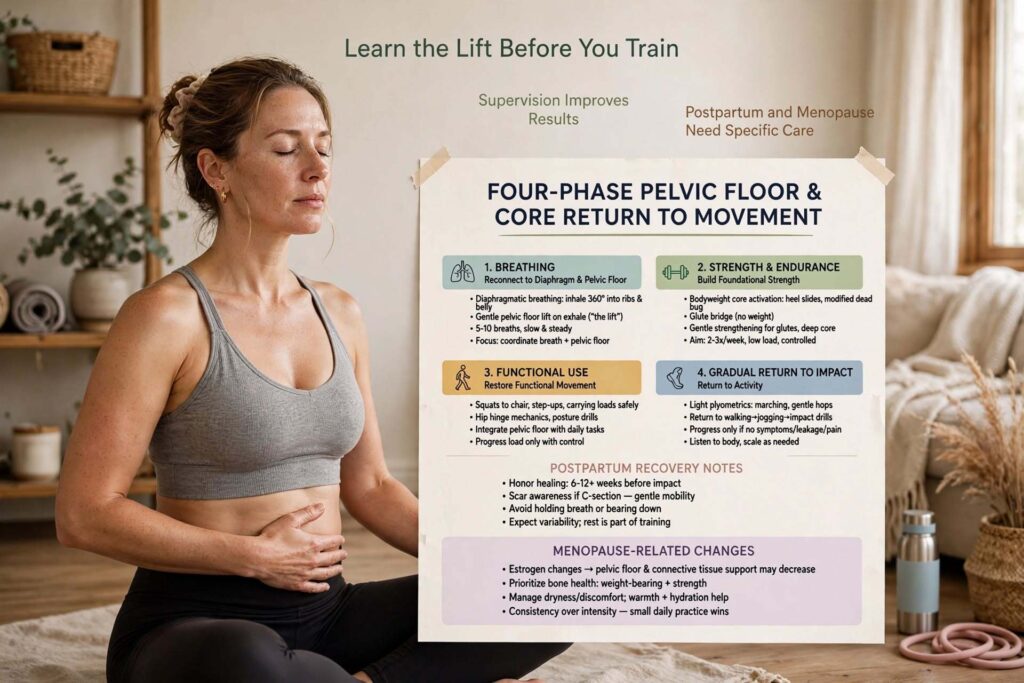
How to Find and Check Your Pelvic Floor Muscles
Before you build a pelvic floor health routine, you need to know you’re activating the right muscles.
The lift and squeeze. Sit or lie comfortably. Imagine stopping yourself passing wind, then imagine also stopping the flow of urine. Aim for a gentle internal lift, up and in, as if closing and drawing a zip upward from the back to the front. Your abdomen, buttocks and thighs should stay relatively quiet, and you should keep breathing.
Quick checks. Place a hand lightly over your lower abdomen: you shouldn’t feel a big bulge or tightening. In a mirror, you might see a small lift of the perineum. Seated on a firm surface, you may feel a subtle lift away from it.
A caution about the toilet. Stopping the flow of urine mid-stream is fine as a one-off test to identify the muscles, but don’t use it as an exercise. Doing it regularly can interfere with normal bladder emptying.
If you can’t feel anything, or you feel only downward pushing, or you feel pain, that’s information. Book an assessment. It’s much cheaper to learn the technique early than to train the wrong pattern for months.
A Practical Pelvic Floor Health Programme
This pelvic floor health framework is general, not a prescription. Adjust it with a clinician if you have pain, prolapse symptoms or a recent birth or surgery.
Phase 1: Breathing and awareness (week 1 to 2)
Your diaphragm and pelvic floor move together. On the inhale, the diaphragm lowers and the pelvic floor softens and lengthens slightly. On the exhale, both recoil upward.
- Lie on your back with knees bent. Breathe in for four seconds, letting your ribs and belly expand and your pelvic floor relax.
- Breathe out for six seconds, gently drawing the pelvic floor up as you exhale.
- Practise five minutes, once or twice a day.
This phase alone helps many women who’ve been over-gripping.
Phase 2: Strength and endurance (week 3 onward)
- Long holds: squeeze and lift, hold up to 10 seconds (build up gradually), then relax fully for the same count. Repeat 8 to 12 times.
- Quick flicks: fast, firm contractions, one second on, one second off, 10 repetitions.
- Do the set up to three times a day, or as your physiotherapist advises.
- Always relax fully between reps. The release is half the exercise.
Phase 3: Make it functional
- The Knack: contract the pelvic floor just before and during a cough, sneeze or lift. Practise on purpose until it becomes reflex.
- Everyday positions: progress from lying to sitting to standing to walking.
- Strength work that includes the floor: glute bridges, squats, hip hinges (deadlift pattern), bird dogs, and side-lying leg lifts. Exhale on the effort.
Strong hips and glutes support the pelvis, and adequate protein supports muscle repair, which we cover in our guide to protein powder for women and our feature on sex-specific nutrition for women.
Phase 4: Return to impact
If you leak when you run or jump, work back to impact gradually: brisk walking, then low-impact intervals, then short jogging blocks, then full running. If symptoms appear, step back a stage rather than pushing through.
Pelvic Floor Health When You’re Too Tight: Relax First
For a tight pelvic floor, the aim is the opposite of a Kegel.
- Diaphragmatic breathing with a deliberate “drop” of the pelvic floor on each inhale
- Child’s pose, happy baby and deep supported squat to lengthen the muscles
- Warm baths, heat packs and gentle hip mobility work
- Reduced straining and a better toilet posture
- Avoiding “just in case” clenching during the day and noticing where you hold tension: jaw, glutes, belly
Manual therapy, trigger point release, biofeedback and sometimes a guided dilator programme may be used by a pelvic physiotherapist, particularly for painful sex or persistent pelvic pain. Evidence for some techniques is thinner than for strength training, which is another reason to work with someone experienced.
Daily Habits That Protect (or Strain) Pelvic Floor Health
Exercise helps pelvic floor health. Daily habits can undo it.
Bladder habits. Avoid going “just in case” many times a day, which can train the bladder to feel full at lower volumes. Don’t hover over public toilet seats, because it prevents the pelvic floor from relaxing. Drink enough fluid, since concentrated urine irritates the bladder, and watch caffeine, fizzy drinks and alcohol if urgency is an issue.
Bowel habits. Constipation and straining are some of the biggest drivers of pelvic floor damage over time. Eat enough fibre, drink water, and put your feet on a small stool so your knees sit above your hips. Breathe out and let things move rather than holding your breath and pushing.
Lifting. Exhale on the effort and brace gently, rather than holding your breath.
Cough control. A chronic cough puts repeated strain on the floor. Treat the cause. Our guides to natural remedies for cold, flu and sore throat and walking pneumonia cover common reasons for a lingering cough and when to get it checked.
Weight and movement. Even modest weight loss can reduce stress incontinence in people carrying extra weight, and regular walking helps your bowel and mood.
Sleep and stress. Stress makes people clench, and poor sleep reduces tissue repair. Our articles on light hygiene and low-friction prevention show how to build sleep and habit routines that survive real life.
Pelvic Floor Health After Childbirth
Pregnancy and birth change pelvic floor health more than any other life event, and the postpartum period is where the advice gap is widest.
What’s normal. In the first weeks, soreness, swelling, some leaking and a feeling of heaviness are common, and much of it improves over the first year as muscle and connective tissue recover. Researchers estimate roughly one in four women has urinary incontinence after birth, and risk goes up with a vaginal birth, instrumental delivery, a large baby, higher maternal age and body weight, and incontinence before or during pregnancy. Caesarean birth lowers the risk but doesn’t remove it.
What to do early.
- Gentle contractions and breathing exercises can start in the first days if comfortable, unless your clinician advises otherwise.
- Prioritise soft stools, a stool for your feet, and good perineal care.
- Walk short distances, increasing slowly.
- Avoid heavy lifting beyond your baby where possible in the early weeks.
Don’t wait for the six-week check to look after pelvic floor health. Many routine checks don’t include a pelvic floor assessment. If you’re leaking, in pain, feeling a bulge or dreading sex, ask for a referral to a pelvic health physiotherapist. In some countries it’s a standard part of postnatal care. Elsewhere, you may need to ask.
Tears and stitches. Tears are graded one to four. If you had a third- or fourth-degree tear, follow-up with a specialist is important, especially for bowel control.
Returning to running and high-impact exercise. Most expert guidance suggests waiting around three months before running, and longer if you have symptoms such as leaking, heaviness or pain. Build up gradually.
Evidence summary. For postpartum pelvic floor health, muscle training reduces urinary incontinence and improves muscle function. Its effect on prolapse is less certain. The benefits fade if you stop, which is why a long-term maintenance plan matters.
Sleep deprivation and feeding. Low estrogen while breastfeeding can cause vaginal dryness and painful sex, which is common and treatable. Don’t tolerate it quietly.
Hormones, thyroid and iron also shape how you feel after birth. Our guides to women’s hormonal health and iron deficiency and anemia in women are worth a read if you’re exhausted well beyond what a newborn explains.
Pelvic Floor Health and Menopause
Estrogen keeps vaginal, urethral and bladder tissue thick, elastic and well-lubricated. When estrogen falls during perimenopause and after menopause, those tissues thin and weaken. That’s why many women notice new pelvic floor health problems in their late 40s and 50s even if they never had a problem before.
Common changes include:
- Vaginal dryness, burning or irritation
- Pain with sex
- Urgency and frequency
- Recurrent urinary tract infections
- More stress incontinence
- A feeling of heaviness or prolapse symptoms
Together these are known as genitourinary syndrome of menopause, and unlike hot flashes, they usually get worse over time without treatment rather than fading.
What helps:
- Pelvic floor muscle training still works, and often works well alongside other treatment.
- Low-dose vaginal estrogen (creams, tablets or rings) is an effective, widely used treatment for genitourinary symptoms and may reduce urgency and recurrent UTIs. It acts locally with very little absorbed into the bloodstream, but discuss it with your clinician, especially if you have a history of hormone-sensitive cancer.
- Vaginal moisturisers and lubricants for dryness and comfortable sex.
- Resistance training and weight-bearing exercise for muscle and bone.
- Treating constipation and chronic cough.
Our guides to perimenopause symptoms and how to manage them and perimenopause and menopause natural remedies go deeper on the wider picture. Ask your doctor about these symptoms directly. Many women assume they’re an unavoidable cost of ageing and never mention them.
Pain, Sex and the Pelvic Floor
Painful intercourse, difficulty using tampons, or a reflexive clenching when penetration is attempted aren’t “in your head,” and they aren’t something to grit your teeth through. Overactive pelvic floor muscles, vaginismus, endometriosis, low estrogen, scar tissue and infections can all contribute. A good pelvic physiotherapist, often working with a gynaecologist, can combine education, breathing, relaxation, graded desensitisation and sometimes dilator therapy. Many people are surprised by how much pelvic floor health treatment helps.
Pelvic Floor Health Gadgets and Gimmicks: Are They Worth Your Money?
The market for pelvic floor health devices has exploded, and here’s where a cost-versus-benefit mindset is useful. Before you spend, ask what the evidence says and what a physiotherapy session would cost for the same money.
- App-guided trainers and biofeedback devices can help you see whether you’re contracting correctly, which is genuinely useful, particularly if you can’t feel the muscle. Quality varies.
- Vaginal weights and cones have some evidence but need to be used properly and aren’t suitable for everyone.
- Electrical stimulation and “magnetic chair” treatments have mixed evidence and are expensive. They might help some people who can’t contract voluntarily, but they aren’t a shortcut for most.
- Generic exercise apps aren’t harmful but don’t replace assessment.
- “Tightening” supplements and creams have no solid evidence behind them.
A pragmatic rule for pelvic floor health spending: if you’ve spent more than the price of one physiotherapy session on gadgets without improvement, book the session.
Pelvic Floor Health: When to See a Physiotherapist or Doctor
Book an assessment if you:
- Leak urine or stool, even “just a little”
- Feel a bulge, heaviness or dragging in the vagina
- Have pain in the pelvis, vulva, tailbone or with sex or tampons
- Struggle to empty your bladder or bowel fully
- Have constipation that needs regular straining
- Are pregnant and want to prepare, or postpartum and unsure how to recover
- Have had pelvic surgery or radiotherapy
- Have followed a programme for 8 to 12 weeks without improvement
- Are returning to running or heavy lifting and have any symptoms
See a doctor promptly or go to emergency care if you have:
- Sudden inability to pass urine
- Blood in the urine, or bleeding after menopause
- New loss of bowel control
- Numbness around the genitals or buttocks, with back pain and bladder or bowel changes, which can signal cauda equina syndrome and needs urgent care
- Severe pelvic pain with fever, or a bulge that’s dark, painful or can’t be pushed back
- Heavy bleeding or fever in the days after childbirth
What to expect at a first appointment
A typical session includes a conversation about your bladder, bowel, pain, sexual function, births and exercise history. You may be asked to keep a bladder diary. An examination can include external observation and, only with your consent, an internal assessment to check strength, coordination and tenderness. Some clinics use real-time ultrasound instead. You can say no to any part, and you can bring a chaperone.
Treatment for pelvic floor health problems usually involves a handful of sessions over two to three months, with home exercises and follow-up. In many countries you can book directly or ask your GP for a referral. In India, look for women’s health or pelvic health physiotherapists with specific postgraduate training, and ask what their experience is with your concern.
Common Myths About Pelvic Floor Health
“Everyone should do Kegels.” Not if your muscles are tight, painful or already overactive.
“Leaking is normal after having children.” It’s common, not normal, and it’s treatable.
“It’s just ageing.” Age plays a part, but training and treatment still work at any age.
“Pads solve it.” Pads manage the symptom. They don’t fix the cause.
“Surgery is the only fix for prolapse.” Many women manage mild and moderate prolapse with training, lifestyle changes or a pessary.
“Stopping my pee mid-flow is good exercise.” It’s a one-off test, not a workout.
“If it doesn’t hurt, it’s fine.” Weakness and prolapse are often painless.
Where to Go Next
- Hormones and the cycle: Women’s hormonal health, Cycle syncing guide
- Perimenopause and menopause: Symptoms and management, Natural remedies
- Strength and nutrition for women: Protein powder for women, Sex-specific nutrition, Iron deficiency in women
- Habits and sleep: Low-friction prevention, Light hygiene
- Using online health tools wisely: AI self-diagnosis and digital health
- Browse more: Women’s Health, Health & Wellness
Frequently Asked Questions About Pelvic Floor Health
1. What is pelvic floor health and why does it matter?
Pelvic floor health describes how well the muscles at the base of your pelvis support your organs, control your bladder and bowel, contribute to sexual function and manage pressure during movement. When they work well, you rarely think about them. When they don’t, leaking, pain, heaviness and discomfort can affect work, exercise and relationships.
2. Are Kegels enough for pelvic floor health?
For many people, a properly taught programme works well, but Kegels alone often aren’t enough. You also need correct technique, endurance and quick contractions, use of the muscles in daily movements, strength work for the hips and core, and, if you’re tight, relaxation training.
3. How do I know if my pelvic floor health problem is weakness or tightness?
Weak muscles tend to cause leaking with effort and a dragging heaviness. Tight muscles tend to cause pain, urgency, incomplete emptying, constipation and painful sex. Some people have both. A pelvic physiotherapist can tell you which, often within one session.
4. How long does it take to improve pelvic floor health?
Most research uses programmes of at least three months, and many women notice improvement within six to twelve weeks of consistent training. Gains fade if you stop, so plan for maintenance.
5. Can I do Kegels if I have pelvic pain?
Not until you’ve been assessed. If your muscles are overactive, extra squeezing can make symptoms worse. Relaxation, breathing and manual therapy usually come first.
6. How can I improve pelvic floor health after a baby?
Start with gentle breathing and low-effort contractions when comfortable, walk gradually, avoid straining, and ask for a pelvic health physiotherapy referral rather than waiting for symptoms to resolve alone. Build up strength work and impact slowly, and keep training beyond the early months.
7. When can I run after giving birth?
Many guidelines suggest waiting about three months, and longer if you leak, feel heaviness or have pain. A gradual return, starting with walking and short jogging intervals, protects the pelvic floor. A physiotherapist can check you are ready.
8. Does menopause affect pelvic floor health?
Yes. Falling estrogen thins and weakens pelvic tissues, which can cause dryness, urgency, recurrent UTIs, painful sex and more leaking. Pelvic floor training, vaginal moisturisers and, for many women, low-dose vaginal estrogen can help. Talk with a clinician about the right mix.
9. Can a prolapse get better without surgery?
Mild and moderate prolapse often improves in terms of symptoms with pelvic floor training, lifestyle changes and sometimes a pessary. The anatomical drop doesn’t always reverse. Surgery is generally reserved for severe or persistent symptoms.
10. When should I see a physiotherapist about pelvic floor health?
Whenever you leak, feel a bulge or heaviness, have pelvic or sexual pain, struggle to empty your bladder or bowel, or want a safe postpartum or post-surgery plan. Seek urgent care for sudden inability to pass urine, new loss of bowel control or numbness around the genitals with back pain.
Final Thoughts
Pelvic floor health deserves the same attention as your heart, your back or your knees, and it responds just as well to good training and good habits. The main lessons of pelvic floor health are simple: learn to find and use the muscles correctly, train strength and relaxation, match your approach to your life stage, protect the floor in everyday habits, and get assessed rather than guessing when symptoms persist. Leaking, heaviness and pain are common, they’re treatable, and you don’t need to tolerate them quietly.
If you take one action for your pelvic floor health after reading this, make it a short breathing and awareness session tonight, and book an assessment if anything in this guide sounded familiar. For more practical, evidence-led guides, visit our Women’s Health section.
Disclaimer: this article is general education and not medical advice. Seek personal assessment from a qualified healthcare professional for symptoms, and urgent care for any warning signs described above. See our full disclaimer.
Research referenced: the Cochrane review of pelvic floor muscle training versus no treatment for urinary incontinence in women (abridged republication); the Cochrane comparison of approaches to training (summary); the 2023 supervised versus unsupervised meta-analysis; the seven-year follow-up of antenatal training; and the 2026 postpartum incontinence and prolapse lecture abstract from the International Continence Society.






Leave a Reply