
Nobody gets admitted to hospital with “lonely” on the chart. The heart attack gets written down, and so does the stroke and the pneumonia, but the empty evenings behind them don’t, and that’s a big reason the loneliness epidemic stayed off the medical radar for so long.
It’s on the radar now. In June 2025 the World Health Organization’s Commission on Social Connection said one in six people on the planet is affected by loneliness and linked it to about 871,000 deaths a year. I’ve spent a while with the studies behind that loneliness epidemic number, and my view is this: the headline version is a little exaggerated, the underlying findings are not, and the usual advice (“just get out more!”) is mostly wrong. Below I go through what loneliness does to your heart, brain and immune system, how it differs from being happily alone, what it looks like in your twenties, with a newborn and in old age, and what actually helps.
General information only. If you feel hopeless or you’re thinking of hurting yourself, talk to a doctor or a crisis line today. Numbers are near the end.
Three words that get mixed up
Most articles on the loneliness epidemic treat these as one thing. The research doesn’t, so I won’t.
Loneliness is a feeling: the gap between the company you have and the company you want. You can have it at your own wedding.
Social isolation is a headcount. How many people do you speak to in a week, and who would you ring at 2 a.m.? A man with two close friends and a quiet life may be perfectly fine. A woman with 400 WhatsApp contacts may not be.
Living alone is an address. That’s all.
They overlap, and the studies measure them differently, which is why you’ll see “26% higher risk” in one place and “32%” in another and think someone made a mistake. Nobody did. They’re counting different people.
The loneliness epidemic numbers, and why I don’t trust the loud version
About 1 in 6 people worldwide report loneliness, according to the WHO. The 871,000 deaths a year (roughly 100 an hour, which is the figure that went viral) is a modelled estimate from cohort studies, not a count from death certificates. Treat it as “very large”, not as precise.
The detail that surprised me is who’s lonely. Not pensioners, mainly. Teenagers. About 21% of 13-to-17-year-olds and 17% of 18-to-29s report it, against much lower figures in middle age. It’s also higher in low-income countries (around 24%) than rich ones (around 11%). Isolation, the headcount kind, may touch up to a third of older adults.
And “epidemic”? The word implies a curve that’s shot up. The WHO data is mostly a snapshot of how common it is now, not proof of a steep climb. I still think the word is fair. Plenty of things worth worrying about don’t follow a clean upward line.
What the loneliness epidemic does to the body
Quick warning first: almost all loneliness epidemic research is observational. People get followed for years and researchers see who ends up ill. That can show a link, never prove a cause. Keep that in mind and read on.
Death. The loneliness epidemic’s best-known study is Julianne Holt-Lunstad’s 2010 paper, which pooled 148 studies and about 309,000 people. Those with stronger relationships were roughly 50% more likely to survive the follow-up. Her 2015 follow-up split the three ideas: 29% higher chance of dying for isolated people, 26% for lonely ones, 32% for people living alone.
You’ll have heard “as bad as 15 cigarettes a day”. I wish people would stop saying that. It’s catchy, it’s loosely based on those numbers, and the error bars around it are huge. What you can say safely is that the link is big enough to be mentioned alongside smoking.
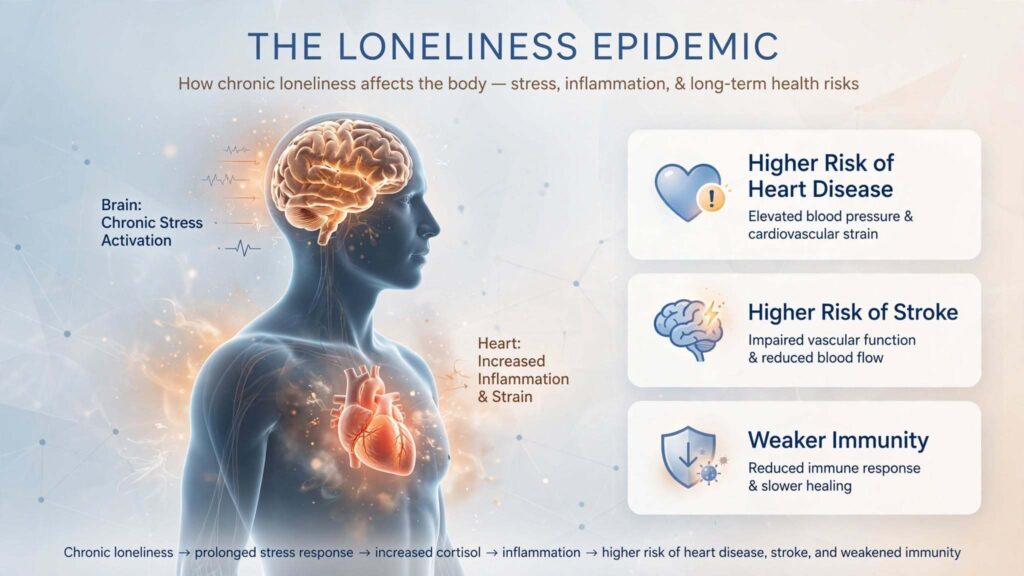
Heart and stroke. This is the best-evidenced part of the loneliness epidemic’s health case. A 2016 review in Heart pooled studies with 4,628 coronary events and 3,002 strokes, followed for between 3 and 21 years. Poor social ties meant a 29% higher risk of coronary heart disease and 32% higher risk of stroke. The American Heart Association’s 2022 statement added the figure that stuck with me: people with three or fewer social contacts a month had about a 40% higher risk of a second heart attack or stroke. Some of it is habit. Lonely people walk less, eat fewer vegetables and sit more. But the link survived adjusting for those, so stress biology is the likelier suspect for the rest.
Dementia. Meta-analyses, one covering over 2.3 million people, tie loneliness, little social contact and living alone to higher dementia risk, and the Lancet Commission on dementia now counts social isolation as a modifiable risk factor. But here the arrow may point backwards. Early dementia makes people withdraw long before anyone diagnoses it, so isolation can be the symptom.
Immunity. Lonely people show higher inflammation markers (CRP, interleukin-6). In a few smaller experiments people with thin social networks were likelier to get ill after being exposed to a cold virus, and some responded worse to vaccines. I’d call this plausible, not proven. A body that’s always slightly on guard pumps out more cortisol, sleeps worse, inflames more. If you pick up every winter infection going, our guide to natural remedies for cold, flu and sore throat is worth a read.
Sleep and blood pressure. Lonely people sleep lighter and wake more. In some older groups blood pressure runs higher too. A brain scanning for social threat doesn’t switch off at 11 p.m., and a bad night makes the next day feel lonelier, so it loops. If your nights are part of the problem, start with light hygiene and circadian health, then our sleep hygiene and cortisol and stress pages.
Mood. The loneliness epidemic feeds depression and anxiety, and depression makes picking up the phone feel impossible. Each one props the other up. Our Mental Health section has practical help.
| What | What the studies find | How firm |
|---|---|---|
| Early death | 26% to 32% higher, depending on definition | Large meta-analyses, observational |
| Heart disease | About 29% higher | Pooled cohorts, consistent |
| Stroke | About 32% higher | Pooled cohorts, consistent |
| Dementia | Higher with isolation and little contact | Mixed; reverse causation likely |
| Inflammation, immunity | Higher markers, some weaker vaccine response | Smaller studies |
Where the loneliness epidemic evidence is shaky
I trust the direction of the loneliness epidemic findings more than the exact percentages. Illness makes people lonely just as loneliness might make them ill: chronic pain, bad hearing, poor mobility, a long recovery. Researchers adjust for it and can’t fully remove it. Studies also measure loneliness in different ways, some asking “do you feel lonely?” and others counting visits, then get pooled together. Nearly all the data comes from richer countries.
The big gap is on the fixing side. We have plenty of studies showing that loneliness goes with heart disease. We have hardly any that follow people for years after reducing loneliness and check whether the heart disease went away.
That’s not a reason to shrug. Being lonely is miserable enough that you’d want to fix it even if it did nothing to your arteries. Think of the health link as a second reason, not the only one.
Alone is not lonely: solitude and the loneliness epidemic
I have nothing against time by yourself, and the loneliness epidemic isn’t about that. Chosen solitude does good: it settles strong emotions, gives you room to think, lets you recover after a crowded day. What matters is that you chose it and that it’s in moderation. A quiet Sunday you picked and the same Sunday you were stuck with feel nothing alike.
My rough test: at the end of an evening alone, do you feel topped up or hollowed out? If you wanted to call someone, could you? If the answer to the second question is “nobody would pick up”, that’s loneliness, however introverted you are. Introverts just need smaller doses of company. They’re not lonelier.
The warning signs that solitude’s gone sour: it keeps getting longer, you’re avoiding people out of dread, it feels like proof nobody wants you, or you’ve stopped doing things you used to enjoy.
The loneliness epidemic in your twenties, with a newborn, and in old age
In your twenties
Picture someone twenty-five who moved cities for a job eighteen months ago. College friends have scattered, colleagues are friendly and that’s it, and the group chat is loud and empty. Studying handed out friends automatically. Working life doesn’t, and arranging everything yourself feels needy, so you don’t.
That’s why the loneliness epidemic hits the young hardest. Leaving school, moving, shaky jobs and hours spent looking at other people’s polished lives all land at the same time. In India the loneliness epidemic adds the PG or hostel room, a new language in a new city, and family a train ride (or a flight) away.
What works against the loneliness epidemic is dull: repeat things. A weekly class, a football team, a Sunday volunteering shift. Friendship comes from repeated low-pressure contact, and one-off mixers rarely give you that. One often-quoted estimate says it takes about 50 hours together to go from acquaintance to casual friend, roughly 200 for a close one. Treat the numbers as rough, but the point stands, closeness gets built. And be the one who suggests the second coffee. Almost everybody is secretly hoping somebody else will. If you’ve just moved and your routine is a mess, our piece on low-friction prevention shows how to hang new habits on ones you already have.
With a newborn in the loneliness epidemic
No one tells you a baby can make you lonelier than you’ve ever been, partly because you’re never technically alone. Leave takes away the office, broken sleep takes away the energy to see anyone, childless friends drift off and friends with kids are knackered too. Fathers usually go back to work within days, and their isolation gets noticed even less. Low social support is a known risk for postnatal depression, and depression makes reaching out harder still.
Find people at the same stage (baby classes, library sessions, a local parents’ group), since shared circumstances need no explaining. Ask for something specific. “Can you come Thursday for an hour so I can sleep?” gets a yes. “Let me know if you can help” gets nothing. Protect one adult conversation a day, even ten minutes on the phone. A pram walk counts as socialising if somebody’s walking next to you.
And look after your body. Pain, leaking and exhaustion all make leaving the house harder. Our guides to pelvic floor health and iron deficiency and anemia in women cover things routinely missed at postnatal checks, and women’s hormonal health explains why mood can swing for months. If low mood, anxiety or “I can’t cope” hangs around, tell your doctor or midwife soon, not once things calm down.
In old age
Retirement ends the daily contact of work. A partner dies. Children move away, often abroad, and in many Indian families the older generation now lives apart from the children for the first time in generations. Hearing fades, eyesight dims, driving stops, and every small loss makes the next invitation easier to turn down. The chai at the gate with neighbours doesn’t happen when everyone lives in separate flats with a lift.
For this group the loneliness epidemic overlaps with the conditions above: heart disease, stroke, memory. What helps is structure, not good intentions. A walking group, a choir, a temple or church committee, a hobby club or a volunteering role works because it happens whether or not you feel like it. “I should ring people more” doesn’t. Check hearing; fixing it can reopen conversation. Sort out transport, because that’s often the real barrier. Video calls help when there’s a relationship to keep going, preferably with someone patient setting it up. And give older people a job. Teaching, mentoring, minding grandchildren, community work: feeling useful is half the treatment.
Some people face extra barriers at any age: carers, people with disabilities, migrants, refugees, LGBTQ+ people, remote workers. If that’s you, you’re not bad at friendship. The setup is working against you.
What actually works against the loneliness epidemic (and the part that surprised me)
I expected the research to say “get out more.” It mostly doesn’t.
The best-known meta-analysis of loneliness interventions (Masi and colleagues) found the winners were programmes working on how lonely people read other people: their social thinking. Putting lonely people in a room together did worse, and so did teaching social skills. A later umbrella review of randomised trials found mindfulness, social cognitive training and social support all reduced loneliness, but the certainty was low or very low and social support’s effect was small. So hold it loosely.
Why would thinking beat contact? Because loneliness rewires how you handle people. You spot rejection faster, read a neutral face or a late reply as a snub, and pull back to protect yourself, which removes the contact that would have helped. A party doesn’t break that loop.
So begin with the thoughts. When you catch “they don’t really want me there” or “I’d just be a burden”, write it down and ask what else could be true. Treat social guesses as small experiments: send the message and see what comes back. People are usually startled by how warm the reply is. Assume a slow answer means a busy person. And watch your own cancelling. “I’m too tired” feels sensible every single time, and it adds up. If the pattern runs deep or comes with low mood, therapy (cognitive behavioural therapy is the best studied) is worth it.
After that, structure starts to pay off:
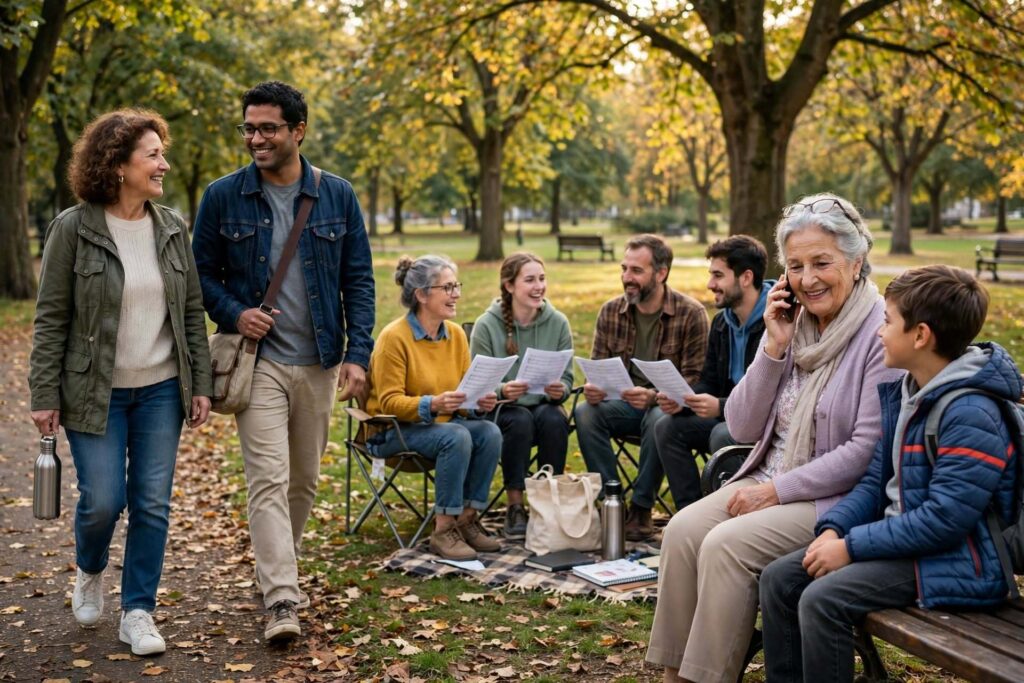
- Join something that repeats and has a task: a walking club, choir, sports team, volunteering, a class.
- Count small talk. In experiments people consistently underestimate how much they’ll enjoy a brief chat with a stranger.
- Aim for one or two people who really know you rather than a long list.
- Message someone you’ve drifted from. People like surprise messages more than the sender expects.
- Use messaging to keep friendships warm between meetings, not to replace them.
- Protect sleep, daylight and movement. They change how brave you feel socially.
Weak bets against the loneliness epidemic: vaguely “putting yourself out there”, one-off big events, and loneliness apps or AI companions. A chatbot might comfort you in the moment, but there’s little evidence it reduces loneliness over time, and it can’t replace a person. Our guide to AI self-diagnosis and digital health gives you a way to judge any health-related digital tool.
One month against the loneliness epidemic, in small steps
Loneliness makes big plans feel impossible, so keep this modest. Week one, just notice: write down when you feel most alone and what you were doing, and pick one relationship worth warming up. Week two, send two short messages to people you’ve lost touch with, with something specific in them (“saw this, thought of you”), and don’t wait for perfect wording. Week three, commit to one repeating group activity and go three times before judging it, because most people quit after one awkward visit. Week four, look back at which contact left you feeling better and which thought stopped you.
Money people will recognise this: relationships behave like a long-term investment. Small regular deposits compound. One large payment every few years doesn’t, and a neglected account is much harder to restart.
If the loneliness epidemic has caught someone you love
Reach out first and keep doing it, because lonely people often stop initiating. Be specific: “walk on Saturday morning?” works better than “we should catch up.” Listen without fixing. They don’t want a list of clubs. A weekly phone call beats an occasional grand gesture. And watch for changes in sleep, appetite or self-care, or any talk of hopelessness, and push gently towards professional help.
When it’s more than loneliness
See a GP, counsellor or mental health professional if loneliness has lasted weeks, you’ve stopped enjoying things you used to like, your sleep or appetite has changed, you feel worthless, or you’re leaning on alcohol to get through.
If you’re thinking of harming yourself or ending your life, contact emergency services or a crisis line now. In the US call or text 988. In the UK, Samaritans are on 116 123. In India, Tele-MANAS is on 14416. Helpline numbers change, so check the current one for your country, and if you’re in immediate danger call your local emergency number. A real person is the right help here.
Where to go next
- Mental wellbeing: Mental Health
- Sleep and stress: Light hygiene and circadian health, Sleep hygiene, Cortisol and stress
- Habits that last: Low-friction prevention
- New parents: Pelvic floor health, Women’s hormonal health, Iron deficiency in women
- Immune health: Natural remedies for cold, flu and sore throat
- Digital tools: AI self-diagnosis and digital health
- More guides: Health & Wellness
Questions people ask about the loneliness epidemic
What is the loneliness epidemic?
A popular label for the finding that loneliness and isolation are common and tied to worse health. The WHO’s 2025 commission put it at about 1 in 6 people and about 871,000 deaths a year. Whether it’s climbing over time is less certain than how widespread it is now.
Does the loneliness epidemic cause physical illness?
It’s linked to heart disease, stroke, dementia, early death, poorer sleep and more inflammation. The evidence is observational, so nobody can say loneliness alone causes them, and illness can also cause loneliness.
How does the loneliness epidemic affect the heart?
A big 2016 meta-analysis found poor social relationships went with a 29% higher risk of coronary heart disease and 32% higher risk of stroke. Habits explain part of it, stress likely the rest.
Is the loneliness epidemic just about being alone?
No. Being alone is a circumstance. Loneliness is the painful feeling that your relationships fall short, and you can have it in a crowd.
In the loneliness epidemic, what’s the difference between loneliness and social isolation?
Loneliness is the feeling. Social isolation is having few contacts. They overlap, but you can have one without the other, and both show health risks in studies.
Who is most affected by the loneliness epidemic?
Teenagers and young adults report the highest rates (around one in five). Older adults face high isolation, and people in low-income countries, with disabilities, or who are migrants or from minority groups face extra barriers.
Does the loneliness epidemic raise dementia risk?
Large analyses link loneliness, little contact and living alone with higher dementia risk. It’s less consistent than the heart data, and early dementia itself makes people withdraw.
How can I stop feeling lonely during the loneliness epidemic?
Start with the thoughts that keep it going (like expecting rejection) and test them with small social experiments. Then join something that repeats, message people you’ve lost touch with, and consider therapy if low mood is involved. More events alone often isn’t enough.
How can new parents cope with the loneliness epidemic?
Find people at the same stage, ask for specific help, keep one adult conversation a day and look after your physical recovery. If low mood or anxiety lingers, see your doctor or midwife.
When should I see a doctor about loneliness?
When it’s lasted weeks, or comes with low mood, hopelessness, changed sleep or appetite, or heavier drinking. If you have thoughts of self-harm, contact emergency services or a crisis line immediately.
Last word
The loneliness epidemic is easy to caricature, and the research underneath it still holds up. Isolation and loneliness travel with more heart disease, stroke, dementia and early death across lots of large studies, even if none can prove cause. And the fix is rarely the one people suggest: turning up to more events won’t do it alone. Look at how you read social situations, build routines you share with other people, and treat friendships like something you pay into steadily.
If you do one thing about the loneliness epidemic this week, send the message you’ve been putting off. People are almost always gladder to get it than you expect.
Disclaimer: this article is general education, not medical or psychological advice. If you’re struggling, speak to a qualified healthcare professional. See our full disclaimer.
Research referenced: the WHO Commission on Social Connection summary, June 2025; Holt-Lunstad and colleagues’ 2010 and 2015 meta-analyses; the 2016 Valtorta et al. meta-analysis in Heart; the American Heart Association’s 2022 scientific statement; the National Academies report on social isolation and loneliness in older adults; Masi et al.’s meta-analysis of loneliness interventions; and the umbrella review of loneliness interventions.







Leave a Reply