
Most people who say they have acid reflux are describing a Tuesday night after a heavy dinner, and that’s fine. Your stomach pushed a bit of its contents the wrong way, you felt a burn behind the breastbone, you swore off biryani for a week. It’s the other group that worries me: the ones who’ve been chewing antacids three nights a week for two years and calling it “gas”.
This guide to acid reflux is for both. I’ll explain where occasional heartburn ends and GERD begins, which home approaches have real evidence behind them (some do, and a few are more boring than you’d like), where ginger and aloe vera fit, why I’d keep apple cider vinegar far away from your oesophagus, and which symptoms mean you should stop experimenting and see a doctor. I’ve leaned on the 2022 American College of Gastroenterology guideline wherever I could, because it’s refreshingly honest about how weak some of the lifestyle evidence is.
General information only. Chest pain can be a heart attack. If yours is severe, spreads to the arm or jaw, or comes with sweating or breathlessness, call your local emergency number rather than reading further.
Heartburn, acid reflux and GERD are not the same thing
Heartburn is a symptom: a burning feeling rising behind the breastbone, often after eating or when lying down.
Acid reflux is the event. Stomach contents flow back up into the oesophagus. Everybody has a little acid reflux, mostly without noticing.
GERD (gastro-oesophageal reflux disease) is when it’s frequent or damaging enough to cause trouble. The usual rule of thumb is symptoms twice a week or more, or any sign that the oesophagus is being hurt.
So a single bad night is acid reflux. A pattern that keeps coming back is GERD. In Western countries roughly one in five adults gets reflux symptoms weekly. Indian studies give numbers all over the place, anywhere from about 8% to 20%, depending on how people were asked, which tells you something about how many cases get filed under “gastric” or “acidity” and never reach a doctor.
Why acid reflux happens: the valve that fails
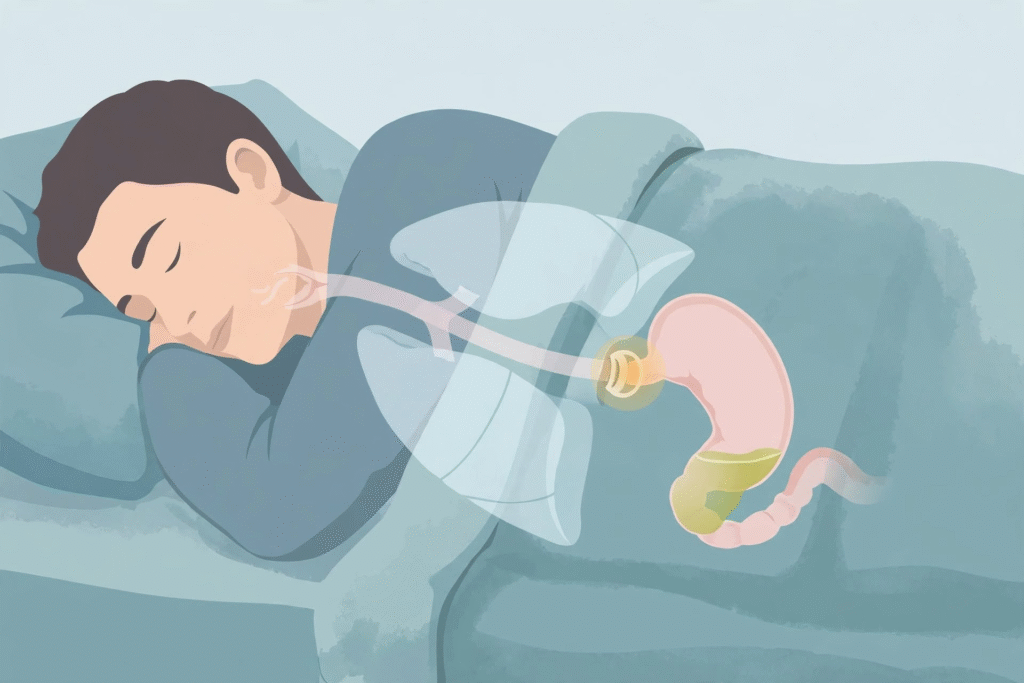
Between the oesophagus and the stomach sits a ring of muscle, the lower oesophageal sphincter (LES). It opens when you swallow and clamps shut afterwards. Reflux mostly happens when it relaxes at the wrong moment, or when something pushes against it hard enough to win.
The usual pushers and loosening factors are worth knowing because they’re also your levers:
- A big meal, which stretches the stomach and slows emptying
- Extra weight around the middle, which raises pressure inside the abdomen
- A hiatal hernia, where part of the stomach slides up through the diaphragm
- Pregnancy, when progesterone relaxes smooth muscle and the baby takes up room
- Smoking and alcohol
- Lying flat soon after eating
- Some medicines, including certain blood pressure drugs, nitrates and anti-inflammatories, plus the newer weight-loss injections that slow stomach emptying (more on those later)
Notice what isn’t on the list of acid reflux causes: “too much acid”. People assume reflux means an overproducing stomach, and for most it doesn’t. Often the acid is normal. It’s just in the wrong place.
What the guidelines say about acid reflux (and how shaky it is)
Here’s the part I like. The ACG’s 2022 guideline lists the lifestyle measures and then rates how good the evidence is. Almost none of it gets the top grade.
| Measure | ACG recommendation | Evidence quality |
|---|---|---|
| Lose weight if overweight or obese | Recommended (strong) | Moderate |
| Avoid meals within 2 to 3 hours of bedtime | Suggested (conditional) | Low |
| Raise the head of the bed for night symptoms | Suggested (conditional) | Low |
| Avoid personal “trigger foods” | Suggested (conditional) | Low |
| Stop smoking and avoid tobacco | Suggested (conditional) | Low |
| Take a PPI 30 to 60 minutes before a meal, not at bedtime | Recommended (strong) | Moderate |
Read that table slowly. The one lifestyle measure with real weight behind it is weight loss. The rest are sensible, cheap and low-risk, but they rest on thinner studies than their reputation suggests. That doesn’t make them useless. It means you should treat them as experiments and keep notes, not as laws.
What actually helps acid reflux
Weight and acid reflux, if it applies to you
If you’ve gained weight and your reflux arrived or worsened with it, this is the one change with the strongest case. Large studies link a bigger waistline with more reflux, and trials of weight loss show fewer symptoms. You don’t need to reach some ideal number. Many people notice improvement with a modest loss, and belly fat in particular seems to matter. Our guides on blood sugar and insulin resistance cover how to do it without wrecking your relationship with food.
Stop eating late if you want less acid reflux
Finish dinner two to three hours before lying down. If you’re in the habit of eating at 10:30 p.m. and falling asleep at 11:15, you’re pouring a full stomach into a horizontal position and hoping for the best. This is the single most common mistake I’d bet on, particularly in households where dinner is late and heavy.
A short, gentle walk after eating, the old “sau kadam” habit, helps some people. The evidence is modest, and I wouldn’t promise it, but it costs nothing and gets you upright. If you’re also experimenting with eating windows, be careful: our piece on circadian fasting and time-restricted eating is a reminder that an early, finished dinner works in your favour, while skipping breakfast and then eating a huge late meal doesn’t.
Raise the head of the bed properly
For night-time reflux, elevating the head of the bed by roughly 15 to 20 cm (6 to 8 inches) is the standard advice. Use bed risers under the top legs or a foam wedge that lifts the whole upper body. Stacking pillows is a poor substitute, because it bends you at the waist and can squeeze the stomach, which is the opposite of what you want.
Sleep on your left
Studies on sleep position find less acid exposure lying on the left side than on the right or the back. The reason is anatomy: on the left, the stomach hangs below the oesophagus junction, and acid pools away from the opening. Some people find it fixes their nights. Others never get used to it. Try it for a couple of weeks before deciding.
Smaller meals, slower eating
Giant plates stretch the stomach and slow emptying. Smaller meals, chewed properly, leave less to reflux. Wear looser trousers while you’re at it. Tight waistbands push upward on the stomach, and it’s a free fix.
Keep a trigger diary instead of banning everything
The standard list of acid reflux troublemakers is coffee, chocolate, mint, alcohol, fizzy drinks, fried and fatty food, spicy food, citrus and tomatoes. Some people react to several, some to one, and some to none. The research linking specific foods to acid reflux is patchy and often contradictory, which is why the guideline says “personal” triggers, not a universal blacklist.
For a few weeks, write down what you ate, when, and whether you had symptoms in the next few hours. You’ll probably find one or two real culprits. Common Indian suspects include chai on an empty stomach, deep-fried snacks, pickles, very spicy gravies and late-night sweets, but your list might look nothing like that. If you drink a lot of coffee, our look at mushroom coffee is worth a read, since swapping the cup doesn’t always swap the problem.
Chew sugar-free gum
This one sounds like a gimmick and isn’t. Chewing raises saliva flow, which washes acid back down and buffers it. Half an hour after a meal, sugar-free gum can take the edge off. Avoid mint flavours if mint is one of your triggers.
Breathing exercises
The diaphragm helps hold the LES shut, and small trials suggest that diaphragmatic breathing practice can reduce reflux symptoms. It’s low effort: a few minutes of slow belly breathing, a couple of times a day. Stress itself doesn’t create acid reflux, but it can make you more aware of symptoms, which is why reflux often feels worse in a bad week. Our guides to cortisol and stress and sleep hygiene cover that side.
Stop smoking, ease off alcohol
Both weaken the sphincter. Both appear on every guideline. If you only manage one change, pick whichever you’re more attached to, because that’s probably the one that matters.
Alginates
Alginate products, such as Gaviscon and similar brands, are plant-derived (seaweed) liquids or tablets that form a foamy gel “raft” on top of stomach contents. The raft physically blocks reflux, particularly after meals. Trials support them, and they’re generally considered safe in pregnancy. Availability and formulation vary between countries and brands, and some contain sodium, so check the label if you have high blood pressure or heart failure.
Herbs and kitchen remedies for acid reflux
Ginger
Ginger gets recommended everywhere, and the honest summary is “plausible, modest, not proven for GERD”. Some research suggests it speeds up stomach emptying, which could in theory reduce reflux, and a cup of weak fresh-ginger tea is unlikely to hurt. But direct trials in people with reflux are scarce, and in large amounts ginger can irritate the stomach and actually cause heartburn in some people. Think “a few slices in hot water after a meal”, not “capsules by the handful”. It’s also not a replacement for medication you’ve been prescribed.
Aloe vera juice for acid reflux
This has a real trial behind it, with caveats. In a 2015 randomised pilot study of 79 people, 10 ml of aloe vera syrup daily for four weeks reduced reflux symptoms and was well tolerated. It was also less effective than omeprazole or ranitidine at easing heartburn and belching, and the trial was open-label, meaning everyone knew what they were taking. So: promising, small, not as good as the drugs.
If you try it, the form matters a lot. Raw aloe latex contains compounds that act as a strong laxative, so look for purified, “decolourised” or “latex-free” products made for drinking. Many bottled aloe drinks are heavily sweetened or acidified, which defeats the point. And stop if you get cramps or diarrhoea.
DGL licorice
Deglycyrrhizinated licorice has some small studies behind it for indigestion. The “DGL” part matters, because ordinary licorice can raise blood pressure and lower potassium. Evidence for GERD itself is thin, so I’d call it a low-risk maybe, not a pillar.
Banana, oats, chamomile
Oatmeal and bananas are bland, and a bland breakfast tends to cause fewer problems than a greasy one. That’s practical, not magical. Chamomile tea is soothing, with little data for reflux.
Cold milk, fennel, jeera water
Cold milk is the classic Indian first response. It feels soothing for a few minutes, but the fat and calcium can stimulate more acid afterwards, so many people get a rebound. Fennel seeds (saunf) and cumin water are traditional and harmless, but nobody has shown they treat reflux. Use them if you like them.
Baking soda
It neutralises acid quickly. It’s also loaded with sodium and can cause bloating and, if overused, a shift in your body’s acid-base balance. Occasional emergency use is fine. As a habit, avoid it, especially with high blood pressure or kidney disease.
Why apple cider vinegar is not the acid reflux cure it’s sold as
Apple cider vinegar (ACV) is probably the most-repeated reflux remedy online, usually with a story about how it “balances stomach acid”. I’ve looked, and there is no published clinical research showing it helps acid reflux, heartburn or GERD. None. The theory is that reflux comes from too little acid, and vinegar tops it up. That theory is mostly wrong. For most people, acid isn’t the problem. Position is.
What vinegar is certain to do is arrive highly acidic at an oesophagus that’s already irritated, and wear at your tooth enamel on the way down. Some people feel better and many feel worse. If you’ve tried it and it helped, that’s fine, but I wouldn’t recommend it to anyone, and I’d say that firmly to someone with moderate or severe symptoms.
Other acid reflux myths worth retiring
“Acid reflux means too much acid.” Often it doesn’t. Many people with GERD have normal acid levels.
“Alkaline water fixes it.” Minimal evidence.
“Stop all spicy food.” Only if spice is one of your triggers. Plenty of people eat chilli daily without trouble.
“Milk cures acidity.” Brief relief, then often a rebound.
“PPIs are dangerous and addictive.” Overstated, and I’ll get to this below.
“If it’s not working, double the dose.” The guideline actually says to optimise (right timing, right dose) before escalating.
“Gas and acidity are the same.” They aren’t, and the casual word “gas” in many Indian households hides everything from reflux to ulcers to gallstones to heart pain.
A four-week acid reflux reset you can actually follow
I’m going to keep this modest, because anything harder won’t get done.
Week 1. Change one thing: finish dinner at least three hours before bed. Keep a simple note of symptoms each day.
Week 2. Add head-of-bed elevation, and try sleeping on your left. Keep the diary going.
Week 3. Look at the diary. Cut out the one or two foods that clearly show up before symptoms, not the whole list. Add sugar-free gum after meals and five minutes of slow breathing.
Week 4. Add what’s left: smaller portions, a short walk after dinner, lighter waistbands. If you’re overweight, make a realistic plan for the next three months.
If your acid reflux symptoms haven’t clearly improved by the end of the month, or they’re getting worse, that’s the point to see a doctor, not to try a fifth remedy.
Over-the-counter medicines, and where they fit
Antacids (calcium carbonate and similar) work in minutes for occasional heartburn and wear off in an hour or two. Magnesium-based ones can loosen your stools, aluminium-based ones can constipate. People with kidney problems should ask before using them regularly.
Alginates are good for post-meal heartburn and regurgitation, as above.
H2 blockers such as famotidine reduce acid for hours and suit night-time symptoms. Ranitidine was withdrawn from many markets in 2020 over contamination concerns, so famotidine is the usual choice now.
Proton pump inhibitors (PPIs) like omeprazole and pantoprazole are the strongest. The ACG recommends an eight-week trial for classic reflux symptoms without alarm features, taken once a day 30 to 60 minutes before a meal, not at bedtime. That timing matters. Taken at the wrong moment, they work noticeably worse. After the trial, the aim is to step down to the lowest effective dose, or take them only when needed, and stop if symptoms stay away.
The PPI scare stories (low B12 or magnesium, bone fractures, infections) come mostly from observational studies. The guideline says that for people with erosive oesophagitis or Barrett’s oesophagus, the benefit of taking one clearly outweighs the theoretical risks, and those patients should stay on them. For everyone else, the sensible rule is “use them when you need them, for as short as you can, and review”. Don’t stop abruptly on your own after a long course, because rebound acid is real. Talk to your doctor about tapering.
One more thing. Some research suggests up to three in four people who don’t respond to a PPI may not actually have reflux. If a PPI trial does nothing, the answer isn’t to keep escalating. It’s to find out what else might be going on.
Acid reflux in special situations
Pregnancy. Very common, especially in the third trimester, because of hormones and the growing baby. Smaller meals, not lying down after eating, and alginate or calcium-based antacids are the usual first steps. Check with your midwife or doctor before taking anything else. Our guide to women’s hormonal health explains why progesterone has such a wide reach.
People on GLP-1 weight-loss injections. These medicines slow stomach emptying, and many users report reflux, nausea and early fullness. Smaller meals, earlier dinners and skipping heavy, fatty food help, and our GLP-1 foods articles cover practical choices. Tell your prescriber if reflux is persistent or bothersome.
Babies. Spitting up is normal in most infants. See a paediatrician if the baby is distressed, refuses feeds, isn’t gaining weight, or vomits forcefully or with green or bloody fluid.
Older adults. New reflux after 50 deserves more attention than the same symptom at 25, and several common medicines make it worse. Don’t assume it’s “just age”.
Women generally. Reflux can be underdiagnosed because heart-related chest pain in women is often atypical. Our feature on sex-specific nutrition for women touches on how often women’s symptoms get treated differently.
When to see a doctor about acid reflux
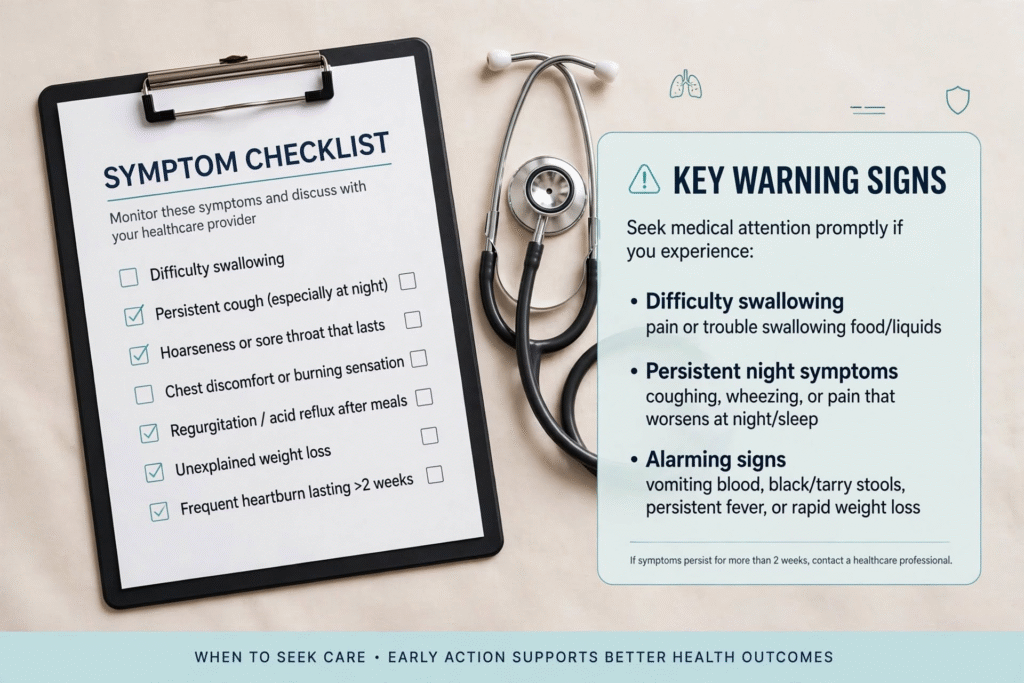
Stop experimenting and book an appointment if you have any of these:
- Trouble swallowing, or food sticking in the chest
- Pain when swallowing
- Unexplained weight loss
- Vomiting that won’t stop, or vomiting blood
- Black, tarry stools, or blood in the stool
- Iron deficiency anaemia with no clear cause (see our guide to iron deficiency and anemia in women)
- Symptoms most days for more than a few weeks, or needing antacids regularly
- New reflux symptoms after age 50
- A persistent night cough, hoarse voice, throat clearing or asthma-like symptoms that don’t respond to usual treatment (reflux can reach the throat)
- Reflux that hasn’t improved after a proper PPI trial
- A family history of oesophageal or stomach cancer
The guideline is clear that people with swallowing difficulty or alarm features need an endoscopy (a camera test) first, not a trial of tablets.
Chest pain needs separate care. Heart attacks can feel like heartburn, particularly in women, older adults and people with diabetes. If the pain is crushing, spreads to the arm, jaw or back, or comes with breathlessness, sweating or nausea, treat it as an emergency. Please don’t ask a chatbot to decide. Our article on AI self-diagnosis and digital health explains why this is exactly the kind of situation where an app can mislead you.
Why persistent acid reflux matters
Years of acid exposure can inflame the oesophagus (oesophagitis), cause scarring and narrowing, and in a minority of people lead to Barrett’s oesophagus, a change in the lining that carries a small but real risk of cancer. The absolute risk is low, which is why most people with GERD never develop it. But it’s the reason long-standing reflux in someone with risk factors (male, over 50, overweight, smoker, family history) is worth checking rather than masking. A cheap strip of antacids every night is a fine answer to an occasional problem. Used for years, it can quietly postpone a diagnosis.
What the doctor might do
Expect questions about your symptoms, medicines and diet, possibly a trial of a PPI, and in some cases an endoscopy, a pH or reflux monitoring test, or a test for H. pylori, a stomach infection that’s common in India and causes ulcers and gastritis that can pass as reflux. If you’ve had “gas” for months, ask about it.
Where to go next
- Gut and digestion: Gut health
- Sleep and stress: Light hygiene and circadian health, Sleep hygiene, Cortisol and stress
- Food and habits: Circadian fasting, Mushroom coffee, Low-friction prevention
- Weight and metabolic health: Blood sugar, Insulin resistance, GLP-1 foods
- Supplements and safety: Supplement safety, Functional protein and next-gen collagen
- Women’s health: Women’s hormonal health, Iron deficiency in women
- More guides: Nutrition & Diet, Health & Wellness
Questions people ask about acid reflux
What is the difference between acid reflux and GERD?
Acid reflux is when stomach contents flow back up, which happens to everyone occasionally. GERD is the chronic version, usually symptoms twice a week or more, or reflux that causes damage or complications.
What are the best natural remedies for acid reflux?
The best-supported ones are weight loss if you’re overweight, finishing meals two to three hours before lying down, raising the head of the bed, sleeping on your left, and avoiding your personal trigger foods. Sugar-free gum, breathing exercises and alginate products can help too. Ginger and aloe vera have some support, but less.
Does apple cider vinegar help acid reflux?
There’s no clinical evidence that it does, and because it’s very acidic it can irritate the oesophagus and worsen symptoms in some people. I wouldn’t recommend it, especially if you have frequent or severe reflux.
Is aloe vera juice good for acid reflux?
A small 2015 trial found aloe vera syrup reduced reflux symptoms and was well tolerated, though it worked less well than omeprazole or ranitidine. If you try it, choose a purified, latex-free product made for drinking, and stop if it upsets your stomach.
Does ginger help acid reflux?
Maybe a little. Ginger may speed up stomach emptying, but direct evidence in GERD is limited, and large amounts can cause heartburn. A few slices in hot water after a meal is reasonable.
Which foods should I avoid with acid reflux?
It varies. Common triggers include coffee, chocolate, mint, alcohol, fizzy drinks, fried and fatty food, spicy food, citrus and tomatoes. Keep a diary and cut the ones that clearly bring on your symptoms, instead of banning everything.
Does sleeping position affect acid reflux?
Yes. Studies suggest sleeping on your left side reduces acid exposure compared with your right side or back. Raising the head of the bed by about 15 to 20 cm also helps night-time symptoms.
Is it safe to take PPIs long term for acid reflux?
For people with erosive oesophagitis or Barrett’s oesophagus, yes, the benefits outweigh the risks. For others, the aim is the lowest effective dose for the shortest time, with regular review. Taken 30 to 60 minutes before a meal, they work best. Don’t stop a long course abruptly without advice.
Can acid reflux feel like a heart attack?
Yes. The two can feel alike, particularly in women, older adults and people with diabetes. Crushing pain, spread to the arm or jaw, sweating or breathlessness need emergency care.
When should I see a doctor about acid reflux?
If you have trouble or pain swallowing, weight loss, vomiting blood, black stools, anaemia, symptoms most days for weeks, new symptoms after 50, or no relief after a proper treatment trial. Don’t wait for these to become severe.
The short version
Acid reflux is common, mostly manageable and often dealt with badly. The things with the best backing are unglamorous: lose weight if you carry extra, eat earlier, raise the head of the bed, find your own triggers, quit smoking. Ginger, aloe and chewing gum can help at the edges. Apple cider vinegar can’t, and may hurt. And if swallowing hurts, you’re losing weight, you’re passing black stools or your symptoms won’t quit, that’s a doctor’s job, not a kitchen project.
If you do one thing tonight, finish eating three hours before bed. It’s free, and it’s the change I’d bet on first.
Disclaimer: this article is general education, not medical advice. Always consult a qualified healthcare professional about persistent symptoms, medication or supplements. See our full disclaimer.
Research referenced: the 2022 ACG Clinical Guideline on GERD and its summary in Healio; the ACG and ASGE comparison; coverage in ACP Gastroenterology; the 2015 aloe vera syrup trial by Panahi and colleagues, as summarised in Natural Medicine Journal; and the botanical review of herbal management of reflux.







Leave a Reply