
Raisins benefits get repeated in Indian homes as if the matter were settled: five soaked kishmish every morning, drink the water, done. Some raisins benefits are old wisdom and some are modern marketing, and the two have blended so well that it’s hard to tell where one ends. There are real human trials on raisins and blood pressure, after-meal blood sugar and constipation. The catch is that the people in those trials ate somewhere between 85 and 120 grams a day, while the habit most of us follow involves about 2 or 3 grams.
I went to the raisins benefits trials themselves, including the funding statements, to see what stands up. Below you’ll find what’s in a raisin, which raisins benefits hold up, what each study actually tested, which claims hold, which are stretched (the iron-and-copper story and the “protects your teeth” story both need a correction), a realistic daily amount, soaked versus dry, and the safety points that rarely come up: potassium and blood pressure tablets, sulphur dioxide in golden raisins, and why a handful of raisins is a serious problem for a dog.
General information only. If you have diabetes, kidney disease, or you take blood pressure medicines, read the safety section before you change your routine.
What’s behind the raisins benefits: what’s in a raisin
A raisin is a grape that’s lost most of its water, so everything in it, sugar included, is concentrated. Per 100 g, the USDA data list roughly:
- Energy: about 299 kcal
- Carbohydrate: about 79 g, of which about 59 to 65 g is sugar (the figure varies slightly between database versions)
- Fibre: about 4.5 g
- Potassium: about 745 mg
- Iron: about 1.8 mg
- Copper: about 0.27 mg
- Vitamin C: about 2 mg, which is almost nothing
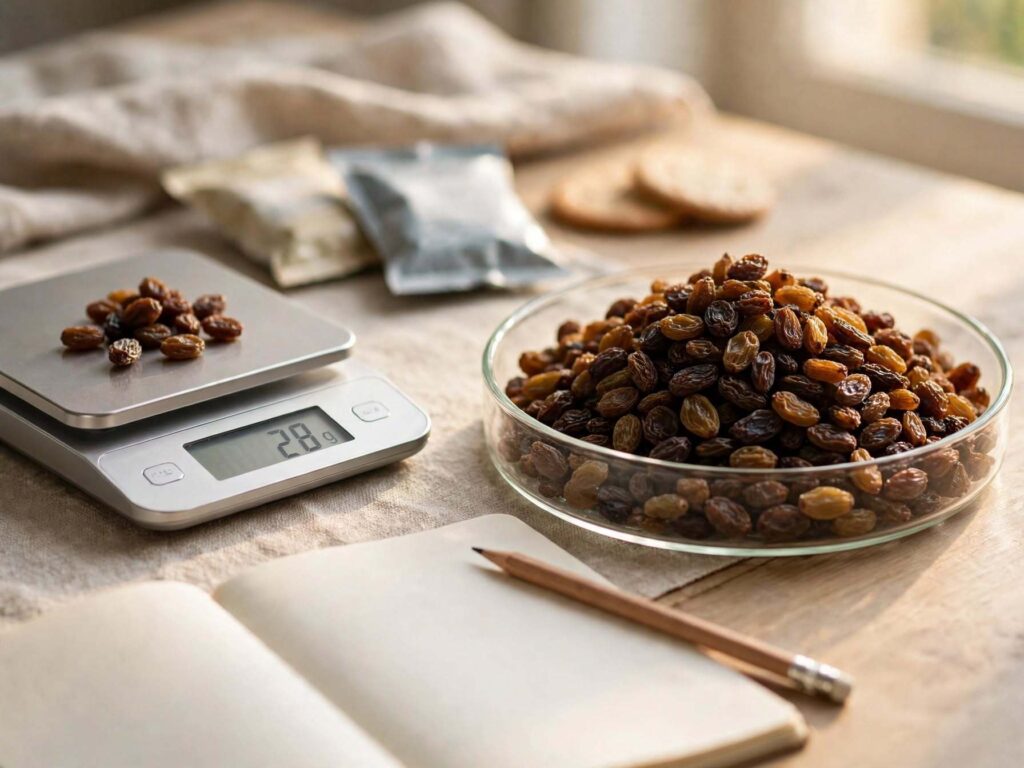
In plain terms, a small handful of 30 g gives you about 90 kcal, roughly 20 g of sugar (around four to five teaspoons) and 24 g of carbohydrate. That’s worth keeping in your head, because it’s the reason raisins are a good swap and a bad free-for-all.
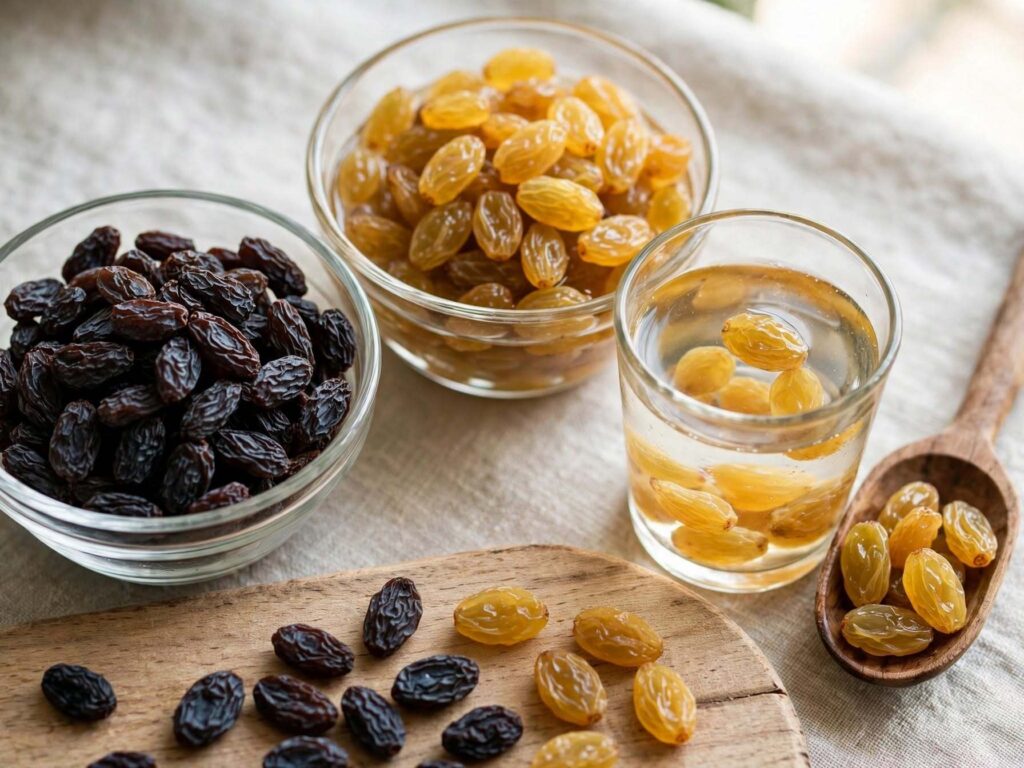
A word on varieties, since the Indian market is confusing. Kishmish usually means seedless raisins, often golden-green. Kali kishmish are the dark seedless ones. Munakka are large dark raisins that traditionally still have seeds. Golden raisins are typically treated with sulphur dioxide to keep their colour. And “currants” in some countries means tiny dried Zante grapes, which is a different thing again.
The raisins benefits scorecard
| Claim | What the research shows | How firm |
|---|---|---|
| Lowers blood pressure | One 12-week trial in 46 people with prehypertension; industry-funded | Promising, one trial |
| Lowers after-meal blood sugar compared with other snacks | Same trial and a second one in type 2 diabetes; both industry-funded | Promising, one group of researchers |
| Relieves constipation | Small studies in healthy adults using 84 to 168 g a day | Real effect, at big doses |
| Protects teeth and gums | Lab findings plus a small plaque pH study | Overstated |
| Treats anaemia | No trials; iron content is small | Not supported |
| Helps weight loss, skin, eyes, “detox” | No solid human evidence | Marketing |
| Five soaked raisins a day does something | The dose is about 30 to 50 times lower than the trials | Tradition, not evidence |
Raisins benefits for blood pressure
This is the best-known of the raisins benefits, so let me describe it precisely. In a 2014 randomised, controlled trial (Anderson and colleagues, in Postgraduate Medicine), 46 men and women with prehypertension ate either raisins or commercial snacks three times a day for 12 weeks. The raisin portions were about an ounce (roughly 28 g) each, so around 85 g a day. The comparison snacks were packaged items like crackers and cookies, matched for calories, with no fruit or vegetables.
At weeks 4, 8 and 12, the raisin group’s systolic blood pressure was lower than the snack group’s by roughly 6 to 10 mmHg. Diastolic pressure fell within the raisin group by about 2 to 5 mmHg, while the snack group’s blood pressure didn’t change significantly.
The plausible reason is potassium. Raisins carry about 745 mg per 100 g, so 85 g supplies around 630 mg, and potassium helps the body shed sodium and relaxes blood vessel walls.
Here are the things I’d want you to know about these raisins benefits before getting excited.
- The funder. The trial was paid for by the California Raisin Marketing Board, through a grant to the research centre that ran it. That doesn’t invalidate the findings, and it’s common in food research, but it’s a reason to want independent replication. I couldn’t find a large independent trial.
- The comparison. Raisins were compared with cookies and crackers, not with nuts, other fruit or no snack. So the finding is really “raisins beat processed snacks”, which is a much lower bar than “raisins lower blood pressure”.
- The dose. About 85 g a day is around 250 kcal and over 50 g of sugar. That’s a lot of raisins.
- It’s one trial of 46 people.
So raisins benefits for blood pressure might help a bit, instead of biscuits, and they’re not a substitute for blood pressure medicine. The bigger levers are cutting salt (see our guide to habits to quit for better health), sleep, weight and exercise.
Raisins benefits for blood sugar
It’s counter-intuitive that raisins benefits might include blood sugar, since the food is two-thirds sugar, and the evidence is more limited than the headlines suggest.
The same 12-week study reported that after-meal blood sugar was lower in the raisin group than in the snack group, and that HbA1c (the three-month average) fell compared with the group’s own baseline. A second trial from the same research centre, published in 2015 in The Physician and Sportsmedicine, involved 51 people with type 2 diabetes and again compared raisins with crackers over 12 weeks. The raisin board’s summaries report lower after-meal glucose and lower systolic blood pressure there too. I haven’t been able to check those figures in the full paper, so I’d read them as claims, not confirmed numbers. Both studies were funded by the California Raisin Marketing Board.
The explanation usually offered is a moderate glycaemic index (often quoted as roughly 50 to 64) plus fibre and polyphenols that slow absorption. That’s plausible. It’s also true that glycaemic index doesn’t tell you what a whole serving does to you, and a raisin serving still carries a lot of sugar.
The takeaway on raisins benefits is narrow: if you’re going to have a snack anyway, raisins may raise blood sugar less than a biscuit or a packet of namkeen. It isn’t a reason to eat a bowl of raisins, and it isn’t evidence for people with diabetes to eat them freely. If you have diabetes, count a 30 g portion as about 24 g of carbohydrate, check how your own readings respond, and talk to your doctor or dietitian. Our guides to blood sugar, insulin resistance and CGM for non-diabetics explain how to test what a food does for you.
Raisins benefits for constipation
Raisins have a long reputation for constipation, and this is where the raisins benefits evidence is most concrete, although it needs a lot of raisins.
In a 2003 crossover study in the British Journal of Nutrition (Spiller and colleagues), 13 healthy adults ate 120 g of sun-dried raisins a day for three weeks. Intestinal transit time fell from about 42 hours to 28 hours, stools became softer, and stool weight rose. A comparison arm using cream of tartar, which supplies the tartaric acid found in raisins, also shortened transit time (to 31 hours) and softened stools but didn’t add bulk. So both the fibre and the tartaric acid appear to contribute.
A separate dose-response study from the same group looked at 84, 126 and 168 g a day, in 16 healthy adults, in two-week blocks. The transit time reduction at 84 g a day (to about 44 hours) wasn’t statistically significant. At 168 g a day, transit time fell from about 54 to 42 hours and stool weight rose.
Three things to take from that about raisins benefits. First, the effect is real and sensible: raisins are a decent fibre source, and the tartaric acid probably helps. Second, the doses were large. 120 g is about 360 kcal and 80 g of sugar a day, and most people would find that impractical, and more likely to cause loose stools than comfort. Third, the volunteers were healthy, not people with constipation, so we’re extrapolating.
If constipation is a persistent problem, the foundations are fibre from many sources, fluids, movement and sometimes isabgol, as we explain in our guide to home remedies for piles and our gut health pages. A few raisins can be one part of that. If you notice blood in the stool, weight loss or a lasting change in your bowel habit, see a doctor.
Raisins benefits for teeth and gums: the claim that needs a correction
The popular version of the raisins benefits is that raisins protect your teeth. The research is more careful than that.
In lab studies (Rivero-Cruz and colleagues, reviewed in a 2009 Journal of Nutrition supplement), compounds extracted from raisins, notably oleanolic acid, inhibited the growth of two oral bacteria, Streptococcus mutans, linked to cavities, and Porphyromonas gingivalis, linked to gum disease, and oleanolic acid reduced biofilm adherence in the dish. In a small study in children aged 7 to 11, eating raisins didn’t push plaque pH below the level at which enamel starts to dissolve over a 30-minute period. That research was supported partly by the California Raisin Marketing Board.
So the fair reading is that raisins appear to be less harmful to teeth than many sugary snacks, and the compounds are interesting. What hasn’t been shown is that eating raisins prevents cavities or gum disease in people. They’re still sticky, still about two-thirds sugar, and they can lodge in the grooves of your molars. If raisins replace a toffee, you’re better off. If you graze on them all day, you’re not. Rinse your mouth after eating them, and don’t have them just before bed without brushing.
Raisins benefits for anaemia: the claim that doesn’t hold up
Among raisins benefits, you’ll hear that raisins are rich in iron, or that their copper is the hidden key to fixing anaemia. Neither is quite right.
Iron. A raisin isn’t an iron-rich food. At about 1.8 mg per 100 g, a 30 g handful gives you around half a milligram. Adult women need roughly 18 mg a day (and less after menopause), so a handful covers a few percent. Raisins also have almost no vitamin C, which helps you absorb plant-based iron.
Copper. Copper is needed to move iron around the body, and raisins do contain a meaningful amount, about 0.27 mg per 100 g or around a third of the daily need. But copper deficiency is a relatively uncommon cause of anaemia, and it’s usually seen after gastric or bariatric surgery, with malabsorption, or with very high zinc intake. The idea that many people take iron tablets for months and don’t improve because they’re short of copper is an overreach.
The usual reasons iron tablets “don’t work” are more mundane:
- Ongoing blood loss, such as heavy periods, piles or stomach ulcers
- Poor absorption, from coeliac disease, H. pylori infection or acid-reducing medicines
- Taking it wrongly, for instance with tea, coffee or calcium
- A different diagnosis, like thalassaemia trait or low vitamin B12 or folate
- Not taking it consistently, or stopping too early
I found no trial showing raisins raise haemoglobin. Dark and golden raisins also don’t seem to differ by a factor of two in iron, which is another number I couldn’t back up. If you think you’re anaemic, get a blood count and ferritin checked. Our guide to iron deficiency and anemia in women explains what to ask for, and our piece on amla benefits shows an easy way to pair vitamin C with iron-rich meals.
The dose problem with raisins benefits: why five raisins can’t be the answer
Let me lay the raisins benefits numbers next to each other.
| What | Amount per day |
|---|---|
| The common habit: 5 soaked raisins | about 2 to 3 g |
| Blood pressure and blood sugar trial | about 85 g (28 g three times) |
| Constipation study | 120 g |
| Dose-response study | 84 to 168 g |
| A practical daily amount | about 30 g, a small handful |
The five-raisin figure for raisins benefits comes from tradition, not from any study. It’s about 30 to 50 times lower than the doses that showed effects, which means it can’t be expected to do what the trials did. A raisin weighs roughly half a gram to a gram, so 30 g is somewhere between 30 and 60 raisins depending on size, or a bit under a quarter cup.
My practical suggestion for raisins benefits: aim for about 30 g a day, and treat it as a swap, not an addition. A handful of raisins is about 90 kcal. If you eat it on top of your usual biscuits, you’ve added calories and sugar. If it replaces the biscuits, you’ve probably improved the snack. The trials were designed that way, which is the main lesson from them.
Soaked or dry?
Every study mentioned here used dry raisins. Soaking comes from Ayurvedic and family tradition, and there’s no trial comparing the two. It isn’t a bad idea. Soaked raisins are softer, which suits weak digestion, older people and children, and it makes them easier to chew.
A few practical points:
- Wash first. Raisins can carry dust, residues and sometimes a thin coating of oil. Rinse them under running water.
- Soak for 4 to 8 hours. That’s enough.
- The water. Some of the sugar and potassium leach into the soaking water. If you drink it, you’re drinking sugary water. If you’re watching blood sugar, I’d eat the raisins and skip the water.
- Pair them. Eating raisins with a few nuts or some curd, instead of alone, is a common-sense way to blunt a sugar rush. The research on that exact pairing is thin, but the logic is sound.
Dark or golden?
The video advice I saw says dark raisins have twice the iron and that golden raisins are bleached with sulphur dioxide. The second point is right and the first I couldn’t confirm.
Golden raisins are usually treated with sulphur dioxide to keep their colour, which is listed on Indian labels as INS 220 or “sulphur dioxide” or “preservative”. People with asthma or sulphite sensitivity can wheeze or get breathless from sulphited foods. If that’s you, choose unsulphured dark raisins and read the label. Otherwise there’s no strong health reason to avoid golden ones.
Raisins benefits and safety: who should be careful
- Diabetes. Raisins are concentrated sugar. Keep to a small portion, count the carbohydrate and monitor your readings.
- Kidney disease, and blood pressure medicines that raise potassium. Raisins are a potassium-rich food. People with advanced kidney disease, and those taking ACE inhibitors, ARBs or potassium-sparing diuretics such as spironolactone, can accumulate too much potassium. In practice a handful is usually fine, but a trial-sized daily dose isn’t something to start without your doctor’s agreement.
- Sulphite sensitivity and asthma. Avoid sulphured raisins.
- Kidney stones. Raisins contain oxalate, which can matter for people prone to stones.
- Weight management. Easy to overeat, because they’re small and sweet.
- Teeth. Sticky and sugary. Rinse afterwards.
- Loose stools. Large amounts will do it, as the constipation trials intended.
- Toddlers. Raisins are a choking hazard for very young children.
- Dogs and cats. Raisins and grapes can cause kidney failure in dogs, and cats too, though the toxic agent isn’t known. If a pet eats them, call a vet immediately. Chocolate-covered raisins and trail mix are a common way this happens.
- Storage. Keep raisins dry. Dried vine fruit can be affected by moulds that produce ochratoxin A, and regulators set limits for it. Discard anything that smells musty or looks mouldy, as distinct from the harmless sugar crystals that sometimes form.
Easy swaps that use the raisins benefits research sensibly
- The tea-time swap. A small handful of raisins (about 30 g) with 5 almonds instead of two sweet biscuits. It’s roughly similar in calories but with more fibre, some protein and healthy fat.
- Curd and raisins. A small bowl of curd with a spoon of raisins and a pinch of cinnamon, instead of a sweet dessert.
- Oats or porridge topper. A tablespoon of raisins instead of sugar or honey.
- A packed snack. Raisins and roasted chana in a small box, as a replacement for a packet of namkeen, which is often high in salt too.
- Soaked raisins with nuts in the morning, if that suits your digestion, with the water discarded or kept to a minimum.
For ideas on building these swaps into your day, our guide to low-friction prevention shows how to attach a small change to a routine you already have.
When to see a doctor instead of relying on raisins benefits
Don’t rely on raisins for:
- Blood pressure readings repeatedly at or above 140/90
- Excessive thirst, frequent urination, unexplained weight loss or blurry vision
- Tiredness, pallor, breathlessness or heavy periods that could mean anaemia
- Constipation that lasts weeks, with blood in the stool, abdominal pain or weight loss
- Wheezing or breathing trouble after dried fruit
- Gum bleeding or toothache that doesn’t settle
If you’ve been reading symptoms online first, our article on AI self-diagnosis and digital health explains how to use that research without letting it make the decision.
Where to go next
- Blood pressure and salt: Habits to quit for better health
- Blood sugar: Blood sugar, Insulin resistance, CGM for non-diabetics
- Iron and vitamin C: Iron deficiency and anemia in women, Amla benefits
- Digestion: Gut health, Home remedies for piles
- Habits that stick: Low-friction prevention
- More guides: Nutrition & Diet, Health & Wellness
Questions people ask about raisins benefits
What are the main raisins benefits?
Raisins supply fibre, potassium and polyphenols. In small trials, mostly funded by the California Raisin Marketing Board, eating raisins instead of cookies or crackers was linked to lower blood pressure and after-meal blood sugar, and larger amounts softened stools and shortened transit time. They aren’t a good iron source, and the dental and anaemia claims are overstated.
Do raisins benefits include lower blood pressure?
One 12-week trial in 46 people with prehypertension found systolic pressure about 6 to 10 mmHg lower with about 85 g of raisins a day than with processed snacks. It was industry-funded and the comparison was cookies and crackers. Raisins aren’t a substitute for blood pressure medicine.
Are raisins benefits real for diabetes?
In small, industry-funded trials, raisins raised after-meal blood sugar less than crackers or biscuits. That doesn’t make them a free food. A 30 g portion has about 24 g of carbohydrate, so people with diabetes should count it and monitor their readings.
How many raisins should I eat a day for raisins benefits?
A practical amount is about 30 g, a small handful, as a swap for another snack. The trials used 85 to 120 g a day, which is too much for most people. Five raisins is about 30 to 50 times lower than what the studies tested.
Do soaked raisins give more raisins benefits than dry raisins?
There’s no evidence either way, since the trials used dry raisins. Soaked raisins are softer and easier to digest. Some sugar leaches into the water, so if you’re watching blood sugar, eat the raisins and skip the water.
Are constipation raisins benefits real?
Yes, at large doses. In a small study of healthy adults, 120 g a day shortened intestinal transit time from about 42 to 28 hours. A lower dose of 84 g a day didn’t reach statistical significance in another study. Fibre from many sources and fluids matter more.
Are anaemia raisins benefits real?
No. A 30 g handful gives about half a milligram of iron and almost no vitamin C. Copper deficiency is an uncommon cause of anaemia. If you suspect anaemia, get a blood count and ferritin test.
Do raisins benefits include healthier teeth?
Lab studies found compounds in raisins that suppress cavity and gum-disease bacteria, and a small child study found raisins didn’t drop plaque pH below the danger point. That doesn’t prove they prevent cavities. They’re still sticky and sugary, so rinse afterwards.
Are golden raisins safe?
They’re usually treated with sulphur dioxide, which can trigger wheezing in people with asthma or sulphite sensitivity. Choose unsulphured dark raisins if that applies to you.
Who should avoid chasing raisins benefits?
People with advanced kidney disease or on potassium-raising medicines should check with their doctor, and anyone with sulphite sensitivity should avoid sulphured raisins. Raisins are also dangerous to dogs and cats, and a choking risk for toddlers.
The short version
The real raisins benefits are modest and conditional: a few small, industry-funded trials suggest that raisins beat cookies and crackers for blood pressure and after-meal blood sugar, large amounts soften stools, and the dental and iron stories are overstated. The five-soaked-raisins ritual is tradition, and its dose is far below anything tested.
If you want a rule for raisins benefits, make it this: about a small handful (30 g) as a swap for the biscuit or namkeen you’d otherwise eat, not an extra on top. And if you have diabetes, kidney disease or take blood pressure medicine, check with your doctor before treating raisins as a remedy.
Disclaimer: this article is general education, not medical advice. Always consult a qualified healthcare professional about blood pressure, diabetes, kidney disease or medication. See our full disclaimer.
Research referenced: Anderson et al., 2014, Postgraduate Medicine, raisins compared with other snacks on glycaemia and blood pressure, and the California Raisin Marketing Board’s summary of the trial results; the 2015 type 2 diabetes raisin trial as summarised in the board’s press release; Spiller et al., 2003, British Journal of Nutrition, tartaric acid and fibre from sun-dried raisins on colonic function; Spiller et al., 2003, Journal of Medicinal Food, dose-response study of sun-dried raisins and transit time; the 2009 Journal of Nutrition review of raisins and oral health, including oleanolic acid findings; and USDA nutrient data for seedless raisins as summarised in reference tables.







Leave a Reply