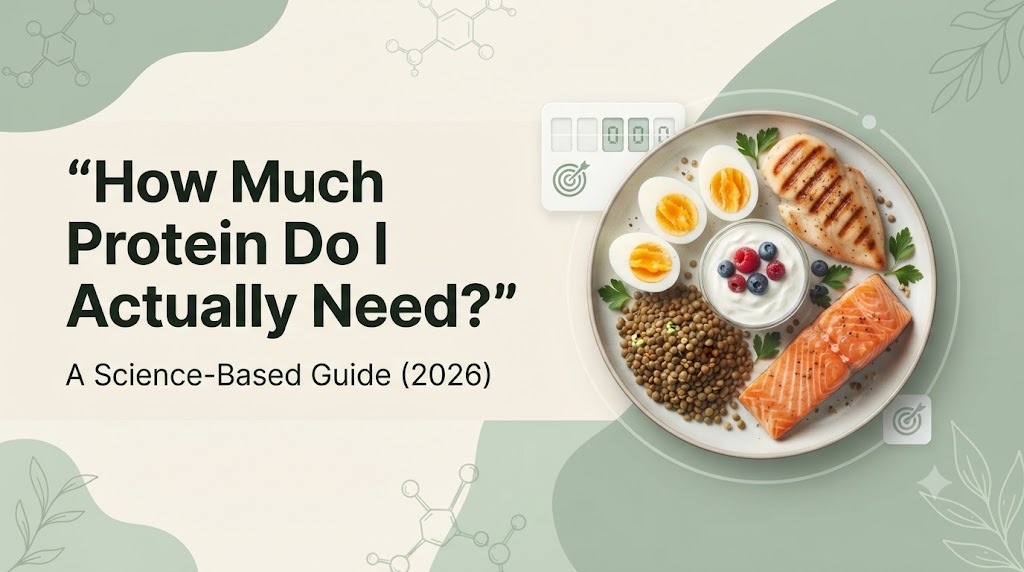
How much protein do you actually need? Most healthy adults need roughly 0.8–1.0 grams of protein per kilogram of body weight just to avoid deficiency, but if you’re trying to build muscle, lose fat, or you’re over 50, the real target is closer to 1.6–2.2 grams per kilogram (about 0.7–1.0 grams per pound). For a 70 kg (154 lb) adult, that’s roughly 112–154 grams of protein a day — not the 46–56 grams the outdated RDA label suggests.
If you’ve ever typed “how much protein do you actually need” into Google at 11 p.m. while staring at a tub of whey powder, you’re not alone. Protein has become the most argued-about macronutrient in nutrition — high-protein diets, protein RDA charts, and “eat more protein” advice are everywhere, but almost none of it tells you the number that actually applies to your body, your goals, and your activity level. This guide breaks down exactly how much protein you need per day, how that number changes depending on whether you’re trying to build muscle, lose weight, or just stay healthy as you age, and how to hit your target without turning every meal into a chicken-breast ritual.
Why the Official Protein RDA Is Misleading
Before we get into the exact numbers, it helps to understand why so many people search “how much protein do you actually need” instead of trusting the label on a nutrition chart in the first place — because the standard guidance was never built for the goals most people actually have.
The Recommended Dietary Allowance (RDA) for protein — 0.8 grams per kilogram of body weight — is one of the most misunderstood numbers in nutrition. It wasn’t designed to help you feel your best, build muscle, or support an active lifestyle. It was calculated as the minimum amount needed to prevent deficiency in a sedentary person, with a safety margin built in for the general population.
In other words, the RDA is a floor, not a target. It’s the protein equivalent of “the minimum water you need to avoid dying of dehydration” — technically true, but not useful advice if you actually want to thrive. Sports scientists and dietitians who study muscle protein synthesis, recovery, and satiety generally agree that most people — especially anyone who exercises, is trying to manage body weight, or is over 40 — benefit from intakes well above the RDA.
This is part of a bigger pattern in nutrition where “meeting the minimum” and “actually feeling good” are two very different targets — the same disconnect we saw when breaking down what actually happens to your body during a sugar detox: the official guidance and the lived experience often don’t match.
How Much Protein Do You Actually Need Per Day?
Your ideal daily protein intake depends on four things: body weight, activity level, primary goal, and age. Here’s how the numbers break down by category, using grams of protein per kilogram of body weight (g/kg) — the standard measurement researchers use.
| Goal / Population | Protein Target (g/kg body weight) | Example for a 70 kg (154 lb) adult |
|---|---|---|
| Sedentary, general health (RDA minimum) | 0.8 g/kg | 56 g/day |
| Active adult, general fitness | 1.2–1.6 g/kg | 84–112 g/day |
| Muscle building / strength training | 1.6–2.2 g/kg | 112–154 g/day |
| Fat loss (preserving muscle in a calorie deficit) | 1.8–2.4 g/kg | 126–168 g/day |
| Endurance athletes | 1.2–1.6 g/kg | 84–112 g/day |
| Adults over 50 | 1.2–1.6 g/kg | 84–112 g/day |
| Pregnant/breastfeeding | 1.1–1.3 g/kg | 77–91 g/day |
Notice how wide that range is. Someone lifting weights four times a week and trying to build muscle needs roughly double what a sedentary person needs — and that gap is exactly why generic advice (“just eat 60 grams a day”) fails so many people.
How to Calculate Your Personal Protein Target
Skip the guesswork with this three-step formula:
- Convert your weight to kilograms. Divide your weight in pounds by 2.2. (A 160 lb person weighs about 72.7 kg.)
- Pick your multiplier from the table above based on your primary goal.
- Multiply. 72.7 kg × 1.8 g/kg (fat loss target) = about 131 grams of protein per day.
If you’re significantly overweight, use an adjusted body weight rather than total body weight, since fat tissue doesn’t require the same protein support as lean tissue does — a registered dietitian can help fine-tune this if you’re carrying substantial excess weight.
Signs You’re Not Getting Enough Protein
Protein deficiency in people eating a normal Western diet is rare, but under-eating relative to your activity level is extremely common — especially among people cutting calories, following restrictive diets, or eating mostly plant-based without planning carefully. Watch for these signs:
- Constant hunger and snacking, even shortly after meals — protein is the most satiating macronutrient, so low intake often shows up first as appetite that won’t quiet down
- Slow recovery from workouts — persistent soreness, stalled strength gains, or feeling flat during training
- Thinning hair, brittle nails, or slow wound healing — protein is the raw material for keratin and collagen
- Losing muscle while dieting — the scale drops, but so does strength and muscle tone, not just fat
- Frequent illness or slow recovery from colds — antibodies are built from protein
- Fatigue and brain fog, particularly in the afternoon
If several of these sound familiar, it’s worth tracking your intake for a few days using a food-logging app before assuming the problem is something else — low protein intake often masquerades as poor sleep, low iron, or “just being tired,” the same way unexplained bloating or irregular digestion often gets misdiagnosed before people connect it back to gut health and what’s actually happening in the digestive tract.
Can You Eat Too Much Protein? Separating Myth From Evidence
The two biggest protein myths refuse to die, so let’s address them directly.
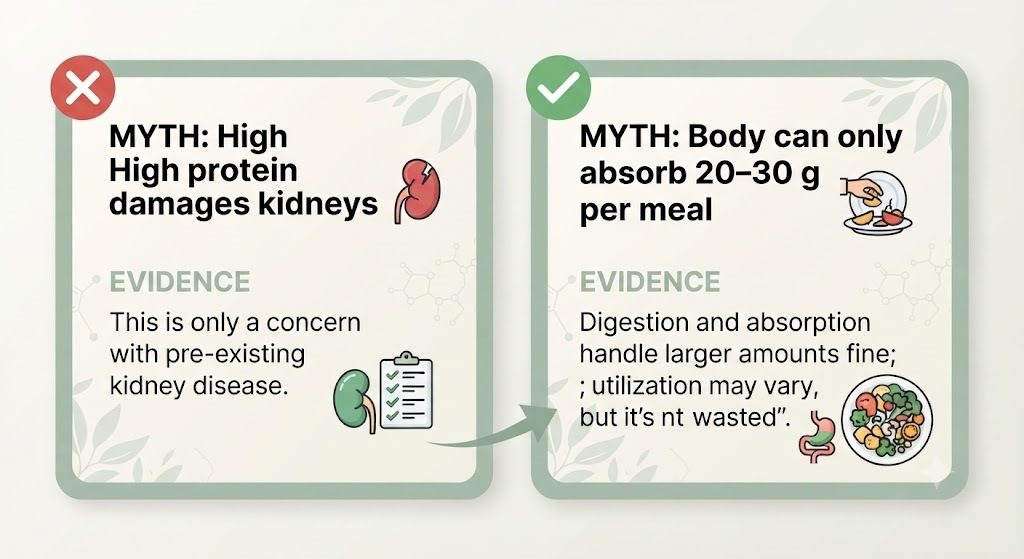
Myth 1: High protein intake damages your kidneys. This fear comes from studies on people who already have kidney disease, where restricting protein is medically appropriate. In healthy individuals with normal kidney function, research has not shown that higher protein intake — even up in the 2+ g/kg range — causes kidney damage. If you have pre-existing kidney disease, this is genuinely worth discussing with your doctor; otherwise, it’s not a reason to avoid adequate protein.
Myth 2: Your body can only absorb 20–30 grams of protein per meal. This idea gets repeated constantly, but it confuses muscle protein synthesis per sitting with digestion and absorption. Your gut absorbs protein from a 60-gram meal just fine — the amino acids simply get used for different things (energy, other tissues, circulating amino acid pools) beyond the immediate muscle-building response. You don’t need to obsessively split protein into tiny meals throughout the day.
The realistic downside of very high protein intake isn’t organ damage — it’s usually just displacing other nutrients (like fiber-rich carbohydrates) if you’re not planning meals thoughtfully, which is one more reason to pair your protein strategy with enough high-fiber foods to support gut and digestive health.
Best Protein Sources: Animal and Plant-Based Options
Not all protein sources are created equal. “Complete” proteins contain all nine essential amino acids your body can’t produce on its own; some plant sources need to be combined to get the same effect.
High-quality animal protein sources:
- Chicken breast (~31g per 100g)
- Eggs (~6g per large egg)
- Greek yogurt (~10g per 100g)
- Salmon and other fatty fish (~20–25g per 100g)
- Lean beef (~26g per 100g)
- Cottage cheese (~11g per 100g)
Plant-based protein sources:
- Lentils and beans (~9g per 100g cooked)
- Tofu and tempeh (~8–19g per 100g)
- Quinoa (~4g per 100g cooked, and a complete protein)
- Edamame (~11g per 100g)
- Seitan (~25g per 100g)
- Protein powders (pea, soy, or blended plant proteins)
If you’re eating mostly plant-based, the fix isn’t to panic — it’s to eat a variety of plant proteins across the day (grains + legumes is the classic combo) and lean slightly higher on total grams, since plant proteins tend to be somewhat less efficiently used than animal sources. This is also where a well-planned supplement routine matters — the same way choosing evidence-backed supplements matters when comparing creatine options and dosages for women, picking a clean, third-party-tested protein powder is worth more scrutiny than most people give it.
Does Protein Timing Actually Matter?
Short answer: less than the fitness industry wants you to believe, but not zero.
The old idea of a tiny “anabolic window” right after a workout has been largely walked back by more recent research — total daily protein intake matters far more than hitting a 30-minute post-workout deadline. That said, two timing principles still hold up:
- Spread protein across 3–4 meals rather than eating almost none at breakfast and a huge amount at dinner. This keeps muscle protein synthesis elevated more consistently throughout the day.
- Include protein at breakfast. Most people front-load carbs in the morning and protein at dinner — flipping that habit improves satiety for the rest of the day and can make a noticeable dent in afternoon cravings, similar to how stabilizing blood sugar earlier in the day reduces the crash-and-crave cycle discussed in our guide on what actually changes in your body during a sugar detox.
Protein Needs for Specific Groups
Women: Protein needs don’t differ dramatically by sex once you adjust for body weight and activity, but women are more likely to under-eat protein overall — especially during perimenopause, when maintaining muscle mass becomes harder and more important. Pairing adequate protein with resistance training is one of the most effective tools for preserving strength through midlife.
Adults over 50: Muscle naturally declines with age (a process called sarcopenia), and older adults actually need more protein per kilogram than younger adults to trigger the same muscle-building response — a phenomenon researchers call “anabolic resistance.” The 1.2–1.6 g/kg range is a reasonable floor for most older adults, not a ceiling.
Endurance athletes: Runners and cyclists often underestimate their protein needs because they’re focused on carbohydrate fueling. But endurance training breaks down muscle protein too, and 1.2–1.6 g/kg supports recovery without displacing the carbohydrates you need for performance.
Pregnant and breastfeeding individuals: Protein needs rise moderately during pregnancy and lactation to support fetal growth and milk production — always confirm your specific target with an OB or dietitian rather than self-prescribing a high-protein plan.
Sample Daily Protein Targets (Quick Reference)
- 60 kg (132 lb) sedentary adult: ~48–96 g/day
- 70 kg (154 lb) active adult building muscle: ~112–154 g/day
- 80 kg (176 lb) person in a fat-loss phase: ~144–192 g/day
- 90 kg (198 lb) strength athlete: ~144–198 g/day
Frequently Asked Questions: How Much Protein Do You Actually Need for Different Goals
How much protein do I need to build muscle? Aim for 1.6–2.2 grams per kilogram of body weight, combined with resistance training. Beyond roughly 2.2 g/kg, additional protein provides little extra muscle-building benefit for most people.
How much protein per day to lose weight? Higher protein intake (1.8–2.4 g/kg) during a calorie deficit helps preserve muscle mass and keeps you fuller for longer, which makes sustaining the deficit easier.
Is 100 grams of protein a day enough? It depends entirely on your body weight and goals. For a smaller, sedentary adult, 100g may be plenty. For an active 90 kg adult trying to build muscle, it’s likely too low.
Can I get enough protein from a plant-based diet? Yes, with planning. Combine varied plant protein sources across the day and consider a plant-based protein powder to close any gaps, particularly if your calorie intake is also reduced.
Does eating more protein burn fat directly? Not directly, but protein has a higher thermic effect than fat or carbs (your body burns more calories digesting it) and it preserves the muscle mass that keeps your metabolism higher — both of which support fat loss indirectly.
The Bottom Line
The honest answer to how much protein do you actually need is: more than the RDA label suggests, and the exact number depends on your weight, your goal, and your age. Use the 1.6–2.2 g/kg range as a practical target if you’re active or trying to build or preserve muscle, spread it across your meals instead of loading it all at dinner, and don’t lose sleep over the outdated fears about kidney damage or “wasted” protein. Get the number right for your body, prioritize whole-food sources most of the time, and the rest of your nutrition strategy — from gut health to sustainable fat loss — tends to fall into place around it.
This article is for informational purposes only and is not a substitute for personalized medical or nutritional advice. Consult a registered dietitian or physician before making significant changes to your protein intake, especially if you have kidney disease, liver disease, or another medical condition.







Leave a Reply