
Quick Answer: High-fiber foods for gut health work by feeding the beneficial bacteria in your microbiome, which ferment fiber into short-chain fatty acids that support digestion, immunity, and even mood regulation. Most adults fall well short of the recommended daily intake, and the fix isn’t a supplement — it’s a specific mix of legumes, whole grains, vegetables, fruit, and seeds eaten consistently, increased gradually to avoid bloating.
If you’ve been paying attention to nutrition trends this year, high-fiber foods for gut health have quietly become one of the most-searched topics in wellness — and unlike a lot of what trends on social media, this one actually holds up under scrutiny. Fiber isn’t a new discovery dressed up as a biohack. It’s one of the most consistently evidence-backed levers you have for digestive health, and the growing conversation around gut microbiome support has finally caught up to what nutrition science has been saying for decades.
The problem is that most fiber content online falls into one of two camps: generic “eat more fruits and vegetables” advice that doesn’t tell you anything useful, or supplement-first content that skips past whole foods entirely. Neither actually helps you build a fiber-rich diet for digestive health you’ll stick with.
This guide breaks down what fiber actually does in your gut, the best high-fiber foods to prioritize, how much you really need, and how to increase your intake without the bloating that stops most people from sticking with it. We’ll also look at where Ayurvedic gut health principles and modern microbiome research genuinely overlap, since it’s a connection most fiber guides skip entirely.
What Is Gut Health, and Why Does Fiber Matter So Much?
Your gut is home to trillions of bacteria collectively known as the gut microbiome, and the balance of that ecosystem influences far more than digestion — it’s linked to immune function, inflammation levels, and even mood regulation through the gut-brain axis. A healthy, diverse microbiome depends heavily on what you feed it, and fiber is the single most important input.
Here’s the key mechanism: your body can’t digest fiber the way it digests fat, protein, or simple carbohydrates. Instead, fiber travels largely intact into your large intestine, where beneficial gut bacteria ferment it. That fermentation process produces short-chain fatty acids (SCFAs) like butyrate, which fuel the cells lining your colon, help regulate inflammation, and support the integrity of your gut lining. In short: fiber isn’t just “roughage” that keeps things moving — it’s the primary fuel source for a healthy microbiome.
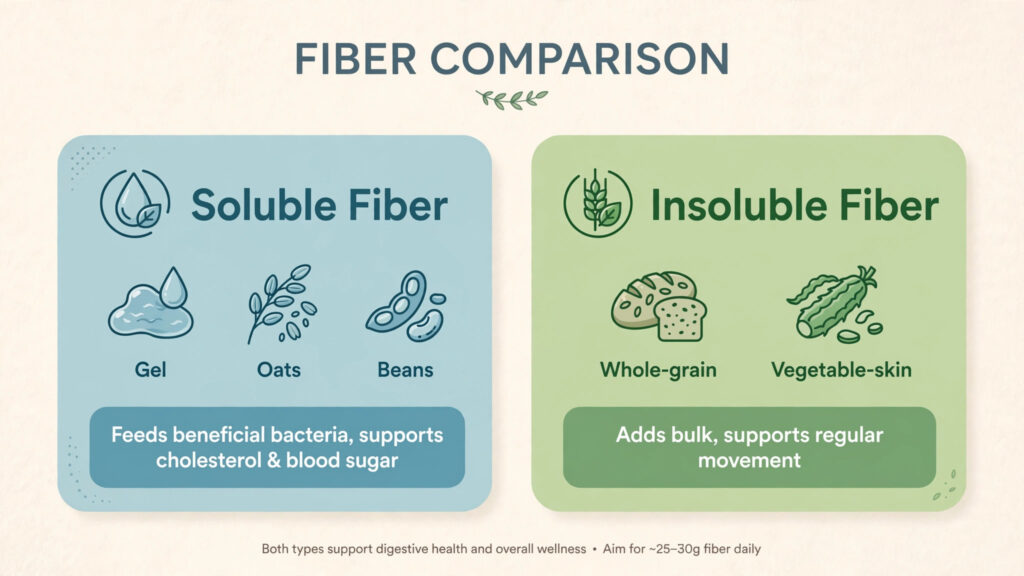
Soluble vs Insoluble Fiber: Why the Difference Matters
Not all fiber works the same way, and a well-rounded fiber-rich diet for digestive health needs both types.
- Soluble fiber dissolves in water and forms a gel-like substance in the digestive tract. It’s particularly effective at feeding beneficial gut bacteria and has been associated with improved cholesterol and blood sugar regulation. Found in oats, beans, apples, and psyllium.
- Insoluble fiber doesn’t dissolve in water and adds bulk to stool, helping food move through the digestive system more efficiently. Found in whole wheat, nuts, and the skins of many fruits and vegetables.
Most whole foods contain a mix of both, which is one reason whole-food sources tend to outperform single-ingredient fiber supplements for overall gut health.
How Fiber Feeds Your Gut Microbiome
Fiber that resists digestion and reaches the colon intact is often referred to as a “prebiotic” — essentially, food for your gut bacteria rather than food for you directly. When beneficial bacteria ferment this fiber, they don’t just produce SCFAs; they also multiply, which helps crowd out less beneficial strains and supports overall microbial diversity. A more diverse microbiome is consistently associated with better metabolic and digestive health outcomes in the research, which is part of why “gut health” has become such a central focus in nutrition science rather than just a wellness trend.
This is also where fiber diversity matters as much as fiber quantity. Different types of fiber feed different bacterial strains, so eating the same two or three fiber sources repeatedly is less effective than rotating through a genuinely varied list of high-fiber foods.
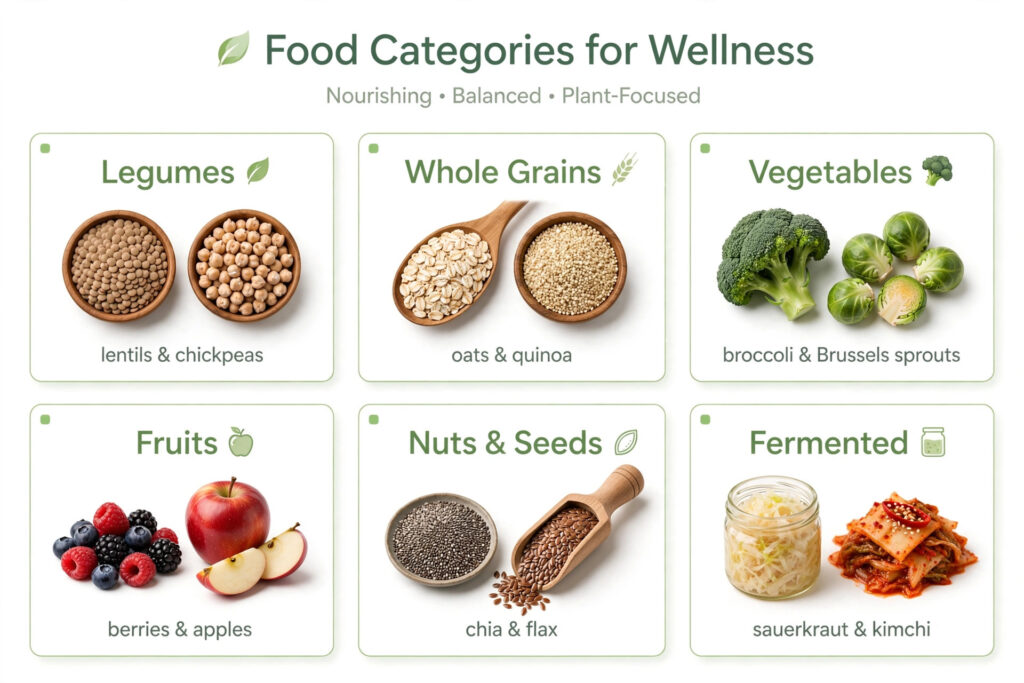
Top High-Fiber Foods for Gut Health
Legumes
Lentils, chickpeas, black beans, and kidney beans are among the most fiber-dense foods available, often providing well over a third of a day’s fiber needs in a single cooked cup. They’re also a strong source of resistant starch, a specific type of fiber particularly effective at feeding beneficial gut bacteria.
Whole Grains
Oats, quinoa, barley, and brown rice provide a mix of soluble and insoluble fiber. Oats in particular contain beta-glucan, a soluble fiber with strong research support for both gut and cardiovascular health.
Vegetables
Broccoli, Brussels sprouts, artichokes, and leafy greens are excellent fiber sources that also deliver a wide range of micronutrients and plant compounds that support overall gut and immune health.
Fruits
Berries, pears, and apples (with the skin on) are among the highest-fiber fruit options, and many also contain pectin, a soluble fiber specifically linked to beneficial changes in gut bacteria composition.
Nuts and Seeds
Chia seeds, flaxseeds, and almonds pack a meaningful amount of fiber into a small serving, and chia seeds in particular form a gel-like texture when soaked, similar to soluble fiber’s behavior in the digestive tract.
Fermented, Fiber-Rich Foods
Foods like sauerkraut and kimchi combine fiber with live beneficial bacteria, offering a combined prebiotic-and-probiotic effect that whole fiber sources alone don’t provide.
How Much Fiber Do You Actually Need Per Day?
General nutrition guidance recommends roughly 25 grams of fiber per day for women and around 38 grams for men, though most adults in Western diets consume significantly less than this on a typical day. Rather than fixating on hitting an exact number, the more practical approach is building meals consistently around whole, fiber-rich ingredients rather than trying to supplement your way to the target after the fact.
If you’re also tracking other nutrient intake as part of a broader health routine, our guide on magnesium for sleep and anxiety covers another commonly under-consumed nutrient worth paying attention to alongside fiber.
Signs You’re Not Getting Enough Fiber
A handful of signals may point to insufficient fiber intake, though it’s worth noting these overlap with other conditions and aren’t diagnostic on their own:
- Irregular bowel movements or persistent constipation
- Feeling hungry again shortly after meals
- Blood sugar spikes and crashes after eating
- Low energy that doesn’t clearly track back to sleep or stress
If any of these are persistent or significantly affecting your daily life, it’s worth discussing with a healthcare provider rather than self-diagnosing based on a symptom list.
How to Increase Fiber Intake Without Digestive Discomfort
One of the most common reasons people abandon a high-fiber diet is bloating or digestive discomfort — usually the result of increasing intake too quickly rather than fiber itself being a problem.
- Increase gradually — Adding 5 grams of fiber per week, rather than jumping straight to 30+ grams, gives your gut bacteria time to adjust.
- Increase water intake alongside fiber — Fiber needs adequate hydration to move through the digestive system smoothly; more fiber without more water is a common cause of discomfort.
- Spread intake across meals — A large amount of fiber in a single meal is harder to tolerate than the same amount spread across the day.
- Prioritize whole foods over fiber supplements — Whole foods provide fiber alongside water content, micronutrients, and natural digestive enzymes that isolated fiber supplements don’t replicate.
Fiber and Ayurveda: A Natural Convergence
Long before “gut health” became a mainstream wellness term, Ayurvedic medicine centered digestion — referred to as agni, or digestive fire — as foundational to overall health. The emphasis on whole, minimally processed foods, warm cooked meals, and fiber-rich legumes and vegetables in traditional Ayurvedic eating patterns aligns closely with what modern microbiome research now supports.
This overlap isn’t a coincidence so much as two different frameworks arriving at similar conclusions from different starting points. If you’re interested in how Ayurvedic principles apply to digestion more broadly, our guides on intermittent fasting and Ayurveda and best Triphala supplements explore this connection further — Triphala in particular has a long traditional use specifically tied to digestive support.
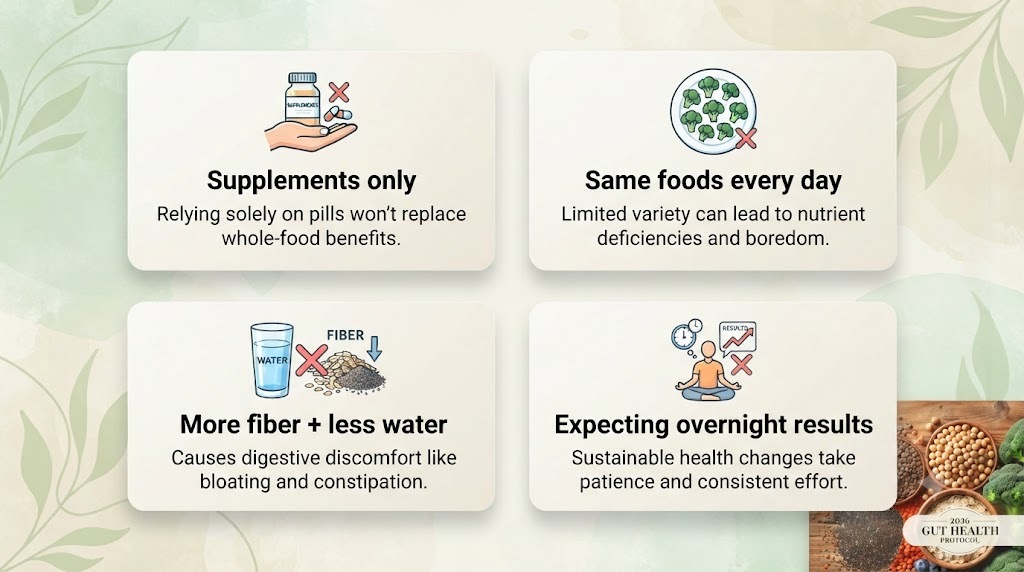
Common Mistakes When Increasing Fiber Intake
- Relying on supplements instead of food — Fiber supplements can help close a gap, but they don’t replicate the full nutritional profile of whole high-fiber foods.
- Ignoring fiber diversity — Eating the same one or two fiber sources repeatedly is less effective for microbiome diversity than rotating through a wider range of foods.
- Increasing fiber and cutting water simultaneously — This combination is one of the most common causes of constipation, ironically the opposite of the intended effect.
- Expecting immediate results — Meaningful shifts in gut bacteria composition typically take weeks of consistent dietary change, not days.
Frequently Asked Questions
What are the best high-fiber foods for gut health? Legumes, whole grains like oats and quinoa, cruciferous vegetables, berries, and chia or flax seeds are among the most fiber-dense, gut-supportive whole foods, offering a mix of soluble and insoluble fiber.
How much fiber should I eat per day for good gut health? General guidance suggests around 25 grams per day for women and 38 grams for men, though building meals consistently around whole, fiber-rich foods matters more than hitting an exact daily number.
Can too much fiber be bad for gut health? Increasing fiber too quickly, without adequate hydration, can cause bloating and digestive discomfort. A gradual increase alongside sufficient water intake typically resolves this.
Is fiber more important than probiotics for gut health? Fiber and probiotics serve different but complementary roles — fiber feeds the beneficial bacteria already present in your gut, while probiotics introduce additional beneficial strains. Most research suggests a fiber-rich diet has a larger overall impact on long-term microbiome health.
Do Ayurvedic principles align with modern gut health research? Yes, in several respects. Traditional Ayurvedic emphasis on digestive fire (agni), whole foods, and fiber-rich legumes and vegetables aligns closely with what current microbiome research identifies as supportive of gut health.
Final Thoughts
Gut health doesn’t come down to a single supplement, a trendy fermented drink, or a single “superfood.” The research consistently points back to something far less exciting but far more effective: a consistent, varied intake of high-fiber whole foods, given time to actually shift your microbiome. Legumes, whole grains, vegetables, fruits, and seeds — rotated regularly rather than repeated on autopilot — remain the most well-supported foundation for long-term digestive health.
If you’re building out a broader gut-health or nutrition routine, our guides on Ayurvedic remedies for better sleep and creatine for women cover other evidence-based pieces of the same puzzle — sleep and digestion, in particular, influence each other more than most people realize.
This article is for educational purposes only and is not a substitute for professional medical advice. If you have persistent digestive symptoms, please consult a qualified healthcare provider. Learn more about our approach on our About Us page.







Leave a Reply