
Celebrities across Hollywood and Bollywood have gotten dramatically thinner in the last few years, and the reason isn’t a secret anymore — most of it traces back to a diabetes injection called Ozempic. But there are actually evidence-backed foods that work like Ozempic for belly fat by targeting the exact same hunger-signaling pathway, without the injection’s real and well-documented downsides. This guide covers what Ozempic actually does in the body, what happened when several celebrities who’ve spoken publicly about it tried it, what the clinical research shows happens after people stop taking it, and five kitchen foods with genuine science behind their effect on appetite and abdominal fat.
What Ozempic Actually Does
Ozempic is a brand name for semaglutide, a medication originally developed and FDA-approved to manage blood sugar in type 2 diabetes. It belongs to a drug class called GLP-1 receptor agonists, which work by mimicking a hormone your gut already produces after eating. In practice, this means the drug slows down how quickly food leaves your stomach and sends stronger, more persistent fullness signals to your brain — which is why appetite drops so sharply for most people who use it. We go deeper into how supplements and specific foods interact with this same pathway in our guide to natural GLP-1 alternatives.
What Celebrities Have Actually Said About Using It
Several public figures have spoken candidly about their experience, and their accounts are worth knowing before assuming the results come without cost.
Sharon Osbourne has been especially open about this. She has publicly said she started the medication and ended up losing around 42 pounds — more than she intended — dropping to under 100 pounds at just over five feet tall. In multiple interviews, she described weeks of persistent nausea and constant thirst without appetite, and said that even after stopping the drug, she struggled to put any of the weight back on. Her most consistent message across interviews has been a caution specifically aimed at younger people: that the drug works almost too easily, and that it’s possible to lose more than intended without meaning to.
Comedian and actress Amy Schumer has described an even more difficult experience. She has said she became so nauseated and depleted of energy that she was largely bedridden and unable to play with her young son, eventually stopping the medication altogether. She later attributed part of her severe reaction to a genetic variant (GDF15) that appears to make some people unusually prone to nausea — a reminder that individual response to these drugs varies significantly and isn’t predictable in advance.
Both women have also been clear that other people they know have used the same medication with far fewer problems — which is really the core takeaway: individual response to GLP-1 drugs varies enormously, and what happens for one person on social media isn’t a guarantee of what will happen for you. That variability shows up in other areas of hormonal health too — our guide to perimenopause symptoms and how to manage them covers a similar pattern, where the same intervention affects women very differently depending on their individual hormonal picture.
What Happens When You Stop
This is the part most celebrity coverage skips entirely, and it matters more than any single side-effect story. A 2022 extension of the STEP 1 clinical trial followed people who had lost significant weight on semaglutide and then stopped taking it. One year after stopping, participants had regained about two-thirds of the weight they’d originally lost, along with a reversal of most of the cardiometabolic improvements they’d gained during treatment. That’s a meaningful, well-documented finding from a randomized trial, not speculation.
More recent real-world data, however, complicates that picture in an interesting way. A newer Cleveland Clinic study looking at nearly 8,000 patients who stopped semaglutide or a related drug found much smaller regain — about half a percent of body weight on average one year later. The likely explanation, according to the study’s lead author, is that many real-world patients don’t simply stop and do nothing; they switch to another weight-management medication or approach rather than going off treatment entirely, which is different from how the original controlled trials were structured.
The practical takeaway: these medications generally aren’t a one-time fix. Sustained results appear to require an ongoing plan — whether that’s continued medication, a switch to another approach, or a serious commitment to the lifestyle changes below, including the kind of gut-health foundation we cover in our guide to gut health signs, causes, and what helps — not a few months of injections followed by a return to old habits.
5 Foods That Work Like Ozempic for Belly Fat
These won’t replicate a prescription drug’s potency, but each one has genuine research behind its effect on appetite, gut hormones, or the specific biology of abdominal fat.
1. Curd (Yogurt) and Buttermilk
Your gut hosts trillions of bacteria that directly influence how your body stores fat — particularly visceral fat, the deep abdominal fat that’s hardest to lose through exercise alone. A meta-analysis of eight randomized controlled trials involving over 400 patients found that probiotic supplementation produced significantly greater weight loss than a placebo. More specifically, the strain Lactobacillus gasseri has repeated randomized trial evidence — including a six-month, double-blind study published in the British Journal of Nutrition — showing measurable reductions in visceral fat area measured by CT scan, concentrated specifically in the trunk region. Daily curd or a glass of buttermilk after meals is a low-risk way to support this same gut-hormone pathway that GLP-1 drugs act on directly.
2. Sattu and Roasted Chana (Roasted Gram)
Both are inexpensive, protein-rich foods, and protein matters here for a specific reason: muscle tissue is what drives your resting metabolic rate. When protein intake is inadequate, muscle mass declines, metabolism slows, and fat accumulation — especially around the abdomen — becomes easier. If you’re unsure how much you actually need, our guide to how much protein you actually need breaks down the numbers by body weight and goal. Sattu and roasted chana also digest slowly enough to extend fullness for hours, which naturally reduces snacking and portion sizes at the next meal without requiring willpower. A glass of sattu mixed with cold water, a pinch of salt, and lemon in the morning is a traditional, low-cost way to use this effect.
3. Eggs
Eggs are one of the more consistently studied high-satiety foods. Their protein content triggers the release of gut hormones that reduce appetite for hours afterward — working on a similar hunger-signaling pathway to what GLP-1 drugs activate pharmacologically, just at a much smaller, food-based scale. They’re also a naturally low-purine protein source, which is worth knowing if you’re also managing high uric acid alongside weight. Two to four boiled eggs at breakfast is a reasonable starting point; those avoiding eggs can substitute sprouted moong or paneer for a similar protein and satiety effect.
4. Bottle Gourd and Leafy Greens (Spinach, Fenugreek)
These vegetables are almost entirely water and fiber, which means they physically fill the stomach and stimulate satiety signals without contributing meaningful calories. They also happen to be some of the same leafy greens we recommend for collagen and cartilage support in our joint pain guide, so the benefit isn’t limited to appetite alone. Eating a generous portion before your main meal, or filling half your lunch plate with greens, is a simple way to reduce the volume of rice or bread you eat afterward — an easy structural change rather than a willpower-dependent one.
5. Guava and Papaya
Both fruits are notably high in fiber relative to their sugar content and have a low glycemic index, meaning they don’t spike blood sugar sharply. This matters for belly fat specifically because insulin — the hormone released in response to blood sugar spikes — is one of the primary drivers of abdominal fat storage. Keeping blood sugar and insulin more stable through fiber-rich, low-glycemic fruit is a genuinely evidence-aligned strategy, not just a wellness trend.
Building These Into a Realistic Routine
- Start the day with protein (eggs, sattu, or sprouted moong) rather than carbohydrate-heavy breakfasts alone — the same shift we recommend for stabilizing blood sugar and cravings in our perimenopause guide
- Add a serving of curd or buttermilk daily, ideally with breakfast or lunch
- Fill at least half your lunch and dinner plates with vegetables like bottle gourd, spinach, or fenugreek before adding rice or roti
- Keep guava or papaya as your go-to fruit snack when in season
- Stay active, prioritize sleep, and manage stress — none of these foods work in isolation from the basics
A Fair Comparison
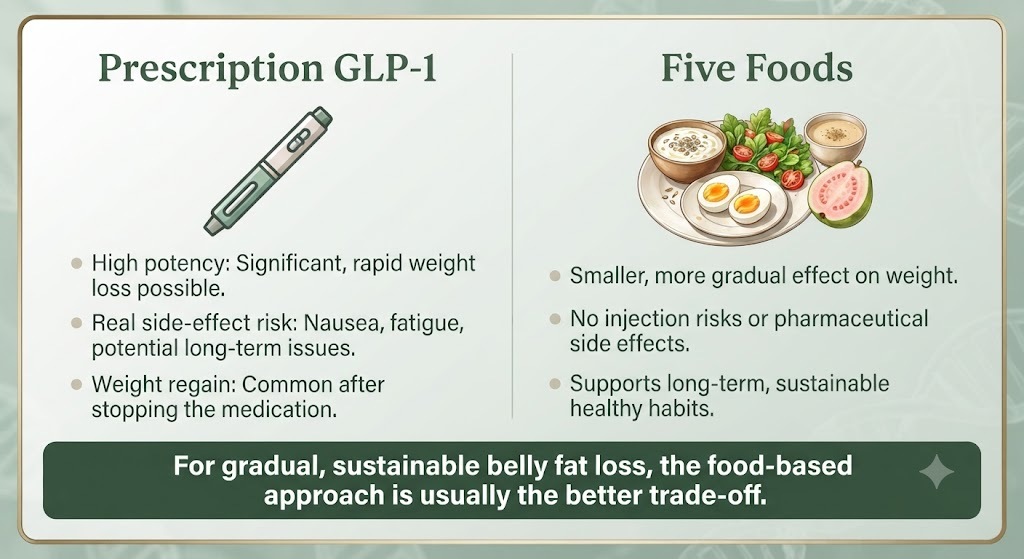
To be clear, none of this claims food can replace a prescription GLP-1 drug for someone with diabetes or a medically significant weight condition — that’s a decision for a doctor, not a blog post. What it does claim is narrower and better supported: these five foods work on genuinely overlapping biology — gut hormone release, blood sugar stability, sustained satiety — without the downside risk Sharon Osbourne and Amy Schumer have both described in public. It’s a similar risk-reward pattern to what we found digging into vitamin E capsule benefits and risks — the food-based version of a benefit is usually the lower-risk one. If your goal is gradual, sustainable belly fat loss rather than a medical intervention, that trade-off favors the food.
Frequently Asked Questions
Can food really work like Ozempic? No food replicates a prescription GLP-1 drug’s potency, but several foods — particularly probiotic-rich curd, high-protein foods like eggs and sattu, and fiber-rich, low-glycemic produce — genuinely influence the same gut-hormone and blood-sugar pathways the drug targets, just at a smaller scale.
What happens to your body after you stop Ozempic? Clinical trial data shows most people regain a significant portion of lost weight within a year of stopping — about two-thirds in the original controlled STEP 1 extension study. More recent real-world data suggests regain may be smaller for patients who transition to another treatment approach rather than stopping entirely.
Why did celebrities like Sharon Osbourne and Amy Schumer stop taking Ozempic? Both have publicly described severe nausea, extreme fatigue, and losing more weight than intended. Amy Schumer has said a genetic factor made her particularly prone to these side effects, underscoring how individual response to the drug varies.
Do probiotics actually reduce belly fat? Yes, with real caveats. Multiple randomized controlled trials, particularly involving the Lactobacillus gasseri strain, show measurable reductions in visceral fat, though the effect is modest compared to prescription medication and requires consistent use over months.
How much protein do I need to support this approach? Protein needs vary by body weight, activity level, and goal — our full guide on how much protein you actually need walks through the specific numbers.
The Bottom Line
Ozempic’s popularity comes from a real, well-understood mechanism. What doesn’t make the highlight reel is everything that comes after — Sharon Osbourne’s persistent nausea, Amy Schumer’s extreme fatigue, and trial data showing most people regain the weight once they stop. Foods that work like Ozempic for belly fat — probiotic-rich curd, protein from sattu and eggs, high-fiber vegetables, low-glycemic fruit — work on that same overlapping biology with none of that downside. The effect is smaller, and it asks more of you in consistency than an injection does. For most people chasing gradual, sustainable fat loss rather than a medically indicated intervention, it’s still the better trade.
This article is for informational purposes only and is not a substitute for personalized medical advice. If you are considering a GLP-1 medication or have a diagnosed metabolic condition, consult a physician before making treatment decisions.







Leave a Reply