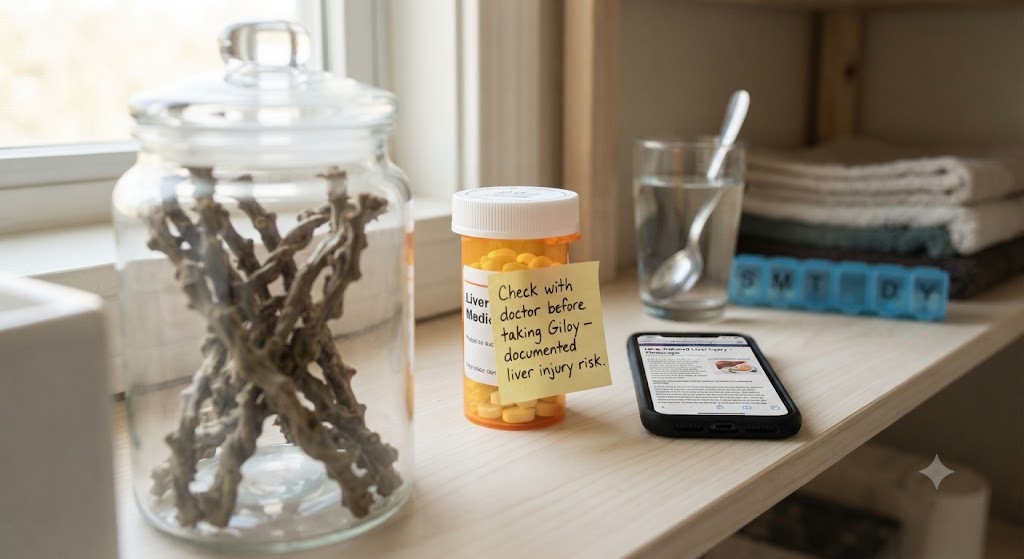
Giloy benefits and liver safety rarely get discussed in the same breath, and that gap is exactly the problem. Giloy (Tinospora cordifolia, also called Guduchi or Amrita) became one of the most consumed herbal supplements in India almost overnight during the COVID-19 pandemic, marketed heavily as an immunity booster — and the underlying pharmacology genuinely does support real immune and antioxidant effects. What got far less attention, and deserves far more, is a growing body of documented case reports and multicenter studies linking Giloy to real, sometimes serious liver injury. This is the same pattern we found separating real mechanism from oversold hype in our fact-check on cortisol face and cortisol detox — a plausible biological story spreading faster than the actual safety data behind it. This isn’t a fringe internet rumor; it’s published in peer-reviewed hepatology journals, including a 43-patient nationwide Indian study. This guide covers both halves honestly: what Giloy’s immunity claims actually rest on, what the liver injury research actually found, and how to use it — if you choose to — with real precaution rather than blind trust in tradition.
What Giloy Is and Why It Got So Popular
Giloy is a climbing shrub native to India, used for centuries in Ayurvedic medicine and referenced in classical texts like the Charaka Samhita. Its popularity spiked dramatically during the COVID-19 pandemic, when it was widely promoted across India as a way to boost immunity against the virus — a claim that spread faster than the clinical evidence behind it ever caught up to. Giloy contains alkaloids, diterpenoid lactones, polysaccharides, and other bioactive compounds that researchers have linked to genuine immunomodulatory, antioxidant, anti-inflammatory, and antiviral activity in laboratory and animal studies.
What the Immunity and Health Research Actually Shows
This is where honesty about evidence quality matters. Giloy’s pharmacological profile is genuinely interesting — a 2012 study isolated and characterized seven active immunomodulatory compounds from the plant, and subsequent research has continued to map out mechanisms including NF-κB pathway modulation and interleukin regulation, both relevant to how the body coordinates immune and inflammatory responses. Reviews consistently describe antidiabetic, anti-arthritic, antioxidant, and hepatoprotective properties in preclinical research.
The honest caveat, stated plainly by multiple review authors themselves: the overwhelming majority of this evidence comes from in vitro (test tube) and animal studies, not human clinical trials. One notable exception is a randomized, double-blind, placebo-controlled trial in HIV-positive patients, which found Giloy extract produced a significant reduction in several disease-associated symptoms compared to placebo over six months — a genuinely real human trial, though a narrow one, studying a specific population rather than general immunity claims. Beyond this, human evidence for Giloy’s broader immune-boosting claims — including anything related to COVID-19 specifically — remains thin, and researchers reviewing the field have repeatedly called for more extensive human trials before treating these traditional uses as clinically established.
The realistic takeaway: Giloy has a genuinely plausible, mechanistically interesting profile, similar in some ways to the evidence pattern we found researching ashwagandha’s benefits and dosage — promising preclinical science, with human evidence still catching up to the popular claims.

The Liver Injury Research: What Actually Happened
This is the part of the Giloy story that deserves far more visibility than it currently gets, particularly given how casually the herb is often recommended.
During and after the COVID-19 pandemic, hepatologists across India began documenting a pattern: patients presenting with acute liver injury, in some cases severe, with Giloy use as the identifiable common factor. A landmark multicenter, nationwide Indian study, published in Hepatology Communications and led by the Liver Research Club India, examined 43 patients across 13 centers with herb-induced liver injury temporally associated with Giloy consumption. Patients presented with acute hepatitis, acute worsening of existing chronic liver disease, or in some cases, acute liver failure. Causality assessment found the connection to Giloy was “probable” in 67.4% of cases. Liver biopsy in a subset of patients revealed injury with autoimmune-like features — meaning the herb appeared, in some individuals, to trigger or unmask an autoimmune-type liver reaction rather than causing straightforward toxic damage.
Separate case reports have documented similar patterns. A case published in Cureus described a 50-year-old woman who developed severely elevated liver enzymes after starting a Giloy-containing supplement, with symptoms resolving after stopping the herb and a short course of steroids. A commentary published in the Journal of Clinical and Experimental Hepatology, responding to the growing case series, made the point directly: the widespread, casual use of “immunity boosters” during the pandemic proceeded with essentially no long-term human safety data to support it, and Giloy’s liver injury reports are exactly the kind of consequence that pattern was likely to eventually produce.
An important scientific counter-argument worth knowing: some researchers have pushed back specifically on whether Tinospora cordifolia is truly the culprit, arguing that many reported liver injury cases may actually involve Tinospora crispa — a visually similar but chemically distinct species sometimes mistakenly harvested or sold in its place, and one already independently linked to hepatitis in other research. This is a genuine, unresolved scientific debate, not a settled dismissal of the risk — and it’s worth noting the nationwide Indian study specifically performed DNA barcoding and chemical analysis on retrieved samples to confirm species identity in their patient cohort, which strengthens rather than weakens the case that genuine T. cordifolia was involved in at least a meaningful share of these reports.
A separate, practical concern: chemical and toxicological analysis of Giloy samples retrieved from affected patients in the nationwide study found heavy metal contamination — mercury, arsenic, and lead above prescribed limits — in some samples. This points to a real quality-control problem in how some commercial Giloy products are sourced and manufactured, independent of the plant’s own inherent properties, and it’s a genuine reason to be selective about where any Giloy product comes from.
How to Use Giloy More Safely, If You Choose To
- Don’t use it continuously, indefinitely. Traditional and clinical caution both point toward limited, defined courses rather than daily use for months or years without a break — the median time from starting Giloy to symptom onset in the nationwide study was 46 days, meaning problems can develop well within a typical “immunity booster” course.
- Source it carefully. Given the documented heavy metal contamination findings, buying from a reputable, tested source matters more with Giloy than with many other herbs — the same “check the source, not just the plant name” principle we emphasize in our guide to natural remedies for high uric acid, where product quality is as important as the ingredient itself.
- Watch for early warning signs. Nausea, abdominal discomfort, unusual fatigue, yellowing of the skin or eyes, or dark urine while taking Giloy warrant stopping immediately and seeking medical evaluation, not waiting to see if symptoms pass — several of these symptoms also overlap with thyroid dysfunction, covered in our hypothyroidism guide, so it’s worth telling your doctor about any supplements you’re taking rather than assuming fatigue has just one possible cause.
- Be especially cautious with pre-existing liver conditions or autoimmune disease. Given the biopsy findings suggesting autoimmune-like liver reactions, this population appears to carry disproportionate risk based on the case reports available.
Who Should Avoid Giloy Entirely
- Anyone with existing liver disease — the documented pattern of acute worsening of chronic liver disease in the nationwide study makes this a real, not theoretical, risk
- Anyone with an autoimmune condition, given the autoimmune-like features seen on liver biopsy in affected patients
- Pregnant or breastfeeding individuals — insufficient safety data exists to support use in this population
- Anyone already taking hepatotoxic medications or other supplements with liver-related risk, where combined exposure compounds uncertainty — a caution that applies just as directly to supplements like vitamin E at high doses, where stacking multiple substances the liver has to process adds risk that’s easy to underestimate
About the Rest of a Common Giloy Home Remedy
Giloy is frequently combined with cinnamon, turmeric, and black pepper in a boiled decoction, and it’s worth being clear that these three companion ingredients have a considerably different, generally more reassuring safety profile than Giloy itself. Cinnamon has real supporting evidence for blood sugar and cholesterol effects, which we cover in more depth in our guide to natural remedies for high BP and cholesterol. Turmeric and black pepper’s combined anti-inflammatory and bioavailability-boosting effects are covered in detail in our turmeric-ginger joint pain remedy guide. None of that changes the specific caution that applies to the Giloy component of a combined decoction — the other three ingredients being reasonably safe doesn’t offset Giloy’s own documented risk profile.
When to See a Doctor
- Yellowing of the skin or eyes (jaundice)
- Persistent nausea, vomiting, or abdominal pain, particularly in the upper right abdomen
- Unusually dark urine or pale stools
- Unexplained fatigue that develops or worsens after starting Giloy
- Any of the above occurring within weeks of starting a Giloy-containing supplement or decoction
Frequently Asked Questions
Is Giloy actually dangerous, or is the liver injury risk overblown? It’s a genuine, documented risk backed by peer-reviewed research, including a 43-patient multicenter Indian study — not internet rumor. That said, the absolute number of confirmed cases remains small relative to how widely Giloy is used, so this is a real risk to take seriously and manage, not a reason to assume every user will be affected.
Does Giloy actually boost immunity against COVID-19 or other viruses? The direct human evidence for this specific claim is thin. Most of the immunomodulatory research behind Giloy’s popularity comes from lab and animal studies, and the strongest human trial evidence available (in HIV-positive patients) doesn’t directly support the general “COVID immunity booster” framing that drove its pandemic-era popularity.
How long is it safe to take Giloy? There’s no firmly established safe duration from clinical research, but the median time to symptom onset in documented liver injury cases was 46 days, suggesting problems can develop within a typical multi-week “immunity” course. Limited, defined courses rather than continuous daily use appear to be the more cautious approach.
Is Tinospora cordifolia different from the giloy that caused liver injury in these studies? This is a genuine scientific debate. Some researchers argue reported cases may partly involve a different, similar-looking species (Tinospora crispa) rather than true T. cordifolia. However, the largest nationwide study specifically verified species identity through DNA barcoding in its patient samples, which supports genuine T. cordifolia involvement in at least a meaningful portion of cases.
Can Giloy cause liver damage even in healthy people with no prior liver issues? Yes — documented cases include patients without pre-existing liver disease. Risk does appear elevated in people with existing liver conditions or autoimmune disease, but healthy individuals are not automatically exempt based on the case reports available.
What are the early warning signs of Giloy-related liver injury? Nausea, abdominal discomfort, unusual fatigue, yellowing of the skin or eyes, and dark urine are the key symptoms to watch for, and any of these appearing after starting Giloy warrants stopping the herb and seeking medical evaluation promptly.
Is it safer to take Giloy powder, fresh stem, or a commercial tablet? There’s no clear evidence that one form is definitively safer than another, but the documented heavy metal contamination findings in some commercial samples make sourcing quality — not just form — a genuinely important safety factor, regardless of which preparation you choose.
Should I avoid the cinnamon-turmeric-black pepper decoction entirely because of the Giloy risk? Not necessarily, but it’s worth being clear-eyed that the Giloy component carries a distinct, documented risk that the other three ingredients don’t share to the same degree. If you’re cautious about Giloy specifically, the decoction can reasonably be made with just cinnamon, turmeric, and black pepper, omitting Giloy, and still retain real evidence-backed benefits from those three ingredients alone.
Does short-term or occasional Giloy use carry the same risk as daily long-term use? The available research doesn’t clearly establish a safe threshold, but the case pattern suggests risk isn’t limited to only long-term heavy use — some documented cases developed within weeks of starting. This isn’t a “small amounts are definitely fine” situation the way it might be with a lower-risk herb.
What should I do if I’ve already been taking Giloy for a while with no symptoms? The absence of symptoms is reassuring but not a guarantee, since some cases develop gradually. If you’ve been using it for an extended period, it’s reasonable to get baseline liver function tested and discuss continued use with a doctor, particularly if you plan to keep taking it long-term.
The Bottom Line
Giloy benefits and liver safety need to be weighed together, not separately, and that’s precisely what most Giloy content online fails to do. The immunity and antioxidant research is genuinely interesting at the mechanistic level, but it’s built mostly on preclinical evidence, not robust human trials. The liver injury research, by contrast, is published in serious peer-reviewed hepatology journals, backed by a real multicenter study with biopsy-confirmed findings. That combination — promising but preclinical benefit, alongside documented and serious risk — means Giloy deserves real caution rather than the blanket “it’s natural, so it’s safe” assumption that fueled its pandemic-era popularity. If you use it, keep courses limited, source it carefully, watch for symptoms, and treat any warning sign as a reason to stop and see a doctor immediately, not a reason to push through.
This article is for informational purposes only and is not a substitute for personalized medical advice. Consult a physician before starting Giloy or any Tinospora cordifolia supplement, particularly if you have liver disease, an autoimmune condition, are pregnant, or take other medications or supplements.





Leave a Reply