
Are seed oils bad for you? Few nutrition questions have generated as much heat relative to the actual evidence in the last few years, fueled by the “Make America Healthy Again” movement and a wave of viral claims that oils like canola, soybean, sunflower, and corn are quietly poisoning modern diets. The honest answer, once you actually read the randomized controlled trials rather than the headlines, doesn’t fit neatly into either camp. The core “seed oils cause inflammation” claim that launched this controversy doesn’t hold up well against the human trial evidence — the same gap between wellness marketing and peer-reviewed research we found digging into continuous glucose monitors for non-diabetics. But a genuinely new 2026 finding — one almost no viral content on either side has mentioned — does suggest something more nuanced is worth paying attention to. This guide walks through what the actual research says, separates the settled science from the still-open questions, and gives you a clear, evidence-based way to think about the oil in your kitchen.
What Seed Oils Actually Are
“Seed oils” refers to vegetable oils extracted from plant seeds — canola (rapeseed), soybean, sunflower, safflower, corn, grapeseed, and cottonseed oil are the most common in a typical kitchen and in packaged food manufacturing. They became dominant in the food supply through the 20th century largely because they’re cheap to produce at scale and, per official dietary guidance, were positioned as heart-healthier alternatives to saturated animal fats like butter and lard. Their primary fatty acid is linoleic acid, an omega-6 polyunsaturated fat — and linoleic acid specifically is where nearly the entire modern controversy is actually centered.
The Core Claim: Do Seed Oils Cause Inflammation?
This is the claim driving most of the anti-seed-oil sentiment, and it’s worth tracing the actual biological logic before checking it against evidence. Linoleic acid can be converted in the body into arachidonic acid, which is a precursor for certain inflammatory signaling molecules called eicosanoids. On paper, that sounds like a plausible mechanism for “more seed oil equals more inflammation.” In practice, the human research tells a considerably different story.
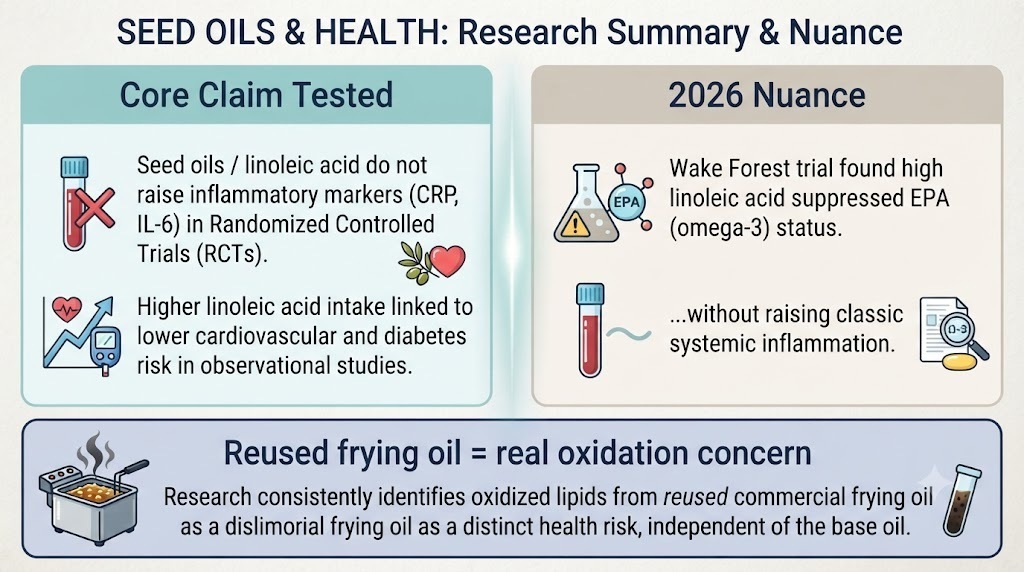
Only about 0.2% of dietary linoleic acid actually gets converted into arachidonic acid in the body — a tightly regulated enzymatic process that doesn’t ramp up proportionally just because you eat more linoleic acid. Two separate systematic reviews of randomized controlled trials — one examining 15 trials in 2012, another examining 30 trials in 2017 — found that raising dietary linoleic acid did not raise C-reactive protein or other standard inflammatory markers in healthy people. A 2024 systematic review and meta-analysis went further, finding that higher linoleic acid intake was actually consistently associated with lower levels of inflammatory biomarkers like CRP and interleukin-6, not higher ones. This pattern — a biologically plausible mechanism for harm that doesn’t actually materialize in human trials — is the same honest evidence-versus-mechanism gap we found separating real risk from overstated concern in our look at Giloy’s benefits and liver safety.
The observational data tells a similarly consistent story. A 2019 analysis in Circulation, pooling data from roughly 68,000 people across 30 prospective studies with over 15,000 cardiovascular events, found higher blood levels of linoleic acid were linked to lower risk of total cardiovascular disease, cardiovascular death, and stroke — the opposite direction from what the “seed oils are inflammatory” narrative predicts. A separate analysis in The Lancet Diabetes & Endocrinology, following nearly 40,000 people, found the highest blood linoleic acid levels associated with roughly 35% lower risk of type 2 diabetes.
The Omega-6:Omega-3 “Ratio” Myth
A related, frequently repeated claim is that modern diets have a dangerously skewed omega-6-to-omega-3 ratio compared to ancestral diets, and that fixing this ratio (often cited as an ideal of 1:1) is essential for health. Researchers at Johns Hopkins reviewing this specific claim, including the authors of the large 2019 Circulation analysis above, found the evidence doesn’t actually support it — when the same study population’s omega-3 levels were examined alongside their omega-6 levels, the ratio itself wasn’t what predicted cardiovascular outcomes. This is a good example of a claim that sounds intuitively compelling but doesn’t survive contact with the actual data once researchers look for it directly, similar to the polyvagal theory pattern we unpacked in our piece on somatic therapy and nervous system regulation, where a plausible-sounding mechanism didn’t hold up as cleanly as its popularity suggested.
Cardiovascular Benefit: Where the Evidence Is Genuinely Strongest
This is the part of the seed oil conversation that has the most consistent, most rigorously reviewed support. The 2020 U.S. Dietary Guidelines Advisory Committee, after reviewing the available evidence, concluded that strong evidence demonstrates replacing saturated fat with polyunsaturated fat in adults reduces the risk of coronary heart disease events and cardiovascular mortality. Randomized controlled trials specifically show that swapping saturated fat for seed oils lowers LDL cholesterol, raises HDL cholesterol, and in some trials modestly lowers blood pressure — a genuinely well-replicated finding, not a single study result. This lines up with the same “replacing saturated fat with unsaturated fat measurably helps cardiovascular markers” pattern we found researching garlic’s real evidence for cholesterol and blood pressure, where the direction of the underlying dietary fat science is consistent across multiple independent research areas.
The Genuinely New 2026 Finding Most Coverage Has Missed
This is where an honest answer to “are seed oils bad for you” gets more interesting than either side of the debate typically allows for.
A randomized, double-blind, controlled trial from Wake Forest University School of Medicine, published in Nutrients in June 2026, directly compared a low-linoleic-acid diet (2.5% of calories) against a high-linoleic-acid diet (10% of calories, roughly matching typical modern intake) over 12 weeks in healthy adults, while keeping omega-3 intake constant across both groups. The result wasn’t that high linoleic acid increased classic inflammatory markers or raised arachidonic acid levels — it didn’t. What the researchers found instead was that the high-linoleic-acid diet significantly suppressed EPA (an omega-3 fatty acid) status and shifted the body’s oxylipin balance — the signaling molecules derived from these fats — toward a more omega-6-dominant profile, specifically by reducing EPA-derived mediators relative to arachidonic-acid-derived ones.
Why this matters, and why it’s more nuanced than either “seed oils are toxic” or “seed oils are completely fine”: this isn’t evidence that seed oils directly cause inflammation, and it doesn’t contradict the cardiovascular and inflammatory-marker research above. What it does suggest is that very high linoleic acid intake may make it harder for the body to maintain adequate omega-3 status and signaling — which points toward the importance of your overall dietary balance, not a reason to avoid seed oils outright. In practice, this strengthens the case for making sure you’re getting enough omega-3s (fatty fish, walnuts, flaxseed) alongside typical seed oil consumption, rather than treating seed oils themselves as the problem.
The Legitimate Concern That Gets Lost in the Noise: Oxidation From Reheating and Deep Frying
This is a real, separate issue from the inflammation debate, and it’s worth understanding on its own terms rather than lumping it into the broader “seed oils are dangerous” claim. Repeatedly heating oil to high temperatures — the kind of reuse common in commercial deep frying — genuinely does produce harmful oxidation byproducts, including aldehydes linked to health concerns in laboratory research. This is a legitimate, evidence-supported reason to be cautious about food fried in old, repeatedly reused oil, particularly from certain commercial and street-food settings. It is a meaningfully different claim than “the seed oil in your kitchen bottle is inherently toxic” — freshly used oil at home, even at typical cooking temperatures, doesn’t carry the same oxidation burden as oil reused dozens of times in an industrial fryer.
Untangling the Ultra-Processed Food Confound
A significant share of the observational data linking seed oils to poor health outcomes comes from populations eating diets heavy in ultra-processed food — and seed oils happen to be a near-universal ingredient in that category of food. This creates a genuine confounding problem: is it the oil itself, or is it that seed oils are simply present in the chips, packaged snacks, and fried fast food that are independently linked to poor metabolic health for other reasons entirely? This is a similar untangling problem to the one we worked through in our guide to habits that damage your kidneys, where hidden sodium in packaged food, not the salt shaker, turned out to be the real driver behind a commonly misattributed risk. The randomized controlled trial evidence above, which isolates linoleic acid intake specifically rather than the surrounding food matrix, is what allows researchers to actually separate these two questions — and it’s a large part of why the RCT data and the observational “seed oils are everywhere in bad food” intuition point in somewhat different directions.
A Practical, Evidence-Based Way to Think About This
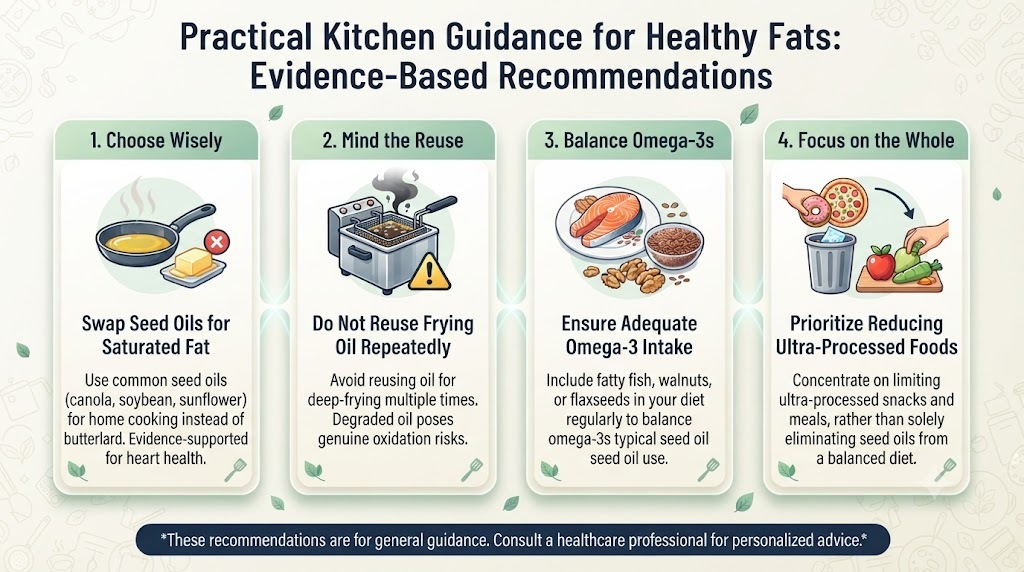
- Using seed oils for home cooking, replacing butter or lard, is evidence-supported, not something to be anxious about based on current RCT data
- Don’t reuse oil repeatedly for high-heat frying — this is where the genuine oxidation concern lives, not in ordinary home cooking
- Make sure you’re getting adequate omega-3s alongside typical seed oil intake, given the 2026 Wake Forest finding on EPA suppression — fatty fish, walnuts, chia, and flaxseed are practical sources, and this is the same lignan-and-omega-3 profile we cover in our guide to natural remedies for hypothyroidism, where flaxseed’s omega-3 content shows up as relevant to more than one area of health
- Focus on reducing ultra-processed food generally, rather than treating “no seed oils” as a standalone health strategy — the food matrix these oils typically appear in matters at least as much as the oil itself, and pairing better fat choices with habits like walking after meals for blood sugar control does more for overall metabolic health than any single ingredient swap
- Extreme, very high supplemental doses of isolated linoleic acid aren’t well studied and shouldn’t be assumed equivalent to normal dietary intake from cooking oil
Frequently Asked Questions
Are seed oils actually bad for you, or is this overblown? The core claim that seed oils cause inflammation and cardiovascular harm doesn’t hold up against randomized controlled trial evidence — multiple RCTs and large observational studies show linoleic acid is associated with lower, not higher, inflammatory markers and cardiovascular risk. A genuinely new 2026 finding on omega-3 suppression suggests a more nuanced picture worth watching, but it doesn’t support the “seed oils are toxic” framing.
Do seed oils cause inflammation? The strongest available evidence, including multiple systematic reviews of RCTs, shows dietary linoleic acid does not raise standard inflammatory markers like CRP or IL-6 in healthy people, and in several studies is associated with lower inflammation, not higher.
Is canola oil bad for you? Canola oil, like other seed oils high in unsaturated fat, has RCT evidence supporting improved cholesterol markers when it replaces saturated fat in the diet. Current evidence doesn’t support the claim that canola oil is uniquely harmful compared to other cooking oils.
Should I avoid seed oils and switch to olive oil or butter? Olive oil has its own strong evidence base and is a reasonable choice, but current RCT evidence doesn’t show a meaningful health advantage to avoiding seed oils in favor of butter or other saturated fats — the opposite direction is better supported, with seed oils generally outperforming saturated fat on cardiovascular markers.
What is the 2026 Wake Forest study, and why does it matter? It’s a randomized controlled trial comparing low versus high dietary linoleic acid intake, finding that high intake suppressed omega-3 (EPA) status and shifted the body’s lipid signaling balance toward omega-6 dominance — without increasing classic inflammatory markers. It suggests dietary balance with omega-3s matters, rather than proving seed oils themselves are harmful.
Is the omega-6 to omega-3 ratio really important for health? Research specifically examining this claim, including analysis from the large 2019 Circulation study, found the ratio itself wasn’t what predicted cardiovascular outcomes — a widely repeated claim that doesn’t hold up as cleanly as its popularity suggests.
Is reused frying oil actually dangerous? Yes, this is a genuine, evidence-supported concern, separate from the inflammation debate. Oil reheated and reused repeatedly at high temperatures produces oxidation byproducts linked to health concerns, which is a meaningfully different issue than typical home cooking with fresh oil.
Do seed oils cause heart disease? Current strong evidence, including conclusions from the U.S. Dietary Guidelines Advisory Committee, points the opposite direction — replacing saturated fat with the polyunsaturated fat found in seed oils reduces cardiovascular disease risk in randomized controlled trials.
Why do seed oils have such a bad reputation if the RCT evidence doesn’t support it? Much of the concern stems from seed oils’ near-universal presence in ultra-processed foods, creating a real confounding problem in observational data — it’s difficult to separate the oil’s own effect from the effect of the processed food it typically appears in. Public health and political movements have also amplified the claim beyond what current controlled trial evidence supports.
How much seed oil is safe to consume daily? Typical dietary intake — roughly 6-9% of total calories from linoleic acid, consistent with what most people already consume from a normal diet including cooking oil — falls within the range studied in the research discussed here. There isn’t strong evidence supporting either avoiding seed oils entirely or deliberately consuming very high supplemental amounts beyond typical dietary levels.
The Bottom Line
Are seed oils bad for you? Based on the actual randomized controlled trial evidence, the core claims driving the anti-seed-oil movement — that they cause inflammation and cardiovascular harm — don’t hold up, and the cardiovascular evidence points in the opposite direction, favoring seed oils over saturated fat. What genuinely deserves more attention than it’s getting is the 2026 Wake Forest finding on omega-3 suppression at high linoleic acid intake — not a reason to fear seed oils, but a good reason to make sure your overall diet includes adequate omega-3s alongside them. The real, evidence-backed concerns sit elsewhere: repeatedly reused frying oil, and the broader pattern of seed oils showing up mostly in ultra-processed food. Cook with seed oils in place of saturated fat with reasonable confidence, skip the repeatedly reused deep-fryer oil, and make sure omega-3s are part of your regular diet — that’s what the actual research supports, independent of which side of the public debate you’ve been hearing from.
This article is for informational purposes only and is not a substitute for personalized medical or nutritional advice. Consult a physician or registered dietitian for guidance specific to your health history and dietary needs.







Leave a Reply