Ice baths and cold plunges have gone from niche athlete recovery tool to full-blown lifestyle trend, and the research underneath the trend is more interesting — and more conditional — than the “cold exposure fixes everything” framing you’ll see on most fitness accounts. There’s a real, well-documented benefit for muscle soreness. There’s also a genuinely important finding that gets left out of nearly every cold plunge video: regular post-workout ice baths can measurably blunt muscle growth if you’re strength training for size. And the mood benefits people talk about constantly are real in the short term, but thinner in the long-term data than the hype suggests. This guide walks through exactly what the clinical trials found, who cold plunging actually helps, who it can quietly work against, and the safety details that matter more than the Instagram version of this practice ever mentions.
What Cold Water Immersion Actually Does to Your Body
Immersing yourself in water below about 15°C triggers a cascade of physiological responses: blood vessels near your skin constrict to preserve core temperature, your heart rate and blood pressure spike, and your body releases catecholamines — including norepinephrine — along with endorphins. This is also the same stress-response machinery we cover in our guide to cortisol and what genuinely affects it, since cold exposure is, in a real physiological sense, a deliberately applied acute stressor rather than a purely relaxing practice, regardless of how calm people report feeling afterward.
Muscle Soreness and Recovery: The Strongest Evidence Behind Cold Plunging
This is where cold water immersion has its best-established research base. A Cochrane systematic review pooling 17 randomized controlled trials found statistically significant reductions in perceived muscle soreness at 24, 48, 72, and even 96 hours after exercise, compared to passive rest. The effect was strongest at the 72-hour mark, and participants also reported lower fatigue ratings immediately after immersion. A separate 2016 meta-analysis in the International Journal of Sports Medicine found a similar pattern of reduced soreness across the same recovery window.
The honest caveat, which the Cochrane reviewers themselves flagged directly: overall study quality across this research was low, sample sizes were small, and results varied considerably between trials. One individual double-blind randomized controlled trial specifically testing eccentric exercise-induced muscle damage — the kind that produces the worst next-day soreness — found ice-water immersion provided no benefit for pain, swelling, strength, or function, and in some measures left participants more sore the following day than passive recovery. The practical takeaway: cold water immersion has real, moderate evidence for easing general post-exercise soreness, but it’s not a universal fix, and the type of exercise and soreness involved genuinely changes how well it works.
The Finding Most Cold Plunge Content Leaves Out: It Can Blunt Muscle Growth
If you’re strength training specifically to build muscle, this is the single most important piece of research in this entire article, and it’s routinely missing from cold plunge marketing.
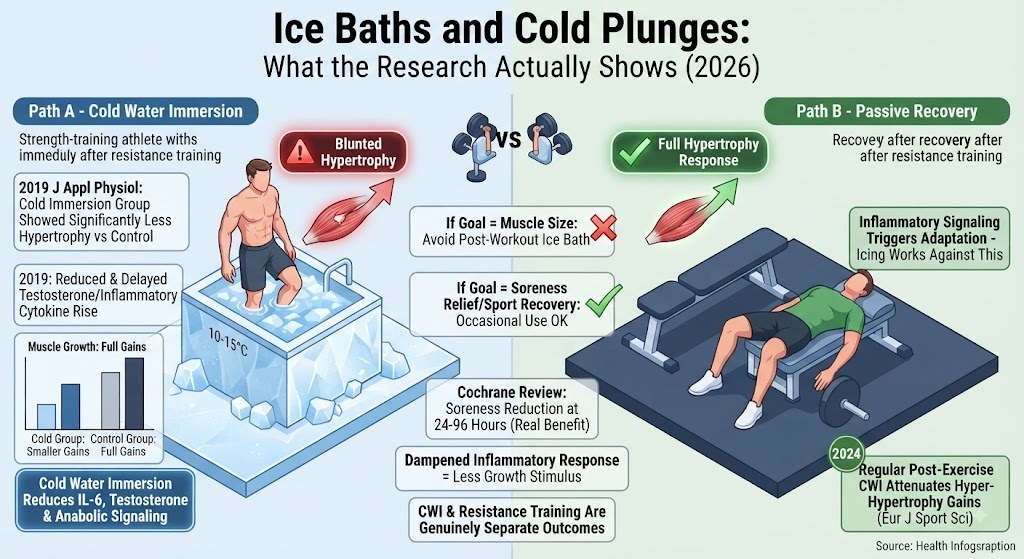
A landmark 2019 study published in the Journal of Applied Physiology had participants perform seven weeks of resistance training, with one leg group following each session with cold water immersion and the other with passive recovery. The cold water immersion group showed significantly blunted muscle fiber hypertrophy compared to the control group, despite training identically — likely because cold exposure reduces post-exercise inflammatory signaling (IL-6, testosterone, and other anabolic markers) that muscles actually need to trigger growth. A separate 2019 study found cold water immersion reduced and delayed the normal post-exercise rise in testosterone and inflammatory cytokines. A 2024 systematic review and meta-analysis in the European Journal of Sport Science, examining the pooled evidence on this exact question, confirmed the pattern: regular post-exercise cold water immersion following resistance training measurably attenuates hypertrophy gains, even though the effect on raw strength gains is smaller and less consistent across studies.
The practical rule that follows from this research: if your training goal is building muscle size, avoid cold water immersion in the immediate hours after a resistance training session — the inflammation you’d be icing away is doing real work. If your priority is soreness relief for general activity, sport-specific recovery between competitions, or simply feeling less beat up, the calculus is different, since the research on soreness and the research on hypertrophy are measuring genuinely separate outcomes, not two ways of describing the same thing. This is also a reasonable moment to double-check you’re eating enough to support recovery in the first place — our guide on how much protein you actually need is worth reading alongside this, since under-eating protein compounds the same recovery problem from a different angle.
Mood and Mental Health: Real, But More Modest Than the Hype
A 2022 study published in Lifestyle Medicine found a single cold water immersion session produced a measurable improvement in mood immediately afterward, and the researchers linked this to the same catecholamine and endorphin release involved in the “runner’s high” phenomenon. A separate study measuring cortisol directly found levels were significantly lower 180 minutes after a single cold water immersion session, alongside reduced negative mood ratings — a genuinely interesting data point for anyone specifically chasing the calming effect, and one that connects to the broader evidence-and-hype gap we found researching somatic nervous system regulation more generally.
A more recent 2025 systematic review and meta-analysis, pooling 11 randomized trials and over 3,100 participants, found consistent improvements across several wellbeing measures following cold water immersion. But the review’s authors were candid about a real limitation: most existing research measures single-session or short-term effects using subjective self-report, and rigorous studies with objective biomarkers and longer-term follow-up remain limited. The honest summary: cold exposure does appear to produce a real, acute mood lift for many people, but “cold plunging cures anxiety and depression” is a claim the current evidence doesn’t support — it’s closer to “cold plunging reliably makes most people feel noticeably better for a while afterward,” which is still a genuinely useful effect, just a smaller and shorter-lived one than some wellness marketing implies.
The Safety Risks That Actually Matter
This is the section that gets skipped most often, and it shouldn’t be, given that cold water immersion carries real, documented risk — not hypothetical fine print.
Cold shock response. Sudden immersion in cold water triggers an involuntary “gasp reflex,” rapid hyperventilation, and a spike in heart rate and blood pressure — a response strongly implicated in drowning deaths even among strong swimmers. Multiple documented fatalities, including from cardiac arrhythmia triggered by cold shock, have occurred in uncontrolled cold water settings. Researchers specifically recommend slow, controlled entry — splashing water on your face and chest first, then easing in gradually — rather than jumping or diving in, since a gradual entry meaningfully reduces the severity of this response.
Cardiovascular strain. Cold immersion causes a genuine, measurable spike in blood pressure and heart rate, along with reported cases of arrhythmia and reduced cerebral blood flow during immersion. This makes cold plunging a real contraindication — not just a caution — for anyone with existing heart disease, uncontrolled high blood pressure, or a history of arrhythmia, and it’s worth a direct conversation with a doctor before starting if any of those apply to you.
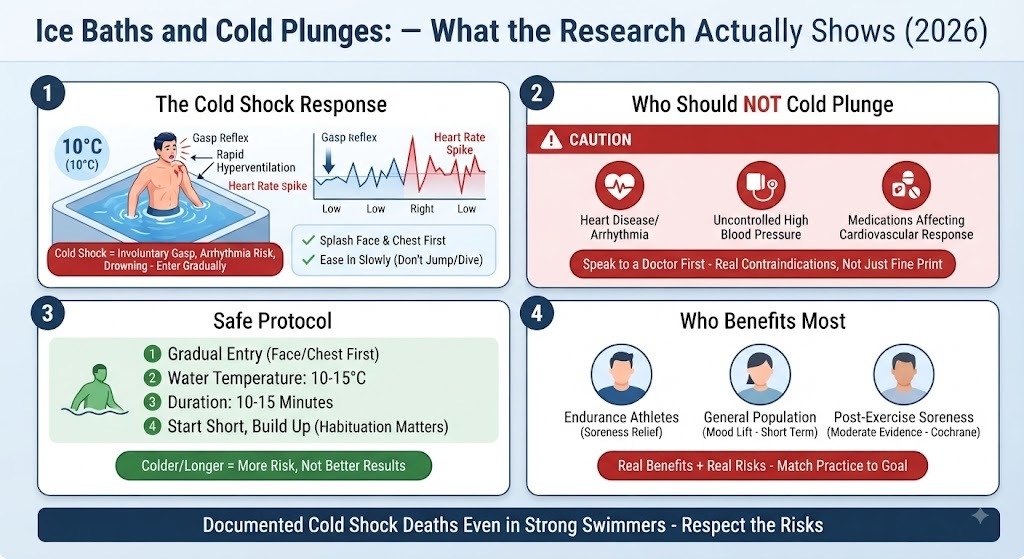
Habituation matters. Research suggests repeated, controlled cold exposure over multiple sessions can blunt the intensity of the cold shock response compared to a single unhabituated exposure — part of why easing in gradually over successive sessions, rather than starting with the coldest, longest plunge you can find, is both safer and more sustainable, echoing the same “start low and build up” dosing logic that shows up throughout the supplement research we’ve covered, including our breakdown of ashwagandha dosing.
A Realistic, Evidence-Informed Approach to Cold Plunging
- For general soreness and recovery feel: 10–15°C water for 10–15 minutes, ideally within two hours of exercise, is the protocol most consistent with the supporting research
- If your goal is muscle growth: skip cold immersion in the hours immediately following resistance training, or reserve it for rest days and pure soreness management instead
- For mood benefits specifically: even brief exposure — cold showers or short plunges — appears to produce measurable effects, so an elaborate daily ritual isn’t required to get the acute lift people report
- Always enter gradually, not by jumping or diving in, to reduce cold shock severity
- Skip it entirely, or clear it with a doctor first, if you have any cardiac condition, uncontrolled blood pressure, or are on medication that affects cardiovascular response
- Never cold plunge alone in open, uncontrolled water — the drowning risk from cold shock is real and well documented, independent of swimming ability
If sleep is part of why you’re drawn to cold exposure in the first place, it’s worth pairing this with the techniques that actually have the strongest evidence in our guide to how to fall asleep faster, since a cold plunge alone isn’t a substitute for the fundamentals covered there.
Frequently Asked Questions
Do ice baths actually reduce muscle soreness? Yes, with real supporting evidence — a Cochrane review of 17 trials found statistically significant soreness reduction at 24 to 96 hours post-exercise. The effect is more modest for eccentric, exercise-induced muscle damage specifically, where at least one trial found no benefit.
Do ice baths stop you from building muscle? They can, specifically if taken immediately after resistance training done for hypertrophy. Multiple studies, including a 2024 meta-analysis, found regular post-workout cold water immersion measurably blunts muscle growth, likely by dampening the inflammatory signaling muscles use to trigger adaptation.
Are cold plunges good for anxiety or depression? There’s real evidence for a short-term mood boost after a single session, including measurably lower cortisol. Evidence for cold plunging as a treatment for clinical anxiety or depression specifically is much thinner, and most existing studies only measure short-term, self-reported effects.
How cold and how long should an ice bath be? Most supporting research used water temperatures of 10–15°C for 10–15 minutes. Colder or longer isn’t shown to produce proportionally better results and increases both discomfort and cold shock risk.
Is cold water immersion dangerous? It carries real risk, particularly the cold shock response (which can trigger dangerous hyperventilation and cardiac strain) and genuine cardiovascular risk for anyone with existing heart conditions. Documented deaths have occurred from cold shock-related cardiac arrhythmia, which is why gradual entry and medical clearance for at-risk individuals both matter.
Should athletes avoid ice baths after every workout? Not necessarily — it depends on the training goal. For sport-specific recovery between competitions or general soreness relief, the evidence supports occasional use. For a dedicated muscle-building phase, regularly icing immediately post-workout works against the adaptation you’re training for.
The Bottom Line
Ice baths and cold plunges have real, research-backed benefits — genuine soreness relief and a measurable short-term mood lift — alongside a genuinely important trade-off that most cold plunge content conveniently skips: regularly icing immediately after resistance training can blunt the muscle growth you’re working for. Match the practice to your actual goal rather than following a blanket “cold plunge every day” routine, respect the real cardiovascular and cold shock risks with a gradual entry and appropriate medical caution, and treat the mood benefits as a genuine but modest bonus rather than a mental health treatment on their own.
This article is for informational purposes only and is not a substitute for personalized medical advice. Consult a physician before starting cold water immersion if you have a cardiac condition, uncontrolled blood pressure, or any condition affecting cardiovascular or cold tolerance.







Leave a Reply