
Libido supplements are one of the fastest-growing, most stigma-clouded corners of the wellness industry right now, and the honest reason so many people quietly search for this topic instead of asking a doctor is that most of what shows up online is either breathless marketing or reflexive dismissal — rarely an actual look at the clinical trials. Maca, tongkat ali, and L-arginine (or its more effective cousin, L-citrulline) are the three names that come up constantly, and it turns out all three have genuine, if modest, human research behind them — which honestly puts them ahead of most supplement categories we’ve fact-checked. This guide walks through exactly what the trials found, who they actually helped, the doses that were used, and where the real safety caveats sit.
Why This Category Is So Hard to Research Well
Sexual health research faces a real, structural evidence gap compared to most other supplement categories — smaller trial sizes, more self-reported outcome measures, and historically less research funding directed at conditions that don’t carry the same institutional urgency as, say, cardiovascular disease. That doesn’t mean the existing research is worthless; it means “modest but real” is a more honest description of the evidence ceiling here than either “clinically proven” or “just a placebo,” and it’s worth holding both of those possibilities as you read the specifics below.
Maca: The Best Human Evidence in This Category
Maca root (Lepidium meyenii), a Peruvian plant traditionally used for fertility and vitality, has the most substantial and most reassuring human trial data of the three supplements in this guide.
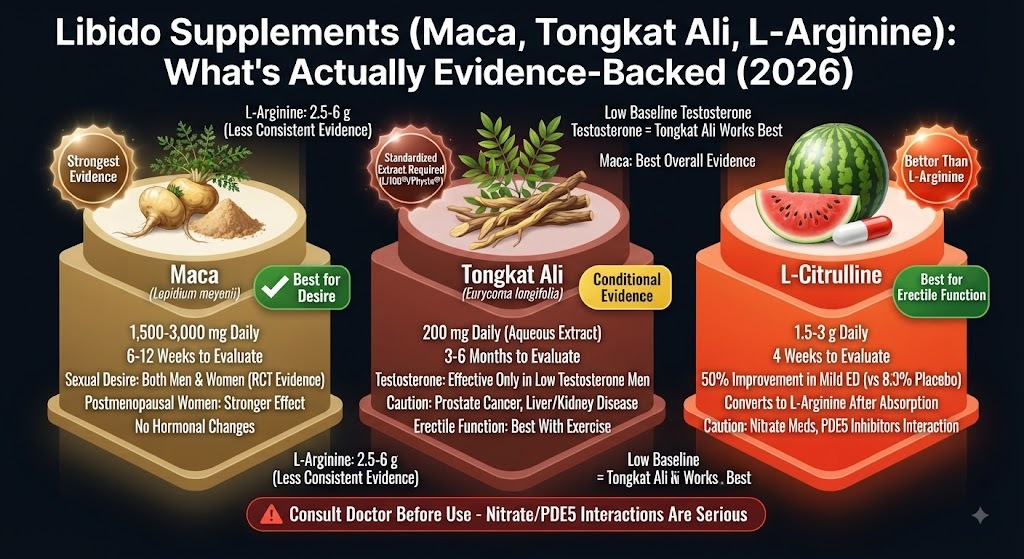
A randomized, double-blind, placebo-controlled trial in 57 adult men with self-reported low sexual desire found that 1,500 mg of maca daily produced a significant increase in sexual desire scores compared to placebo over 12 weeks — notably, without changing testosterone or other hormone levels, suggesting maca works through a different mechanism than a hormonal supplement would. A separate, particularly useful trial looked at women specifically: a 12-week, double-blind, placebo-controlled study in 45 women with antidepressant-induced sexual dysfunction found meaningfully higher remission rates in the maca group compared to placebo across multiple validated sexual function scales, with the effect notably stronger in postmenopausal women — a population whose sexual health concerns are frequently under-addressed, and one we’ve covered from a related hormonal angle in our perimenopause symptoms guide.
A broader systematic review pooling the maca research base found consistent evidence of benefit for sexual desire in both men and women, typically emerging after 6–8 weeks of regular use, without significant hormonal shifts or safety concerns. The evidence for maca improving erectile function specifically, rather than desire, is thinner — one trial found only mild improvement in erectile function scores, meaningfully more modest than what prescription ED medication achieves. Maca isn’t a fast-acting aphrodisiac, and it isn’t a substitute for addressing underlying relationship, mental health, or medical causes of low libido — but for desire specifically, it’s genuinely one of the better-evidenced natural options available.
Tongkat Ali: Real, But Only in a Specific Population
Tongkat Ali (Eurycoma longifolia, also sold as Longjack) has become one of the most searched natural testosterone-support herbs, and unlike most “test boosters” flooding the supplement market, it actually has a handful of legitimate randomized controlled trials behind it — with one important catch that most marketing conveniently leaves out.
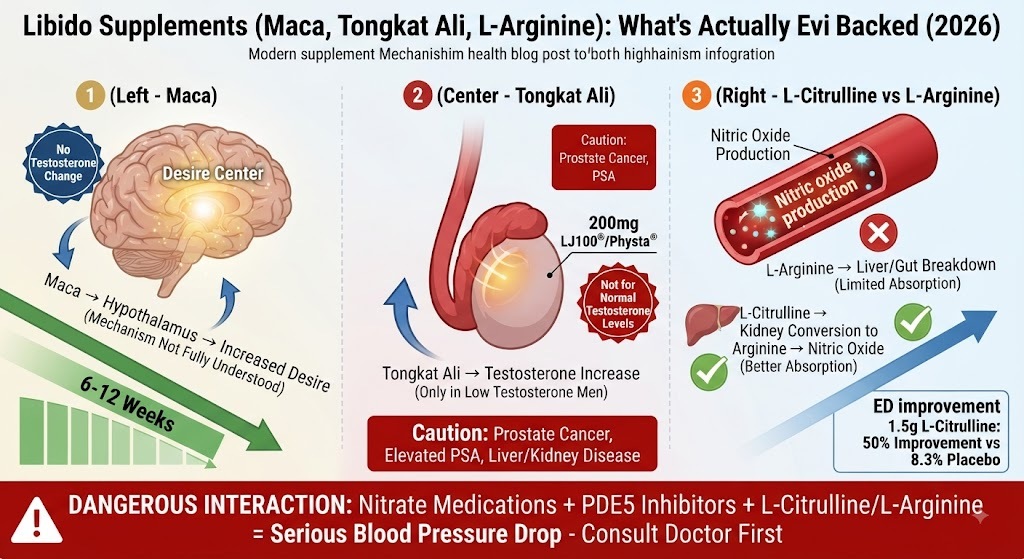
A systematic review and meta-analysis of clinical trials found Tongkat Ali extract meaningfully improved serum total testosterone in men — but the effect is concentrated specifically in men with low or borderline-low baseline testosterone, not in young, healthy men with normal levels to begin with. A 6-month randomized, double-blind, placebo-controlled trial in men with age-related androgen deficiency found a 200 mg daily dose improved testosterone levels, aging-male symptom scores, and fatigue, with the most significant improvements in erectile function occurring in men who combined the supplement with structured exercise training rather than using it alone — a useful reminder that supplements tend to work best as one piece of a broader approach, not a standalone fix.
The detail worth paying close attention to: almost all of the positive human trial data used standardized, water-based (aqueous) extracts — often branded as Physta® or LJ100® — not raw root powder, which appears to lack the same concentration of the active quassinoid compounds, particularly eurycomanone. Checking for a standardized extract on the label is genuinely more important here than with most supplements, since the product-to-product variation in this category is unusually wide — the same “check the extract, not just the plant name” lesson we found researching ashwagandha dosing.
Real safety flags: Tongkat Ali is not appropriate for men with a history of prostate cancer, elevated PSA, liver disease, kidney disease, or those on hormone therapy without direct medical supervision — since it does meaningfully affect androgen levels, it deserves the same caution as any hormone-adjacent intervention, not a “natural, so automatically safe” assumption.
L-Arginine and L-Citrulline: Real Mechanism, but Citrulline Wins on the Evidence
L-arginine is the most recognizable name in this category because of its role in nitric oxide production — the same physiological pathway prescription ED medications like sildenafil work through, just from a different angle. But the more interesting, more current research actually points toward a related compound, L-citrulline, as the better-evidenced option.
L-arginine taken orally undergoes extensive breakdown in the liver and gut before it ever reaches circulation, which limits how much actually becomes available to the body. L-citrulline sidesteps this problem — it’s converted to L-arginine after absorption, bypassing that first-pass metabolism, and research has found it raises circulating arginine levels, and sustains them longer, more effectively than taking arginine directly. A single-blind clinical trial in men with mild erectile dysfunction found that 1.5 g of L-citrulline daily for one month moved 50% of participants from mild ED to normal erection hardness scores, compared to 8.3% on placebo — a genuinely notable result for an amino acid supplement, even accounting for the small trial size.
For straight L-arginine, the evidence is more mixed: typical studied doses run in the 2.5–6 g per day range over several weeks, with modest, inconsistent effects on erectile function and blood pressure across a fairly heterogeneous set of small trials. The clearer, more consistent signal in more recent research sits with L-citrulline specifically, generally dosed at 1.5–3 g daily.
The safety flag that matters most here: both compounds raise nitric oxide activity, which means real caution — and direct medical guidance — is warranted if you’re taking nitrate medications (common in cardiovascular disease treatment) or PDE5 inhibitors like sildenafil or tadalafil, since combining nitric-oxide-boosting supplements with these medications can cause a dangerous drop in blood pressure. This isn’t a minor interaction to gloss over; it’s the single most important safety consideration in this entire guide.
Doses That Were Actually Used in the Research (Quick Reference)
As with most evidence-backed supplements, the exact number matters more than the general idea — the same principle behind getting specific about how much protein you actually need rather than just “eating more protein.”
- Maca: 1,500–3,000 mg daily, taken consistently for at least 6–12 weeks before evaluating results
- Tongkat Ali: 200 mg daily of a standardized aqueous extract (look for Physta® or LJ100® on the label), typically evaluated over 3–6 months
- L-citrulline: 1.5–3 g daily, with effects assessed after roughly 4 weeks
- L-arginine: 2.5–6 g daily if used instead of citrulline, though the evidence is less consistent at this dose range
Who Should Actually Talk to a Doctor First, Not Just Start Supplementing
- Anyone on nitrate medication or PDE5 inhibitors — the L-arginine/L-citrulline interaction risk above is genuinely serious, not a theoretical caveat
- Men with a history of prostate cancer, elevated PSA, or liver/kidney disease considering Tongkat Ali specifically
- Anyone whose low libido has developed alongside other symptoms — fatigue, mood changes, unexplained weight changes, or menstrual irregularity — since these supplements address symptoms, not underlying causes like thyroid dysfunction, depression, or a medication side effect that needs its own evaluation, similar to how we approach cortisol-related fatigue as a symptom worth investigating rather than just treating directly
- Anyone on antidepressants (SSRIs/SNRIs) experiencing sexual side effects — this is specifically the population the strongest maca trial studied, so it’s worth raising with your prescribing doctor as a genuine, evidence-informed option rather than something to self-manage entirely alone
Frequently Asked Questions
Do libido supplements actually work, or is it mostly placebo? For maca and, in the right population, Tongkat Ali, there’s genuine randomized controlled trial evidence beyond placebo — modest effects, but statistically real ones. This puts them ahead of most supplement categories, where placebo-level or absent evidence is far more common.
Which libido supplement has the strongest evidence? Maca has the most consistent, broadest human evidence across both men and women. Tongkat Ali’s evidence is strong but conditional — it mainly benefits men who already have low testosterone, not everyone. L-citrulline has smaller but genuinely promising trial data specifically for mild erectile dysfunction.
Is L-arginine or L-citrulline better for libido and erectile function? Current research favors L-citrulline, since it’s absorbed more efficiently and raises blood arginine levels more effectively than taking arginine directly, translating to more consistent results in the available trials.
How long do libido supplements take to work? Most of the positive trials evaluated results after 4 to 12 weeks of consistent daily use, not a single dose — treating any of these as a same-day fix isn’t supported by how the research was actually designed.
Can I take these supplements with erectile dysfunction medication? Not without checking with a doctor first. L-arginine and L-citrulline both affect the same nitric oxide pathway as PDE5 inhibitors and nitrate medications, and combining them without medical guidance carries a real risk of dangerously low blood pressure.
The Bottom Line
Libido supplements sit in a genuinely more evidence-backed spot than their reputation suggests, provided you’re looking at the right ones and the right doses. Maca has the broadest, most reassuring human trial data for sexual desire in both men and women. Tongkat Ali works, but specifically for men with low baseline testosterone, and only with standardized extracts rather than raw powder. L-citrulline outperforms plain L-arginine in the more recent research for erectile function specifically. None of the three is a substitute for addressing an underlying medical, hormonal, or relationship cause of low libido, and the nitric-oxide interaction risk with ED medication and nitrates is a genuine safety issue, not just fine print — worth a real conversation with a doctor rather than a supplement aisle decision made alone.
This article is for informational purposes only and is not a substitute for personalized medical advice. Consult a physician before starting any of these supplements, particularly if you take nitrate medication, PDE5 inhibitors, or have a diagnosed hormonal, cardiovascular, prostate, liver, or kidney condition.






Leave a Reply