
Walk through an Indian kitchen in winter and you’ll often find amla three ways: a jar of murabba, a packet of powder, and a bottle of juice nobody has opened. The list of amla benefits that comes with each one is long and confident. Some of it has human trials behind it. A fair amount is a vitamin C story stretched across every organ in the body.
I went through the three meta-analyses of amla benefits trials, the vitamin C analyses, the safety databases and the “how much, in what form” question that most posts answer with a shrug. Below you’ll find what amla really contains, which amla benefits have evidence, what the research shows for cholesterol, blood sugar and the other claims, whether juice, powder, fresh fruit or capsules is the better buy, how to use each one properly with exact amounts and recipes, and the safety points about blood thinners, diabetes medicines, pregnancy and your teeth.
General information only. Amla is a food, but concentrated amla products act like supplements. If you take medicines for diabetes, blood pressure or clotting, or you’re pregnant, read the safety section first.
What’s behind the amla benefits: what’s actually in amla
Amla (Phyllanthus emblica, also Emblica officinalis, amalaki) is a small, sour, astringent fruit. Per 100 g of fresh fruit it provides roughly 44 to 58 calories, around 3 to 4 g of fibre and very little fat or protein. The reason it’s famous is vitamin C, and here the numbers deserve a pause.
You’ll see “600 mg per 100 g” quoted everywhere. Published analyses give a wider range, roughly 200 to 700 mg per 100 g depending on variety, ripeness and how it was measured. An orange has about 50 mg per 100 g, so even the lower end makes amla a rich source. But treat any single number as an estimate, not a guarantee. Two cups of juice from different varieties can differ several-fold.
Amla also carries polyphenols, including ellagitannins such as the emblicanins, plus gallic acid and flavonoids. Researchers have noted for years that amla’s tannins appear to protect its vitamin C from breaking down, which is one reason amla holds up better than many fruits. Frying is another matter. An older Indian analysis of three market chyawanprash samples found no detectable vitamin C at all, and the authors suspected it was destroyed when the amla pulp was fried in ghee. So if you take chyawanprash for vitamin C, the evidence says to eat the fruit instead. Chyawanprash may have other merits, but that isn’t one I can support.
The amla benefits scorecard
Here’s the verdict before the detail.
| Claim | What the research shows | How firm |
|---|---|---|
| Rich source of vitamin C | Yes, in fresh fruit and likely juice | Solid |
| Helps absorb iron from plant foods | Vitamin C boosts non-heme iron absorption | Solid (a vitamin C effect, not amla-specific) |
| Lowers LDL cholesterol | Meta-analyses of small trials, mostly extracts | Modest, uneven, low certainty |
| Lowers blood sugar | Short trials, mostly extracts, often in people with diabetes | Promising, not a treatment |
| Lowers inflammation (CRP) | Small pooled reductions | Modest |
| Lowers blood pressure | Inconsistent | Thin |
| Prevents colds | No amla trials; general vitamin C evidence is modest | Unproven |
| Helps hair | One small trial of an oral amla syrup in women with pattern loss | Preliminary |
| Improves skin | One small trial of a topical branch-extract gel | Preliminary |
| Improves eyesight, melts fat, prevents cancer | No solid human evidence | Marketing |
Amla benefits for cholesterol: what the trials show
This is the strongest research area for amla benefits, and it’s still modest.
A 2023 systematic review in BMC Complementary Medicine and Therapies (Brown and colleagues) pooled randomised trials of amla fruit products lasting 14 to 84 days. It found lower LDL cholesterol by about 15 mg/dL on average, lower VLDL by about 5 mg/dL and lower triglycerides by about 22 mg/dL. But note the heterogeneity: for LDL the I² was 77%, and the prediction interval ran from about -48 to +18 mg/dL, meaning a future trial could plausibly find no benefit or even a small rise.
A second 2023 meta-analysis in Diabetes & Metabolic Syndrome (Setayesh and colleagues) pooled five randomised trials in adults, mostly aged 40 to 58 with an average BMI around 25.5, lasting 3 to 12 weeks. Amla supplementation significantly lowered CRP (a marker of inflammation), fasting glucose, LDL, total cholesterol and triglycerides, and raised HDL.
A third, in Acta Medica Philippina (2023), looked at aqueous amla extract in four trials with 227 people with dyslipidaemia over 12 weeks. It found lower total cholesterol and LDL and higher HDL, but no significant effect on triglycerides, and rated the certainty of evidence as low.
Putting those amla benefits results together: there’s a consistent signal across several small trials, with a lot of variation between them. The doses were typically 500 mg of standardised extract twice a day, or about 1 to 2 grams of extract daily, for a few weeks to three months. Side effects were generally mild, with indigestion the most common.
What these trials don’t tell you
- They mostly tested extracts, not fresh fruit, juice or the powder in your kitchen. Extracts are concentrated, and some are labelled by ratio (a “25:1” extract means a gram of extract represents about 25 g of fruit).
- They’re short. Three to twelve weeks says nothing about years.
- They measured numbers, not outcomes. Nobody has shown that amla prevents heart attacks or strokes.
- Many are small and some are linked to the companies making the extract, which doesn’t invalidate them but calls for caution.
- A few small trials compared extract with statins, but nothing large enough to say it can replace them.
So if your doctor has prescribed a statin, amla benefits aren’t a substitute. As a food that may nudge your numbers a little, it’s a reasonable addition.
Amla benefits for blood sugar
The same Setayesh analysis found lower fasting glucose with amla. Separate trials of standardised extracts in people with prediabetes and type 2 diabetes have reported reductions in fasting and after-meal glucose, and in one review a standardised extract performed better than a low dose of metformin in newly diagnosed diabetes. Reported results varied widely, the studies were short, and several were industry-linked, so I’d read them as a hint, not a result.
Two practical points. First, amla could add to the effect of diabetes medicines and cause low blood sugar, so tell your doctor and monitor. Second, if you’re prediabetic, the strongest evidence is for weight loss, movement and fewer refined carbs and sugary drinks. Our guides to blood sugar, insulin resistance, habits to quit for better health and CGM for non-diabetics cover that.
Amla benefits for immunity and colds: the honest version
Amla benefits are sold on immunity, and the reasoning is vitamin C. I’d separate two ideas. There are no good trials showing amla prevents colds. And the general research on vitamin C is less dramatic than its reputation: regular supplements don’t reduce how often most people catch colds, though they may shorten a cold a little (about 8% in adults in the Cochrane analysis, from my notes). If you’re deficient, vitamin C matters a great deal. If you already get enough from food, a bigger dose won’t build extra immunity. For comfort and recovery tips, see our guide to natural remedies for cold, flu and sore throat.
The amla benefits I trust most: better iron absorption
This one isn’t glamorous, and it’s the best-supported of the amla benefits. Vitamin C helps your body absorb the non-heme iron in plant foods like dal, spinach, rajma and chana, which is the iron most Indian vegetarians rely on. Low iron is common, particularly in women, and a squeeze of lemon or a spoon of amla chutney with an iron-rich meal is an easy habit. It doesn’t replace treatment if you’re actually deficient. Our guide to iron deficiency and anemia in women explains what to test and what to ask for.
Amla benefits for hair and skin
For hair, one triple-blind trial of an oral amla syrup in women with pattern hair loss reported better ratios of growing to resting hairs after 12 weeks. A small trial of a 0.1% amla branch-extract gel applied to skin for 84 days reported better hydration and elasticity. Both are single, early studies, and neither tests the amla juice you’d drink or the oil you’d rub on your head. I covered the hair evidence in detail in our guide to Ayurvedic remedies for hair fall, and our broader piece on hair fall solutions covers the non-Ayurvedic side.
Amla benefits by form: juice vs powder vs fresh vs murabba vs capsules
This is the question behind half the searches on amla benefits, so here’s a straight comparison.
| Form | Vitamin C | Fibre | Sugar | Best for | Watch out for |
|---|---|---|---|---|---|
| Fresh amla | Highest, though varies by variety | Yes (about 3 to 4 g/100 g) | Low | Everyday use in season | Very sour; hard on sensitive stomachs |
| Fresh juice | Good, some loss with time and air | Mostly removed | Low if unsweetened | A refreshing diluted drink | Spoils fast; don’t store for days |
| Powder | Varies widely with drying method | Yes | None | Year-round use in water, curd, chutney | Quality varies; vitamin C rarely on the label |
| Murabba | Reduced by cooking; some remains | Some | High (roughly 20 g per piece) | Palatability for kids and elders | Sugar load, especially for diabetes |
| Candy and “amla supari” | Low | Little | High, plus salt | Occasional treat | Mostly sugar |
| Capsules and extracts | Often standardised to tannins or polyphenols | None | None | What the trials actually used | Medicine-like; check with a doctor |
A few notes on that table.
Online retention figures, like “juice keeps 80 to 90% and powder 30 to 50%”, are rules of thumb. I couldn’t trace them to controlled lab data. What I can say is that it depends on the variety, how the fruit was dried and stored, and how long it sat. One analysis found freeze-dried amla powder holding a high concentration of vitamin C, while hot-air or sun-dried powder is likely lower. Powder labels almost never state vitamin C content, so you can’t tell. If vitamin C is your goal, fresh fruit in season is the safest bet.
Powder isn’t useless for amla benefits. Its polyphenols are more stable than its vitamin C, and a teaspoon in water or curd is a cheap, convenient habit.
The amla benefits trial doses don’t map onto a teaspoon. A teaspoon of plain powder is roughly 3 to 5 g of dried fruit. The trials used standardised extracts, so you can’t say “1 tsp powder equals the trial dose”. That’s a good reason to be modest about what you expect from home use.
The cost-per-dose check for amla benefits. Compare by what you’re actually after. Per rupee, fresh amla in season (roughly October to February) is among the cheapest vitamin C sources in India. For polyphenols, powder gives you more days per rupee. Divide the price by the number of servings, and compare it with a lemon or guava if vitamin C is the goal. A pricey “amla elixir” is usually paying for the bottle.
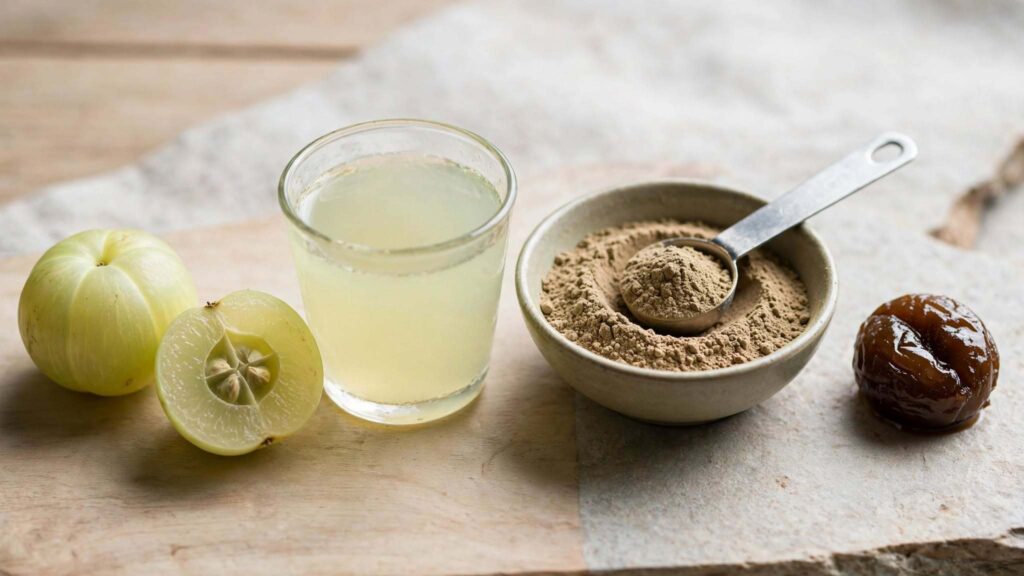
How to get amla benefits: amounts and recipes
There’s no official dose for getting amla benefits from food, so these are practical ranges based on traditional use and the amounts studied, not prescriptions.
| Form | Typical daily amount |
|---|---|
| Fresh fruit | 1 to 2 amla (about 30 to 60 g) |
| Fresh juice | 20 to 30 ml, diluted with water |
| Powder | 1 tsp (about 3 to 5 g) |
| Extract capsules | Only with a doctor’s guidance; trials used about 500 mg twice daily |
Timing for amla benefits. Online posts insist on an empty stomach. There’s no good trial showing that’s better, and a sour fruit on an empty stomach can set off acidity in some people. If you get heartburn, have it with or after food, and see our guide to acid reflux and GERD. If you’re using it for iron absorption, have it with the iron-rich meal.
Five simple formulas for amla benefits
- The iron-boost plate. Dal, a green sabzi or rajma, and a spoon of raw amla chutney or a few drops of juice. The vitamin C helps you absorb the plant iron. Keep the amla uncooked, since long heating reduces vitamin C.
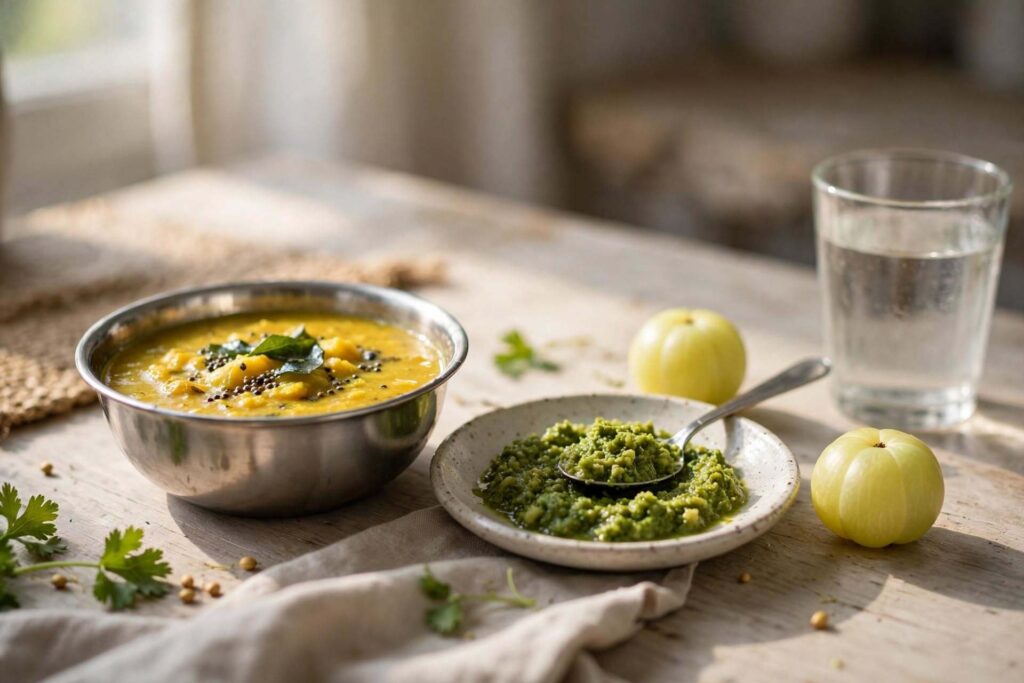
- Raw amla chutney. Blend 2 deseeded amla with a handful of coriander or mint, a small piece of ginger, a green chilli, cumin and salt to taste. No cooking, no sugar. Keep refrigerated and use within 3 to 4 days.
- Diluted amla-ginger morning drink. 20 ml fresh juice, 100 ml water, and a little ginger juice. It’s a pleasant, sour, warming drink. Don’t expect miracles. Skip it if you have reflux.
- Amla powder in curd or chaas. Half to one teaspoon stirred into a glass. The dairy buffers the sourness, and it pairs well with a meal.
- Low-sugar dried amla. Slice fresh amla, deseed, and dry in shade or a low oven. Store airtight. It’s a chewy, tart snack without the syrup in murabba. Make sure it’s fully dry before storing, or it will go mouldy.
Preserving the season. You can freeze fresh juice in ice-cube trays for use over a few weeks, or freeze whole fruit. Both lose some vitamin C over time, so use them sooner rather than later.
Buying well
- Fresh fruit: firm, glossy, unblemished, greenish-yellow.
- Powder: the label should list one ingredient, amla. Avoid added sugar, fillers and “flavours”. Store airtight, cool and dark, and use within a few months.
- Juice: check the sugar content and avoid anything sweetened or “from concentrate” with a long ingredient list.
- Supplements: independent testers have analysed amla products for phenolic content and for lead and other heavy metals, which is a reason to prefer brands that publish third-party results. Our supplement safety articles are a good general guide.
Amla benefits and safety: who should be careful
Amla in food amounts is safe for most people, and the amla benefits don’t need more. Concentrated products are different, and a few cautions are worth knowing.
- Diabetes medicines or insulin. Amla may add to their effect and could cause low blood sugar. Monitor your blood sugar and let your doctor know.
- Blood thinners and antiplatelets (warfarin, clopidogrel, aspirin). Reference databases list a theoretical risk of extra bleeding, though the research is conflicting. One study that combined an amla extract with clopidogrel reported no added bleeding or clotting time. Because it’s theoretical but possible, check with your doctor, and stop concentrated amla about two weeks before surgery.
- Blood pressure medicines. Amla may lower blood pressure slightly, so people on treatment or with low blood pressure should be careful with large amounts.
- Pregnancy and breastfeeding. Normal food amounts are generally considered fine. For concentrated extracts and supplements there isn’t enough reliable information, so avoid them. Very high vitamin C doses aren’t advised in pregnancy.
- Kidney stones and kidney disease. High intakes of vitamin C may raise oxalate and the risk of stones in susceptible people. If you’ve had stones or have kidney disease, ask your doctor.
- Acidity and reflux. Amla is sour, and some people get heartburn, as with any acidic food.
- Teeth. Frequent amla juice can wear enamel. Drink it through a straw, rinse your mouth with water afterwards, and wait before brushing.
- Stomach upset. Indigestion is the commonest reported side effect in trials, and very large amounts of vitamin C cause loose stools. The upper intake level for vitamin C is 2,000 mg a day. Three or four large amla could approach 1,000 mg or more of vitamin C, so there’s no need to push it.
- Liver. Some reports of raised liver enzymes involved herbal formulas that contained amla alongside other herbs, and it’s unclear which ingredient was responsible. Be cautious with multi-herb blends.
- Children. Food amounts are fine. Skip concentrated supplements.
Amla benefits myths worth retiring
“Amla on an empty stomach is the best way.” Not proven, and it can aggravate acidity.
“More is better.” It isn’t. You can overdo vitamin C, and extracts act like medicines.
“Amla powder is the same as fresh.” It isn’t, particularly for vitamin C.
“Chyawanprash is a vitamin C source.” The one analysis I found suggests the frying step destroys it. It’s also sweet.
“Amla cures grey hair, eye problems or cancer.” No solid human evidence.
“Amla can replace my cholesterol or diabetes tablets.” It can’t. Don’t stop prescribed medicines.
Who gets the most amla benefits
For amla benefits on vitamin C: if your intake is low, amla is an inexpensive way to raise it, especially in winter. If you’re a vegetarian trying to absorb iron better, it’s a smart habit alongside iron-rich foods. If your cholesterol or blood sugar is borderline, amla can be one small part of a diet that also includes more fibre, fewer refined carbohydrates and regular movement. If your numbers are high, it’s an add-on, not a treatment.
When to see a doctor instead of relying on amla benefits
Amla isn’t the answer to any of these:
- A diagnosis of high cholesterol, prediabetes or diabetes you haven’t followed up
- Blood sugar that keeps rising, or symptoms like excessive thirst, frequent urination or weight loss
- Persistent tiredness, pallor or breathlessness, which can mean anaemia
- Heartburn that’s frequent or comes with trouble swallowing
- Any bleeding or bruising more than usual if you’re on blood thinners
- Plans for surgery, if you take concentrated amla
If you’ve been searching symptoms online first, our article on AI self-diagnosis and digital health explains how to use that research without letting it make the decision.
Where to go next
- Hair and skin: Ayurvedic remedies for hair fall, Hair fall solutions
- Iron and anemia: Iron deficiency and anemia in women
- Blood sugar and metabolism: Blood sugar, Insulin resistance, CGM for non-diabetics, Habits to quit for better health
- Digestion and reflux: Gut health, Acid reflux and GERD
- Another herbal tea, fact-checked: Butterfly pea flower tea
- Supplements and safety: Supplement safety, Shatavari and adaptogens
- Colds and recovery: Natural remedies for cold, flu and sore throat
- More guides: Nutrition & Diet, Health & Wellness
Questions people ask about amla benefits
What are the main amla benefits?
Amla is a rich source of vitamin C and polyphenols, and it helps your body absorb plant-based iron. Small trials, mostly of extracts, suggest modest reductions in LDL cholesterol, fasting glucose and inflammation markers. Claims for eyesight, cancer and weight loss have no solid human evidence.
Do amla benefits differ between amla juice and amla powder?
Fresh juice and fresh fruit are the safer choice if vitamin C is your goal, because powder quality varies and labels rarely state vitamin C. Powder is cheaper, convenient and retains polyphenols. Trials used standardised extracts, so neither matches the trial doses.
How much amla should I eat a day to get amla benefits?
A practical range is one to two fresh amla, 20 to 30 ml of diluted juice, or about one teaspoon of powder. There’s no official dose. Extracts should be used under medical guidance.
Is it good to drink amla juice on an empty stomach?
There’s no good evidence that an empty stomach is better, and the sourness can trigger acidity in some people. Have it with or after food if you get heartburn.
Are cholesterol-lowering amla benefits real?
Meta-analyses of small, short trials found lower LDL (about 15 mg/dL on average in one) and total cholesterol, but the results varied a lot between studies, and most trials used extracts. It’s a modest addition, not a substitute for prescribed medicine.
Are blood sugar amla benefits real for diabetes?
Short trials, mostly of extracts, report lower fasting and after-meal glucose. It may add to diabetes medicines and cause low blood sugar, so monitor and tell your doctor. It isn’t a treatment.
Do amla benefits come with side effects?
In food amounts it’s generally safe. Possible issues include acidity, stomach upset, tooth enamel wear, low blood sugar with diabetes medicines and a theoretical bleeding risk with blood thinners. High vitamin C intakes can contribute to kidney stones in susceptible people.
Is amla safe during pregnancy?
Normal food amounts are generally considered fine. Concentrated amla extracts and supplements lack reliable safety data in pregnancy, so avoid them. Ask your doctor or midwife.
Are immunity amla benefits proven?
There are no amla-specific trials showing it prevents colds. Vitamin C matters if you’re deficient, but extra amounts don’t reliably build immunity in people who already get enough.
Is chyawanprash a good source of vitamin C?
Probably not. An older analysis of three market chyawanprash samples found no detectable vitamin C, likely destroyed during frying. It’s also high in sugar, so eat fresh amla if vitamin C is your goal.
The short version
The real amla benefits are a rich, cheap source of vitamin C in season, better iron absorption from plant foods, and a modest, uneven nudge to cholesterol and blood sugar in small trials of extracts. Fresh fruit and fresh juice are the better bet for vitamin C, powder is a convenient year-round habit, murabba and candy are mostly sugar, and chyawanprash isn’t the vitamin C source people assume.
If you do one thing, eat a fresh amla chutney with your next dal and see how you feel, and check with your doctor first if you take diabetes medicine or blood thinners. It’s cheap, it’s tasty in its sour way, and it doesn’t ask you to believe anything the research can’t back up.
Disclaimer: this article is general education, not medical advice. Always consult a qualified healthcare professional before using concentrated amla products, especially if you take medication, are pregnant or have a medical condition. See our full disclaimer.
Research referenced: Brown et al., 2023, BMC Complementary Medicine and Therapies, effects of Emblica officinalis fruit on cardiovascular risk factors (systematic review and meta-analysis); Setayesh et al., 2023, Diabetes & Metabolic Syndrome, effects of amla on lipids, glucose and CRP; the 2023 meta-analysis of Emblica officinalis aqueous extract in dyslipidaemia (Acta Medica Philippina); Scartezzini et al., 2006, vitamin C content and antioxidant activity of amla and Ayurvedic preparations; Shishoo et al., vitamin C in Phyllanthus emblica and chyavanprash; the 2024 review of amla as food (Journal of Food Technology Research); the 2024 amla hair-loss trial (Journal of Ethnopharmacology); and safety and interaction summaries from the Natural Medicines database entries on Indian gooseberry.




Leave a Reply