Understanding vitamin E capsule benefits and risks matters more than most wellness content admits, because the popular advice to “just take one 400 IU capsule daily” happens to be the exact dose that the largest clinical trial ever conducted on this vitamin linked to real, measurable harm. Vitamin E is actually useful — it’s a fat-soluble antioxidant with real, trial-backed benefits for liver health and skin, and it’s an essential nutrient your body needs from food regardless. But the supplement-aisle version of this story usually stops at the benefits and skips the part where major research bodies and cancer institutes have specifically warned against the common daily dose — the same gap we found when we looked closely at ashwagandha’s benefits, dosage, and liver safety. This guide covers both halves honestly.
What Vitamin E Actually Is
Vitamin E isn’t a single compound — it’s a family of eight related fat-soluble compounds, four tocopherols and four tocotrienols, with alpha-tocopherol being the form your body actually maintains in blood and uses biologically. As an antioxidant, it helps neutralize free radicals, the unstable molecules generated during normal cell metabolism that damage cells and are linked to aging-related tissue damage. This antioxidant role is the mechanism behind most of vitamin E’s genuine benefits — and, as it turns out, some of its risks too.
What the Research Actually Supports
Liver Health (NAFLD/NASH) — The Strongest Evidence Here
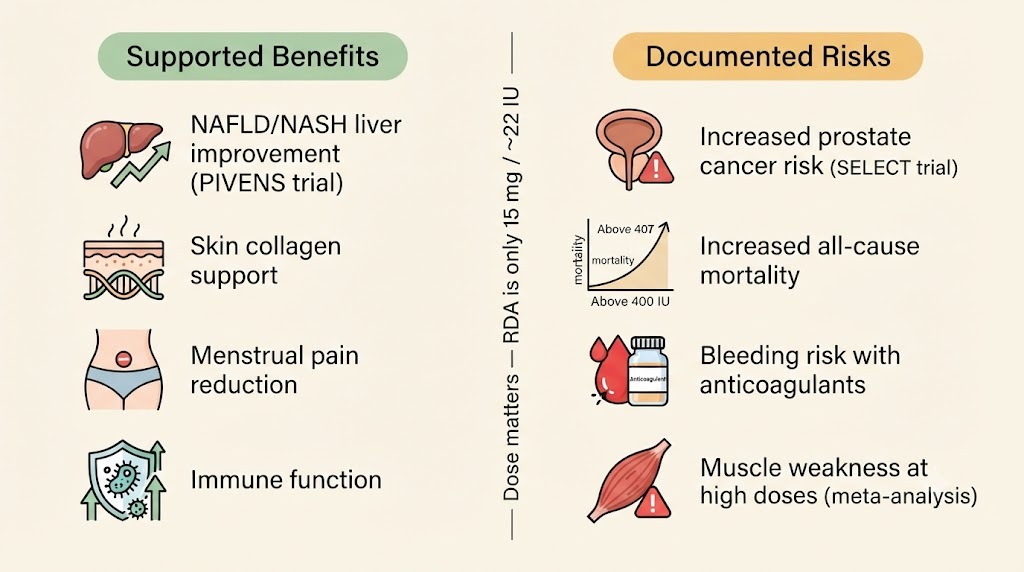
This is genuinely the best-supported use of vitamin E in current medicine. In the PIVENS trial, a major randomized controlled study, vitamin E produced significant improvement in liver inflammation and fat accumulation in adults with non-alcoholic steatohepatitis (NASH), a more advanced form of fatty liver disease, compared to placebo. A more recent systematic review of 11 studies confirmed vitamin E supplementation significantly improves liver enzyme levels and histological markers of inflammation and fat buildup in NAFLD patients.
The honest caveat: a 2024 Cochrane systematic review — generally considered the gold standard for evidence synthesis — found that while vitamin E clearly improves these intermediate liver markers, the certainty of evidence for harder outcomes like preventing liver-related death or serious complications remains very low, and vitamin E’s effect on liver fibrosis specifically (scarring, which is what actually drives long-term liver damage) is still inconclusive. Liver health rarely operates in isolation from the gut, either — our guide to gut health signs, causes, and what helps covers the broader picture. In practice, this means vitamin E is a reasonable, doctor-supervised option specifically for diagnosed NAFLD/NASH, not a general liver “detox” supplement for everyone.
Skin Health
Vitamin E supports collagen production, the structural protein responsible for skin elasticity and firmness, which is the biological basis for its widespread use in skincare marketing — the same protein we cover from a joint and cartilage angle in our natural remedy for joint pain guide. This effect is real at the cellular level, though it’s worth noting that topical application and dietary/supplemental intake work through different pathways, and oral supplementation is not a proven substitute for sun protection or topical skincare specifically for cosmetic skin outcomes.
Dysmenorrhea (Menstrual Cramps)
Several clinical trials have examined vitamin E, often combined with fish oil (omega-3s), for primary dysmenorrhea, with a number showing meaningful reductions in pain severity and duration compared to placebo. This is one of the more practically useful, lower-risk applications of moderate-dose vitamin E, though most positive trials used it for a few days around menstruation rather than continuous year-round dosing. For a broader look at hormone-related symptom management across the reproductive lifespan, see our guide to perimenopause symptoms and how to manage them.
Immune Function and Respiratory Protection
There’s reasonable evidence that vitamin E supports immune cell function, and some research — particularly in older adults — has linked adequate vitamin E status to fewer respiratory infections. Immune function and gut health are closely linked too, which we cover in more depth in our gut health guide. This is more established as a “correcting a deficiency” benefit than a “more is better” one, though, which matters given how the dosing conversation below plays out.
What the Research Does NOT Support (Or Actively Warns Against)
This is the section most vitamin E content skips entirely, and it’s the most important part of understanding vitamin E capsule benefits and risks honestly.
Prostate Cancer Risk at Common Supplement Doses
The Selenium and Vitamin E Cancer Prevention Trial (SELECT), a National Cancer Institute-funded study of more than 35,000 men, was specifically designed to test whether vitamin E could help prevent prostate cancer. The trial found the opposite: men taking 400 IU of vitamin E daily — the exact dose found in most standard over-the-counter capsules — had a statistically significant 17% higher rate of prostate cancer compared to men on placebo, translating to about 11 additional cases per 1,000 men over roughly seven years. It’s the kind of well-hidden downside we ran into again when researching celebrity accounts of Ozempic side effects — the risks rarely make it into the version of the story that goes viral. Researchers involved in the trial were explicit afterward that men in the general population should not take high-dose vitamin E supplements for health promotion, given this finding.
All-Cause Mortality at High Doses
A widely cited meta-analysis published in the Annals of Internal Medicine, pooling data from 19 clinical trials and nearly 136,000 participants, found that vitamin E doses of 400 IU per day or higher were associated with a small but statistically significant increase in all-cause mortality, with the dose-response relationship showing increased risk starting above roughly 150 IU per day. Doses below 400 IU showed no such increase. The researchers’ own conclusion was direct: high-dosage vitamin E supplementation should be avoided pending stronger evidence of benefit. It’s a useful reminder of the “more isn’t automatically better” principle we also lean on in our guide to natural GLP-1 alternatives. This finding has been debated, to be fair — the high-dose trials involved were often smaller and conducted in people with existing chronic disease, so how well the finding generalizes to healthy adults is honestly uncertain — but it’s a serious enough signal that it shouldn’t be left out of any responsible discussion of dosing.
Bleeding Risk
Because vitamin E has mild blood-thinning properties, high-dose supplementation is linked to an increased risk of bleeding complications, including hemorrhagic stroke in some studies. This is exactly why it’s specifically contraindicated for anyone on anticoagulant medication — the same caution that applies to turmeric and ginger, which we flag in our joint pain remedy guide for the same reason.
What the Correct Dosing Actually Looks Like
Here’s where the gap between common supplement marketing and official guidance is widest. The RDA (Recommended Dietary Allowance) for adults is just 15 mg per day — equivalent to about 22.4 IU of the natural form. Most standard over-the-counter vitamin E capsules contain 200 to 400 IU, which is roughly 9 to 18 times the actual daily requirement. It’s the same kind of gap between the labeled minimum and what’s actually optimal that we unpack in how much protein you actually need — official numbers and marketing numbers rarely match.
The tolerable upper limit set by nutrition science bodies is 1,000 mg/day (about 1,500 IU of natural vitamin E or 1,100 IU of synthetic), and supplement labels typically distinguish natural vitamin E (listed as “d-alpha-tocopherol”) from synthetic (“dl-alpha-tocopherol”) — the natural form is roughly twice as biologically active per milligram. But as the SELECT trial and the mortality meta-analysis both illustrate, “under the upper limit” and “actually beneficial for a healthy adult with no deficiency” are two different questions, and the research increasingly suggests routine high-dose supplementation in people without a diagnosed need isn’t supported.
Food Sources: The Safer Way to Get Vitamin E for Most People
For general health maintenance in people without a specific diagnosed condition, getting vitamin E from food avoids essentially all of the risks discussed above, since dietary intake at food-level amounts has never been linked to the harms seen in high-dose supplement trials — the same diet-first philosophy behind our natural remedy for high uric acid. Good sources include:
- Oils and seeds: wheat germ oil, sunflower seeds
- Nuts: almonds, peanuts
- Vegetables: broccoli, spinach, tomatoes
- Fruits: kiwi, mango, avocado
A tablespoon of wheat germ oil or a small handful of sunflower seeds or almonds daily reasonably covers the RDA for most adults without approaching supplement-level doses.
Who Should Avoid Vitamin E Supplements Specifically
- Anyone on blood-thinning (anticoagulant) medication — real, well-documented bleeding risk
- Men, particularly regarding prostate cancer risk — based directly on SELECT trial findings, high-dose supplementation isn’t recommended for general health promotion
- Pregnant individuals — should not take vitamin E supplements without medical guidance
- Anyone considering supplementing children — should consult a doctor first, given lower upper limits and different risk profiles
- Anyone taking supplements longer than a few months without a diagnosed reason — given the dose-response mortality signal, open-ended high-dose use isn’t well supported by current evidence, a caution that echoes what we found researching ashwagandha’s own liver safety signal
Frequently Asked Questions
Is it safe to take a vitamin E capsule every day? At food-level or RDA-equivalent doses, yes. At the common supplement dose of 400 IU daily, research — including a National Cancer Institute-funded trial of over 35,000 men — has found real associated risks, particularly for prostate cancer in men and, in a large meta-analysis, all-cause mortality. This is worth discussing with a doctor rather than assuming more is automatically better — the same “know your actual number” approach we recommend in our protein intake guide.
What is the actual recommended daily amount of vitamin E? The RDA for adults is 15 mg per day (about 22.4 IU of the natural form) — far lower than the 200–400 IU found in most standard supplement capsules.
Does vitamin E really help with fatty liver disease? Yes, this has real randomized trial support, including the PIVENS trial, for improving liver inflammation and fat markers in diagnosed NAFLD/NASH. However, a 2024 Cochrane review found the evidence for harder outcomes like fibrosis reversal or preventing liver-related death is still uncertain, so this use should be doctor-supervised rather than self-directed.
Can vitamin E supplements increase cancer risk? For prostate cancer specifically, yes — the SELECT trial found a statistically significant 17% increased risk in men taking 400 IU daily. This is one of the most important, and most commonly omitted, pieces of vitamin E safety information.
What’s the safest way to get more vitamin E? Food sources — wheat germ oil, sunflower seeds, almonds, spinach, broccoli, and avocado — provide vitamin E without the dose-related risks associated with concentrated supplements, and are the better default for anyone without a specific diagnosed deficiency or condition.
The Bottom Line
Most sources tell you half of this story. The liver health evidence is real, and a diet built around wheat germ oil, nuts, seeds, and colorful produce is a low-risk way to support skin, immune function, and general antioxidant defense. But “take one 400 IU capsule a day” — the single most repeated piece of vitamin E advice online — happens to be the exact dose a 35,000-person National Cancer Institute trial linked to higher prostate cancer risk, and the exact threshold a 136,000-person meta-analysis linked to increased all-cause mortality. That’s not a small footnote. If you’ve been diagnosed with something like NAFLD, where vitamin E genuinely helps, dosing and monitoring belong in a conversation with your doctor — not on the back of a supplement bottle or in a video’s recommendation.
This article is for informational purposes only and is not a substitute for personalized medical advice. Consult a physician before starting vitamin E supplementation, particularly if you are male, pregnant, on blood-thinning medication, or considering use beyond a few months.







Leave a Reply