
Creatine and collagen for healthy aging is one of the biggest supplement shifts of 2026, and if you still associate creatine with gym locker rooms and pre-workout scoops, that reputation is quietly becoming outdated. Both compounds are now being studied less as bodybuilding tools and more as everyday aging support, aimed at the two things that quietly decline with age whether you lift weights or not: muscle and connective tissue. If you’re over 35 and have never touched a protein shake in your life, this is genuinely for you too, not just the gym crowd.
Quick Answer: Creatine monohydrate has solid evidence for preserving muscle mass, strength, and even some cognitive function as you age, typically at 3–5 grams daily. Collagen peptides have more modest but real evidence for skin elasticity and joint comfort, usually studied at 2.5–15 grams daily depending on the outcome. Neither is a miracle anti-aging pill, and both work best alongside resistance training and adequate total protein — which is exactly where this piece connects to our guide on how much protein you actually need after 40.
Creatine and Collagen for Healthy Aging: Why Aging Bodies Need More Than Just Protein
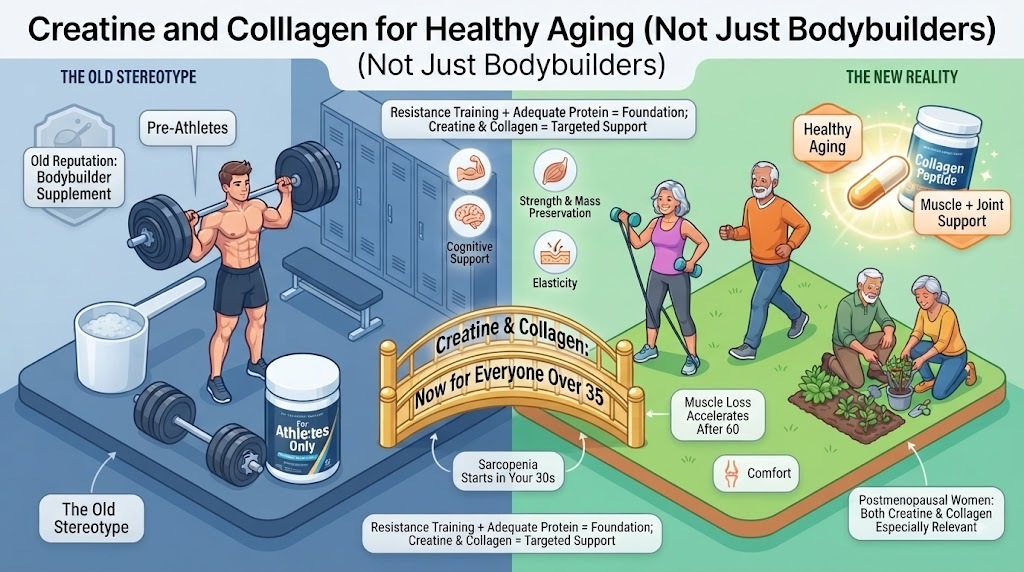
Muscle loss with age, known clinically as sarcopenia, doesn’t wait for old age to start. Research consistently shows adults begin losing measurable muscle mass and strength starting somewhere in their 30s, and the pace picks up noticeably after 60. This isn’t just a cosmetic issue — muscle mass is tied to metabolic health, fall risk, and independence later in life. Total protein intake matters enormously here, which is why our piece on how much protein you actually need is worth reading alongside this one. But protein alone isn’t the whole picture. This is where creatine and collagen come in — not as replacements for protein, but as targeted support for two specific things protein alone doesn’t fully cover: rapid energy availability in muscle tissue, and the structural proteins in skin, tendons, and joints.
What Creatine Actually Does (Beyond the Gym)
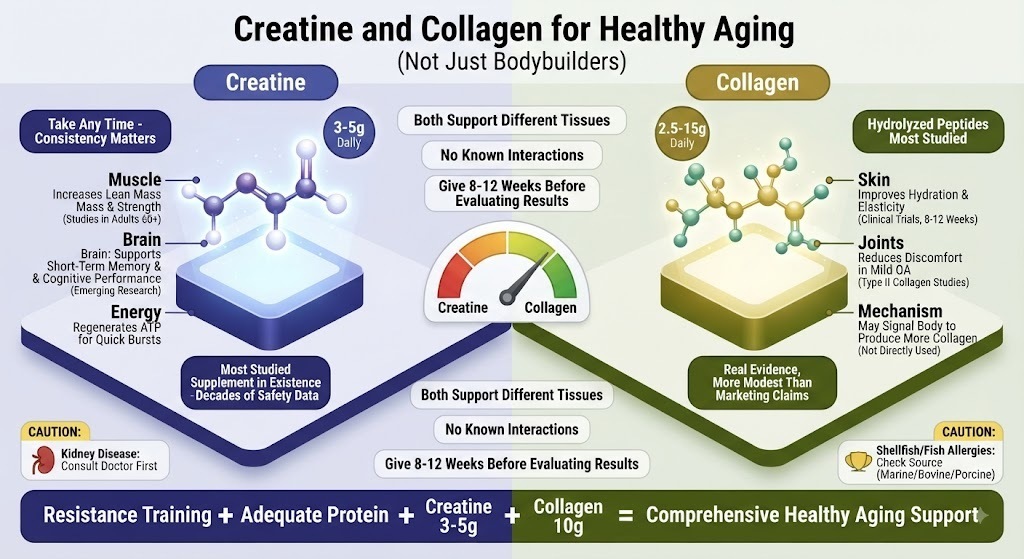
Creatine is one of the most heavily studied supplements in existence, and the aging-specific research has grown substantially in the last few years. It works by helping regenerate ATP, the molecule your cells use for quick bursts of energy — which matters for muscle contraction, but increasingly appears to matter for brain energy metabolism too.
For muscle: creatine supplementation combined with resistance training has repeatedly been shown to increase lean mass and strength gains beyond training alone, and this effect holds up in older adults specifically, not just young athletes. Several studies in adults over 60 have found meaningful improvements in strength and functional performance — things like getting up from a chair or climbing stairs — when creatine was paired with even modest resistance training.
For the brain: this is the newer, more interesting territory. A handful of studies have found creatine supplementation may support short-term memory and cognitive performance under conditions of stress, sleep deprivation, or in older adults with lower baseline creatine stores. This research is still developing and shouldn’t be oversold, but it’s part of why creatine’s reputation has shifted so much from “gym supplement” to “healthy aging supplement” in the last couple of years.
If you’re a woman wondering whether the dosing or safety picture differs for you, our dedicated piece on creatine for women goes deeper into that specific question — the short version is that the core benefits and safety profile are similar, though a few practical considerations around dosing and water retention are worth knowing.
What Collagen Actually Does (And Where the Evidence Gets Thinner)
Collagen is the most abundant protein in your body, forming much of the structural framework in skin, tendons, ligaments, and cartilage. Natural collagen production slows with age, generally starting in your mid-20s and declining further after menopause in women, which is part of why skin loses elasticity and joints can feel stiffer over time.
The evidence for oral collagen supplements is real but more modest than marketing tends to suggest. Multiple clinical trials on hydrolyzed collagen peptides have shown measurable improvements in skin hydration and elasticity after consistent daily use over 8-12 weeks, typically at doses between 2.5 and 10 grams. For joints, several trials — particularly using collagen types II — have shown modest reductions in joint discomfort in people with mild osteoarthritis or exercise-related joint stress, at somewhat higher doses around 10 grams daily.
Here’s the honest caveat worth sitting with: collagen you eat gets broken down into amino acids and peptides during digestion, and your body doesn’t necessarily route those directly back into new collagen in your skin or joints. The prevailing theory is that these collagen peptides may signal your body to produce more of its own collagen, rather than being used as raw building material directly — which is a more indirect mechanism than most marketing implies. The clinical results are still real, but understanding the mechanism helps set realistic expectations rather than “drink this and reverse aging” claims.
Creatine and Collagen Together: Does Stacking Make Sense?
There isn’t extensive research specifically testing creatine and collagen taken together, but there’s no biological reason to expect them to interfere with each other, and their target tissues are different enough — creatine acting mainly on muscle and brain energy metabolism, collagen acting on connective tissue — that combining them makes reasonable sense as part of a broader healthy-aging approach. Neither substitutes for the other, and neither substitutes for the fundamentals: adequate total protein, as covered in our protein needs after 40 guide, and resistance training, which remains the single most effective intervention against age-related muscle loss according to the research.
If you’re building a resistance training habit for the first time specifically to support healthy aging, our strength training for beginners guide is a genuinely useful starting point — creatine’s muscle benefits are consistently shown to be larger when paired with actual resistance training rather than taken passively.
Dosage, Timing, and Practical Use
For creatine, the most well-studied approach is a steady daily dose of 3–5 grams of creatine monohydrate, taken any time of day — timing relative to workouts appears to matter far less than consistency. There’s no meaningful benefit to the “loading phase” some older bodybuilding advice recommends; it just gets you to saturation faster, not to a higher final level. Creatine monohydrate specifically has by far the largest and most consistent evidence base compared to newer, more expensive forms marketed as superior — the extra cost of those alternatives generally isn’t backed by better outcomes.
For collagen, hydrolyzed collagen peptides (sometimes labeled collagen hydrolysate) are the most studied and most easily absorbed form. Doses in published research range from 2.5 grams for skin-focused outcomes up to 10-15 grams for joint-focused outcomes, typically taken once daily, often mixed into coffee, water, or a smoothie since it’s largely flavorless.
Safety Considerations Worth Actually Knowing
Creatine has an unusually strong long-term safety record for a supplement — decades of research, including in older adults, haven’t turned up the kidney damage concerns that circulated in earlier internet myths for people with normal kidney function. That said, anyone with existing kidney disease should talk to a doctor before starting, and it’s worth mentioning any new supplement to your physician if you’re on medications, simply as routine practice rather than because of a specific known risk.
Collagen supplements are generally very well tolerated, with mild digestive upset being the most commonly reported side effect, usually resolving by lowering the dose. People with shellfish or fish allergies should check the collagen source, since much commercial collagen is derived from bovine, porcine, or marine sources, and marine collagen specifically carries allergy considerations worth reading the label for.
This is a good moment to note, as our site generally does: supplement research is genuinely useful for making informed decisions, but it isn’t a substitute for personalized medical advice, especially if you have an existing health condition or take prescription medication.
Who Actually Benefits Most From This
Adults over 40 dealing with the early, often invisible signs of muscle loss — slightly harder time recovering from workouts, subtle strength decline, joints that feel a bit less resilient — are the clearest fit for this combination, particularly alongside the protein targets covered in our protein after 40 guide. Postmenopausal women, who face both accelerated collagen decline and increased sarcopenia risk due to hormonal changes, are another group where the research support is particularly relevant — again, our creatine for women piece covers considerations specific to that stage of life in more depth. And anyone building a long-term resistance training habit, regardless of age, may find creatine specifically useful as one of the more evidence-backed, unglamorous supplements worth actually taking — a stark contrast to a lot of trendier options.
What I’d Actually Tell Someone Starting This Today
If you’re new to creatine and collagen for healthy aging and want the simplest, most evidence-aligned starting point: 3–5 grams of creatine monohydrate daily, taken consistently, alongside some form of regular resistance training, and 10 grams of hydrolyzed collagen peptides daily if joint or skin support is your specific goal. Give it eight to twelve weeks before expecting to notice anything meaningful — these aren’t fast-acting supplements, and expecting overnight results is the most common reason people quit before the evidence has had a chance to show up.
Frequently Asked Questions
Is creatine safe for healthy aging, or is it just for bodybuilders? Creatine has strong, long-term safety data and growing evidence specifically in older adults for preserving muscle mass, strength, and possibly cognitive function. It’s increasingly recommended as a general healthy-aging supplement rather than something limited to athletes or bodybuilders.
Does collagen actually work, or is it mostly marketing? The evidence for collagen supplements is real for skin elasticity and joint comfort, though more modest than aggressive marketing often implies. Clinical trials generally show measurable but gradual improvements over 8-12 weeks of consistent use, not dramatic overnight changes.
Can you take creatine and collagen together? Yes — there’s no known interaction risk, and since they act on different tissues (muscle and brain energy versus connective tissue), combining them as part of a broader healthy-aging routine is reasonable, though direct research testing them together specifically is still limited.
What’s the best dosage of creatine for healthy aging? Most research supports 3–5 grams of creatine monohydrate daily, taken consistently regardless of time of day. A loading phase isn’t necessary — it just reaches saturation faster, not a higher overall level.
Is collagen or protein more important for healthy aging? They’re not interchangeable. Total protein intake is the foundation and directly supports muscle maintenance; collagen is a more targeted, secondary addition mainly relevant for skin and joint-specific goals. Neither should replace adequate total protein intake.
If this was useful, you might also want to read how much protein you actually need after 40, creatine for women, and strength training for beginners.
This article is for educational purposes only and isn’t a substitute for personalized medical advice. Talk to a doctor before starting any new supplement, especially if you have an existing health condition or take prescription medication.






Leave a Reply